Little Rock Look Back: City Hall resumes after Civil War

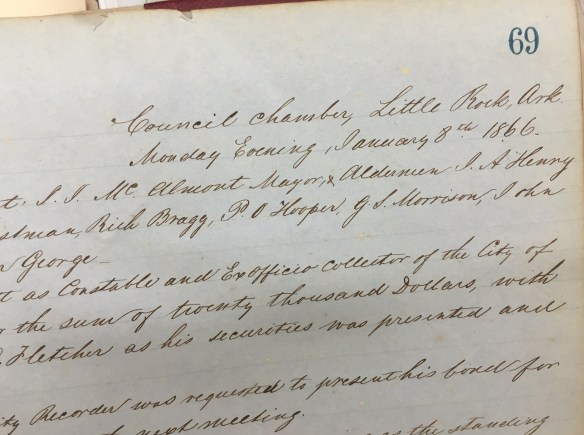
Jan 1866 minsOne hundred and fifty-one years ago this month, Little Rock City Hall resumed functioning after the Civil War.  The City government had disbanded in September 1863 after the Battle of Little Rock.  From September 1863 through the end of the war (on on through part of Reconstruction), Little Rock was under control of Union forces.

Following the April 1865 conclusion of the Civil War, plans were made to restart local government in Little Rock.  Even though Arkansas would not have Congressional representation in Washington until June 1868 (becoming the second Confederate state after Tennessee), the establishment of local government took place in January 1866.

The first City Council meeting took place on Monday, January 8, 1866. The council met again on Tuesday, January 9 and Monday, January 15 as they were trying to establish committees and rules for the new government.

The first post-Civil War mayor was Dr. J. J. McAlmont, who was a physician and pharmacist. Following his service as the city’s chief executive, he would later be a co-founder of what is now UAMS.  The initial aldermen were I.A. Henry (who had been on the City Council when it ceased in 1863), Henry Ashley, M. H. Eastman, Rick Bragg, P. O. Hooper, G. S. Morrison, John Collins and Alexander George.

Their first action was to approve the bond of Thomas C. Scott as Constable and City Collector.  Vouching for him were S. H. Tucker and John Gould Fletcher.  The Recorder was asked to present his bond and the next meeting.

The Mayor then established several committees of the City Council and named his appointments. Among the committees were Finances, Streets, Ordinances, Mount Holly Cemetery, Fire Department and Police.

That meeting and the following two meetings, the City continued to approve motions, resolutions and ordinances to set up the duties and responsibilities of a government.

Ordinance Number 1 established the rates of Licenses for 1866.  Among those were:

  • $100 for the privilege of selling goods at auction
  • $20 for a one-horse wagon, paid quarterly
  • $35 for a two-horse wagon, paid quarterly
  • $50 for a four-horse wagon, paid quarterly
  • $25 to run a cab or bus (which would have been in some horse drawn conveyance), paid quarterly
  • $40 a month to sell liquor, wine, ale, beer, etc., by the glass or bottle to be consumed in a store, tavern, shop or store
  • $25 each quarter for each billiard table
  • $50 each quarter for each ten pin alley


Little Rock Look Back: J. J. McAlmont (Little Rock Mayor and UAMS founder)

McAlmontJohnJ_fFuture Little Rock Mayor John Josephus McAlmont was born on this date in 1821 in New York state. (Various reports give his birth date as December 22 — but the family reports December 19 as the date.)

After studying medicine in Pennsylvania and Ohio, he arrived in Little Rock in March 1850 with his family.  After practicing medicine in nearby Benton, he returned to Little Rock in 1852.  In addition to being a physician, he was a pharmacist.

During the Civil War, he relocated his family out of Little Rock (to a spot where the present day community of McAlmont bears his name).  Following the war, he moved them back to the City.  In 1866 he was elected Mayor of Little Rock, the first elected Mayor since local government resumed following the Civil War.

In October 1879, he and seven other physicians founded the Arkansas Industrial University Medical Department in Little Rock. This institution has grown into the University of Arkansas for Medical Sciences.  He served on the faculty of the medical school for several years.

Dr. McAlmont died in September 1896.  He is buried at Mount Holly Cemetery.  In addition to the McAlmont community bearing his name, there is a McAlmont street in downtown Little Rock which was named in his memory.

Little Rock Look Back: Gordon N. Peay, Little Rock’s 23rd Mayor

Mayor PeayOn December 12, 1819, future Little Rock Mayor Gordon Neill Peay was born.  The Peay family arrived in Arkansas from Kentucky in 1825.  They quickly became one of Little Rock’s leading families.  Mayor Peay’s father, Nicholas Peay served on the Little Rock Board of Trustees (which existed before the town was incorporated) and later served on the City Council and was acting mayor.

Godon N. Peay served as mayor of Little Rock from 1859 to 1861.  During the Civil War, Peay served as Captain and later Colonel of the Capital Guard.  He later received a pardon from the federal government.  In the days leading up to the Civil War and during it, Mayor Peay was one of a select group of civic leaders who corresponded with President Lincoln and other Union leaders. It has been said that this conciliatory tone is a reason that Little Rock fared better during Federal occupation and Reconstruction than did many other Confederate cities.

The Peay family owned the Peay Hotel, Little Rock’s first hotel, and were also co-founders of what became Worthen Bank.  They were also a founding family of Christ Episcopal Church. Mayor Peay later served as Pulaski County Chancery Clerk.

He died on December 14, 1876, and is buried at Mount Holly Cemetery along with many members of his family.  A nephew of his, Ashley Peay, served on the City Council in the 1920s.  Mayor Peay’s great-grandson Joseph Barber Hurst, Sr. served on the Little Rock City Board of Directors from 1967-1971. One of Mr. Hurst’s sons, Howard, was born on Mayor Peay’s birthday.

Arkansas Heritage Month – On Armed Forces Day visit the City of Little Rock’s MacArthur Museum of Arkansas Military History

MacPark ArsenalToday is Armed Forces Day.  It is a good day to visit Little Rock’s museum devoted to Arkansas’ military heritage.  Located in the historic Arsenal Tower in MacArthur Park, the MacArthur Museum of Arkansas Military History honors the Arkansans who have served in the armed forces.  Exhibits feature artifacts, photographs, weapons, documents, uniforms and other military items that vividly portray Arkansas’s military history at home and abroad.

The exhibits include:

  • From Turbulence to Tranquility: The Little Rock Arsenal
  • Capital In Crisis and Celebration: Little Rock and the Civil War
  • Alger Cadet Gun
  • Camden Expedition
  • David Owen Dodd
  • Through the Camera’s Eye: The Allison Collection of World War II Photographs
  • By the President in the Name of Congress: Arkansas’ Medal of Honor Recipients
  • Conflict and Crisis: The MacArthur- Truman Controversy
  • Duty, Honor and Country: General Douglas MacArthur
  • The Sun Never Sets on the Mighty Jeep: The Jeep During World War II
  • War and Remembrance: The 1911 United Confederate Veterans Reunion
  • First Call – American Posters of World War I
  • Undaunted Courage, Proven Loyalty: Japanese American Soldiers in World War II
  • Vietnam, America’s Conflict

The MacArthur Museum of Arkansas Military History is a museum of the City of Little Rock.  It is led by executive director Stephan McAteer who works with the MacArthur Military History Museum Commission.  The museum is open Tuesday through Friday from 9am to 4pm, Saturday from 10am to 4pm and Sunday from 1pm to 4pm.

Little Rock Look Back: Little Rock City Hall resumes after Civil War

Jan 1866 minsOne hundred and fifty years ago this month, Little Rock City Hall resumed functioning after the Civil War.  The City government had disbanded in September 1863 after the Battle of Little Rock.  From September 1863 through the end of the war (on on through part of Reconstruction), Little Rock was under control of Union forces.

Following the April 1865 conclusion of the Civil War, plans were made to restart local government in Little Rock.  Even though Arkansas would not have Congressional representation in Washington until June 1868 (becoming the second Confederate state after Tennessee), the establishment of local government took place in January 1866.

The first City Council meeting took place on Monday, January 8, 1866. The council met again on Tuesday, January 9 and Monday, January 15 as they were trying to establish committees and rules for the new government.

The first post-Civil War mayor was Dr. J. J. McAlmont, who was a physician and pharmacist. Following his service as the city’s chief executive, he would later be a co-founder of what is now UAMS.  The initial aldermen were I.A. Henry (who had been on the City Council when it ceased in 1863), Henry Ashley, M. H. Eastman, Rick Bragg, P. O. Hooper, G. S. Morrison, John Collins and Alexander George.

Their first action was to approve the bond of Thomas C. Scott as Constable and City Collector.  Vouching for him were S. H. Tucker and John Gould Fletcher.  The Recorder was asked to present his bond and the next meeting.

The Mayor then established several committees of the City Council and named his appointments. Among the committees were Finances, Streets, Ordinances, Mount Holly Cemetery, Fire Department and Police.

That meeting and the following two meetings, the City continued to approve motions, resolutions and ordinances to set up the duties and responsibilities of a government.

Ordinance Number 1 established the rates of Licenses for 1866.  Among those were:

  • $100 for the privilege of selling goods at auction
  • $20 for a one-horse wagon, paid quarterly
  • $35 for a two-horse wagon, paid quarterly
  • $50 for a four-horse wagon, paid quarterly
  • $25 to run a cab or bus (which would have been in some horse drawn conveyance), paid quarterly
  • $40 a month to sell liquor, wine, ale, beer, etc., by the glass or bottle to be consumed in a store, tavern, shop or store
  • $25 each quarter for each billiard table
  • $50 each quarter for each ten pin alley
 

Little Rock Look Back: Mayor Gordon N. Peay

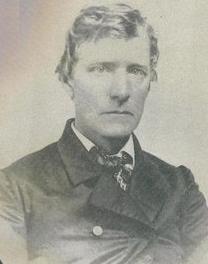
Mayor PeayOn December 12, 1819, future Little Rock Mayor Gordon Neill Peay was born.  The Peay family arrived in Arkansas from Kentucky in 1825.  They quickly became one of Little Rock’s leading families.  Mayor Peay’s father, Nicholas Peay served on the Little Rock Board of Trustees (which existed before the town was incorporated) and later served on the City Council and was acting mayor.

Godon N. Peay served as mayor of Little Rock from 1859 to 1860.  During the Civil War, Peay served as Captain and later Colonel of the Capital Guard.  He later received a pardon from the federal government.

The Peay family owned the Peay Hotel, Little Rock’s first hotel, and were also co-founders of what became Worthen Bank.  They were also a founding family of Christ Episcopal Church. Mayor Peay later served as Pulaski County Chancery Clerk.

He died on December 14, 1876, and is buried at Mount Holly Cemetery along with many members of his family.  A nephew of his, Ashley Peay, served on the City Council in the 1920s.  Mayor Peay’s great-grandson Joseph Barber Hurst, Sr. served on the Little Rock City Board of Directors from 1967-1971. One of Mr. Hurst’s sons, Howard, was born on Mayor Peay’s birthday.

Little Rock Look Back: Mayor C. P. Bertrand

Bertra1On November 23, 1808, future Mayor Charles P. Bertrand was born in New York.  He was the son of Pierre and Eliza Wilson Bertrand; his father died in 1809 in an uprising in Haiti and his mother eventually remarried.  With her new husband, Dr. Matthew Cunningham, she and the family moved to Little Rock in 1820.

After apprenticing with family friend William Woodruff at the Arkansas Gazette, Bertrand opened the Arkansas Advocate newspaper.  He later studied law under Robert Crittenden and entered the legal profession.

In 1835-1836, he served as State Treasurer for the Arkansas Territory, and in 1836 as secretary for the first constitutional convention. He was a member of the Arkansas House of Representatives from 1840-1841 and 1844-1849.

Bertrand followed in his stepfather’s footsteps and became Mayor of Little Rock.  (Dr. Cunningham had been the first Little Rock Mayor in 1831.)  He was in office from January 1855 through January 1857, serving two one-year terms.  He later served on the City Council and filled in as acting mayor. (Another influence on his upbringing was studying under future Mayor Jesse Brown who taught at the first school in Little Rock.)

Bertrand, as acting mayor, was involved in the negotiations of the surrender of Little Rock to federal troops in 1863.  He also later corresponded with President Lincoln on behalf of Little Rock citizens.

Though a staunch Confederate, his good will toward the Union soldiers and federal officials is credited with helping to save Little Rock from the destruction which befell many other Southern cities.  He is also credited with delaying the start of the Civil War.  Prior to the attack on Fort Sumner, members of the Arkansas Militia were planning to attack the Federal Arsenal at Little Rock during the absence of Governor Rector.  This would have been viewed as an act of war.  Bertrand was able to dissuade them from the attack.  Had he been unsuccessful, the Civil War would have likely started in Arkansas instead of South Carolina.

He had put his considerable fortune into Confederate money during the war. At the Civil War’s conclusion, the family was financially ruined. Though they had vast land holdings, those would be sold off in parcels to pay for taxes.

Bertrand died August 27, 1865, shortly after the conclusion of the Civil War.  He, like his mother, step-father, and several other relatives, is buried in Mt. Holly Cemetery.