Little Rock Look Back: Clinton Center Opened 11 Years Ago Today

SkipMany remember November 18, 2004, for the rain and cold wind which greeted visitors to the opening of the William Jefferson Clinton Presidential Center and Park.  In the years which lead up to that day, November 18, 2004, was known simply as “Game Day” for a group of people.  The chief one was Skip Rutherford.

Overseeing the planning for the Clinton Presidential Center and the events surrounding it had been the focus of James L. “Skip” Rutherford for many years. A FOB for decades, he had stayed in Little Rock when so many went to Washington DC in 1993.

He oversaw the planning for the Clinton Library and led the Clinton Foundation.  No detail was too small or insignificant for him to consider. For months leading to the opening he led meetings to help restaurants, hotels, and attractions understand the scope of the opening.

Together with Dean Kumpuris and Bruce Moore on behalf of the City of Little Rock and Stephanie Streett of the Clinton Foundation, he reviewed plans for the Clinton Presidential Park and the streets and neighborhoods around the Clinton Presidential Center.

He used his connections with the business community in Little Rock and throughout the state to discuss the importance of a Presidential Library regardless of one’s personal political affiliations.  He withstood critics who second-guessed everything from the cost, the design, the location, the purpose, and even the anticipated tourism and economic impacts.

Finally the big day had come.  If the weather was not ideal, that was almost inconsequential. It was still the culmination of more than seven years hard work.

However, the opening of the Clinton Presidential Center was not the end of the task. It merely was the move from one phase to another. A few years later, Skip’s role would change as he would leave the Foundation and become the second Dean of the Clinton School of Public Service.

Coke is it! in new Clinton Center exhibit

The Clinton Presidential Center celebrates the art and history of the Coca-Cola Bottle’s 100-year anniversary during its upcoming temporary exhibit, Coca-Cola: An American Original. The exhibit is divided into two sections and occupies both the Garden View room, located on the first floor, and the Temporary Gallery, located on the third floor.
Illustrations of an American Original will be located in the Garden View Room and will have as its focus the now-iconic images and advertising campaigns that have helped define the Coca-Cola brand. Illustrations will include three original paintings by Norman Rockwell, an American artist who created a total of six paintings that were ultimately used in finished Coca-Cola ads. The three others, known as the “Missing Rockwells,” have yet to be located. Additionally, Illustrations feature several images of Santa Claus, including the first Coca-Cola Santa painted by Fred Mizen that appeared in The Saturday Evening Post in December of 1930, as well as nine original Haddon Sundblom illustrations.
An American Original at 100 is housed in the Temporary Gallery, bringing together historic bottle “firsts.” It features a 13-bottle chronology, including an original glass bottle produced in 1902, a replica of the prototype contour bottle created by the Root Glass Company in 1915, and a prototype of the aluminum bottle that debuted in 2008.
Also, the exhibit showcases pop art by Andy Warhol—including videos, photographs, prints, and other original works—and folk art by Howard Finster, who incorporated the Coca-Cola bottle into dozens of his pieces over his prolific career. Another portion of this exhibit is dedicated to American presidents and their connection to the global brand. An American Original at 100 was recently on display at the High Museum of Art Atlanta.
In addition to Illustrations of an American Original and An American Original at 100, the Center is also displaying a full-size antique Coca-Cola delivery truck produced in 1949 by the White Motor Company and a spectacular hanging installation comprised of more than 750 3D-printed, ribbon-shaped interpretations of the bottle’s classic shape.
Coca-Cola: An American Original is the Center’s 42nd temporary exhibit. It will close on February 15, 2016.  Admission to temporary exhibits is included in the price of Library admission.

Little Rock Look Back: LR chosen for Clinton Library

ClintonCenterConstruction-48

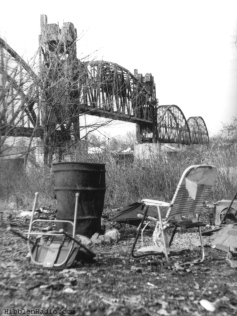
Refuse littered the future site of the Clinton Presidential Center

On November 7, 1997, President Bill Clinton announced his intentions to locate his presidential library in Little Rock at the end of a warehouse district.

The Little Rock City Board met in a special meeting that day to rename part of Markham Street, which would lead to the site, as President Clinton Avenue.

While the announcement was met with excitement in many quarters, there were still some skeptics who had a hard time envisioning a presidential library and park in the middle of a wasteland worthy of a T. S. Eliot poem.

There would be many hurdles between the November 1997 announcement to the December 2001 groundbreaking. But for the moment, City of Little Rock leaders, celebrated the achievement.  Then Mayor Jim Dailey had appointed City Director Dean Kumpuris and City employee Bruce T. Moore to lead the City’s efforts.  Moore and Kumpuris worked with Skip Rutherford and others to narrow the potential sites.

In September 1997, the Clintons were in town for the 40th anniversary of the integration of Central High School.  They surprised Kumpuris and Moore with a decision for a Sunday afternoon visit to the warehouse district proposed site. Secret Service would not let the limousine drive in part of the property, so the Clintons, Moore, Kumpuris, and Rutherford walked up a path to the roof of the abandoned Arkansas Book Depository.  It was there that the Clintons could see the Little Rock skyline which would be visible from the library.

Of course by the time the library had opened in November 2004, the Little Rock skyline was different. Spurred on by the library, several new highrises had been constructed in downtown.

250 year old Gagliano violin celebrated at tonight’s ASO River Rhapsodies

drew asoThe Arkansas Symphony Orchestra will showcase Concertmaster Andrew Irvin’s 250 year old Gagliano violin on October 27 as part of the ASO’s 2015-2016 River Rhapsodies Chamber Music series at 7 PM. The program features Mr. Irvin and his exceptional violin in various ensemble settings in the beautiful Great Hall of the Clinton Presidential Center, performing music spanning the quarter-century life of the instrument.

The program includes:

  • Mozart – Sonata for Violin and Piano
  • Shostakovich – String Quartet No. 11 in F minor, Op. 122

A cash bar is open at 6 PM and at intermission, and patrons are invited to carry their drinks into the hall. The media sponsor for the River Rhapsodies Chamber Series is KUAR/KLRE.

General admission tickets are $23; active duty military and student tickets are $10 and can be purchased online at www.ArkansasSymphony.org, at the Clinton Presidential Center box office beginning 60 minutes prior to the concert, or by phone at 501-666-1761, ext. 100

“Great instruments require skilled musician hands to come alive — yet in these hands, they become personified beings that dwell in a realm unshackled from the bonds of time — and in so doing, connect musicians across centuries through the uniquely profound relationship that musicians have with their instruments.  Mr. Irvin’s violin is a direct connection to musical history.  Its previous masters’ preferences are infused in is tone, their gaffes inscribed upon its body, and its surface is a story of centuries of perspiration and effort in service to art. Musicians are merely the caretakers, or curators, of these instruments for a short human lifespan, and this program is a celebration of not only an instrument’s anniversary, but of all the musicians since 1765 who have made it possible.”  Philip Mann, music director

About the violin

The violin was made by Nicolo Gagliano in approximately 1765 (Gagliano marked his violins by decade only, so the exact date is unknown) in Naples, Italy. Headed by Alessandro Gagliano, the Neapolitan school of violin makers is considered to be among the pinnacles of high quality musical artisanship. Alessandro’s son, Nicolo, is possibly the greatest of the Gagliano luthiers. His legacy began with his four sons employed in his workshop and lasted well into the 20th Century, ending when the firm of Vincenzo Gagliano and Sons closed in 1925.

Before 1820 violins had shorter necks set up for gut strings, which have lower tension than modern steel strings. Composers like Beethoven demanded higher pitches and more sound, which drove changes to violin constructions. Violins were refitted with a longer neck for an increased range and the body was reinforced to handle the increased tension of more resonant steel strings.

Michael Purcell of Philadelphia maintains the violin, and Mr. Irvin returns to his shop twice a year for maintenance.

Creative Class of 2015: Stephanie S. Streett

StreettStephanie S. Streett is the executive director of the Clinton Foundation. In this role she oversees the day-to-day operations of the Clinton Presidential Center, including the development and implementation of its educational programs, special events, exhibits, and services as well as staff management. She establishes and cultivates strategic partnerships and cooperative arrangements with state and local governments, the non-profit and private sector, community groups and other organizations. Stephanie also serves as the corporate secretary for the Clinton Foundation Board of Directors.

Stephanie has used her position to broaden culture in Little Rock through the wide variety of exhibits which the Clinton Center has hosted. A wide variety of styles of visual arts, design, contemporary craft, sports, science and history have been showcased in exhibits at the Clinton Center.  She also was instrumental in planning the special events in conjunction with the Clinton Center 10th Anniversary in 2014.  In addition, she has been active in promoting partnerships with the Kennedy Center for the Performing Arts. Together with Kaki Hockersmith, she has facilitated several seminars which have brought key Kennedy Center leaders to Little Rock.

She is the president of the University of Arkansas Alumni Association National Board of Directors and is co-chair of the Board of Directors for City Year Little Rock. She also serves on the Board of Directors for the Downtown Partnership of Little Rock and is a member of the International Women’s Forum Arkansas.

Final Days for Dinosaurs at Clinton Center

These are the final days for the dinosaurs at the Clinton Center.  No, a huge meteorite is not hurdling toward the Clinton Presidential Park, it is just that the exhibit is coming to a close this weekend.

Clinton Dinos

Photo courtesy of Clinton Presidential Center

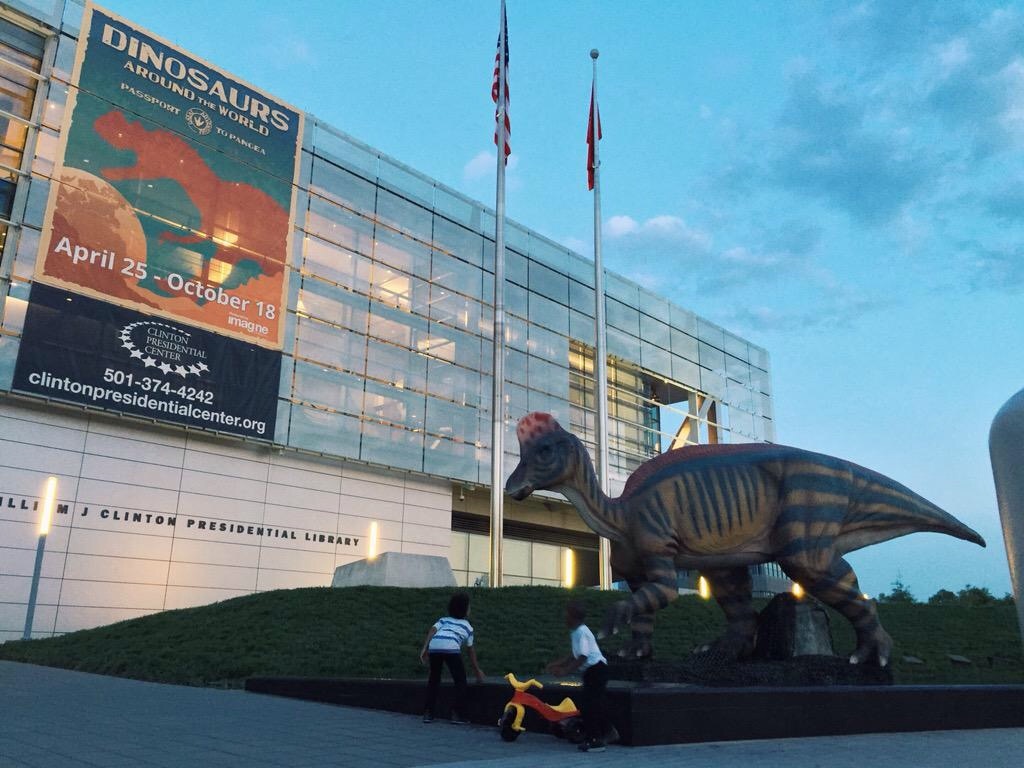
Dinosaurs Around the World takes you back in time on a dinosaur adventure and a tour of an Earth very different from today – a time before the continents as we know them existed, when lush landscapes covered Africa and greenery was the norm in Antarctica! With 13 life-sized animatronics, a multi-layered narrative, fossils, authentic casts, cutting-edge research and immersive design elements, you’ll experience the Age of Reptiles as it comes to life!

 Dinosaurs Around the World invites you to grab your prehistoric passport to Pangea and discover how continental splits driven by plate tectonics, land bridges revealed after sea level fluctuations, and new landforms created by volcanic activity allowed dinosaurs to disperse to all corners of the globe. These left each of the seven continents with its own unique selection of these giant reptiles. During their 172 million year reign, dinosaurs adapted into a variety of forms including enormous long-necked herbivores, the mighty T. rex, and more.
“We are thrilled to host the global premiere of Dinosaurs Around the World and look forward to sharing this interactive and scientific exhibit with our visitors,” said Stephanie S. Streett, executive director of the Clinton Foundation. “Our summer exhibits are highly anticipated by the community because they are specifically designed to appeal to the entire family.”
In addition to advanced animatronics, Dinosaurs Around the World also features information about the geologic time scale, geology, geography, and climatology. The exhibition questions how the dinosaurs lived on each continent, how they interacted with each other, how geography impacted their behavior and diets, and what the continents were really like at the time.
The exhibit also features an area that chronicles the accomplishments of four U.S. Presidents who worked to preserve the fossil-rich areas in North America where dinosaurs once roamed. Exhibit artifacts include items from the administrations of Presidents Bill Clinton, Dwight D. Eisenhower, Franklin D. Roosevelt, and Harry S. Truman. This display includes a dinosaur skull replica on loan from the Grand Staircase-Escalante National Monument, an area that President Clinton designated as a national monument in 1996.
Dr. Gregory M. Erickson, a world-renowned dinosaur paleontologist, is the Senior Scientific Advisor for Dinosaurs Around the World. Dr. Erickson received his Bachelor of Science degree from the University of Washington, a Master’s degree from Montana State University, and a Ph. D. in Integrative Biology from the University of California, Berkeley and conducted post-doctoral research at Stanford University and Brown University before joining the faculty at Florida State University in Tallahassee. Dr. Erickson is currently the curator for the Florida State University Museum and holds research appointments with the American Museum of Natural History in New York, The Field Museum in Chicago, and University of Alaska’s Museum of the North in Fairbanks. Dr. Erickson is working with Imagine Exhibitions as an advisor, writer, and editor of the paleontology copy for the Company’s Dinosaurs Around the World exhibition.
Dinosaurs Around the World is open daily to the public from 9 a.m. to 5 p.m., Monday through Saturday, and 1 to 5 p.m. on Sunday, through October 18, 2015. Tickets are available to purchase at the Clinton Center.

Anne Frank Tree exhibit to be dedicated today at Clinton Center

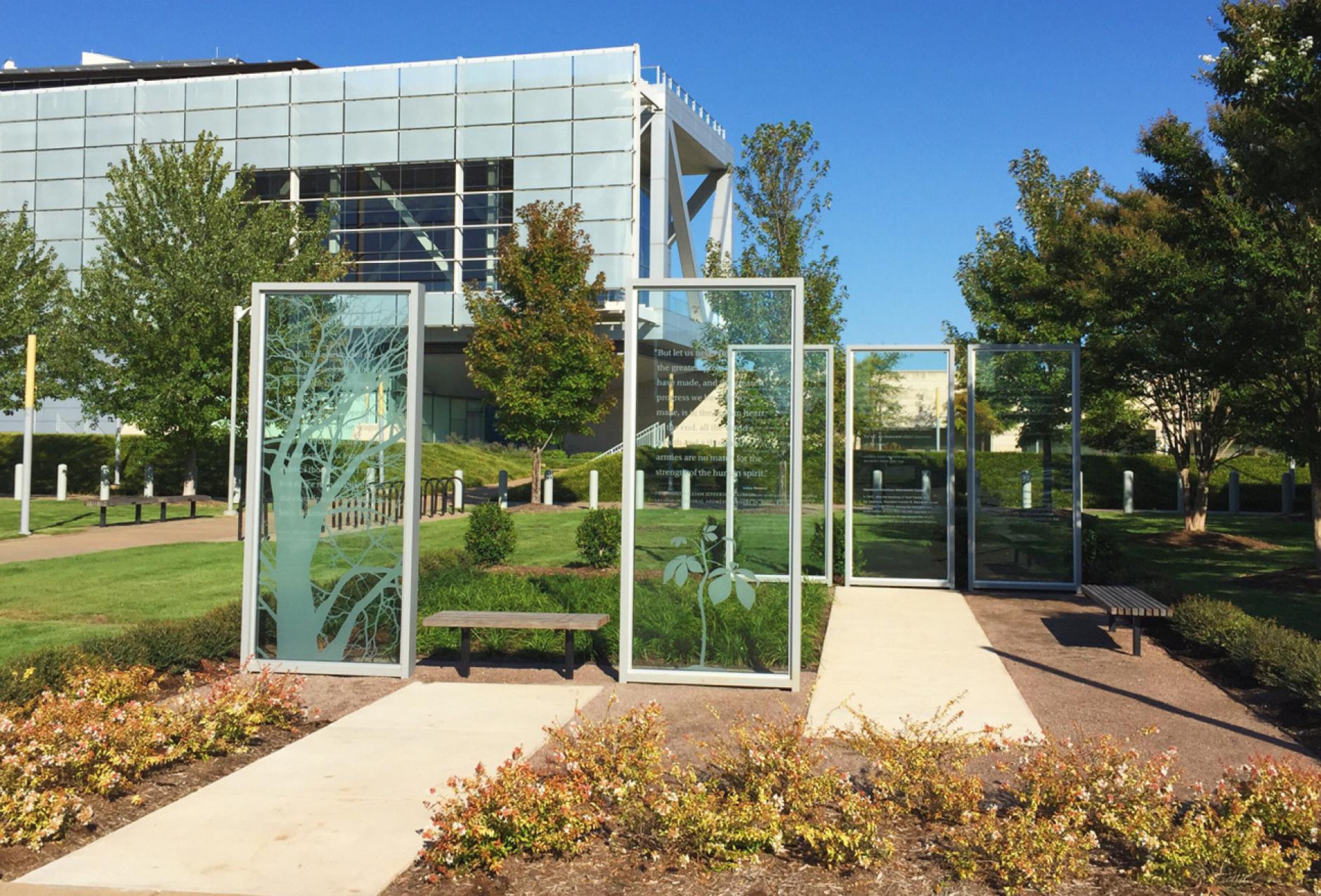
AnneFrankTreeThe Clinton Foundation and the Sisterhood of Congregation B’nai Israel, in conjunction with the Anne Frank Center USA, have joined together to create a new powerful exhibit, The Anne Frank Tree, which will be located on the grounds of the Clinton Presidential Park.  The permanent installation, which will surround the Anne Frank Tree sapling, will open today.

In 2009, the Clinton Center was one of 11 entities in the United States to be awarded a young chestnut tree by the Anne Frank Center USA’s “Sapling Project.” The sapling was taken from the white horse chestnut tree that stood outside Anne Frank’s Secret Annex when she and her family were in hiding from the Nazis during World War II. The young writer cherished and wrote about the tree frequently in her famous diary.

“As long as this exists,” Anne wrote on February 23, 1944, “how can I be sad?” During the two years she spent in the Secret Annex, the solace Anne found in her chestnut tree provided a powerful contrast to the Holocaust unfolding beyond her attic window. And as war narrowed in on Anne and her family, her tree became a vivid reminder that a better world was possible.

Anne’s tree would outlive its namesake by more than 50 years before being weakened by disease and succumbing to a windstorm in 2010. But today, thanks to dozens of saplings propagated in the months before its death, Anne’s tree lives on in cities and towns around the world. The Anne Frank tree saplings provide an opportunity for these sites to tell the story of Anne Frank and connect it to incidents of injustice witnessed in each locale. To date, seven saplings have been planted at locations as diverse as the U.S. Capitol and the Children’s Museum of Indianapolis.

The Center’s installation consists of five framed, etched glass panels – arranged to evoke the feeling of being inside a room – surrounded by complementary natural landscaping. The two front panels feature quotes from Anne Frank and President Clinton. The three additional panels will convey the complex history of human rights in Arkansas through descriptions of the Indian Removal Act of 1830, the internment of Japanese Americans during World War II, and the Little Rock Central High School desegregation crisis of 1957. These panels will feature quotes from Chief Heckaton, hereditary chief of the Quapaw during Arkansas’ Indian Removal; George Takei, Japanese-American actor who was interned at the Rohwer Relocation Center in Desha County in 1942; and Melba Patillo Beals, member of the Little Rock Nine.

In collaboration with the Clinton Foundation, Little Rock landscape architect Cinde Drilling and Ralph Appelbaum Associates, exhibit designer for both the Center and The National Holocaust Museum, assisted in the design of the exhibit. The installation has been made possible thanks to the support of the Ben J. Altheimer Charitable Foundation and other generous partners.

The Center’s sapling is currently housed in a local nursery where it is acclimating to Arkansas’s environment. And although it will be present during the ceremony, it will be returned to the nursery where it will be cared for until it has matured and can thrive in its new home, located on the grounds of the Park. A similar chestnut tree will be temporarily planted in its place until the Anne Frank tree can be permanently transplanted.