
Skip to primary content
Skip to secondary content

Little Rock Culture Vulture

Cultural events, places and people in the Little Rock area

Little Rock Culture Vulture

Main menu

  • Home
  • About the Little Rock Culture Vulture
  • Little Rock Cultural Institutions and Organizations (alphabetical)
  • LR Cultural Sites by Discipline
  • Pulitzer Prize
  • Shows Seen
  • Theatre Reviews
    • Lucky 13
    • NPHS Fall of the House of Usher, ushers in fall
    • PIPPIN’s Magic Just for You
    • The Lullaby of a Golden Tent Season
    • Thoroughly Enjoyable Millie(s)
  • Tony Awards
    • 2014 Tony Award Predictions
    • 2015 Tony Awards
      • 2015 Tony Award Nomination Predictions
      • Tony Award Nomination Analysis
    • 2016 Tony Awards
      • 2016 Tony nomination predictions

Tag Archives: Crisis at Central High

Post navigation

← Older posts
Newer posts →

Birth of J. N. Heiskell on November 2, 1872

Posted on November 2, 2019 by Scott

At the age of 87, J. N. Heiskell in 1960.

John Netherland (J. N.) Heiskell served as editor of the Arkansas Gazette for more than seventy years.  He was usually called “Mr. Heiskell” by all, but a very few confidantes felt confident to call him “Ned.”

Mr. Heiskell is the person most responsible for Robinson Center Music Hall being located at the corner of Markham and Broadway.  As Chair of the Planning Commission and editor of the Arkansas Gazette he had twin bully pulpits to promote this location when those on the City Council (who actually had the final say) were looking at other locations.  He felt the location would help create a cluster of public buildings with its proximity to the county courthouse and to City Hall.  Mr. Heiskell finally succeeded in winning over the mayor and aldermen to his viewpoint.

He was born on November 2, 1872, in Rogersville, Tennessee, to Carrick White Heiskell and Eliza Ayre Netherland Heiskell. He entered the University of Tennessee at Knoxville before his eighteenth birthday and graduated in three years at the head of his class on June 7, 1893.

His early journalism career included jobs with newspapers in Knoxville and Memphis and with the Associated Press in Chicago and Louisville. On June 17, 1902, Heiskell’s family bought controlling interest in the Arkansas Gazette. Heiskell became the editor, and his brother, Fred, became managing editor.

Governor George Donaghey appointed Heiskell to succeed Jeff Davis in the United States Senate after Davis’s death in office. Heiskell served from January 6, 1913, until January 29, 1913, when a successor was chosen by the Arkansas General Assembly.  His tenure is the shortest in the U. S. Senate history.  His first speech on the Senate floor was his farewell.  He was also only the second US Senator to live to be 100.

On June 28, 1910, Heiskell married Wilhelmina Mann, daughter of the nationally prominent architect, George R. Mann. The couple had four children: Elizabeth, Louise, John N. Jr., and Carrick.

In 1907, he joined a successful effort to build the city’s first public library. He served on the library board from that year until his death and was issued the first library card.  He also served on the City’s Planning Commission for decades.  In 1912, he was instrumental in bringing John Nolen to Little Rock to devise a park plan.

In the paper and in his own personal opinions, he crusaded on a variety of progressive causes.  Perhaps the most famous was the Gazette’s stance in the 1957 Central High desegregation crisis.  It was for this effort that the paper received two Pulitzer Prizes.

Although Heiskell stopped going to the office at age ninety-nine, he continued to take an active interest in the newspaper. He began by having a copy of the newspaper delivered to his home by messenger as soon as it came off the press each night. Eventually, he switched to having his secretary call him daily at his home and read the entire newspaper to him. He operated on the premise that “anyone who runs a newspaper needs to know what’s in it, even to the classified ads.”

A few weeks after turning 100, Heiskell died of congestive heart failure brought on by arteriosclerosis on December 28, 1972. He is buried in Little Rock’s Mount Holly Cemetery.  Interestingly, he is buried in the same cemetery as two of his most notable adversaries: Governor Jeff Davis, and segregationist Congressman Dale Alford.

Mr. Heiskell donated his vast papers to UALR. They are part of the Arkansas Studies Institute collection. These papers give insight into not only his career as a journalist, but also his political and civic affairs.  Thankfully he saved much of his paperwork. Without it, much insight into Little Rock in the 20th Century would be lost.
Share this:

  • Click to share on Facebook (Opens in new window) Facebook
  • Click to email a link to a friend (Opens in new window) Email
  • Click to share on X (Opens in new window) X
  • Click to share on LinkedIn (Opens in new window) LinkedIn
  • Click to share on Tumblr (Opens in new window) Tumblr
  • More
  • Click to share on Reddit (Opens in new window) Reddit
Like Loading...
Posted in Civic Engagement, Government, History, Literature, LR Look Back | Tagged Arkansas Gazette, Arkansas Studies Institute, CALS, Central Arkansas Library System, City of Little Rock, Crisis at Central High, Little Rock Central High School, Little Rock Planning Commission, Mount Holly Cemetery, Pulitzer Prize, Robinson Center Performance Hall, U. S. Senate, UA Little Rock

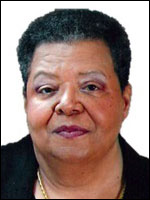
Happy Birthday to Elizabeth Eckford

Posted on October 4, 2019 by Scott

After 60 years, the most dramatic images of the 1957 crisis at Little Rock Central High School remain those of 15-year-old Elizabeth Eckford, being taunted as she walked through a hate-filled mob, on her way to school.  Today, Ms. Eckford recalls how difficult it was for her parents, Oscar and Birdie, to allow her to continue the struggle to integrate the Little Rock schools.

Last month, a replica of the bench on which she sat on that first day in 1957 was unveiled.  Instead of sitting on a bench surrounded by taunters, this time she sat on a bench surrounded by cheers and applause.  The bench was the latest project of the Central High Memory Project which has also produced an audio tour which takes listeners down the street as Ms. Eckford experienced it in 1957.

Born on October 4, 1941, she grew up in Little Rock.  Because all of the city’s high schools closed her senior year, Ms. Eckford moved to St Louis, where she obtained her GED. She attended Knox College in Illinois, and received her BA in History from Central State University in Wilberforce, Ohio.  While in college, Ms. Eckford became one of the first African Americans to work in a local St. Louis bank, in a non-janitorial position, and later she worked as a substitute teacher, in Little Rock public schools.

Ms. Eckford, a veteran of the U.S. Army, has also worked as a substitute teacher in Little Rock public schools, test administrator, unemployment interviewer, waitress, welfare worker, and military reporter.  Along with her fellow Little Rock Nine members, she is a recipient of the NAACP’s Spingarn Medal and the prestigious Congressional Gold Medal.  Together with one of her former tormenters, Ms. Eckford also received a Humanitarian award, presented by the National Conference for Community and Justice (NCCJ), following their meeting 34 years after an apology.  The award recognizes forgiveness and atonement.  They talked to students for two years, and, together, attended a 12-week racial healing course.

Ms. Eckford has started to walk through the painful past in sharing some of her story.  She has said that true reconciliation can occur if we honestly look back on our shared history. She believes that the lessons learned from Little Rock Central High School must continue to be shared with new generations, reminding audiences that “the dead can be buried, but not the past.”  Ms. Eckford continues her interest in education by sharing her story with school groups, and challenges students to be active participants in confronting justice, rather than being passive observers.

Share this:

  • Click to share on Facebook (Opens in new window) Facebook
  • Click to email a link to a friend (Opens in new window) Email
  • Click to share on X (Opens in new window) X
  • Click to share on LinkedIn (Opens in new window) LinkedIn
  • Click to share on Tumblr (Opens in new window) Tumblr
  • More
  • Click to share on Reddit (Opens in new window) Reddit
Like Loading...
Posted in Civic Engagement, History, LR Look Back | Tagged Central High Memory Project, Central High School National Historic Site, Crisis at Central High, Elizabeth Eckford, Just Communities of Arkansas, Little Rock Central High School, Little Rock School District, NAACP

Artober – Photography

Posted on October 2, 2019 by Scott

October is Arts and Humanities Month nationally and in Little Rock. Americans for the Arts has identified a different arts topic to be posted for each day in the month. Today’s focus is photography.

While Little Rock has many photographers of whom I very fond, I have chosen to highlight an image taken by Ernest Withers in September 1957. A copy of this photo is in the collection of the Smithsonian National Museum of African American History and Culture as well as the Museum of Fine Arts, Houston.

The photo is The “Little Rock Nine’s” first day of school. Little Rock, Arkansas.

Collection of the Smithsonian National Museum of African American History and Culture. © Ernest C. Withers Trust

It depicts several members of the Little Rock Nine getting out of the car on September 25, 1957, their first day of school. On one hand, it is typical of teenagers then, and now. They are carrying assignments and their books.  One of them has dropped something and is bent over to pick it up.  It appears to be from left to right, Carlotta Walls, Melba Pattillo, Elizabeth Eckford, and Minnijean Brown.

But on the other hand, the photo is anything but typical. They are being escorted by soldiers. Crowds of people are amassed on the front steps watching it all unfold. The rest of the street by the car is bare.

History was about to be made.

Share this:

  • Click to share on Facebook (Opens in new window) Facebook
  • Click to email a link to a friend (Opens in new window) Email
  • Click to share on X (Opens in new window) X
  • Click to share on LinkedIn (Opens in new window) LinkedIn
  • Click to share on Tumblr (Opens in new window) Tumblr
  • More
  • Click to share on Reddit (Opens in new window) Reddit
Like Loading...
Posted in Arts & Humanities Month, Civic Engagement, History, Visual Art | Tagged Carlotta Walls LaNier, Crisis at Central High, Elizabeth Eckford, Ernest Withers, Little Rock Nine, Melba Pattillo, Minnijean Brown, photography, Smithsonian National Museum, Smithsonian National Museum of African American History and Culture

September 27, 1958 – LR voters keep high schools closed

Posted on September 27, 2019 by Scott

Spelling error and factual error both in this sign

On Saturday, September 27, 1958, voters in Little Rock approved the continuation of the closure of the city’s high schools.

Using legislation passed by the General Assembly in a hastily called special session in summer of 1958, Governor Orval Faubus had ordered the closure of Little Rock’s four public high schools in order to keep them from being desegregated.

But that state law only allowed the closure of Central, Hall, Horace Mann and Technical high schools on a temporary basis. In order for them to be closed permanently, the city’s voters must approve it by a vote.

The election date was to be set by Governor Faubus.  Originally scheduled for Tuesday, October 7, the date was moved to September 27.  Speculation for the new date selection centered on:

  • Faubus wanted it to be prior to the October 1 poll tax deadline so that only people who had paid their poll tax for the prior year were eligible
  • The election was on a Saturday.  Though Tuesday was the most common day of the week for elections, in the late 1950s Saturdays were used on elections as well.  The school board elections, for instance, were on Saturdays in some years.
  • On September 27, 1958, the Arkansas Razorbacks had a home football game in Fayetteville.

These were all designed to stifle voter turnout. In addition, the state law required a majority of eligible voters to approve reopening the schools.  The law also spelled out the confusing wording of the ballot question.  As historian Sondra Gordy points out in her book FINDING THE LOST YEAR, the ballot question was about only being for or against integration of the schools – it did not say anything about closure or opening of schools.

While the newly formed Women’s Emergency Committee did put forth efforts to educate voters about the issue and encourage a vote to reopen the schools, this nascent group was less than a fortnight old by the Saturday election day.  On the other side, the Governor campaigned for the remaining closure of the schools including in television appearances.

On that Saturday, Little Rock voters voted 19,470 to keep schools segregated to 7,561 to integrate them.

The WEC was disappointed but remained even more determined.  As some of the members have commented – having over 7,000 people be WITH them was encouraging.

It would be a long road ahead to reopen the schools.  It would take two more elections before the City’s four public high schools would reopen.

Share this:

  • Click to share on Facebook (Opens in new window) Facebook
  • Click to email a link to a friend (Opens in new window) Email
  • Click to share on X (Opens in new window) X
  • Click to share on LinkedIn (Opens in new window) LinkedIn
  • Click to share on Tumblr (Opens in new window) Tumblr
  • More
  • Click to share on Reddit (Opens in new window) Reddit
Like Loading...
Posted in Civic Engagement, Government, History, LR Look Back | Tagged Arkansas Razorbacks, Crisis at Central High, Horace Mann Middle School, Little Rock Central High School, Little Rock Hall High, Lost Year, Orval Faubus, Sondra Gordy, Women's Emergency Committee

Happy Birthday to Gloria Karlmark

Posted on September 26, 2019 by Scott

Gloria Ray Karlmark enraptured the audience in 2017 at the Central High Integration 60th Anniversary when she talked about how welcomed she finally felt in the city of her lost youth.  She was born on September 26, 1942. So her second full day of classes in 1957 was her birthday.
Gloria was the youngest daughter of H. C. Ray, son of a former slave, and founder of the Arkansas Agricultural Extension Service for Negroes, and Julia M. Ray, a Sociologist and a graduate of Tuskegee Institute and Philander Smith College.  Her father was Laboratory Assistant to George Washington Carver, and received his degree in Horticulture under Booker T. Washington at Tuskegee Institute.  Her mother was fired when she refused to withdraw Gloria from Little Rock Central High School in 1957-1958.

When Central High School remained closed, on an order from Governor Faubus the following year, Gloria moved to Kansas City, Missouri, where she graduated in 1960 from the newly integrated Kansas City Central High School.  She went on to graduate from Illinois Institute of Technology (IIT), Chicago, after which she joined the IIT Research Institute as Assistant Mathematician on the APT IV Project (robotics, numerical control, and online technical documentation).  This included work at Boeing in Seattle, McDonnell-Douglas in Santa Monica, and NASA Automation center in St. Louis.

In 1969, she and her husband took a sabbatical year following the trail of the Maya Indians from Mexico through Central America by car.  Soon after, they immigrated to Sweden.  In the years that followed, the Karlmark family was blessed with a son and a daughter.

Recruited to join IBM’s Nordic Laboratory, Mrs. Karlmark completed the Svenska Patent och Registreringsverket “Patent Examiner” Program in 1975, and joined IBM’s International Patent Operations as European Patent Attorney.

In 1976, she co-founded Computers in Industry, and international journal of practice and experience of computer applications in industry affiliated with UNESCO and the International Federation of Information Processing-IFIP.  She served some 15 years as Editor-in-Chief.

In the years leading up to her retirement in 1994, Mrs. Karlmark also worked for Philips International in management as a specialist in Belgium, the Netherlands, France, Germany, Spain, and Scotland.  She and her family currently reside in Europe.

Share this:

  • Click to share on Facebook (Opens in new window) Facebook
  • Click to email a link to a friend (Opens in new window) Email
  • Click to share on X (Opens in new window) X
  • Click to share on LinkedIn (Opens in new window) LinkedIn
  • Click to share on Tumblr (Opens in new window) Tumblr
  • More
  • Click to share on Reddit (Opens in new window) Reddit
Like Loading...
Posted in Civic Engagement, Government, History, LR Look Back | Tagged Central High School National Historic Site, Crisis at Central High, Gloria Ray, Little Rock Central High School, NAACP, Philander Smith College

September 25, 1957 – The Little Rock Nine enter Little Rock Central High School for good

Posted on September 25, 2019 by Scott

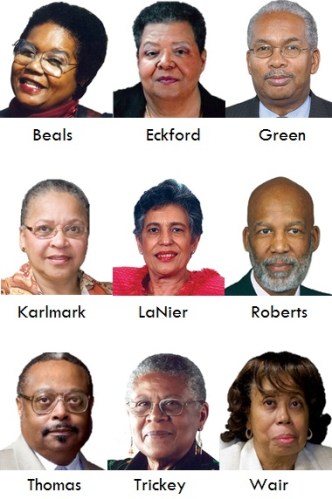
After legal challenges, stymied attempts, and literally countless threats, it was on Wednesday, September 25, 1957, that the group of African American students known as the Little Rock Nine actually entered Little Rock Central High School for a full day.  They would return each day through the end of the school year.
Unlike September 23, when they went in a side door before being hustled a few hours later for their own protection, on September 25 they walked in the front door.  They did so escorted by members of the 101st Airborne who had been ordered to Little Rock by President Eisenhower.

Much has been written about the events of September 25, 1957.  Several of the participants that day have penned memoirs.

Whatever I would write today would pale in comparison to the accounts of those who lived it.

So I just end this with words of gratitude to:

  • Melba Pattillo Beals
  • Elizabeth Eckford
  • Ernest Green
  • Gloria Ray Karlmark
  • Carlotta Walls LaNier
  • Terrence Roberts
  • Jefferson Thomas
  • Minnijean Brown Trickey
  • Thelma Mothershed Wair

Thank you to these nine pioneers, who were simply teenagers trying to have equal education opportunities.  Thank you to their parents, their families, their pastors, their legal team, their support system.  Thank you to Daisy and L. C. Bates, Wiley Branton Sr. Chris Mercer, and Thurgood Marshall for the roles they played.

While Jefferson Thomas passed away in 2010, the other eight continue to tell their stories and speak truth to audiences ranging from one to thousands and ages from pre-school to seniors.

Share this:

  • Click to share on Facebook (Opens in new window) Facebook
  • Click to email a link to a friend (Opens in new window) Email
  • Click to share on X (Opens in new window) X
  • Click to share on LinkedIn (Opens in new window) LinkedIn
  • Click to share on Tumblr (Opens in new window) Tumblr
  • More
  • Click to share on Reddit (Opens in new window) Reddit
Like Loading...
Posted in Civic Engagement, History | Tagged Carlotta Walls, Carlotta Walls LaNier, Crisis at Central High, Daisy Bates, Dwight Eisenhower, Elizabeth Eckford, Ernest Green, Gloria Ray, Jefferson Thomas, L. C. Bates, Little Rock Central High School, Little Rock Nine, Melba Pattillo, Minnijean Brown, Terrence Roberts, Thelma Mothershed, Thurgood Marshall, Wiley Branton Sr.

Ike sends the 101st to Little Rock, announces in national TV address on Sept. 24, 1957

Posted on September 24, 2019 by Scott

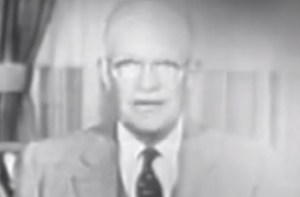
On September 24, 1957, President Dwight Eisenhower ordered the 101st Airborne to Little Rock to ensure that the Little Rock Nine would be able to enter Central High School.

In a thirteen minute televised White House address to the nation, President Eisenhower stated he had acted to prevent “mob rule.”  The President made his decision about the troops while vacationing in Rhode Island. But he flew to Washington DC to deliver the address from the White House. In his remarks, he stated that he felt it was important to discuss this action from the house of Lincoln.

Following the President’s noontime decision, 1,000 members of the 101st Airborne Division were flown to Little Rock.  In addition, all 10,000 members of the Arkansas National Guard were “federalized.”

Earlier in the day, Little Rock Mayor Woodrow Mann had pleaded with the President and US Attorney General for federal intervention.  He stated that the Little Rock police could not quell the crowds alone.

Share this:

  • Click to share on Facebook (Opens in new window) Facebook
  • Click to email a link to a friend (Opens in new window) Email
  • Click to share on X (Opens in new window) X
  • Click to share on LinkedIn (Opens in new window) LinkedIn
  • Click to share on Tumblr (Opens in new window) Tumblr
  • More
  • Click to share on Reddit (Opens in new window) Reddit
Like Loading...
Posted in Civic Engagement, Government, History, LR Look Back | Tagged Crisis at Central High, Dwight Eisenhower, Herbert Brownell, Little Rock Central High School, White House, Woodrow Wilson Mann

Post navigation

← Older posts
Newer posts →

Search the Site

Archives

  • January 2020
  • December 2019
  • November 2019
  • October 2019
  • September 2019
  • August 2019
  • July 2019
  • June 2019
  • May 2019
  • April 2019
  • March 2019
  • February 2019
  • January 2019
  • December 2018
  • November 2018
  • October 2018
  • September 2018
  • August 2018
  • July 2018
  • June 2018
  • May 2018
  • April 2018
  • March 2018
  • February 2018
  • January 2018
  • December 2017
  • November 2017
  • October 2017
  • September 2017
  • August 2017
  • July 2017
  • June 2017
  • May 2017
  • April 2017
  • March 2017
  • February 2017
  • January 2017
  • December 2016
  • November 2016
  • October 2016
  • September 2016
  • August 2016
  • July 2016
  • June 2016
  • May 2016
  • April 2016
  • March 2016
  • February 2016
  • January 2016
  • December 2015
  • November 2015
  • October 2015
  • September 2015
  • August 2015
  • July 2015
  • June 2015
  • May 2015
  • April 2015
  • March 2015
  • February 2015
  • January 2015
  • December 2014
  • November 2014
  • October 2014
  • September 2014
  • August 2014
  • July 2014
  • June 2014
  • May 2014
  • April 2014
  • March 2014
  • February 2014
  • January 2014
  • December 2013
  • November 2013
  • October 2013
  • September 2013
  • August 2013
  • July 2013
  • June 2013
  • May 2013
  • April 2013
  • March 2013
  • February 2013
  • January 2013
  • December 2012
  • November 2012
  • October 2012
  • September 2012
  • August 2012
  • July 2012
  • June 2012
  • May 2012
  • April 2012
  • March 2012
  • February 2012
  • January 2012
  • December 2011
  • November 2011
  • October 2011
Blog at WordPress.com.
Little Rock Culture Vulture
Create a free website or blog at WordPress.com.
Privacy & Cookies: This site uses cookies. By continuing to use this website, you agree to their use.
To find out more, including how to control cookies, see here: Cookie Policy
  • Subscribe Subscribed
    • Little Rock Culture Vulture
    • Join 672 other subscribers
    • Already have a WordPress.com account? Log in now.
    • Little Rock Culture Vulture
    • Subscribe Subscribed
    • Sign up
    • Log in
    • Report this content
    • View site in Reader
    • Manage subscriptions
    • Collapse this bar
 

Loading Comments...
 

    %d