
And the Pulitzer goes to SOUTH PACIFIC

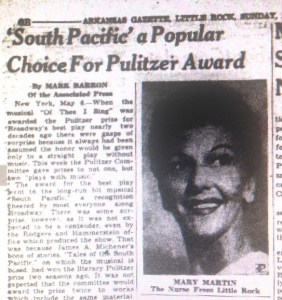
On May 5, 1950, the Rodgers and Hammerstein musical South Pacific captured the Pulitzer Prize in Drama. This would receive special attention in the Arkansas Gazette. The reason this carried such weight in Arkansas was that the musical had a connection to Little Rock.

The 1950 Pulitzer for Drama went to a musical for only the second time in the history of the awards. The recipient was South Pacific by Richard Rodgers, Oscar Hammerstein II and Joshua Logan. The character was the leading lady of Nellie Forbush. She was an Navy ensign and a nurse stationed on an exotic island during World War II. The musical was based on a Pulitzer Prize winning novel, James Michener’s Tales of the South Pacific.

In the Michener novel, Miss Forbush is not from Little Rock. She is actually from a small town in Alabama. But the book does mention Nellie and her mother visiting Little Rock.  The part was written for Mary Martin from Weatherford, Texas. Rodgers, Hammerstein & Logan did not discuss why they relocated Nellie’s birthplace.

Originally the musical contained a song entitled “My Girl Back Home” in which Nellie sang of being from “Little Rock, A-R-K” while another character sang of being from “Philadelphia, P-A” and “Princeton, N-J.” It is possible the change to Little Rock was made because it offered more lyrical possibilities, but that is only a supposition on the part of the Culture Vulture. That song did appear in the movie version in which Mitzi Gaynor played Nellie Forbush. It was also featured in the 2008 Broadway revival, this time with Kelli O’Hara playing Nellie.

In the musical, Nellie struggles with her own prejudices. This issue of prejudice became an instance of fact meeting fiction. In 1957, a few weeks after Eisenhower sent troops into Little Rock to ensure that Central High would be desegregated, a production of South Pacific on Long Island was temporarily halted when the audience booed and yelled after Nellie mentioned she was from Little Rock. Interestingly, the movie was released in 1958, but retained references to Little Rock. That was either a testament to the expense of re-editing it, or the fact that audience reaction had lessened.
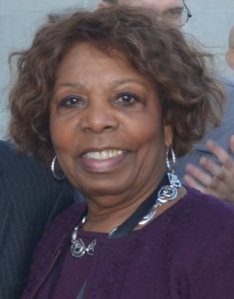
Happy Birthday to Lottie Shackelford, who served as Little Rock’s 68th mayor

On April 30, 1941, future Little Rock Mayor Lottie Shackelford was born. Throughout her career in public service she has been a trailblazer.

Active in community activities and politics, she ran for the City Board in 1974 and lost.  But she was appointed to the Little Rock City Board in September 1978 to fill a vacancy.

This made her the first African American woman to serve on he City Board, and indeed on any governing board for the City (during Reconstruction, there were at least six African Americans on the City Council, but they were all men.) She was subsequently elected to a full-term on the City Board in 1980 winning 55% of the vote over three male candidates.

She was subsequently re-elected in 1984 (unopposed) and in 1988 (with 60% of the vote).

In January 1987, Shackelford became the first female mayor of Little Rock when she was chosen by her colleagues on the City Board to serve in that position. She was Mayor until December 1988.  During that time, Mayor Shackelford invited the Little Rock Nine back to the City to be recognized for the 30th anniversary of their integration of Central High School.

From 1982 until 1992, she served as Executive Director of the Arkansas Regional Minority Purchasing Council.  She left that position to serve as Deputy Campaign Manager of Clinton for President.  She subsequently served on the Clinton/Gore transition team. She later served on the Overseas Private Investment Corporation from 1993 to 2003. She was the first African American to be in that position.

A graduate of Philander Smith College, she has also studied at the Arkansas Institute of Politics at Hendrix College and the Kennedy School of Government at Harvard University.

Mayor Shackelford has also served on numerous boards including the Little Rock Airport Commission, Philander Smith College, Chapman Funds (Maryland) and Medicis Pharmaceutical Corporation (Arizona).  She has the longest tenure of any serving as Vice-Chair of the Democratic National Committee.

Mayor Shackelford was in the first class of inductees for the Arkansas Black Hall of Fame.  In 2015, she was inducted into the Arkansas Civil Rights Heritage Trail.

Women Making History – Nancy Rousseau

Though not a graduate of Little Rock Central High School, Nancy Rousseau is a Central High Tiger through and through.

She has been principal of Little Rock Central High School since the summer of 2002. Born in New York, she graduated high school in Tenafly, New Jersey.  After attending Ohio University, she graduated from Adelphi University with a degree in English education.  Her first job was teaching in Port Washington, NY, where she won the “New Teacher of the Year” award.  After teaching in Midwest City, Oklahoma, she arrived in Little Rock in 1976.

From 1976 until 1986, she taught English at Pulaski Academy.  After receiving her master’s degree in educational administration from the University of Arkansas at Little Rock, she was hired by the Little Rock School District as an Assistant Principal at Central High School.  From 1991 until 1998, she served in that capacity. During that time, she worked on the planning for the 40th anniversary of the integration of Central High by the Little Rock Nine.

In 1998, she became principal of Pulaski Heights Junior High School.  She led the school’s transition from a junior high to a middle school.  When the position of Central High School principal became open in 2002, she applied for the job.

Since returning to Central as its principal, Mrs. Rousseau has been a very visible champion of the school, its students, faculty and alumni.  She served as co-chair for the Central High Integration 50th Anniversary Commission.  During her tenure, the school’s physical plant has been upgrade and much of the historic façade and interior has been restored.  A Central High Alumni Association and a Tiger Foundation have been formed.  Through their effort, the arts, academics and athletics have been enhanced.

Mrs. Rousseau also participated in the planning for the 60th anniversary of the school’s integration.  She is one of a very few who worked on the 40th, 50th and 60th anniversaries.

NO TEARS SUITE, commissioned by OXFORD AMERICAN performed today at Little Rock Central High School

In September 2017, Oxford American premiered a 60-minute jazz composition entitled No Tears Suite, written by Little Rock jazz pianist Chris Parker and vocalist Kelley Hurt. The duo created the work in honor of unity on the 60th anniversary of the Little Rock Central High School desegregation crisis.

In this reprisal, Parker and Hurt will again be joined by five exceptional jazz artists, including GRAMMY-winning jazz drummer Brian Blade, who played in the original 2017 ensemble, in addition to fifteen members of the Arkansas Symphony Orchestra who will premiere the new, expanded symphonic arrangements of the No Tears Suite written by GRAMMY-nominated arranger, composer and bassist Rufus Reid.

This FREE performance starts at 3pm in the Roosevelt Thompson Auditorium at Little Rock Central High School.  Tickets may be reserved here.

The artists include:
Geoffrey Robson, conductor
Kelly Hurt, vocalist
Chris Parker, piano/composer
Rufus Reid, bass/arranger
Brian Blade, drums
Bobby LaVell, tenor saxophone
Marc Franklin, trumpet
Chad Fowler, alto and baritone saxophones

NO TEARS SUITE, commissioned by OXFORD AMERICAN being performed tonight

In September 2017, Oxford American premiered a 60-minute jazz composition entitled No Tears Suite, written by Little Rock jazz pianist Chris Parker and vocalist Kelley Hurt. The duo created the work in honor of unity on the 60th anniversary of the Little Rock Central High School desegregation crisis.

In this reprisal, Parker and Hurt will again be joined by five exceptional jazz artists, including GRAMMY-winning jazz drummer Brian Blade, who played in the original 2017 ensemble, in addition to fifteen members of the Arkansas Symphony Orchestra who will premiere the new, expanded symphonic arrangements of the No Tears Suite written by GRAMMY-nominated arranger, composer and bassist Rufus Reid.

The program starts at 8pm tonight at the Mosaic Templars Cultural Center, 501 W 9th Street.  Tickets may be purchased here.

The artists include:
Geoffrey Robson, conductor
Kelly Hurt, vocalist
Chris Parker, piano/composer
Rufus Reid, bass/arranger
Brian Blade, drums
Bobby LaVell, tenor saxophone
Marc Franklin, trumpet
Chad Fowler, alto and baritone saxophones

Rock the Oscars 2019: Roy Reed

It is possible that journalist extraordinaire Roy Reed appears in archival footage of the Oscar winning documentary “Nine from Little Rock” (Documentary, Short-1964) and Oscar nominated Eyes on the Prize: Bridge to Freedom 1965 (Documentary, Feature-1988).  First for the Arkansas Gazette and then for The New York Times, Reed was an eyewitness to history being made.  What is not in doubt is that he is a character in the Oscar winning film Selma.  In that movie, he was played by actor John Lavelle.

Roy Reed was born on February 14, 1930, in Hot Springs and grew up in Garland County. After attending Ouachita Baptist College and the University of Missouri (from which he would receive a Bachelor’s and a Master’s in Journalism), Reed worked for a newspaper in Joplin and served in the US Army.  In 1956, he returned to Arkansas to work for the Arkansas Gazette.

While he did not specifically cover the integration of Little Rock Central High in 1957, he was part of the paper’s coverage of civil rights. He later was assigned to cover the Faubus administration.  In 1965, he was hired by The New York Times and covered the South. He covered the historic Freedom March to the state Capitol in Montgomery in March 1965.  After spending 1965 and 1966 in the South, he was assigned to the Times’ Washington DC bureau.  In 1969, he moved to New Orleans to open a Southern bureau for the paper.  He remained in the Crescent City until 1976, when he was transferred to the London bureau.

After retiring in 1978, he moved to Northwest Arkansas and taught journalism at the University of Arkansas until 1995.  Reed continued to write essays and books including Faubus: The Life and Times of an American Prodigal (1997),  Looking Back at the Arkansas Gazette: An Oral History (2009) and Beware of Limbo Dancers: A Correspondent’s Adventures with the New York Times (2012).  Reed died in December 2017.

Little Rock Look Back: Home of Carlotta Walls bombed in 1960

On February 9, 1960, a bomb was detonated at the home of Carlotta Walls. One of the Little Rock Nine as a sophomore, she was now in her senior year at Little Rock Central High.  This followed the September 1959 Labor Day bombings in Little Rock.

The bomb went off at approximately 11:00pm.  The blast could be heard for two miles from the house (located at 1500 S Valentine St.). Carlotta’s mother, Juanita, and sisters were at home with her, though her father, Cartelyou, was at his father’s house at 3910 West 18th Street.  Thankfully all members of the family were not physically harmed.  Two sticks of dynamite were used for the bomb.  The blast removed brick and broke three windows in the Walls house.

According to media accounts, this bombing was the first in the United States directed at a student since the 1954 US Supreme Court decision in Brown v. Board of Education.  As such, it made national headlines.  Carlotta was not deterred.  She had no thought of dropping out of school.

Reaction in the community including the Women’s Emergency Committee deploring the action and the NAACP being outraged.  The Little Rock School District only stated that it was a matter for the police.  The Chamber of Commerce was concerned about the impact it would have on attracting industry.

The FBI came in to investigate in addition to the Little Rock Police Department.  Two African Americans, Herbert Monts and Maceo Binns, Jr., were convicted for causing the bombing. Binns’ conviction was thrown out because it was proven he was coerced into a confession.  Monts served twenty (20) months of a five year sentence.  The supposed motive was to build sympathy for the African American community.  Carlotta Walls LaNier has stated that she did not believe the men bombed her house.

Monts petitioned the Arkansas Parole Board for a pardon. In October 2018, Governor Asa Hutchinson included Monts on a list of persons to be pardoned.