Little Rock Look Back: 190 Years of 1st Presbyterian Church

This weekend, Little Rock’s First Presbyterian Church will celebrate 190 years.

The Sunday service will feature a Scottish Bagpiper, special music, and historical readings to recognize the church’s history. The message will be delivered by Reverend Stewart Smith, General Presbyter of the Presbytery of Arkansas.

The church was organized in July 1828. It is the oldest continuously serving Presbyterian church west of the Mississippi River.  Not only that, it appears to be the oldest, continuously serving church of any denomination in Little Rock.  It predated the establishment of Catholic (1830), Methodist (1833) and Episcopal (1839) churches in the city.

Little Rock’s first Presbyterian congregation was organized in July 1828. Reverend James Wilson Moore had been commissioned by the Northumberland Presbytery of Pennsylvania as a Presbyterian Missionary to the Territory of Arkansas.

Prior to the formal establishment  of the church, Rev. Moore preached his first sermon in Little Rock on  January 28, 1828. It took place in Jesse Brown’s schoolhouse (Little Rock’s first school) which was at the foot of Rock Street.

When the church was established, it had seven members: two men and five women.  From 1828 until 1833, it met in a variety of temporary locations.

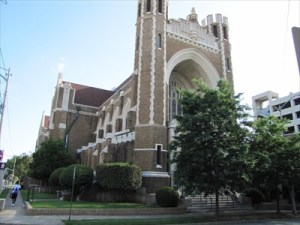
The congregation’s first permanent structure was at the southeast corner of Second and Main (where the Main Street Parking Deck is sited). In 1853, it moved to land on Markham between Cumberland and Rock.  Following an 1866 fire which destroyed the church and several other buildings, the church made plans to move.  In 1869, the congregation moved to three lots at the northwest corner of Capitol Avenue and Scott Streets. This brick sanctuary with a steeple was the first church built in Little Rock after the Civil War.

By 1909, the church was outgrowing the building. There was discussion as to whether the building should be expanded or a new building built elsewhere. Due to the increase in the property value in the existing site, the decision was made to move.  In 1913, property at the southwest corner of 8th and Scott Streets was purchased.  Construction began first on an education building (with a temporary auditorium). That building opened in 1914.

In May 1920, ground was broken for a new sanctuary building; the cornerstone was laid on November 7, 1920.  The first worship service in the sanctuary took place on October 2, 1921.

A disastrous four-alarm fire gutted the sanctuary in May 1958, causing thousands of dollars damage of the chancel and the organ. The sanctuary was restored for worship services within nine months.

A Sesquicentennial Anniversary celebration marking the 150 years of First Presbyterian Church history was held in the summer of 1978. Governor David Pryor (Governor of Arkansas and shortly U. S. Senator-elect) was principal speaker at worship services.

The building was listed on the National Register of Historic Places in 1986.

Little Rock Look Back: Dedication of Clinton Presidential Park Bridge and Bill Clark Wetlands

Photo by the Little Rock Convention and Visitors Bureau

On a very warm Friday, September 30, 2011, the Clinton Presidential Park Bridge was dedicated.  This completed the eastern loop of the Arkansas River Trail as well as created another feature in Clinton Presidential Park.

The ceremony featured remarks by both President Bill Clinton and the incumbent Secretary of State Hillary Rodham Clinton.  Chelsea Clinton also took part in the ceremony.  Former US Senators (and Arkansas Governors) Dale Bumpers and David Pryor were in attendance as was Jim Guy Tucker who followed Clinton into the Arkansas Governor’s Office.  Current Governor Mike Beebe was also present and took part in the ceremony, which was emceed by Stephanie Streett, executive director of the Clinton Foundation.  Many other former and current elected officials were present.

In addition to dedicating the bridge, the ceremony officially dedicated the William E. “Bill” Clark Presidential Wetlands which are adjacent to the bridge.  City Director Dean Kumpuris joined Clark’s widow, Margaret, and son, William, in the dedication of the wetlands.

This Clinton Presidential Park Bridge is over 2,600 ft. long.  It was constructed in 1899 as the Rock Island Bridge.  After the Rock Island stopped using the bridge, the lift span was permanently raised.  It had to stay this was for the Clinton redevelopment.  Therefore a new surface was built that slopingly takes persons from park level up to the span level and back down.

The bridge’s “rusty” structure is complemented by a well-lit 12-18-foot walkway flanked on both sides by silver galvanized steel handrails.
The total investment for this area is over $13.5 million.
Later that weekend, the Clinton Foundation hosted an event to commemorate the 20th anniversary of Clinton’s announcement that he was seeking the Presidency.

Remembering Sid McMath

Born on June 14, 1912, Sidney Sanders McMath would play a key role in the development of Arkansas throughout the 20th Century.

A veteran of World War II, he was part of a new breed of Arkansas politicians who challenged the “old guard.”  He won election of Prosecuting Attorney in Hot Springs and took on gaming and other corruption.  This propelled him into the Governor’s Office (and to be the first family to reside in the Arkansas Governor’s Mansion.)

After being defeated in his bid for a third two-year term as governor, McMath returned to being a full-time attorney.  He also remained active in the Marine Corps Reserves, achieving the rank of Major General.  In 1967, he founded the Marine Corps JROTC program at Catholic High School.

After a lifetime of public service, Gov. McMath died on October 4, 2003.

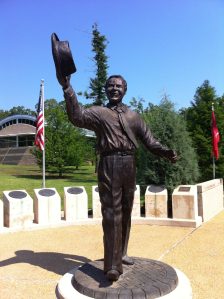
In 2004, the Central Arkansas Library System opened the Sidney Sanders McMath branch library.  A sculpture of him, created by Bryan Massey, Sr. and was commissioned to stand on the campus of the library branch which bears the Governor’s name. It was dedicated in 2006.

This bronze sculpture depicts Gov. McMath in shirt sleeves, slacks and a tie in mid stride. He confidently smiles as he raises his right hand to wave with the hat in the hand. It is based on a photo of the Governor walking in a Little Rock parade along side President Harry S. Truman.

Behind the statue are a series of medallions mounted on individual pedestals which depict scenes from McMath’s life. They are accompanied by a quote from U. S. Senator David H. Pryor “…the best friend Arkansas ever had.”

The plaza is flanked by the United States, Arkansas and Marine Corps flags.

Rock the Oscars: Gregory Peck

In August 1977, Oscar winner Gregory Peck appeared in Little Rock for the premiere of the film MacARTHUR.  He played the general who had been born in Little Rock but who spent most of his life downplaying (or even denying) that fact.
MacArthur was brought to the screen by Universal Pictures.  It was their attempt to capitalize on the success of the movie Patton, including sharing some of the same members of the production team.

Told entirely in flashback, it starred Peck as the fabled World War II general who was born in Little Rock. It focuses primarily on events in 1942 during the war, his dismissal by Truman in 1952, and his famous address to West Point in 1962.

Peck initially did not care for the subject or the script, but eventually stated that he grew to admire the challenges MacArthur faced.  Peck later called it one of his favorites roles, if not one of his favorite movies.

Producer Frank McCarthy, who worked on both Patton and MacArthur once said of Patton and MacArthur: “Both were complex men but General MacArthur was complex on a much broader scale. Patton had no ambition except to be a soldier and to command a field army. He was strictly command.”

Most of the film was shot on the backlot at the movie studio, which impacted the quality of the film.  The production budget simply would not allow for overseas location filming.

The premiere was a fundraiser for the Museum of Science and History (now the Museum of Discovery).  At the time it was located in the Arsenal Building, in which MacArthur had been born.  Since 1999, that has been home to the MacArthur Museum of Arkansas Military History.  Since MacArthur only spent a few hours in Little Rock as an adult, it is possible that Peck spent more time in the building than the General did.

The evening of August 5, 1977, started with an exclusive reception for 100 people with Gregory and Veronique Peck.  The movie itself was shown at the Cinema 150, where its general run would start on Saturday, August 6.  Following the film, a reception and silent auction brought people back to the museum.  Tickets ran $250 a person for all events, $100 a person for the film and post-show reception, and $25 for the movie.  It sold out.

Governor and Mrs. David Pryor escorted the Pecks into the theatre.  Former Governor (and World War II hero) Sid McMath introduced Mr. Peck to the crowd.  He extolled the virtues of Peck and MacArthur.  (It is interesting that he should admire MacArthur so much, since the General and President Truman had a well-publicized tiff, and McMath and Truman had enjoyed a warm relationship.)  Little Rock City Director Jim Dailey presented Peck with a Key to the City.

MacArthur did not lead to an Oscar nomination for Peck (though he did earn a Golden Globe nomination for the role).  But the actor had enjoyed four nominations prior to his win for To Kill a Mockingbird.  He also received the Jean Hersholt Humanitarian Award from the Academy.  He served as president of the Academy for several years.


Women’s History Month – Judge Elsijane Trimble Roy, first woman on Arkansas Supreme Court

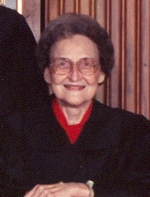
judge-trimbleElsijane Trimble Roy was born the daughter of a judge. At an early age, she knew she wanted to be an attorney.  She would eventually become not only the third female to graduate from the University of Arkansas Law School, but the first female circuit court judge in Arkansas, the first female on the Arkansas Supreme Court, and the first female Federal judge from Arkansas.

She was also the first woman in the United States to follow her father as federal judge.  She presided in the same courtroom where her father had served for 20 years. She retired in 1999 after 21 years on the federal bench.

Judge Roy has received many awards and honors including being selected Woman of the Year by the Business and Professional Woman’s Club in 1969, Arkansas Democrat Woman of the Year in 1976, an honor that her mother also received, and Outstanding Appellate Judge of 1976-1977 by the Arkansas Trial Lawyers Association.

While she was on the Arkansas Supreme Court (to which she had been appointed by Governor David Pryor), she administered the oath of office to Anne Bartley to lead the Department of Arkansas Natural and Cultural Heritage.  Ms. Bartley became the first woman in an Arkansas Governor’s cabinet.  In 1977, President Jimmy Carter appointed her to the federal bench to succeed Judge Oren Harris.

Women’s History Month – Anne Bartley, first woman to serve in Arkansas Governor’s cabinet

bartley_255x320px_0In 1976, Anne Bartley was sworn in as the first director of what was then known as the Department of Arkansas Natural and Cultural Heritage.  In that capacity, she was the first woman to serve in an Arkansas Governor’s cabinet.  She had encouraged Governor David Pryor to propose establishing the department and then had lobbied the Arkansas General Assembly to create it.  (Her oath of office was administered by the first woman on the Arkansas Supreme Court, Justice Elsijane Trimble Roy.)

Since 1968, Bartley had been involved in historic preservation, promotion of the arts, and civic engagement.   In 1979, Bartley was asked to establish a Washington Office for the state of Arkanas.  She later was involved in founding the Threshold Foundation (1981), the Funders’ Committee for Citizen Participation (1983), the Forum Institute for Voter Participation (1986), the Faith and Politics Institute (1991), Vote Now ’92 and ’94, America Coming Together (2004), Democracy Alliance (2004), America Votes (2005), and, currently, the Committee on States.

Some of the boards she has served on have been the New World Foundation, the Winthrop Rockefeller Foundation, and the Rockefeller Family Fund. She is currently on the boards of the Bauman Family Foundation, Rockefeller Philanthropy Advisors, America Votes, and on the Advisory Councils for Project New West and TAI SOPHIA.

Black History Month – Daisy Bates and Robinson Center

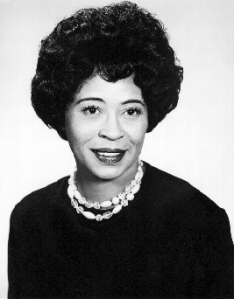
bates daisyToday is the Daisy Bates Holiday in the State of Arkansas.  So it is an appropriate day to pay tribute to Mrs. Bates, who played a leading role in the Little Rock Integration Crisis of 1957.

Daisy Lee Gatson Bates and her husband were important figures in the African American community in the capital city of Little Rock.  Realizing her intense involvement and dedication to education and school integration, Daisy was the chosen agent after nine black students were selected to attend and integrate a Little Rock High School.  Bates guided and advised the nine students, known as the Little Rock Nine, when they enrolled in 1957 at Little Rock Central High School. President Clinton presented the Little Rock Nine with the Congressional Gold Medal and spoke at the 40th anniversary of the desegregation while he was in office.

When Mrs. Bates died, a memorial service was held at Robinson Center on April 27, 2000.  Among the speakers were President Bill Clinton, Secretary of Transportation Rodney Slater, and Rev. Rufus K. Young, pastor of the Bethel AME Church.  Others in attendance included Lt. Gov. Winthrop Paul Rockefeller, Mayor Jim Dailey, Presidential diarist Janis Kearney, former senator and governor David Pryor, and five members of the Little Rock Nine:  Carlotta Walls Lanier, Ernest Green, Minnijean Brown Trickey, Jefferson Thomas, and Elizabeth Eckford.

It was during his remarks at the service that President Clinton announced he had asked that Bates’ south-central Little Rock home be designated as a national historic landmark.