Art as Activism discussion tonight

30americansIn conjunction with the Arkansas Arts Center’s 30 Americans exhibit, tonight at 6:30, the Mosaic Templars Cultural Center will host a panel on the topic of Art as Activism.

As part of the “501 to 501 Partnership Program”, Dr. Ila Sheren, author of “Art as Activism” and professor at Washington University in St. Louis will host a discussion with Thomas Allen Harris, filmmaker of “Through A Lens Darkly: Black Photographers and the Emergence of a People,” Dr. Deborah Willis, Tisch School of the Arts Photography and Imaging Department Chair, Charley Palmer, mixed media artist, and Delita Martin, artist, Black Box Press studios.

This event will be held at the Mosaic Templars Cultural Center, 501 W. 9th Street (9th and Broadway).

The Mosaic Templars Cultural Center is an agency of the Department of Arkansas Heritage.

The event is free and open to the public.

Celebrate Arkansas’ Statehood today at Historic Arkansas Museum and Old State House Museum

Statehood Day

Statehood Day

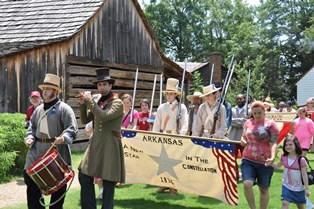
The Old State House Museum and Historic Arkansas Museum will celebrate Arkansas’ Statehood today. A joint living history event, “The Quest for Statehood: From The Delta To The Hills,” will mark 179 years of statehood at both locations.

Costumed interpreters will transform The Old State House and Historic Arkansas Museum into the daily life and work of people representing all sections of 1836 Arkansas with games, talks and activities from 10 to 4 on June 13th.

Pick up a packet of clues about which historical figure you are, where you’re traveling from and why you are in Little Rock on this special day; use these clues to complete a task specific to your character and win a prize! You can participate as an individual, a couple or as a family! All activities are free and open to the public.

The museums are both agencies of the Department of Arkansas Heritage.

Sandwich in History today at St. Edward’s Catholic Church

St. Edward Catholic Church_tour_tnThe monthly architectural history program “Sandwiching in History” visits St. Edward Catholic Church, lodated at 801 Sherman Street.

In 1883 Bishop Edward Fitzgerald sanctioned the creation of St. Edward parish to accommodate the growing number of German Catholics in Little Rock. The current church, dedicated in 1905, was designed by Charles L. Thompson in the Gothic Revival style.

Sandwiching in History is a program of the Arkansas Historic Preservation Program, an agency of the Department of Arkansas Heritage.

Heritage Month – Federal Building

Federal BuildingThe newest property to be added to the National Register of Historic Places closes out the month.  The Federal Building’s inclusion on this list was announced earlier this month.

The seven-story Federal Building at 700 West Capitol Avenue  was constructed in 1959-61.  It was designed in a modern style, featuring a uniform exterior grid of spandrel and plate glass framed by rows of aluminum bands and columns of white stone.

“The Little Rock Federal Building is a good example of the commercial work of two noted Arkansas architecture firms, Swaim & Allen & Associates and Ginocchio, Cromwell & Associates,” according to the National Register nomination. “The building’s design is consistent with modern high-rise office facilities in the late 1950s and early 1960s. Its uniformly packaged facades, defined by a grid of glass, aluminum, and stone, reflected a growing trend in which Federal buildings began to more closely resemble their commercial counterparts.”

The vertical bands mimic the neoclassical columns of the adjacent 1930s Federal Courthouse. While both structures are unique and representative of their architectural styles, a harmony exists based on the strong vertical lines and the use of the white and grey based primary color scheme.


Heritage Month – Paul Laurence Dunbar High School

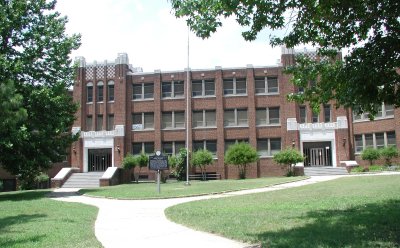
dunbarNow known as Dunbar Middle School, this building originally house students from junior high to junior college.  For years the Paul Laurence Dunbar High School was known throughout Arkansas and the south as an outstanding school for African American students.

From 1929 until 1955, Dunbar High School provided a high-quality education for African American students, not only within Little Rock but also from far-reaching corners of the state.   Today the National Dunbar Alumni Association is a well-organized network of former students with active chapters throughout the United States. 

The school is located in a residential area south of downtown Little Rock. George H. Wittenburg and Lawson L. Delony designed the edifice, built on a southeast-northwest axis. Both architects contributed to the design of Little Rock Central High School (1927; listed on the National Register in 1977), which is nine blocks west of Dunbar.

Dunbar was designed to accommodate an academic curriculum as well as the more traditional vocational programs often considered the limit of education for blacks. In 1980, Dunbar Junior and Senior High School and Junior College was listed on the National Register.

The significance of Dunbar Junior High School derives both from the unique place it occupies in the history of education in Arkansas and from the modern architectural concepts with which it was designed. Dunbar was a center of quality education for black Arkansans in the state’s segregated public school system, functioning as a junior high school, high school, and junior college until its last high-school and junior-college classes graduated in 1955.

It had further distinction as one of only two industrial arts schools in the south to attain junior college rating, also in 1931-1932, as well as the recognition and acceptance of the Dunbar curriculum as the basis for admission to colleges and universities throughout the United States. In 1943 the school was involved in a controversy concerning equal pay for black and white teachers in the Little Rock School System, which was resolved in Morris v. Williams, 149 F. 2d 703, heard before the 8th U.S. Circuit Court of Appeals. This was a landmark case in establishing the principle of “equal pay based on professional qualifications and services rendered.”

The architects’ achievement in designing an architecturally eminent setting for this progressive passage in Arkansas history is also noteworthy. With an eye toward form following function, the plan of the building promotes maximum use of space and expedient circulation. Aesthetically, the building is decidedly modern, with decorative brick and stone work and striking towers reflecting an interest in the Art Deco style of the period.

Heritage Month – White-Baucum House

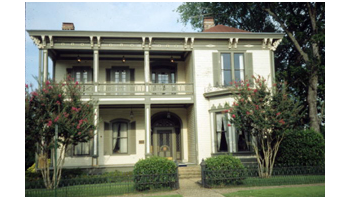
ahpp_nom_whitebaucumhouse_largeThe White-Baucum House is an architecturally significant structure with important historical. associations. The building, with its strong principal entrance, dominant porches and careful detailing, is one of the earliest and best examples of Italianate architecture in the state.

The home was constructed in 1869-1870 for Robert J. T. White, who was then Arkansas Secretary of State. In 1876 the building was sold to George F. Baucum, who entered business in Little Rock after distinguished service in the Civil War. Baucum operated a wholesale grocery business, was a cotton broker, was president of the Bank of Little Rock for a time and was one of the founders of the Board of Trade of the city. The Baucum family lived in the how until the mid-1920s. Lora B. Busick occupied the place from 1935 to 1957.

After being left vacant for four years, the house was adapted to new uses, It served as the home of two restaurants, an interior design studio, a nightclub, an advertising agency, and later an engineering firm.  For several years it sat vacant and fell into disrepair.  It has since been restored.

It was added to the National Register of Historic Places on Leap Day (February 29) in 1980.

Heritage Month – Knoop House

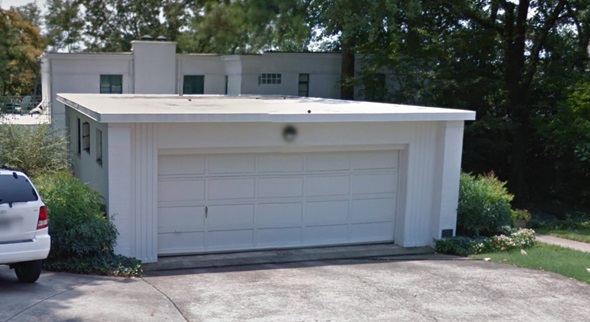
Knoop HouseToday’s historic property is unique for Little Rock.  It is one of the only (if not the only) Art Moderne style residences in Little Rock.

The Knoop House was built in 1936-1937 in Hillcrest for Werner and Faith Knoop. Designed by the architectural firm of Brueggeman, Swaim & Allen, the Art Moderne style of the house departed dramatically from, the mere typical period revival styles of the Hillcrest neighborhood. The Knoop House was (and still is) an outstanding Modernistic architectural statement in an area filled predominantly with English Revival, Colonial Revival, American Four Square, and Bungalow styles.

The house was built by Werner and Faith Knoop in 1936-1937.  In 1948, the original garaged was enlcosed and a new garage was added to the front of the house. Mr. Knoop was a mechanical engineer and founding principal in what is now the Baldwin & Shell Construction Company.  After having served on the school board, in 1957 Mr. Knoop became the first Mayor of Little Rock under the “new” city manager form of government and continued to serve the City on various committees even after his term as Mayor ended. Faith Yingling Knoop was a well-published author of magazine articles, textbooks, and children’s books.

The Knoop House’s simple, restrained detailing is typical of the Art Moderne style, as is the emphasis upon large uninterrupted expanses of smooth wall surface, the preference far a light palette and the selection of such modern materials as metal casement windows and glass block.

The Knoop House was added to the National Register of Historic Places in August 1990.