Heritage Month – Hotze House

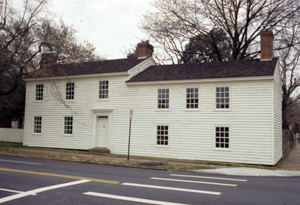
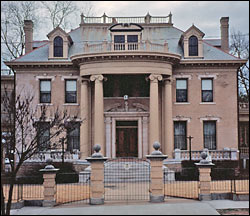
Hotze hosueThe Hotze House, located at 1619 Louisiana in Little Rock’s historic Quapaw Quarter district, was built by one of Arkansas’ most successful and prominent businessmen.  Designed by Charles L. Thompson, Little Rock’s most prominent architect and constructed in 1900, the house reflects the Beaux Arts tradition combined with Georgian influence.  The interior was reputed to have been designed by Tiffany Studios of New York.  The house has been remarkably well preserved and remains practically unaltered.

Peter Hotze was born in Innsbruck, Austria, on October 12, 1836.  He was young at the time of his father’s death, but Mrs. Hotze’s inheritance made it possible for her three sons to attend the University of Innsbruck.  In 1857 Peter Hotze moved to Little Rock and went into the general merchandise business.

Returning to Little Rock after service and imprisonment in the Civil War, Hotze went into a business as a merchant in partnership with Capt. John G. Fletcher, who had been his company commander.  Each man put $2,500 into the business.  After a while, they limited their business exclusively to the cotton trade.  In 1873 it was decided that Hotze should move to New York to handle that end of the firm’s business.  He lived there for 27 years, in a fashionable neighborhood near Central Park.

In 1900, Hotze retired and returned to Little Rock.  Upon his return in 1900 he built the large house in which he lived with his daughter Clara and son Frederick until his death on April 12, 1901.  He chose to build his home directly behind the small frame house he had built about l869 and lived in during his previous residence in Little Rock.

The Hotze House is one of the finer homes remaining in the state which expresses the opulence of the period in which it was constructed, particularly in the interiors, which are extraordinarily rich in quality. Resting on three and one-half lots, the Hotze House is remarkably well preserved and appears practically the same as when it was first constructed.

It was added to the National Register of Historic Places on August 11, 1975.


Heritage Month – Fordyce House

FordyceThe Fordyce House was built in 1904 for Mr. and Mrs John R. Fordyce.  The house was designed architect Charles L. Thompson in an Egyptian Revival style.  The Egyptian Revival style is rarely seen in houses in the United States,  major features of the style include the porch columns resembling bundles of stalks tied together and flared at the top and the “battered” walls that slant inward as they rise.

The Fordyce ‘s lived in the house until 1920 when it was sold to James Shipton who lived in the house until 1950.  The house has remained a single family home through the years.

It was added to the National Register of Historic Places on August 9, 1975.

Heritage Month – Fones House

FonesThe Fones House, located at 902 West Second, has two areas of significance.  Architecturally, the house is a leading example of the Victorian Italianate style, which is rare in Little Rock.  Secondly, the builder, Daniel G. Fones, was a leading Little Rock businessman.

The two and one-half storey Fones House is constructed of red brick.  The exterior features a bracketed frieze topped by a steep gabled roof with wrought iron cresting, decorative window heads in several different styles and ornately railed balconies.

Daniel Gilbert Fones was born in Decatur, Georgia, on August 19, 1837, the eldest son of Alvan T. and Adelia A. Cone Fones.  Though raised in relatively luxurious surroundings, after his father’s death he was apprenticed as a tinsmith at the age of 15.  In 1855, he came to Pine Bluff, and in 1859, moved to Little Rock.  That year, he formed the Fones Brothers’ partnership which would eventually became known as Fones Brothers’ Hardware and existed until 1987.

At the outbreak of the Civil War, Fones enlisted in the Confederate Army; after the war he returned to Little Rock.  He remained a civic leader throughout the rest of his life.  The Fones House was constructed in 1878 for Fones and his wife.

Fones was president of the Fones Brothers’ Hardware Company, President of the Arkansas Building and Loan Association, Vice President of the Equitable Building and Loan Association, President of the German National Bank and was associated with many other financial enterprises.  He served as an alderman in Little Rock and in 1916 was elected to the Little Rock School Board.

Fones married Texanna Dustan Reaves on May 30, 1867, who died in 1893.  In 1899 he was married to Mrs. James Hennegan Tucker.  Fones, who had no descendants, died May 28, 1916.

The Fones House was added to the National Register of Historic Places on August 19, 1975.

Heritage Month – Hinderliter House

HinderliterThe Hinderliter House is the oldest building still in existence in Little Rock.  It is now part of the Historic Arkansas Museum.

The Hinderliter Grog Shop began as a log structure in 1826-27 by Jesse Hinderliter, a man of German descent. It was his home and business, where he lived with his wife and two slaves until his death in 1834. Popular folklore associates the building with the last meeting of the territorial legislature of 1835. Red oak logs and cypress flooring were used in the grog shop’s construction. The clapboard siding and porch were later additions. Inside, the hand-carved federal mantel in the formal dining room shows that style was important, even in a log house on the frontier.

Many modifications were made to the building over the years.  Work to restore it in the late 1930s and again in the late 1960s removed many of these alterations.

The Hinterliter House and other structures on the Historic Arkansas Museum can be toured daily. They are being showcased today (May 9) as part of HAM’s 42nd Annual Territorial Fair.

The Hinderliter House was added to the National Register of Historic Places on March 5, 1970.

42nd Annual Territorial Fair at Historic Arkansas Museum today from 10 to 4

hamlogoHistoric Arkansas Museum will host the 42nd Annual Territorial Fair on Saturday, May 9, from 10 a.m. to 4 p.m. This popular annual event is a fun and free opportunity for adults and children of all ages to experience what life was like during Arkansas’s Territorial era. Living history performances, blacksmith demonstrations, historical dances and pioneer games will be happening on the museum’s historic grounds, a preserved and meticulously recreated section of an early downtown Little Rock neighborhood.

Living historians will portray residents of the museum’s historic block. Visitors can witness a raucous card game in the Hinderliter Grog Shop, Little Rock’s oldest surviving structure (c. 1827), or visit a territorial lawyer for a land deed.  In the Print Shop, “Arkansas Gazette” founder William Woodruff will be looking for apprentices and young visitors are encouraged to apply!

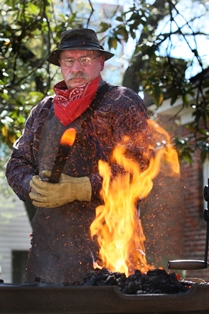
Blacksmith Terr Fair for webHistoric Arkansas Museum’s master bladesmith, Lin Rhea, will provide demonstrations in the Black Smith Shop and visitors can see how cloth was dyed in the Arkansas Territory. Children will have the opportunity to make Mother’s Day cards just in time for Mother’s Day.

The “Early Arkansaw Re-enactors” will interact with guests on the grounds with historically accurate clothing, tools and accessories. The Arkansas Country Dance Society will lead guests in historical dances to tunes that were popular during the territorial era. The Southern Center for Agroecology will be selling a variety of plants and heirloom seeds for Mother’s Day and spring planting. Lunch will be available for purchase from Gammy & Gamp’s “Home Style” Food Truck.

The museum’s seven galleries of Arkansas-made art and artifacts and the Sturgis Children’s Gallery will be open during the Territorial Fair. There is no charge for parking or admission. The Museum Store will be open for Mother’s Day shopping with a variety of unique Arkansas-made gifts and books. From 12 to 2 p.m. in the Museum Store, guests will have the opportunity to meet author Layne Livingston Anderson and buy a signed copy of “Haunted Legends of Arkansasa great book for campfire storytelling.

Currently on exhibit:

  • Suyao Tian: Entangled Beauty
  • Suggin Territory: The Marvelous World of Folklorist Josephine Graham
  • Arkansas Made Gallery
  • We Walk in Two Worlds: The Caddo, Osage and Quapaw in Arkansas (permanent)
  • The Knife Gallery (permanent)

Historic Arkansas Museum is open 9 a.m. – 5 p.m. Monday through Saturday, 1 – 5 p.m. on Sunday. Admission to the galleries and parking are free; admission to the historic grounds is $2.50 for adults, $1 for children under 18, $1.50 for senior citizens. The Historic Arkansas Museum Store is open 10 a.m. – 4:30 p.m. Monday through Saturday, 1 – 4 p.m. on Sunday.

Historic Arkansas Museum is an agency of the Department of Arkansas Heritage, which was created in 1975 to preserve and enhance the heritage of the state of Arkansas. Other agencies of the department are Delta Cultural Center in Helena, Arkansas Arts Council, Arkansas Natural Heritage Commission, Arkansas Historic Preservation Program, Mosaic Templars Cultural Center and Old State House Museum.

May 2nd Friday Art Night features a collaboration between Historic Arkansas Museum and Arkansas Arts Council

It is once again time for 2nd Friday Art Night!  One of the highlights this month is a collaboration between Historic Arkansas Museum and the Arkansas Arts Council.

The Arkansas Arts Council curated exhibition, (Everyday) Interpretations: Cindy Arsaga, Joe Morzuch, and Adam Posnak, opens in the Trinity Gallery  for  Arkansas Artists and the Year of Arkansas Beer continues  with Apple Blossom Brewing Company.


Cindy Arsaga, Joe Morzuch, and Adam Posnak work  in three distinctly different media. Each artist derives inspiration  from everyday experience.
  •  Arsaga, who lives in Fayetteville, uses photography to  capture  images of daily experience and employs a  process of layering encaustic (hot wax) pigment on  her photographs.
  •  Morzuch, who lives in Bono, captures beauty in the  most mundane objects to create dancing color and  light with oil paint on canvas.
  •  Posnak, who lives in West Fork, makes terracotta pottery,  the decoration of which reflects an interest in various  traditional systems of belief, particularly those of  West Africa and the African Diaspora.

For the “Year of Arkansas Beer” this month HAM is featuring Apple Blossom Brewing Company.  

  • Hazy Morning Coffee Stout made with Arsaga’s Coffee – This beer was gently aged on thirty pounds of an Arabica blend roasted by Arsaga’s Coffee Roasters in Fayetteville. Strong notes of coffee in the nose with hints of floral and citrus from the use of American hops. Medium bodied beer  with medium notes of oats and malted barley, and a dominant flavor of coffee.
  •  Armstrong APA – ABBC’s flagship ale features caramel, dried fruit, and nut malt notes with heavy  American citrus hops. Their favorite  blend of India Pale Ale and Strong  American Pale Ale styles.


There will be live music by David Bise, Sam Ellis & Drew Morse of The Cons of Formant.

It all takes place from 5pm to 8pm at Historic Arkansas Museum.

Historic Arkansas Museum and the Arkansas Arts Council are agencies of the Department of Arkansas Heritage.

Heritage Month – Corydon Wassell House

Corydon WassellThe Corydon Wassell House is a one-and-one-half story wood framed Victorian cottage.. The 1882 house is located at 2005 South Scott Street, outside both the Governor’s Mansion and MacArthur Park Historic Districts. There are quite a few Victorian cottages in the vicinity, but it was added to the National Register of Historic Places on June 2, 2000, in recognition of it being the birthplace and residence of Dr. Corydon Wassell.

Born in Little Rock on July 4, 1884, Corydon McAlmont Wassell (called “Cory”) was born to Albert and Leona Wassell. A grandson of Little Rock Mayor John Wassell, he graduated from what is now UAMS in 1909. In 1911, he married Mary Irene Yarnell, with whom he would have four children.  In 1914, the couple volunteered to be Episcopal missionaries in China.  He served there until 1927. Following Mary’s death and his remarriage, he and new wife Madeline Edith Day Wassell returned to Arkansas in 1927.

Dr. Wassell resumed his medical practice. Given his experience with malaria in China, he proved to be an asset fighting malaria among Civilian Conservation Corps members in Arkansas. He was subsequently called to active duty in the Navy in 1936 and stationed in Key West.

After the outbreak of World War II, he was stationed in Indonesia. In early 1942, he refused to abandon his patients after the Japanese started invading Indonesia. Instead, he was able to evacuate a dozen severly wounded men over 150 miles to get to a ship. It took ten days for the ship to get to Australia, during which time it was attacked numerous times.  His official Navy Cross citation notes that he disregarded personal safety while caring for others.

He became an instant international hero. During the early days of the war, his heroism was one of the few bright spots. James Hilton wrote a biography of him; President Roosevelt praised him in a fireside chat; Cecil B. DeMille filmed a movie with Gary Cooper playing him.

Dr. Wassell’s first cousin, Sam Wassell, was serving on the Little Rock City Council at the time. He would later serve as Little Rock Mayor.

After retiring from the navy with the rank of rear admiral, Dr. Wassell worked for a time without pay at a charity hospital in Hawaii. He eventually returned to Key West, Florida. Later, he returned to Arkansas to be near family. He died on May 12, 1958, in Little Rock at the age of seventy-four. He is buried at Arlington National Cemetery.