
Little Rock Look Back: Wilbur D. Mills

While later known more as a punchline due to personal fallibilities, for decades Wilbur D. Mills was one of the most powerful men in the world.  As the chair of the House Ways and Means Committee from 1958 to 1975, he was the architect not only of an overhaul of the tax code, but also determined ways to finance Medicare, Medicaid, and many other federal programs of the Eisenhower, Kennedy, Johnson, Nixon and Ford years.

Wilbur Daigh Mills was born in Kensett on May 24, 1909.  When Mills went to Congress at the age of 29, he was the youngest man elected to that time.  A scant four years later he joined the Ways and Means Committee.

Because Mills rarely had an opponent (only 1942, 1966, and 1974), he was able to focus on learning the ins and outs of the tax code. As long as he delivered some federal dollars to his largely rural district every so often, he did not have to preoccupy himself with the daily issues many in Congress face.  It was not until 1963, when Arkansas lost two of its six congressional seats, that Mills had Little Rock in his district. Prior to that, Searcy had been the largest city he represented.  (There had been concern that Rep. Dale Alford, who had upset incumbent Brooks Hays in 1958 before losing his seat due to reapportionment four years later might challenge Mills. But Alford opted to retire instead of taking on the powerful Mills.)

President Kennedy’s visit to Little Rock and Greers Ferry in October 1963 was the result of bargaining with Congressman Mills over some tax policy.  Mills gave in to JFK a bit, and JFK agreed to come to Arkansas to speak in Little Rock and at the dedication of two dams.  In recognition of his national clout, Mills was briefly considered a contender for the 1972 Democratic nomination for President.

Though he probably struggled with alcoholism for years, he had been able to keep his behavior in check until 1974 when his car was stopped in Washington DC for not having its headlights on. Though Mills was not driving, he was inebriated.  Another occupant of the car, a stripper with the stage name Fanne Fox ran from the car and frolicked in the Tidal Basin.  It became fodder for worldwide headlines.

The incident happened about a month before Election Day, when Mills was facing Republican Judy Petty.  A contrite Mills spent the remaining days in the campaign in Arkansas and won re-election by 59% of the vote.  (Though later in November, he again was in the headlines when Fox pulled him on stage with her at a club in Boston.) In January 1975, he stepped down as Ways and Means Chair.

In 1976, he opted to retire from Congress and did not seek another term.  In retirement, he practiced law in Washington DC before eventually moving back to Kensett full-time.  He died in 1992.
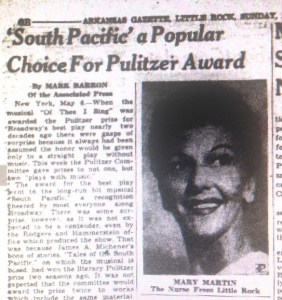
Little Rock Look Back: Pulitzer Prize to SOUTH PACIFIC

On May 5, 1950, the Rodgers and Hammerstein musical South Pacific captured the Pulitzer Prize in Drama. This would receive special attention in the Arkansas Gazette. The reason this carried such weight in Arkansas was that the musical had a connection to Little Rock.

The 1950 Pulitzer for Drama went to a musical, for only the second time in the history of the awards. The recipient was South Pacific by Richard Rodgers, Oscar Hammerstein II and Joshua Logan. The character was the leading lady of Nellie Forbush. She was an Navy ensign and a nurse stationed on an exotic island during World War II. The musical was based on a Pulitzer Prize winning novel, James Michener’s Tales of the South Pacific.

In the Michener novel, Miss Forbush is not from Little Rock. She is actually from a small town in Alabama. But the book does mention Nellie and her mother visiting Little Rock.  The part was written for Mary Martin from Weatherford, Texas. Rodgers, Hammerstein & Logan did not discuss why they relocated Nellie’s birthplace.

Originally the musical contained a song entitled “My Girl Back Home” in which Nellie sang of being from “Little Rock, A-R-K” while another character sang of being from “Philadelphia, P-A” and “Princeton, N-J.” It is possible the change to Little Rock was made because it offered more lyrical possibilities, but that is only a supposition on the part of the Culture Vulture. That song did appear in the movie version in which Mitzi Gaynor played Nellie Forbush. It was also featured in the 2008 Broadway revival, this time with Kelli O’Hara playing Nellie.

In the musical, Nellie struggles with her own prejudices. This issue of prejudice became an instance of fact meeting fiction. In 1957, a few weeks after Eisenhower sent troops into Little Rock to ensure that Central High would be desegregated, a production of South Pacific on Long Island was temporarily halted when the audience booed and yelled after Nellie mentioned she was from Little Rock. Interestingly, the movie was released in 1958, but retained references to Little Rock. That was either a testament to the expense of re-editing it, or the fact that audience reaction had lessened.

Little Rock Look Back: Birth of a General

On January 26, 1880, Douglas MacArthur was born in the Arsenal Building while his father was stationed at the Little Rock Barracks.  Though he left Arkansas a few weeks later when his father was transferred, he returned to his birthplace on March 23, 1952. On that day he was greeted by crowds welcoming one of the USA’s most famous military figures.

Though Gen. MacArthur spent only a few weeks in Little Rock, he was baptized at Christ Episcopal Church.  The location of the baptism remains a mystery today because the church was meeting in temporary locations due to the first structure having been lost to a fire.

When the General returned to Little Rock in 1952, he did pay a brief visit to Christ Church.  He also spoke at the Foster Bandshell in the park which bore his name.  He was one of three presidential candidates to speak at the Foster Bandshell in 1952, the others were the eventual Democratic and Republican nominees Adlai Stevenson and Dwight Eisenhower.

When General MacArthur died, he was granted a state funeral.  He was one of the few non-Presidents to have been given this honor.

Today, the MacArthur Museum of Arkansas Military History is located in the Arsenal building.  It was created to interpret our state’s military heritage from its territorial period to the present.

Located in the historic Tower Building of the Little Rock Arsenal–the birthplace of General Douglas MacArthur–the museum preserves the contributions of Arkansas men and women who served in the armed forces.

Exhibits feature artifacts, photographs, weapons, documents, uniforms and other military items that vividly portray Arkansas’s military history at home and abroad.

JFK in LR and other parts of ARK

JFK LROn October 3, 1963, President John F. Kennedy delivered remarks at the Arkansas State Fairgrounds.  Only a few weeks later, he would be felled by an assassins bullet in Texas.

In the speech, the President praised Arkansas’ congressional delegation including Senators John McClellan and J. William Fulbright and Congressmen Took Gathings, Bill Trimble, Wilbur Mills and Oren Harris.  Each of these men held senior leadership positions in key committees.  The main focus of the speech was to discuss President Kennedy’s vision for a new economy in the South.

The President was actually in the state to speak at the dedication of the Greers Ferry Dam. He agreed to make that appearance as a part of a negotiation with Congressman Mills as they were deadlocked over changes to the tax code.  He had previously visited Little Rock in 1957 when he came to the state to address the Arkansas Bar Association meeting in Hot Springs.

President Kennedy continued the string of 20th Century Presidents to visit Little Rock.  Presidents Theodore Roosevelt, William Howard Taft, Franklin Roosevelt and Harry Truman had all visited while in office.  Woodrow Wilson, Herbert Hoover and Dwight Eisenhower all visited prior to attaining the presidency.

Little Rock Look Back: Sixty Years of the Little Rock Nine

Sixty years ago today the Little Rock Nine entered Central High School and stayed. On one hand, this brought to the end a nearly month long standoff between segregationists and those who wanted to obey the U.S. Supreme Court’s Brown v. Board decision.
In the bigger picture, the struggle did not end that day.  Throughout the remainder of the school year, the Little Rock Nine were subjected to threats, isolation and hostility.  Outside of the school, while the crowds may had dispersed after September 25, the raw feelings did not subside.

This was evidenced by the fact that the following year the high schools were closed to avoid having them integrated.

But September 25, 1957, was an historic day in the United States. Under guard of members of the 101st Airborne Division of the Army, the Little Rock Nine were escorted into Central High School. This action by President Dwight Eisenhower was the result of the intrusive efforts of Governor Orval Faubus who had used the Arkansas National Guard to keep the nine students out.

The City of Little Rock was largely a bystander in this issue. The form of government was changing from Mayor-Council to City Manager in November 1957. Therefore Mayor Woodrow Mann and the entire City Council were lame ducks. Mann, whose son was a senior at Central, tried to focus on keeping the peace in Little Rock. Most (if not all) of his Council members sided with the Governor.

Congressman Brooks Hays, a Little Rock resident, had tried to broker an agreement between the President and the Governor but was unsuccessful.  Following that, Mayor Mann was in discussions with the White House about the ability of the Little Rock Police Department to maintain order.  Finally, in the interest of public safety, the President federalized the National Guard and removed them. This paved the way for the Army to come in.

Though the school year was not easy, the nine youths who became known worldwide as the Little Rock Nine were finally in school.  They were Minnijean Brown, Elizabeth Eckford, Ernest Green, Thelma Mothershed, Melba Pattillo, Gloria Ray, Terrence Roberts, Jefferson Thomas and Carlotta Walls.

In 1997, President Bill Clinton, Governor Mike Huckabee and Mayor Jim Dailey, famously held open the doors of Central High for the Little Rock Nine on the 40th anniversary.  Ten years later, Clinton, Huckabee and Dailey returned joined by Governor Mike Beebe and Mayor Mark Stodola to host the 50th anniversary events.

Today, President Clinton was once again at Central.  This time he was joined by Governor Asa Hutchinson and Mayor Stodola.  Two people who have played parts in organizing all three of these commemorations are City Manager Bruce T. Moore and Central High Principal Nancy Rousseau.  Others, such as Skip Rutherford and Annie Abrams have participated in all three commemorations.

In light of its role in history, the school is a National Historic Site, while still functioning as a high school.

Little Rock Look Back: Ike sends troops to Little Rock

On September 24, 1957, President Dwight Eisenhower ordered the 101st Airborne to Little Rock to ensure that the Little Rock Nine would be able to enter Central High School.

In a thirteen minute televised White House address to the nation, President Eisenhower stated he had acted to prevent “mob rule.”  The President made his decision about the troops while vacationing in Rhode Island. But he flew to Washington DC to deliver the address from the White House. In his remarks, he stated that he felt it was important to discuss this action from the house of Lincoln.

Following the President’s noontime decision, 1,000 members of the 101st Airborne Division were flown to Little Rock.  In addition, all 10,000 members of the Arkansas National Guard were “federalized.”

Earlier in the day, Little Rock Mayor Woodrow Mann had pleaded with the President and US Attorney General for federal intervention.  He stated that the Little Rock police could not quell the crowds alone.

Little Rock Look Back: Little Rock Nine in Central for a few hours

centralentranceOn Monday, September 23, 1957, the Little Rock Nine entered Central High School for a few hours.

The previous Friday, Federal District Judge Ronald Davies ruled that Governor Faubus had used the National Guard to keep the Little Rock Nine out of the school.  At this point, the Governor withdrew the troops.  The duty of maintaining any order on the site and ensuring the safety of the students now fell solely on the Little Rock Police Department.

To minimize interactions with aggressive protestors who were outside of the school, the Nine were escorted into the side of the school.  Word quickly spread that they had made it into the building.  This caused the 1,000 or more people out front to become more hostile.

Threats were called into the building. Some parents of white children called wanting to get their students out of the building.  Some students snuck out of the building, while at the same time some of the crowd were trying to sneak in.  The situation was tense and getting more so by the minute.

Little Rock Mayor Woodrow Mann and police leadership were concerned about the ability of the City to protect the Nine and maintain order.  The Fire Department refused to use water from a firehose to disperse the crowd.

For the safety of the Little Rock Nine the students were removed from the building after having been in it only a few hours.