RobinsoNovember: Senator Joseph Taylor Robinson

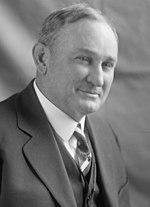
150px-joseph_t-_robinson_croppedThis month, Robinson Center Music Hall will reopen after a two year renovation/restoration/remodeling/reconstruction.  To commemorate that, each day in November, the Culture Vulture will look at a person or event connected to Robinson Center Music Hall.

Up first, the eponym for the building.

Senator Joseph Taylor Robinson was born in Lonoke in 1872.  In 1894 Robinson was elected to the Arkansas General Assembly for one term.  From 1903 until 1913, he served in the US House of Representatives as a Congressman from Arkansas’ then-Sixth District.

He chose not to seek another term in Congress and ran for Governor in 1912.  On January 3, 1913, sitting US Senator Jeff Davis died in office.  Robinson was sworn in as Governor on January 16, 1913. Twelve days later he was chosen by the Arkansas General Assembly to become the next US Senator. He became the final US Senator to be selected by a legislator instead of popular vote.  At the time, Senate terms started in March, so Robinson served as governor until March 8, 1913.

He rose through the ranks of the Senate and eventually became the first person to hold the title of Senate Majority Leader.  In 1928, he was the Vice Presidential nominee for the Democratic Party.  Four years later, he rode with Franklin and Eleanor Roosevelt to the inauguration ceremonies before FDR took the oath.  He would be President Roosevelt’s go-to man on legislative issues.


Senator Robinson died in Washington D.C. on July 14, 1937.  His wife was in Little Rock making preparations for a trip the couple was to take. Following his demise, Mrs. Robinson went to Washington to accompany her husband’s body back to Arkansas.

The Senator was honored with a memorial service in the Senate chambers on Friday, July 17.  President Roosevelt and the cabinet joined members of the senate on the floor in what was described as a state funeral without pomp.  Mrs. Robinson sat with her brothers and two nephews as well as Bernard Baruch and Arkansas Power & Light’s Harvey Couch, who were Senator Robinson’s closest friends.  Eleanor Roosevelt was one of the many crowded in the senate galleries observing the service.  Following the service his body remained in the chambers until it was transferred to a train to make the journey to Little Rock.

The funeral train bore his body, his family, 50 senators and over twenty congressmen. It reached Little Rock around 8am on Sunday the 19th.  From there, Senator Robinson’s body was taken to his house on Broadway Street until noon.  It subsequently lay in state at the Arkansas State Capitol until being escorted by military to First Methodist Church.

As the funeral procession reached Roselawn Cemetery, thunder echoed. The skies which had alternated between sun and rain that day, returned to rain. A deluge greeted the end of the service and sent visitors hurrying for shelter at the end.

It was not until December 1937, that Senator Robinson’s name became attached to the municipal auditorium which Little Rock voters had approved in January 1937.

Arkansas Heritage Month – LR Mayor Overman and a municipal auditorium

Overman AuditR. E. Overman assumed the office of Little Rock mayor in April 1935. Around that time, a new wave of New Deal programs were filtering down from Washington DC to cities.  It can be said of Mayor Overman that he did not meet a New Deal program he did not like.  From rebuilding the sewer system, to creating a public water utility, to constructing of structures for the Museum of Fine Arts, Little Rock Zoo, and Boyle Park, Mayor Overman signed the City up for program after program.

While the programs were all worthwhile, and in some cases absolute necessities, Mayor Overman did not seem to consider how these massive projects running concurrently would impact the City finances.  In November 1935, he submitted a proposal to the Public Works Administration for the construction of a new municipal auditorium to be located at the northeast corner of the intersection of Scott Street and Capitol Avenue. It would have taken up three/quarters of that block and wrapped around the Women’s City Club building (now the Junior League of Little Rock headquarters).  Because of other projects in the works, he did not pursue any further action on the auditorium project at the time.

In November 1936, Mayor Overman asked the City Council to place three bond issues on a special election ballot for January 1937, one of which was a municipal auditorium. Though a location had previously been identified in 1935, at this point in time supporters made a concerted effort to disclose that no location had been selected.  After the election was called, there was a concerted effort by supporters of the three separate bond issues to collaborate.  Voters overwhelmingly approved all three issues, and Little Rock’s journey to a municipal auditorium at last was underway. Perhaps.

Over the summer, architects and lawyers were selected. In the autumn, a consultant was hired to help with the selection for the site.  The month of October was consumed with City Council battles over the auditorium site.  Mayor Overman favored a location at Markham and Spring Streets (now site of the Cromwell Building and the Bankruptcy Courthouse). Because the Federal Government owned half the site and did not want to sell it, that location was deemed not feasible – though that did not stop Mayor Overman and others from repeatedly citing it as their first choice.  The only person who favored the location at Markham and Broadway did not have a vote: Planning Commission Chair J. N. Heiskell. Though he had no vote, he had the twin bully pulpits of Planning Commission and the Arkansas Gazette. As other sites fell by the wayside, he kept advocating for it.  Finally, the City Council approved of Heiskell’s choice, and the auditorium had a site.

The groundbreaking had to take place by January 1, 1938, or the money would be rescinded. After finalizing a location, planning could get underway.  With a week to spare, the ground was broken on December 24, 1937.  Mrs. Joseph T. Robinson, widow of the recently deceased US Senator from Arkansas, joined Mayor Overman in the groundbreaking. This ceremony was the first mention of the building being named in memory of the fallen senator, who had died in the summer of 1937.

Construction progressed throughout 1938 and into 1939.  Because of the precarious state of the City’s finances, Mayor Overman lost the support of the business community.  In November 1938, he lost his bid for the Democratic nomination for Mayor and was denied a third two-year term.  He left office in April 1939.

Little Rock Look Back: Senator Joseph T. Robinson Funeral at Little Rock First Methodist

Senator Joseph Taylor Robinson

Today, Arkansas political icon and longtime United States Senator Dale Bumpers is being remembered in a memorial service at Little Rock’s First United Methodist Church.

On another Sunday afternoon, this time in July 1937, another United States Senator and former Arkansas Governor was also remembered in a service in the same church.  That man was Joseph Taylor Robinson.

Unlike Senator Bumpers, Senator Robinson died in office. Both men, however, shared many of the same qualities. Both were recognized as leaders within their parties and within the Senate. Both were counselors to Presidents. Senator Robinson was usually President Franklin Roosevelt’s point person to shepherd legislation on Capitol Hill.  Senator Bumpers worked closely with Presidents Carter and Clinton.  Both men flirted with national politics. Robinson was the Vice Presidential nominee of the Democratic Party in 1928. Bumpers seriously contemplated a run for the White House on more than one occasion.

It seems fitting that Senator Bumpers would be memorialized at a place of worship which had also been the site of the final rites for another Arkansas lion of the Senate.

Senator Robinson died in Washington D.C. on July 14, 1937.  His wife was in Little Rock making preparations for a trip the couple was to take. Following his demise, Mrs. Robinson went to Washington to accompany her husband’s body back to Arkansas.

The Senator was honored with a memorial service in the Senate chambers on Friday, July 17.  President Roosevelt and the cabinet joined members of the senate on the floor in what was described as a state funeral without pomp.  Mrs. Robinson sat with her brothers and two nephews as well as Bernard Baruch and Arkansas Power & Light’s Harvey Couch, who were Senator Robinson’s closest friends.  Eleanor Roosevelt was one of the many crowded in the senate galleries observing the service.  Following the service his body remained in the chambers until it was transferred to a train to make the journey to Little Rock.

The funeral train bore his body, his family, 50 senators and over twenty congressmen. It reached Little Rock around 8am on Sunday the 19th.  From there, Senator Robinson’s body was taken to his house on Broadway Street until noon.  It subsequently lay in state at the Arkansas State Capitol until being escorted by military to First Methodist Church.

1,500 people packed the church a half hour before the service began. The sun shone through the windows onto the flag-draped coffin as Rev. H. Bascom Watts led the service. Among the pallbearers was former Vice President Charles G. Dawes. Governor Carl Bailey of Arkansas was joined by Governors Richard Leche of Louisiana and E.W. Marland of Oklahoma.

As the funeral procession reached Roselawn Cemetery, thunder echoed. The skies which had alternated between sun and rain that day, returned to rain. A deluge greeted the end of the service and sent visitors hurrying for shelter at the end.


Heritage Month – Joseph T. Robinson House

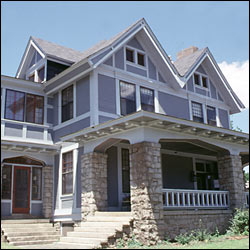
JT Robinson HouseThe Robinson House or the Foster-Robinson House is located at 2122 Broadway.

It was designed by Frank W. Gibb and built in 1904 for lumber man H. H. Foster.  Senator Robinson purchased the home from Foster’s widow and the house remained in the Robinson family until 1972 (following the Senator’s death in 1937 and his widow’s death in 1958). While visiting the state, President Roosevelt stayed at this house.

The Robinson house is a 2-1/2 story wood frame structure resting on a foundation of granite and brick. The exterior is sheathed in clapboards, and the roof is steeply pitched with a complex and irregular plan. There are four chimneys, two of brick and two of granite and brick. The main facade consists of a full-width porch supported by three square granite posts, above which are two pairs of sash windows, topped by a pair of gable ends, each with two small square windows. The gable ends are finished in stucco with decorative half-timbering. The porch is decorated with flattened Tudor-style arches and ornamental brackets, and shelters the main entrance, which is under the right gable, and paired windows under the left gable.

The interior has a wealth of high-quality woodwork, made using some of the choicest and most unusual cuts available at the time.

In addition to the house, the property includes a carriage house built using the same methods as the house. The yard is enclosed by an iron fence on the south and east sides, and a rock wall on the north and west sides.

It was listed in the National Register of Historic Places on March 28, 1975.  On October 12, 1994, it was designated a National Historic Landmark.

Last Week to see First Ladies Gowns

OSH GownsThe Old State House Museum’s First Ladies’ Gown collection, which contains over 120 years of inaugural gowns worn by Arkansas’s First Ladies, will temporarily close to the public on September 8, 2014, so the gowns can be assessed for conservation needs. The last day to see the collection before the assessment is September 7, 2014.

“The Arkansas First Ladies Gowns at the Old State House Museum are, through the years, our most popular artifacts,” said Bill Gatewood, director of the Old State House Museum. ”Our responsibility to preserve the gowns yet make them accessible to the public creates a very challenging situation.  The Museum staff’s decision to begin conservation of the gowns exhibit must balance both considerations.”

During routine assessments this summer, Old State House Museum staff began noticing deterioration of many gowns. Two gowns were immediately removed from display for conservation, and internal discussion began about the futures of every gown. The decision was made to quickly move to have the gowns assessed.

“During a routine survey of artifacts on exhibit I noticed signs of stress on certain gowns in our First Ladies gowns exhibit,” said Jo Ellen Maack, curator at the Old State House Museum. “Upon closer inspection I determined a conservator specializing in textiles should examine the collection. My goal is to create a prioritized list of conservation needs for gowns in the exhibit. Once these needs have been identified, treatment will begin. The challenge is to do this while keeping as much of the exhibit as possible open to the public.”

The assessment will take place at the Old State House Museum beginning September 8 and the exhibit will be closed during this process. The collection will be examined by Textile Conservation Services and handled by Harold Mailand, who first examined the gowns in 1983. Mailand will examine the condition of each gown and work with the professional staff at the Old State House Museum to create a preservation strategy, and may include immediate removal of some gowns from display. The exhibit will then re-open. At a later date, more gowns may be removed from exhibit at the Old State House Museum to an off-site location to make changes in casework and lighting in the exhibit. The exhibit would be closed for several months if the Museum feels it necessary to make those upgrades..

“Even though the physical gowns may not be on permanent display at the Old State House Museum, we’re committed to providing access to information, photos and educational programs about the gowns through the Web, our publications, and any emerging media that becomes available” Gatewood said.

The First Ladies’ Gowns collection was the first exhibit to showcase Arkansas history at the Old State House Museum, debuting in 1955. The oldest gown in the collection is from 1889 and belonged to Mary Kavanaugh Oldham Eagle, the wife of Arkansas’s 16th Governor James Philip Eagle. The collection contains 30 inaugural dresses, including four from former Arkansas First Lady and United States Secretary of State Hillary Clinton. Currently, visitors to the Museum are able to view all 30 gowns, minus the two removed earlier this year, belonging to Elizabeth Little and Ewilda Robinson. After the assessment, the ability for visitors to view all the gowns at once may change.

The First Ladies’ Gowns collection is just one of many collections the Old State House Museum is tasked with maintaining and preserving. Other textile collections curated by the Museum include Civil War flags and quilts sewn by black Arkansans.  The Old State House Museum will provide updates about the gowns on social media including Facebook, Twitter and e-mail lists.

About the Old State House Museum

The Old State House Museum is a museum of the Department of Arkansas Heritage and shares the goal of all seven Department of Arkansas Heritage agencies, that of preserving and enhancing the heritage of the state of Arkansas. The agencies are Arkansas Arts Council, Arkansas Historic Preservation Program, Arkansas Natural Heritage Commission, Delta Cultural Center in Helena, Historic Arkansas Museum, Mosaic Templars Cultural Center, and the Old State House Museum.