
Little Rock Look Back: Orval Eugene Faubus

FaubusOrval_fOn January 7, 1910, one of the most controversial figures in Arkansas history was born: future Governor Orval Eugene Faubus.

Faubus is today remembered for his role fighting for the continued segregation of the Little Rock public schools.  Raised in a socialist family, his staunch embrace of segregation was a surprise to many who viewed him as more of a moderate on the issue.  At the time, and later, it was viewed as more of an opportunistic move to head off a political challenge from segregationists such as Jim Johnson.  However, throughout the rest of his lifetime, as others such as George Wallace would recant and repent, Faubus continued to maintain he was “merely” upholding the law of the land (the Supreme Court striking down the law a few years earlier, notwithstanding).

Interestingly, Faubus was also known for hiring African Americans in state government for more than menial tasks. He worked to increase funding to historically black colleges and universities in Arkansas. He fought to abolish the predatory poll tax.

His segregation efforts curtailed Arkansas’ business recruitment for a few years in the late 50s and early 60s.  But a few years earlier, in 1955 Faubus had created the Arkansas Industrial Development Commission and appointed Winthrop Rockefeller to lead it.  He also increased teacher pay, overhauled the State Hospital, created the Arkansas Children’s Colony, expanded state parks, and stopped the Army Corps of Engineers from damming the Buffalo River.

In late 1965, by executive order, he created the Arkansas Arts and Humanities Council and funded it with his discretionary funds until the legislature would appropriate money in 1967. He also oversaw the creation of the state’s historic preservation program.

Certainly his efforts to flout federal law have tarnished his image. Looking at his accomplishments in the areas of industry, education reform and culture – one wonders what he could have accomplished if he had exerted even more efforts in those areas instead of fighting Eisenhower.  It is all moot, because he did not.  And the reality is that, yes had he supported Eisenhower, he might well have lost in 1958 to someone like Jim Johnson who would have continued fighting for segregation even more vehemently and would have been unlikely to champion these other issues.
Ramifications of Nixon’s Win in 1968 is topic of Clinton School Program today at noon

The 1968 general election was pivotal in the future of the U.S.  While locally it saw Arkansas voters re-electing GOP Governor Winthrop Rockefeller & Democratic Senator J. William Fulbright while tossing their electoral votes for independent (and segregationist) George Wallace, on the national scale the election of Richard M. Nixon set the tone for a new type of political partisanship.  Though the long-reaching outcomes of that election were not really apparent at the time.  The narrative in 1968 was more about Nixon’s career redemption, but it was also about the rise of the GOP in the formerly solidly Democratic South.

Michael Nelson, author of Resilient America: Electing Nixon in 1968, Channeling Dissent, and Dividing Government, will discuss his book at the Clinton School today at 12 noon.

Nelson is the Fulmer Professor of Political Science at Rhodes College, a Fellow of Southern Methodist University’s Center for Presidential History, and a Senior Fellow at the University of Virginia’s Miller Center. He is the author of numerous books, including “How the South Joined the Gambling Nation: The Politics of State Policy Innovation,” with John L. Mason, winner of the 2009 V. O. Key Award for Outstanding Book on Southern Politics from the Southern Political Science Association. His new book, “Resilient America,” explores how urban riots and the Tet Offensive, the assassinations of Martin Luther King, Jr. and Robert F. Kennedy, the politics of outrage and race—all pointed to a reordering of party coalitions, of groups and regions, a hardening and widening of an ideological divide—and to the historical importance of the 1968 election as a watershed event.

With all the talk recently about the 40th anniversary of Nixon’s resignation, this talk will present an interesting take on the set-up to Nixon’s first term.  In addition, as both the GOP and Democrats have their eyes on Arkansas’ political future, Nelson’s book sets the stage for the seeds being sown of the rise of the two party system in the South.

Reserve your seats by emailing publicprograms@clintonschool.uasys.edu or calling (501) 683-5239.

LRFF’s Reel Civil Rights Film Festival concludes with – Beyond Galilee – Central Park Five – George Wallace: Settin’ the Woods on Fire

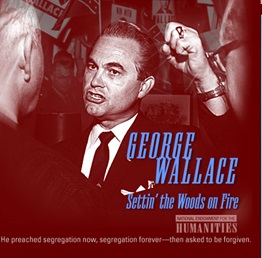
GeoWallaceThe Little Rock Film Festival’s Reel Civil Rights Film Festival concludes today with three different films. The concluding one is George Wallace: Settin’ the Woods on Fire at Historic Arkansas Museum at 6pm.

George Wallace was one of the most controversial and conflicting figures of the second half of the 20th Century in America.  Four times governor of Alabama, four times a candidate for president, he was feared as a racist demagogue and admired as a politician who spoke his mind. A lightning rod for controversy, Wallace both reflected and provoked tensions in American society over more than four decades. This film traces the rise of the firebrand politician from his roots in rural Alabama to the assassination attempt that suddenly transformed him.

Winner of the Sundance 2000 Film Festival Special Jury Prize, “George Wallace: Settin’ the Woods on Fire” is produced by Paul Stekler and Dan McCabe and written by Steve Fayer (“Eyes on the Prize,” “Vote for Me,” “Rock & Roll,” “Nixon”). According to PBS, this film places the public and private George Wallace within the turbulent history of the 1960s and 1970s, tracing a powerful story relevant to today’s presidential politics.

The first film of the day is Beyond Galilee at 12 noon.  It is the story of the Civil Rights movement in Shreveport.  Following the film, director and producer Tim DeWayne will lead a talkback.

At 3pm, the documentary Central Park Five will be shown.  It explores the 1989 case of five black and Latino teenagers who were wrongfully convicted of raping a white woman in Central Park.  Social justice activist Iris Roley will lead a discussion following the film.