Heritage Month – Villa Marre

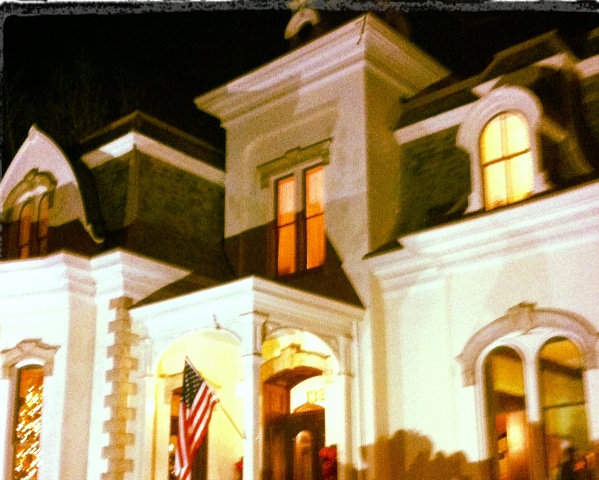
villamarreThe Villa Marre is located at 1321 Scott Street. The Second Empire-style Villa Marre was built in 1881 by Italian immigrant and Little Rock saloonkeeper Angelo Marre, who also served on the Little Rock City Council.

The distinctive home features a mansard roof covered in patterned slate, a central tower topped by wrought-iron cresting, and hood molding above the doors and windows. Marre died in 1889, and his widow, Jennie, remained in the house until about 1900. Arkansas Governor Jeff Davis rented the house for a few years, and in 1905, the home was purchased by E. B. Kinsworthy, former state senator and attorney general of Arkansas.

It is probably most famous today for being the outdoor exterior of Sugarbakers design firm in the CBS sitcom “Designing Women.”  For several years, it was the home of the Quapaw Quarter Association. It later returned to a private residence.  Currently it is a venue for weddings and other events.

It was added to the National Register of Historic Places on June 15, 1970.

On Pulitzer Day – Prizing Mount Holly

The Pulitzer Prizes are to be announced today.  Mount Holly Cemetery not only touts that it is the site of a whole host of elected officials, it is also the only place in Arkansas where two Pulitzer Prize recipients are buried. The cemetery is open every day, but a special visit to these two prize winner gravesites can be made next Sunday during the Mount Holly Cemetery Association’s annual “Rest in Perpetuity” fundraiser picnic.

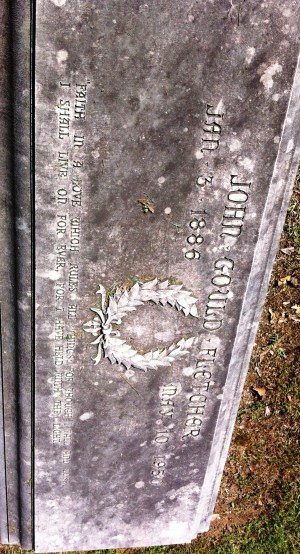
In 1939, John Gould Fletcher became the first Southern poet to win the Pulitzer Prize for Poetry.  He was born into a prominent Little Rock family in 1886.  Fletcher was awarded the prize for his collection Selected Poems which was published by Farrar in 1938.  Two years earlier, he had been commissioned by the Arkansas Gazette to compose an epic poem about the history of Arkansas in conjunction with the state’s centennial.

Fletcher is buried next to his wife, author Charlie May Simon and his parents (his father was former Little Rock Mayor John Gould Fletcher).  Other relatives are buried nearby in the cemetery.

The other Pulitzer Prize winner buried in Mount Holly is J. N. Heiskell, the longtime editor of the Arkansas Gazette.  It was Heiskell, in fact, who asked Fletcher to compose the poem about Arkansas.  Heiskell served as editor of the Gazette from 1902 through 1972.  He died at the age of 100 in 1972.

Under his leadership, the Gazette earned two Pulitzer Prizes for its coverage of the 1957 desegregation of Little Rock Central High.  One was for Harry Ashmore’s editorial writing and the other was for Public Service.

Heiskell remained in charge of the Gazette until his death in 1972.  He is buried alongside his wife with other relatives nearby.  Also not too far from Mr. Heiskell are two of his nemeses, proving that death and cemeteries can be the great equalizer. In the early days of his Gazette stewardship, he often locked horns with Senator (and former Governor) Jeff Davis. Later in Mr. Heiskell’s career, he vehemently disagreed with Dr. Dale Alford, who had been elected to Congress on a segregationist platform.

Visit Veterans at Mount Holly Cemetery this Veterans’ Day

MountHolly Memorial Day

Today is Veterans’ Day – a time to pay tribute to the men and women in uniform who have served their country in the military.

As a way to give this recognition, today would be a good day to visit a cemetery. One of Little Rock’s most storied cemeteries is Mount Holly Cemetery. There are veterans from all wars: Revolutionary, War of 1812, Mexican, Civil War, Spanish-American, World War I and II, Korean, Vietnam and Desert Storm.

Founded in 1843, Mount Holly has been called “The Westminster Abbey of Arkansas.” Thousands of visitors come each year. Those interested in history come to see the resting places of the territorial citizens of the state, including governors, senators, generals, black artisans, and even a Cherokee princess. For others the cemetery is an open air museum of artistic eras: Classical, Victorian, Art Deco, Modern––expressed in gravestone styles from simple to elaborate. Some come to read the epitaphs that range from heartbreaking to humorous to mysterious.

Though a City of Little Rock facility, the cemetery is maintained by the Mount Holly Cemetery Association, a non-profit organization with a volunteer Board of Directors. The cemetery is located at 1200 South Broadway in Little Rock. Gates are open from 8 a.m. until 5 p.m. in the summer and from 8 a.m. until 4 p.m. in the winter.

Interred within the rock walls of Mount Holly are 11 state governors, 15 state Supreme Court justices, four Confederate generals, seven United States senators and 22 Little Rock mayors, two Pulitzer Prize recipients, as well as doctors, attorneys, prominent families and military heroes.  Proving that death is the great equalizer (and the J. N. Heiskell lived a very long time) longtime Gazette owner and publisher J. N. Heiskell is buried near two different nemeses: Senator, Governor and demagogue Jeff Davis; and segregationist Congressman Dr. Dale Alford.

Little Rock Look Back: J. N. Heiskell

At the age of 87, J. N. Heiskell in 1960.

At the age of 87, J. N. Heiskell in 1960.

John Netherland (J. N.) Heiskell served as editor of the Arkansas Gazette for more than seventy years.

He was born on November 2, 1872, in Rogersville, Tennessee, to Carrick White Heiskell and Eliza Ayre Netherland Heiskell. He entered the University of Tennessee at Knoxville before his eighteenth birthday and graduated in three years at the head of his class on June 7, 1893.

His early journalism career included jobs with newspapers in Knoxville and Memphis and with the Associated Press in Chicago and Louisville. On June 17, 1902, Heiskell’s family bought controlling interest in the Arkansas Gazette. Heiskell became the editor, and his brother, Fred, became managing editor.

Governor George Donaghey appointed Heiskell to succeed Jeff Davis in the United States Senate after Davis’s death in office. Heiskell served from January 6, 1913, until January 29, 1913, when a successor was elected.

On June 28, 1910, Heiskell married Wilhelmina Mann, daughter of the nationally prominent architect, George R. Mann. The couple had four children: Elizabeth, Louise, John N. Jr., and Carrick.

In 1907, he joined a successful effort to build the city’s first public library. He served on the library board from that year until his death and was issued the first library card.  He also served on the City’s Planning Commission for decades.

In 1912, he was instrumental in bringing John Nolen to Little Rock to devise a park plan. Heiskell was also largely responsible for the location of Robinson Auditorium. When City Council members had competing locations, he advocated for the corner of Markham and Broadway. And kept at it until the site was selected.

In the paper and in his own personal opinions, he crusaded on a variety of progressive causes.  Perhaps the most famous was the Gazette’s stance in the 1957 Central High desegregation crisis.  It was for this effort that the paper received two Pulitzer Prizes.

Although Heiskell stopped going to the office at age ninety-nine, he continued to take an active interest in the newspaper. He began by having a copy of the newspaper delivered to his home by messenger as soon as it came off the press each night. Eventually, he switched to having his secretary call him daily at his home and read the entire newspaper to him. He operated on the premise that “anyone who runs a newspaper needs to know what’s in it, even to the classified ads.”

A few weeks after turning 100, Heiskell died of congestive heart failure brought on by arteriosclerosis on December 28, 1972. He is buried in Little Rock’s Mount Holly Cemetery.  Interestingly, he is buried in the same cemetery as two of his most notable adversaries: Governor Jeff Davis, and segregationist Congressman Dale Alford.

Little Rock Look Back: TR in LR

TheodoreRooseveltOn October 25, 1905, President Teddy Roosevelt, recently elected to a four year term in his own right, made an appearance in Little Rock.

He was greeted at the train station by Governor Jeff Davis and was the guest of honor in a parade up Main Street to City Park (now MacArthur Park) in where a public meeting was held featuring remarks by the President.  During this remarks, speaking to a largely Democratic crowd, the Republican Roosevelt noted: “The candidate is the candidate of a party; but if the president is worth his salt he is the president of the whole people.”

According to media reports at the time, Main Street from Markham to Tenth was a solid mass of cheering spectators for the parade.  This was the first time a sitting President had spent time in Little Rock away from a train station. The only other incumbent President to visit had been Benjamin Harrison.

He would make three more visits to Arkansas.  In 1910, he spoke at the Arkansas State Fair in Hot Springs.  In April and September 1912, he made several campaign stops in the state as he was running to reclaim the presidency, this time heading the Progressive (or Bull Moose) ticket.  Though Roosevelt’s successor, William Howard Taft, would visit briefly once in office and once after leaving office, it would not be until Roosevelt’s cousin Franklin Delano Roosevelt visited in 1936 that another sitting President spent much time in the state after TR’s 1905 visit.

A Prized Cemetery – Mount Holly on Pulitzer Day

The Pulitzer Prizes are to be announced today.  Mount Holly Cemetery not only touts that it is the site of a whole host of elected officials, it is also the only place in Arkansas where two Pulitzer Prize recipients are buried.

In 1939, John Gould Fletcher became the first Southern poet to win the Pulitzer Prize for Poetry.  He was born into a prominent Little Rock family in 1886.  Fletcher was awarded the prize for his collection Selected Poems which was published by Farrar in 1938.  Two years earlier, he had been commissioned by the Arkansas Gazette to compose an epic poem about the history of Arkansas in conjunction with the state’s centennial.

Fletcher is buried next to his wife, author Charlie May Simon and his parents (his father was former Little Rock Mayor John Gould Fletcher).  Other relatives are buried nearby in the cemetery.

The other Pulitzer Prize winner buried in Mount Holly is J. N. Heiskell, the longtime editor of the Arkansas Gazette.  It was Heiskell, in fact, who asked Fletcher to compose the poem about Arkansas.  Heiskell served as editor of the Gazette from 1902 through 1972.  He died at the age of 100 in 1972.

Under his leadership, the Gazette earned two Pulitzer Prizes for its coverage of the 1957 desegregation of Little Rock Central High.  One was for Harry Ashmore’s editorial writing and the other was for Public Service.

Heiskell remained in charge of the Gazette until his death in 1972.  He is buried alongside his wife with other relatives nearby.  Also not too far from Mr. Heiskell are two of his nemeses, proving that death and cemeteries can be the great equalizer. In the early days of his Gazette stewardship, he often locked horns with Senator (and former Governor) Jeff Davis. Later in Mr. Heiskell’s career, he vehemently disagreed with Dr. Dale Alford, who had been elected to Congress on a segregationist platform.

Sandwiching in History: Villa Marre

villamarreToday at 12 noon, the Arkansas Historic Preservation Program’s monthly “Sandwiching in History” program will visit the Villa Marre.

The Villa Marre is located at 1321 Scott Street. The Second Empire-style Villa Marre was built in 1881 by Italian immigrant and Little Rock saloonkeeper Angelo Marre, who also served on the Little Rock City Council.
The distinctive home features a mansard roof covered in patterned slate, a central tower topped by wrought-iron cresting, and hood molding above the doors and windows. Marre died in 1889, and his widow, Jennie, remained in the house until about 1900. Arkansas Governor Jeff Davis rented the house for a few years, and in 1905, the home was purchased by E. B. Kinsworthy, former state senator and attorney general of Arkansas.

It is probably most famous today for being the outdoor exterior of Sugarbakers design firm in the CBS sitcom “Designing Women.”  For several years, it was the home of the Quapaw Quarter Association. It later returned to a private residence.  Currently it is a rentable venue for weddings and other events.

The “Sandwiching In History” program is a series of tours that seeks to familiarize people who live and work in central Arkansas with the historic structures and sites around us. The tours take place on Fridays at noon, last less than an hour, and participants are encouraged to bring their lunches so that they can eat while listening to a brief lecture about the property and its history before proceeding on a short tour. A representative from the property is encouraged to attend also and address the group.

The tours are organized by the Arkansas Historic Preservation Program, an agency of the Department of Arkansas Heritage. All tours are free and open to the public.