Little Rock Look Back: Mayor Woodrow W. Mann

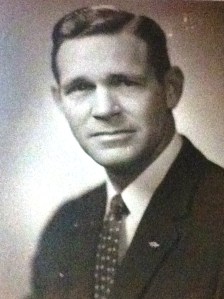
IMG_3231Future Little Rock Mayor Woodrow Wilson Mann was born on November 13, 1916, in Little Rock.  His tenure at Little Rock mayor was tumultuous from both things of his doing as well as events that catapulted him onto the international scene.

In 1955, he ran as the Democratic nominee for Mayor of Little Rock and defeated two term incumbent Pratt C. Remmel, a Republican.  He took office in January 1956 and immediately set about to make a lot of changes.  In addition to revitalizing the City’s bus system, and removing some color barriers at City Hall, he oversaw the dismantling of the copper dome on top of Little Rock City Hall (as opposed to the repair of the dome championed by Mayor Remmel).

Mayor Mann was caught up in a grand jury investigation into purchasing practices at City Hall as well as within the City government in North Little Rock.  Partially in response to this, Little Rock voters approved a new form of government in late 1956.  Mayor Mann opposed the switch to the City Manager form and refused to set the election for the new officials but was ultimately compelled to do so.

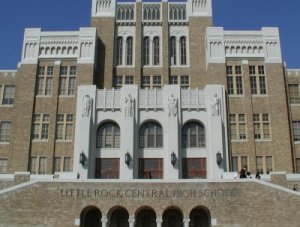
He was also Mayor during the 1957 integration of Little Rock Central High School.  He sought to keep the peace and to broker a deal between President Dwight Eisenhower and Governor Orval Faubus.  His powers within the city were, no doubt, hampered because of his lame duck status as Mayor.  In November 1957 following the election of the new City Board of Directors, he chaired his last City Council meeting and left office.

In January of 1958, a series of articles written by Mayor Mann detailed his perspective on the events at Central High. These were carried by newspapers throughout the US.

Because of ill will toward him due to the Central High crisis (he was criticized by both sides) and grand jury investigation, Mayor Mann felt it would be difficult to maintain his insurance business in Little Rock. He moved to Texas in 1959 and remained there the rest of his life.  He died in Houston on August 6, 2002.

An entry about Mayor Mann in the Encyclopedia of Arkansas History and Culture can be found here.

Little Rock Look Back: Little Rock announced as Clinton Library site

Refuse on the site where the Clinton Center would be built

On November 7, 1997, President Bill Clinton announced his intentions to locate his presidential library in Little Rock at the end of a warehouse district.

The Little Rock City Board met in a special meeting that day to rename part of Markham Street, which would lead to the site, as President Clinton Avenue.

While the announcement was met with excitement in many quarters, there were still some skeptics who had a hard time envisioning a presidential library and park in the middle of a wasteland worthy of a T. S. Eliot poem.

There would be many hurdles between the November 1997 announcement to the December 2001 groundbreaking. But for the moment, City of Little Rock leaders, celebrated the achievement.  Then Mayor Jim Dailey had appointed City Director Dean Kumpuris and City employee Bruce T. Moore to lead the City’s efforts.  Moore and Kumpuris worked with Skip Rutherford and others to narrow the potential sites.

In September 1997, the Clintons were in town for the 40th anniversary of the integration of Central High School.  They surprised Kumpuris and Moore with a decision for a Sunday afternoon visit to the warehouse district proposed site. Secret Service would not let the limousine drive in part of the property, so the Clintons, Moore, Kumpuris, and Rutherford walked up a path to the roof of the abandoned Arkansas Book Depository.  It was there that the Clintons could see the Little Rock skyline which would be visible from the library.

Of course by the time the library had opened in November 2004, the Little Rock skyline was different. Spurred on by the library, several new highrises had been constructed in downtown.

Little Rock Look Back: Mr. J. N. Heiskell

At the age of 87, J. N. Heiskell in 1960.

John Netherland (J. N.) Heiskell served as editor of the Arkansas Gazette for more than seventy years.  He was usually called “Mr. Heiskell” by all, but a very few confidantes felt confident to call him “Ned.”

Mr. Heiskell is the person most responsible for Robinson Center Music Hall being located at the corner of Markham and Broadway.  As Chair of the Planning Commission and editor of the Arkansas Gazette he had twin bully pulpits to promote this location when those on the City Council (who actually had the final say) were looking at other locations.  He felt the location would help create a cluster of public buildings with its proximity to the county courthouse and to City Hall.  Mr. Heiskell finally succeeded in winning over the mayor and aldermen to his viewpoint.

He was born on November 2, 1872, in Rogersville, Tennessee, to Carrick White Heiskell and Eliza Ayre Netherland Heiskell. He entered the University of Tennessee at Knoxville before his eighteenth birthday and graduated in three years at the head of his class on June 7, 1893.

His early journalism career included jobs with newspapers in Knoxville and Memphis and with the Associated Press in Chicago and Louisville. On June 17, 1902, Heiskell’s family bought controlling interest in the Arkansas Gazette. Heiskell became the editor, and his brother, Fred, became managing editor.

Governor George Donaghey appointed Heiskell to succeed Jeff Davis in the United States Senate after Davis’s death in office. Heiskell served from January 6, 1913, until January 29, 1913, when a successor was chosen by the Arkansas General Assembly.  His tenure is the shortest in the U. S. Senate history.  His first speech on the Senate floor was his farewell.  He was also only the second US Senator to live to be 100.

On June 28, 1910, Heiskell married Wilhelmina Mann, daughter of the nationally prominent architect, George R. Mann. The couple had four children: Elizabeth, Louise, John N. Jr., and Carrick.

In 1907, he joined a successful effort to build the city’s first public library. He served on the library board from that year until his death and was issued the first library card.  He also served on the City’s Planning Commission for decades.  In 1912, he was instrumental in bringing John Nolen to Little Rock to devise a park plan.

In the paper and in his own personal opinions, he crusaded on a variety of progressive causes.  Perhaps the most famous was the Gazette’s stance in the 1957 Central High desegregation crisis.  It was for this effort that the paper received two Pulitzer Prizes.

Although Heiskell stopped going to the office at age ninety-nine, he continued to take an active interest in the newspaper. He began by having a copy of the newspaper delivered to his home by messenger as soon as it came off the press each night. Eventually, he switched to having his secretary call him daily at his home and read the entire newspaper to him. He operated on the premise that “anyone who runs a newspaper needs to know what’s in it, even to the classified ads.”

A few weeks after turning 100, Heiskell died of congestive heart failure brought on by arteriosclerosis on December 28, 1972. He is buried in Little Rock’s Mount Holly Cemetery.  Interestingly, he is buried in the same cemetery as two of his most notable adversaries: Governor Jeff Davis, and segregationist Congressman Dale Alford.

Mr. Heiskell donated his vast papers to UALR. They are part of the Arkansas Studies Institute collection. These papers give insight into not only his career as a journalist, but also his political and civic affairs.  Thankfully he saved much of his paperwork. Without it, much insight into Little Rock in the 20th Century would be lost.

Little Rock Look Back: Dedication of LR High School Auditorium

On October 31, 1927, a recital took place in the auditorium of the new Little Rock High School which served as a dedication ceremony for the new high school auditorium.  The school had been serving students for several weeks by the time the recital took place.  The first day of school was Wednesday, September 14, 1927.

The star of the recital was Mary Lewis, a Little Rock High School graduate (from the previous location on Scott Street) who had made her Metropolitan Opera debut and become a toast of New York City.

The evening started with remarks from former Arkansas Governor Charles Brough, who had made a name for himself as an advocate for education before, during and after his stint in the statehouse.  He was followed by Miss Lewis, who sang over a dozen arias and musical selections.  For her first encore, Miss Lewis sang “Dixie.”  Her second encore was supposed to be “Home Sweet Home.”  After several attempts to sing it, she was so overcome with emotion that she had to abandon the effort.

For more on the opening event, read Jay Jennings’ excellent book Carry the Rock: Race, Football, and the Soul of an American City.

The 1927 schoolbuilding replaced one built in 1905 at 14th and Scott Streets (with an auditorium completed a few years later at 14th and Cumberland).  This new building was located in the western edges of Little Rock on what had been city parkland.  The former West End Park was now site to Little Rock High School.  The adjoining Kavanaugh Field was a baseball field on which Earl Quigley’s football Tigers also played their games.

Architects John Parks Almand, Lawson L. Delony, George R. Mann, Eugene John Stern, and George H. Wittenberg (virtually all of Little Rock’s full-time working architects at the time) designed the $1.5 million structure, which the New York Times dubbed the most expensive school ever built in the United States at that time.

Featuring a combination of Collegiate Gothic and Art Deco architecture, Central High spans two city blocks, comprising over 150,000 square feet of floor space, upon its completion. Requiring 36 million pounds of concrete and 370 tons of steel, the finished product consisted of 100 classrooms (accommodating over 1,800 students), a fireproof 2,000-seat auditorium, a gymnasium, and a greenhouse.

The six-story structure (counting the bell tower and basement) features a middle section containing the auditorium with four classroom wings (two per side) flanking a reflection pool in the foreground of the building. Faced with brick, the building’s highlights include pilasters and colonnades of cut stone, double-hung window frames with twelve lights per sash, and a main entry terrace supported by a colonnade of five masonry arches rising above Corinthian columns of stone.

Little Rock Look Back: Hogs vs. Ole Miss in Little Rock

It appears that the first meeting of the Arkansas Razorbacks and Ole Miss Rebels in Little Rock was in 1913. That would have been at Kavanaugh Field (now the site of Quigley Stadium on the campus of Little Rock Central High School).

On November 15, 1913, the two squads faced off in only the second gridiron match between the schools. The Razorbacks were on the losing end of a 21 to 10 score.

The next year, on November 14, 1914, the two teams again met in Little Rock. Because of the use of an ineligible player by Ole Miss, the Razorbacks count this as a victory by a score of 1 to 0 due to a forfeit.  Ole Miss, to this day, disputes that fact and counts it as a 13 to 7 win over the Hogs.  Due to the dispute, the teams would not meet again until 1924.

On October 25, 1924, the Hogs and Rebels resumed their football face off and returned to Little Rock.  That day, the Razorbacks (under third year coach Francis Schmidt) dominated Ole Miss by a score of 20 to 0.  This would be the final time the two teams would meet in Little Rock for over two decades.  Most of their games would be in Memphis during the intervening years.

The series returned to Little Rock on October 25, 1952.  This would be the first time the two teams would meet in War Memorial Stadium. It was in the final of Otis Douglas’ three unremarkable seasons as coach of the team.  The score reflected the disappointments of his tenure as the Razorbacks managed only 7 points to Ole Miss’s 34.

When the Hogs returned to War Memorial two years later to face Ole Miss (October 23, 1954), both teams were nationally ranked. Arkansas was number 7 and Ole Miss was number 5.  The result was a 6-0 upset of Ole Miss on a 66-yard touchdown pass from Bob Benson to Preston Carpenter known to Razorback fans as the “Powder River Play.” After the season, coach Bowden Wyatt left to coach at his alma mater, Tennessee.

In his three seasons as coach, Jack Mitchell led the Razorbacks against Ole Miss in Little Rock only once. But that single entry on October 27, 1956, was a Hog victory. Ole Miss was again held scoreless while the Hogs ended the game with fourteen points. Prior to the game, Ole Miss had been undefeated. (The Razorbacks also would hand the Rebels their first defeat of the season the following year in Jackson.)

On October 25, 1958, first year coach Frank Broyles would lead his Razorbacks into Little Rock to face 6th ranked Ole Miss. It was Broyles’s second appearance in Little Rock following a 12 to zero defeat by Baylor in his inaugural Hogs game. While the Razorbacks lost the game to Ole Miss by a score of 14 to 12, it was in this game that a Broyles-led team scored its first points in Little Rock.

October 22, 1960, saw Broyles and the Hogs return to Little Rock to face Ole Miss.  This time both teams were nationally ranked. Arkansas was 14 and Ole Miss was 2.  After a defensive slugfest, Ole Miss escaped with a 10 to 7 win over the Hogs.  Though Arkansas lost, they actually rose in the national polls to number 12 the following week.

It would be over twenty years before the two teams would again play each other in Little Rock.  On September 25, 1982, the 9th ranked Razorbacks met the unranked Rebels.  This would be coach Lou Holtz’s penultimate season as head coach for the Hogs, though no one knew it at the time. (Except possibly athletic director Frank Broyles.)  The team that season was captained by Gary Anderson, Jessie Clark, Richard Richardson, and Billy Ray Smith.  Arkansas escaped with a 14 to 12 victory. Perhaps because of the closeness of the game, the team fell to number 10 for the following week.

Ken Hatfield’s first game as Hogs head coach was in Little Rock against Ole Miss.  The date was September 15, 1984.  The outcome of the game was a tie.  Both sides scored fourteen points. His other two Little Rock entries that first season would be wins (Texas Tech 24-0, Rice 28-6).

Two years later (September 13, 1986), Hatfield’s Hogs again started the season in Little Rock against Ole Miss. This time Arkansas was ranked 18 while Mississippi was unranked.  The Hogs team (captained by James Shibest, Derrick Thomas, and Theo Young) dominated Ole Miss and ended the game with a final score of 21 to 0.

September 17, 1988 was the next time the two teams met in Little Rock.  That year Hatfield’s team was captained by Steve Atwater, John Bland, Odis Lloyd, and Kerry Owens.  Both teams were unranked for this game.  The Hogs again scored 21 points, but this time Ole Miss scored 13.  While not as convincing a win as two years prior, it was still a victory for the Hogs.

In 1990, new head coach Jack Crowe led the Razorbacks to War Memorial to face Ole Miss.  The Hogs were ranked 13 while Ole Miss was unranked.  Arkansas lost by a score of 21 to 17. The team would fall ten spots in the polls and be out of the polls for the remainder of the season shortly thereafter.

Interim head coach Joe Kines did not have much better luck against Ole Miss in Little Rock.  On October 17, 1992, the two teams met for the first time at War Memorial Stadium as conference foes. This was the first season after the Hogs had made the jump to the SEC.  Ole Miss left win a 17 to 3 win.

With the conference switch, the scheduling of Hogs vs. Rebels games entered a new phase. For the next twenty years the teams would alternate between Fayetteville and Oxford MS for games.  Hogs coaches Danny Ford, Houston Nutt, and Bobby Petrino never coached a Razorback team against Ole Miss in Little Rock.  (Though all coached plenty of games against Ole Miss and in Little Rock.)

When the 2012 season was announced, it looked like Bobby Petrino would coach the Hogs against Ole Miss in Little Rock. However due to an off-season incident, by the time the October 27, 2012, game came around, the Razorbacks were coached by John L. Smith.  In what would be his only season leading the team, Arkansas lost the Little Rock game to Ole Miss by a score of 30 to 27.  That is the most recent meeting of the teams in Little Rock until 2018.

Over all the Razorbacks lead the series against the Rebels by a tally of 36 to 27 to 1.  In Little Rock, the record is 7 wins, 7 losses, and 1 tie.

Little Rock Look Back: Gail Davis

Gail Davis is best known as TV’s Annie Oakley.  She was born Betty Jeanne Grayson on October 5, 1925. Her mother was a homemaker and her father, W. B. Grayson, was a physician in McGehee (Desha County), which did not have a hospital, so her birth took place in Little Rock (Pulaski County).

When her father became the state health officer, the family moved from McGehee to Little Rock, where Grayson attended Little Rock High School. Grayson rode horses and was a tomboy growing up. Grayson also held various beauty titles in high school and college, and she sang and danced in local shows from the time she was eight.

While studying dramatics at the University of Texas in Austin, she married Robert Davis in 1945, with whom she had a daughter, Terrie (the couple divorced in 1952). After World War II, they moved to Hollywood, where she worked as a hatcheck girl until being discovered by an agent who obtained an MGM screen test for her. She was signed to a contract, with her first appearance in 1947’s The Romance of Rosy Ridge, starring Van Johnson.

She worked steadily in movies, including fourteen films with Gene Autry in the late 1940s and early 1950s. He was impressed with her, changed her name to Gail Davis, and cast her as the star of the Annie Oakley TV show, which he produced. The show ran for eighty-one episodes from 1954 through 1956.

After her TV series ended, she appeared as Annie Oakley in the 1959 film Alias Jesse James starring Bob Hope. In that film, she appears in an uncredited role along with such other stars, also uncredited, as Gary Cooper, Bing Crosby, Roy Rogers, James Garner (as Bret Maverick), and Fess Parker (as Davy Crockett).

Her television appearances include guest roles on The Lone Ranger, The Gene Autry Show, The Cisco Kid, and Death Valley Days, as well as a 1961 episode of the Andy Griffith Show (Episode 37, “The Perfect Female”), her final appearance as a performer and in which she demonstrated her trademark sharpshooting.

Gail toured with Gene Autry’s Wild West show and made appearances as herself on TV programs such as Wide, Wide World: “The Western” (1958) with fellow Arkansan Ben Piazza. For her work in television, she was awarded a star on the Hollywood Walk of Fame, located at 6385 Hollywood Boulevard, and in 2004, she was inducted posthumously into the National Cowgirl Hall of Fame.

Gail Davis died of cancer in Los Angeles on March 15, 1997, and is buried in Hollywood’s Forest Lawn cemetery.  In 2007, she was posthumously inducted into the Arkansas Entertainer’s Hall of Fame.  In 2016, a room was named in her memory at the newly renovated Robinson Center.

Little Rock Look Back: First Dance at Robinson Auditorium

In October 1939, it looked as if Robinson Auditorium would never open.  The construction had run out of money.  But in an effort to generate a little revenue and give the public the chance to see the building, a few events were booked in the lower level.

At the time, the entrance to the lower level was off of Garland Street which ran to the north of the structure.

While Mayor J. V. Satterfield and other leaders were in Washington seeking additional funding, the Joseph Taylor Robinson Memorial Auditorium hosted its first event.  On October 4, 1939, the convention hall on the lower level was the site of a preview dance.  The pecan block flooring had been installed just the week before.

RC-dance-orchestraThe first four people to enter the building as paying guests were Mr. and Mrs. Alfred Wilheim, Frances Frazier and Bill Christian.  Reports estimated 3,200 people attended and danced to the music of Jan Garber and His Orchestra.

By happenstance, Garber and his musicians had also played in Little Rock on January 26, 1937, the date of the election which approved the auditorium bonds.  Since Little Rock then did not have a suitable space, that appearance had been on the stage of the high school auditorium.

The dance was a success.  But as the building had no heating or cooling mechanism at the time, there were limits as to how long even the lower level could be in use.  After a few weeks, the PWA, which was still in charge of the construction site, halted all future bookings.