Pulitzer plays Little Rock – YOU CAN’T TAKE IT WITH YOU at LR Central High

George S. Kaufman and Moss Hart’s screwball You Can’t Take It with You is one of the rare comedies to with the Pulitzer Prize for Drama.  This long-running play from the 1930s almost immediately became popular for stock, community, college and high school theatrical troupes.

In April 1980, Little Rock Central High School presented You Can’t Take It With You in one of many times the play has been performed in Little Rock.

Directed by Cheryl Shull with assistance from student director Kim Magee, the cast of nineteen included Mike Breedlove, Teri Thomas, Elizabeth Cobb, Jimmy Jarratt, Murry Newbern, Scott Thomas, Tammy Sellers, Susan Russell, Kevin Baer, Achim Gullatz, and Arnel Joiner.

Roosevelt Thompson as the eccentric Mr. Dipinna in the 1980 Central High production of YOU CAN’T TAKE IT WITH YOU

Also of note in the cast was Roosevelt Thompson, after whom the Central High School auditorium is now named.  (It was also sadly the site of his all-too-soon memorial service in 1984.)


Pulitzers play Little Rock – OF THEE I SING

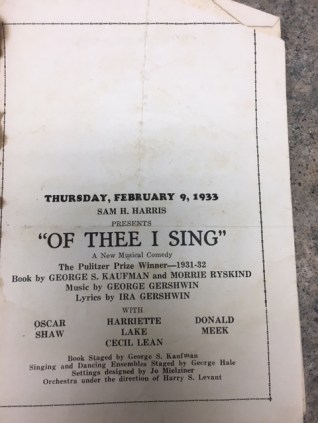
OfTheeISingBefore Robinson Auditorium opened, the stage of Little Rock High School (now Central High) was the prime performance location in Little Rock.  In 1933, it welcomed the national tour of the Pulitzer Prize winning musical Of Thee I Sing.

This was the first musical to win the Pulitzer Prize for Drama.  In fact, because no musical had won the award before, the jury appeared to not know how to handle a composer in a writing category.  Librettists Morris Ryskind and George S. Kaufman and lyricist Ira Gershwin were named as recipients. But composer George Gershwin did not receive the Pulitzer.  (In 1998, he received a posthumous Special Pulitzer.)

The musical, a satire of politics and popular culture, was directed by Mr. Kaufman.  The tour came to Little Rock for one performance on February 9, 1933. The Broadway production had closed less than a month earlier after 441 performances (a very long run at the time).

The tour starred Oscar Shaw (who had played the male lead in the original production of the Gershwins’ Oh Kay!) and Harriette Lake.  She would later change her name to Ann Sothern.  Other main roles were played by Donald Meek and Cecil Lean.   A few months after Little Rock, the tour played a month on Broadway.  Miss Lake continued in her role, but the men were replaced by their original Broadway counterparts.

2018 marks the 100th anniversary of the first Pulitzer Prize for Drama being given. To pay tribute to 100 years of the Pulitzer for Drama, each day this month a different Little Rock production of a Pulitzer Prize winning play will be highlighted.  Many of these titles have been produced numerous times.  This look will veer from high school to national tours in an attempt to give a glimpse into Little Rock’s breadth and depth of theatrical history.

Little Rock Look Back: Werner C. Knoop

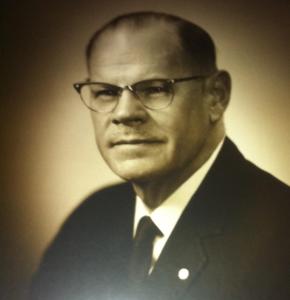
To Little Rock citizens under a certain age, the name Knoop means Knoop Park — a picturesque park tucked away in a pocket of Hillcrest.  There are, however, still many who remember Werner C. Knoop as a business and political leader who helped shape Little Rock as a modern city.

Knoop was born on March 30, 1902.

In 1946, Knoop joined with Olen A. Cates and P. W. Baldwin to form Baldwin Construction Company in Little Rock.  Knoop had previously founded Capital Steel Company and established his business reputation there.  From 1945 through 1951, he served on the Little Rock School Board.

Following a series of political scandals, efforts were undertaken for Little Rock to shift from Mayor-Council to City Manager form of government.  Even before the desegregation of Little Rock Central put the city in the eyes of the world, an election for new leaders had been set for November 1957.  Knoop was on a “Good Government” slate and was one of the members elected.

At the first meeting of the new City Board, Werner C. Knoop was chosen by his fellow directors to serve as Little Rock Mayor.  Knoop served as Mayor until December 1962.  For the first several months in office, Little Rock had no City Manager so Knoop oversaw the transition of City staff as the forms of government changed.

Though City Hall generally stayed out of school district matters, that did not mean that the public viewed the two entities separately.  In September 1959, the Baldwin Construction offices were bombed as part of a series of terrorist activities protesting the desegregated reopening of all Little Rock high schools.

Downtown LR as viewed from Knoop Park

Downtown LR as viewed from Knoop Park

After two terms on the City Board, Knoop decided against seeking a third term.  He concluded his elected public service on December 31, 1962.  Following his time on the City Board, Knoop did not retire from Civic Affairs.  In 1970, he served as Chairman of the Little Rock Chamber of Commerce.   The previous year he served as President of the Arkansas Chapter of Associated General Contractors.

Mayor Knoop died in July 1983.  He is buried at Roselawn Memorial Park next to his wife Faith Yingling Knoop, a renowned author.

In the 1930s, Knoop moved into an Art Moderne house on Ozark Point in Hillcrest.  It was adjacent to Little Rock Waterworks property which was developed around the same time.  Eventually much of the land was deeded to the City for creation of a park.  In 1989, it was named in tribute to long-time neighbor Knoop in honor of his lifetime of service to Little Rock.

LR Women Making History – Nancy Rousseau

Though not a graduate of Little Rock Central High School, Nancy Rousseau is a Central High Tiger through and through.
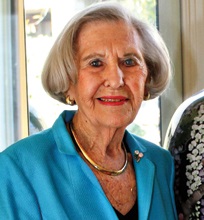
She has been principal of Little Rock Central High School since the summer of 2002. Born in New York, she graduated high school in Tenafly, New Jersey.  After attending Ohio University, she graduated from Adelphi University with a degree in English education.  Her first job was teaching in Port Washington, NY, where she won the “New Teacher of the Year” award.  After teaching in Midwest City, Oklahoma, she arrived in Little Rock in 1976.

From 1976 until 1986, she taught English at Pulaski Academy.  After receiving her master’s degree in educational administration from the University of Arkansas at Little Rock, she was hired by the Little Rock School District as an Assistant Principal at Central High School.  From 1991 until 1998, she served in that capacity. During that time, she worked on the planning for the 40th anniversary of the integration of Central High by the Little Rock Nine.

In 1998, she became principal of Pulaski Heights Junior High School.  She led the school’s transition from a junior high to a middle school.  When the position of Central High School principal became open in 2002, she applied for the job.

Since returning to Central as its principal, Mrs. Rousseau has been a very visible champion of the school, its students, faculty and alumni.  She served as co-chair for the Central High Integration 50th Anniversary Commission.  During her tenure, the school’s physical plant has been upgrade and much of the historic façade and interior has been restored.  A Central High Alumni Association and a Tiger Foundation have been formed.  Through their effort, the arts, academics and athletics have been enhanced.

Mrs. Rousseau also participated in the planning for the 60th anniversary of the school’s integration.  She is one of a very few who worked on the 40th, 50th and 60th anniversaries.

LR Women Making History – Jeane Hamilton

Photo taken for SOIREE

Jeane Hamilton has nurtured the Arkansas Arts Center for over 60 years.  She was present at the genesis of it and has remained so.  In 2007, she was awarded the Arkansas Arts Council’s Lifetime Achievement Governor’s Arts Award.

Arriving in Little Rock a young wife in 1952, she immediately set about to become involved in her new community as she and her husband James set up a household.  In the mid-1950s, the Junior League of Little Rock tapped her to chair the initiative to create a new art museum for Little Rock.  The two decades old Museum of Fine Arts was threadbare through years of neglect and unfocused programming and collecting.

Hamilton, along with Junior League President Carrie Remmel Dickinson and Vice President Martha McHaney, approached Winthrop Rockefeller (then a relatively new resident) to lead the fundraising effort for the new museum.  He agreed on a few conditions: one was that a base amount had to be raised in Little Rock first, and second that the museum would be for the entire State of Arkansas and not just Little Rock.

Hamilton and her colleagues set about to raise the funds. They raised $645,000 at the same time Little Rock’s business climate was stymied by the aftereffects of the Central High crisis.

Now a lifetime honorary member of the Arkansas Arts Center Board, Hamilton has spent much of her life working on Arkansas Arts Center projects since that visit in 1959.  She has served on the Board, chaired committees, chaired special events, served hot dogs, helped kids paint and danced the night away at countless fundraisers.  She was on the committee which hired Townsend Wolfe as executive director and chief curator.  Jeane has led art tours for the Arts Center to a number of countries over the years.

When she is not at the Arts Center, she is often seen at the Rep, the Symphony or any number of other cultural institutions.  While she enjoys seeing old friends at these events, she also loves to see a room full of strangers – because that means that new people have become engaged in the cultural life of Little Rock.

Little Rock Look Back: Sen. William Marmaduke Kavanaugh

On March 3, 1866, William Marmaduke Kavanaugh was born in Alabama. He later moved with his family to Kentucky before coming to Little Rock as a newspaper reporter.

Kavanaugh served as editor and manager of the Arkansas Gazette before entering politics.  From 1896 until 1900, he served as Pulaski County Sheriff, which at the time also included the duties of tax collector.  From 1900 until 1904, he was County Judge of Pulaski County.  In that capacity he helped wrangle several cities, railroads and trolley lines to create a compromise which lead to the completion of the Third Street Viaduct which connected Little Rock with Pulaski Heights. It is still in use today.

After leaving his post as County Judge, he had a varied career in banking and business interests.

When Senator Jeff Davis died in early January 1913, he left the last few weeks of his term incomplete as well as the new term he was set to start in March 1913.  There was much interest in who would fill the remainder of Davis’ current term, because that person might be the frontrunner to also fill out the new term.  (This was at the time that the U.S. Senators were still selected by state legislatures.) Defeated Governor George Donaghey appointed J. N. Heiskell to fill out the term. But once the Arkansas General Assembly convened in mid-January, they overrode Donaghey’s appointment and replaced Heiskell with Kavanaugh.

Kavanaugh served in the Senate from January 29, 1913 until March 3, 1913.  He was succeeded by Joseph T. Robinson who had only recently taken office as Governor.  Speculation was that Kavanaugh would not want the full six year term, so that he was acceptable choice to all of the politicians jockeying for the full appointment.  From 1912 until 1915, he was an Arkansas member of the Democratic National Committee.

Another interest of Kavanaugh’s was baseball.  He served as president of the Southern Association minor league starting in 1903.  The baseball field in Little Rock situated at West End Park was named Kavanaugh Field in his honor.  It stood until the 1930s when it was replaced by what is now known as Quigley Stadium.  (In 1927, Little Rock High School had opened on the land which had been West End Park.)

Kavanaugh died on February 2, 1915 at the age of 48.  He is buried in Oakland Cemetery.

Prospect Road was renamed Kavanaugh Boulevard in his memory.

LR Women Making History: Dr. Sybil Jordan Hampton

Dr. Sybil Jordan Hampton made history as the first African American student to attend each high school year at and graduate from Little Rock Central High School.  But her impact on history exceeds that and extends into classrooms throughout Arkansas.

After a career which took her from elementary classrooms to corporate boardrooms, Dr. Hampton returned to Little Rock in 1996 to become the President of the Winthrop Rockefeller Foundation.  In that capacity, she oversaw many opportunities to broaden the ways the arts and humanities were used in classrooms and outside of classrooms.  Dr. Hampton led the WRF until her retirement in 2006.  Through her vision and leadership, many tens of thousands of dollars of support went to cultural institutions and organizations during her decade at the helm.

Following the untimely death of the Arkansas Symphony Orchestra’s executive director, Dr. Hampton served as acting executive director of the ASO while a national search could be conducted.  She had long been a supporter of the ASO and other cultural institutions as a patron.

During the Central High Integration 60th Anniversary, Dr. Hampton served as emcee of the Commemoration Ceremony.  She continues to be involved with Little Rock’s cultural life through her involvement in the Mount Holly Cemetery Association. She is a tireless advocate for this living museum of Little Rock’s past.