Little Rock Look Back: Opening of Joseph Taylor Robinson Memorial Auditorium

Robinson Auditorium

Robinson Auditorium

On February 16, 1940, after three years of planning and construction including several delays due to lack of funding, the Joseph Taylor Robinson Memorial Auditorium officially opened. It was a cold, rainy night, but those in attendance did not care.

Searchlights painting arcs in the sky greeted attendees. They were borrowed from the Arkansas National Guard. Newspaper accounts noted that only a few of the men who attended were in tuxedos, most were simply in suits. The work to get the building opened had been so harried, that it was discovered there was not an Arkansas Flag to fly in front of the building. Mayor Satterfield found one at the last minute courtesy of the Arkansas Department of the Spanish War Veterans.

The weather delayed arrivals, so the program started fifteen minutes late. Following a performance of Sibelius’ Finlandia by the fledgling Arkansas State Symphony Orchestra, Mayor J. V. Satterfield, Ewilda Robinson (the Senator’s widow), Emily Miller (the Senator’s sister-in-law and a member of the Auditorium Commission) and D. Hodson Lewis of the Chamber of Commerce participated in a brief ribbon cutting ceremony. Mrs Robinson cut the ribbon on her second attempt (once again proving that nothing connected with getting the building open was easy).

The ceremony was originally set to be outside of the building but was moved indoors due to the inclement weather. The ribbon cutting took place on the stage with the ribbon stretched out in front of the curtain. The opening remarks were broadcast on radio station KGHI.

Mr. Lewis, Mrs. Miller and Mayor Satterfield look on as Mrs. Robinson cuts the ribbon

Mr. Lewis, Mrs. Miller and Mayor Satterfield look on as Mrs. Robinson cuts the ribbon

Though he had previously discussed how he had voted against the auditorium in 1937 before entering public life, the mayor’s remarks that evening were appropriately gracious, statesmanlike and a testament to the effort he had invested to get it open upon becoming mayor. “We hope you have a very pleasant evening and hope further that it will be the first in a long series which you will enjoy in this, your auditorium.”

Tickets for the event, advertised as being tax exempt, were at four different pricing levels: $2.50, $2.00, $1.50 and $1.00.

The estimated attendance was 1700. Following the ribbon cutting, the main performance took place. The headliner for the grand opening was the San Francisco Opera Ballet accompanied by the new Arkansas State Symphony Orchestra (not related to the current Arkansas Symphony Orchestra). The featured soloist with the ballet was Zoe Dell Lantis who was billed as “The Most Photographed Miss at the San Francisco World’s Fair.”

At the same time that the gala was going on upstairs in the music hall, a high school basketball double-header was taking place in the downstairs convention hall. North Little Rock lost to Beebe in the first game, while the Little Rock High School Tigers upset Pine Bluff in the marquee game.

Super Bowl Sunday: Little Rock Police Copper Bowl at Quigley Stadium

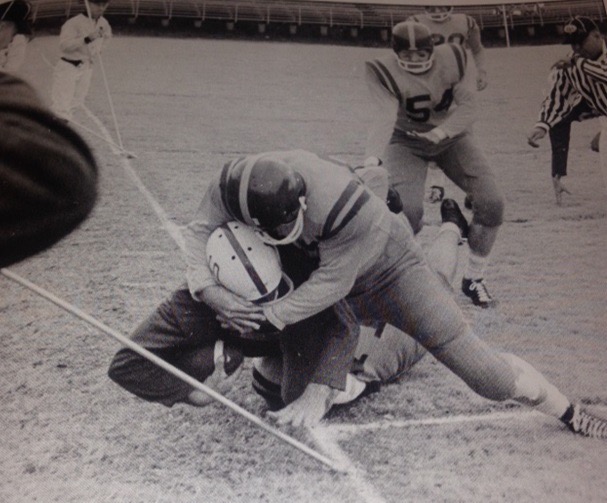
A Little Rock police officer tackles a NLR player in one of the Copper Bowls.


Today is Super Bowl Sunday, so it seems to be a good time to remember the five year series of football games in Little Rock known as the Copper Bowl.

From December 1959 through December 1963, the Little Rock Police Department played the North Little Rock Police Department in a series of football games.  The Copper Bowl games were fundraisers to help the LRPD provide food and presents for needy families during the Christmas season.

The agreement was that the teams would play for five years. The team with the most wins would permanently receive the Copper Bowl trophy.  The LRPD was outfitted with uniforms from Little Rock University and Louisiana State University (thanks to the efforts of Sgt. Harold Zook).  The games were played at Quigley Stadium.

Before the final game on December 1, 1963, the series was tied at 2-2.  The LRPD team won the game and permanently captured the trophy.  Over the five year period several thousand dollars were raised.

Little Rock Look Back: First Basketball at Robinson Center

Former entrance to Robinson off Garland Street. Used to attend basketball games.

Former entrance to Robinson off Garland Street. Used to attend basketball games.

While Joseph Taylor Robinson Memorial Auditorium is known today as a performance and meeting venue, in its early days it was also the home to sports. Seventy-seven years ago tonight the first basketball game was played at Robinson.

One of the first regular activities which took place in the lower level exhibition hall was a series of boxing and wrestling matches.  Building on the success of this, basketball came to the convention hall in January 1940.

A series of games featuring Little Rock High School and North Little Rock High School were announced by Tiger Coach Earl Quigley to take place from January 11 through February 16, the official opening day for the facility.

At that time, neither high school had a gymnasium; therefore both schools played their basketball games on their school auditorium stages with fans seated in the audience. The convention hall offered a regulation size floor (made of pecan block parquet) with seating for over 1,300 people along the sidelines and in the balcony.  The first men’s basketball game in Robinson Auditorium took place between the Little Rock High School Tigers and the North Little Rock High School Wildcats on January 11, 1940.

The Tigers lost the game before a crowd estimated to be 1,300.  Earlier in the evening there had been an exhibition between two women’s basketball teams.  The cost for admission to the games was 35 cents for the reserved seating and 25 cents for general admission.

Little Rock Look Back: Christmas songs on Robinson Center front steps

Today, the Arkansas Symphony wraps up its holiday music concert at Robinson Center.

Similarly, 77 years ago,on December 18, 1939, the sounds of Christmas carols filled the air at Robinson. Only that time it was outside the building, not inside.

That afternoon, 500 school children from elementary schools were joined by the A Capella Choir of Little Rock High School as they sang Christmas carols on the front steps of the auditorium on a weekday afternoon. The singers were accompanied by the Little Rock High School Brass Sextet. The invocation for the event, which was sponsored by the Little Rock Council of Parents and Teachers, was delivered by the Right Reverend Richard Bland Mitchell, the Episcopal Bishop of Arkansas.

A Christmas tree in front of City Hall was lit up as part of the ceremony as well. Media coverage noted that the audience witnessing the program stood on the front steps of the Pulaski County Courthouse, the side lawn of City Hall and in front of the steps of Robinson Auditorium. It was also noted that most windows in the nearby government buildings were filled with people watching the ceremony.

RobinsoNovember: Ben Piazza

benpiazza book coverAnother of the spaces in Robinson Center is named in memory of actor-director-playwright-author Ben Piazza.  He was born on July 30, 1933, in Little Rock, and graduated from Little Rock High School in 1951 as valedictorian. He also had starred in the senior play that year (The Man Who Came to Dinner) and edited the literary magazine.

After graduating from Princeton, he moved to New York City to become an actor.  He made his Broadway debut in 1958 in Winesburg, Ohio.  In April 1959, he starred in Kataki and received a Theatre World Award for his performance.

As the 1960s dawned, Piazza joined a small cadre of actors who had achieved status on Broadway who then also returned to acting Off Broadway.  Colleen Dewhurst, George C. Scott, and James Earl Jones were others in this select group who helped establish Off Broadway as an entity in itself, instead of being just a farm team for Broadway.

In February 1963, he took over the role of Nick in the original run of Who’s Afraid of Virginia Woolf? on Broadway.  During the run of this show, Piazza’s novel The Exact and Very Strange Truth was published.  It is a fictionalized account of his growing up in Little Rock during the 1930s and 1940s.  The book is filled with references to Centennial Elementary, Westside Junior High, Central High School, Immanuel Baptist Church and various stores and shops in Little Rock during that era.

In August of 1967, his play The Sunday Agreement premiered at LaMaMa.  This was Piazza’s first playwright output to be professionally staged.  In March 1969, a double bill of his one-acts: Lime Green/Khaki Blue opened at the Provincetown Playhouse.  It

Throughout the 1960s and early 1970s, Piazza toured in many plays nationally and internationally. He also appeared in major regional theatres as an actor and a director.  As the 1970s progressed, he turned his focus to television and movies.

Piazza’s film debut had been in a 1959 Canadian film called The Dangerous Age. That same year, his Hollywood film debut came opposite Gary Cooper in The Hanging Tree.  Throughout the 1950s and 1960s, he appeared in a number of TV shows including Studio One, Kraft Theatre, Zane Grey Theatre, The Naked City and Dick Powell Theatre.

In the 1970s and 1980s, his appearances included I Never Promised You a Rose Garden, The Bad News Bears, The Blues Brothers, and Mask.  On TV, he appeared in Dallas, Dynasty, Saint Elsewhere, Barnaby Miller, Moonlighting and Family Ties. 

Piazza’s final big screen appearance was in the 1991 film Guilty by Suspicion.  He played studio head Darryl Zanuck in this Robert DeNiro-Annette Bening tale of Hollywood during the Red scare.

Ben Piazza died on September 7, 1991.

1969 Turkey Day Football in LR: Hogs, Tigers, Warriors, Rockets, and Bearcats

The Hogs stop Texas Tech at War Memorial Stadium

The Hogs stop Texas Tech at War Memorial Stadium


Thanksgiving 1969 marked not only the Culture Vulture’s first foray into the holiday, it saw three high schools and the University of Arkansas all playing football games in Central Arkansas.  November 27 was a day for football in the Rock!  It appears this was the only time this feat happened.

It was a cool and misty day which seems to have made balls slippery and grass fields sloppy. But the precipitation seemed to be more an annoyance than a barrier for the players and fans.  

The Arkansas Razorbacks, ranked number 2 in the nation, played host to the Texas Tech Red Raiders at War Memorial Stadium.  The two teams played before a crowd of 35,287.  This was the smallest crowd in LR that season, likely due to it being Thanksgiving and the presence of the Central/Hall football game the same day.  It would have been hard to fit in two football games, Thanksgiving meals, and a possible church service all within one day.  

The Hogs were 16 point favorites for the game with a 1:50 kickoff.  It was broadcast on ABC, and fans were encouraged to wear red to show up well on the color telecast.  

The Hogs beat the Red Raiders by a score of 33 to 0 in their penultimate regular season game.  Turnovers were the key with the Hogs recovering a fumble and intercepting five passes.  (The final Hogs regular season game was the shootout against Texas in Fayetteville on December 6.)

Little Rock Catholic took on NLRHS north of the river with a 10am kick off. The Rockets, under head coach George Loss, were 9-2 heading into the game. The Wildcats (coached by Ken Stephens) were 5-4 and had won four in a row. At the end of the game, NLR was triumphant by a score of 21 to 12.  

Later that day, Jones High hosted Horace Mann at the same stadium. This game, with a 2pm kickoff, would be the final game between Jones and Mann. Jones was being closed at the end of the year.  
The teams had met earlier in the season with Mann triumphing 13 to 8. Mann had a record of 2-8, playing in the larger AAAA classification. Jones, with a record of 4-6, played in the AA classification. It is notable that by 1969 the teams were in Arkansas Activities Association classifications and playing integrated schools.  

Jones scored an upset victory over the Bearcats by a score of 19-8. 

Quigley Stadium was less than three miles from War Memorial Stadium. With a 10am kickoff before a sold out crowd, people who had wanted to go to both the Hogs game and Hall/Central game also had the option of listening to the high school gridiron competition on KARK radio. 
Prior to the game, Hall had captured the AAAA State Championship. CW Keopple was the Warriors’ coach, while Gene Hall was the Tigers’ mentor.  The damp field and high stakes of the game turned it into a defensive slugfest.  Hall had 2 fumbles while Central fumbled four times.  

At the end of the fourth quarter the scoreboard showed a 0 to 0 tie. And that one went into the record books.  Hall’s season record was 9-0-1, while Central’s was 6-2-2.  It was the best season record Hall had amassed in its 13 years of football. 

Four football games within a few miles of each other were a peek into Little Rock life: 

  • The Hogs were riding the crest of their 1960s football superiority in the Southwest Conference.  
  • The final Thanksgiving football game in Arkansas between two segregated public schools. 
  • Continued alternating dominance by Hall and Central in the state’s largest school sports classification.  Soon, Parkview would be added to the mix. Throughout the 1970s, all three Little Rock public high schools would rotate winning state championships. 

Turkey Day Football – Central vs. Hall from 1958 to 1982

hall-central-1966For many years Little Rock dominated the state in football. First as Little Rock High School, then as Little Rock Central, the City’s oldest high school won over 20 state championships from the 1910s through the 1950s. With the emergence of Little Rock Hall, the 1960s were dominated by the City’s newer high school.  Together these schools led the state in football for over 60 years.

While the 1970s and 1980s saw less consistency in the quality of gridiron prowess at Little Rock’s two oldest public high schools, it did not matter.  A Hall vs. Central Turkey Day football game was often like a football season unto to itself.  The previous weeks of the football season did not matter – all that mattered was the Warriors against the Tigers.

The games were always played at Quigley Stadium, which was at the time the home stadium for all three of the Little Rock School District’s high schools (the third high school Parkview opened in 1968).  Each year Central and Hall would alternate which was the “Home” team.

The week leading to the game would feature skits and pep rallies at both high schools.  Pranks, rumors of pranks, and threats of retribution would abound between the schools.  Cars wrapped in orange and white would circle the Central campus one day, while black and gold cars would encircle Hall’s campus another day.

On game day there would be special performances at the stadium by the drill teams, cheerleaders and bands of both schools.  The Tiger and Warrior mascots would taunt each other.  Friendships between students at the rival schools were put on hold.  It was all about the tradition and THE GAME.  Church services, family dinners and any other activities were scheduled around the festivities at Quigley.

Hall High opened its doors and started playing football in 1957. As a new school with a largely younger student body, it only played smaller schools that initial season.  The first Hall vs. Central game was set for Thanksgiving 1958.

During the 1958-1959 school year, Little Rock’s high schools were closed for the ill-conceived, ill-advised reason to keep them from being integrated schools.  Though classes were not in session, football teams practiced and played.  The Arkansas Gazette noted that most of those games that season drew only 1,000 spectators, which was down from the usual 5,000 to 8,000 a game.

With the future of Little Rock’s high schools in doubt, there was some hand wringing about whether the 1958 game would be not only the first meeting between Hall and Central, but perhaps also the last.  In only its second year of playing, Hall was undefeated and poised to win the state championship heading into the Thanksgiving game.  Central surprised the Warriors by winning 7-0 before a crowd of 5,000, which cost Hall the undefeated season and the championship (El Dorado became state champs).  This game set the tone for the high stakes of the rest of the series.

The next year classes were back in session at Hall and Central. The future of the series was not in doubt. Hall achieved its first win with a 16-13 victory over the Tigers. Hall also captured a state championship with the win.

Over the years, the Thanksgiving Day game would deliver state championships to Central in 1960, 1975, 1978, 1980 and 1981.  Hall walked away on Thanksgiving Day with championships in 1964, 1966, 1969, 1977, and 1979.  On several other occasions, Central or Hall kept the other team from winning a championship.

Three times the teams fought to ties: 1962, 1963 and 1969. (The latter two games ended in 0-0 ties.)  The 1980 game was notable for being played in snow at Quigley Stadium. While the Thanksgiving Day games at Quigley (and its predecessor Kavanaugh Field) had often been played in the rain, snow was a new experience for the day.

With the changes of state athletic conference classification, the 1982 game was announced as the final Thanksgiving Day game between Hall and Central. The top two classifications were being combined which would necessitate conferences and playoffs to determine the state champion. This would mean that Hall and Central would need to meet before Thanksgiving.  Going into the game Hall led the series with 13 wins to Central’s 8 wins.

The 1982 edition lived up to the hype.  This was the 25th edition of the Hall and Central rivalry. While there was no doubt that Hall would end up with the most wins, Central wanted to make sure that they ended it in the way they started it in 1958 – with a win.

Central boasted a 4-1 record. Pine Bluff and LR Parkview were both 4-1-1. Hall was 3-0-2. As long as Central or Hall won outright, the winner would be state champ. A tie (and there had been three previous ones) would result in a four-way tie for first place.  Hall’s coach C. W. Keopple had led the team since 1964 and amassed a 10-6-1 record against Central.  The Tigers were mentored by Bernie Cox who was 4-3 against the Warriors since taking over in 1975.

Nearly 9,000 fans packed Quigley Stadium for a cold but dry day. As the buzzer sounded after four quarters, the Hall High Warriors were jubilant. They had won the game 14-3 after putting together a nearly flawless offensive effort. The win moved them into first place with a 4-0-2 record. Central, which had sat atop the conference most of the season, ended up in fourth place with a 4-2 record.  The defeat also ended the Tiger’s hopes for a third consecutive championship.  This game, like so many before it, provided high drama and excitement as it confounded some pundits yet also lived up to billing.

And with that, the series concluded.  In the end, Hall had fourteen wins while Central had eight.  There were also three hard-fought ties.  Central achieved four shutouts of Hall, while the Warriors blanked the Tigers three times.  In the twenty-five games, Central scored 228 points, and Hall scored 297 points.

From 1983 until 2005, Hall and Central continued to play each other in football. This time, they played for the ceremonial bell in what became known as “The Battle for the Bell.”  Today, the bell is proudly displayed at Quigley Stadium.  After 2005, Hall moved into a lower classification than Central. This put them on separate tracts facing different sets of teams.


Central Hall Central Hall
1958 7 0 1971 7 28
1959 13 16 1972 7 10
1960 20 0 1973 7 3
1961 6 9 1974 25 24
1962 14 14 1975 26 6
1963 0 0 1976 10 11
1964 0 8 1977 8 18
1965 7 20 1978 17 14
1966 3 7 1979 0 17
1967 0 28 1980 7 0
1968 14 17 1981 15 0
1969 0 0 1982 3 14
1970 14 35