PIGSKIN TURKEY DAY IN THE ROCK, Part 2 – Hall vs. Central, or Central vs. Hall

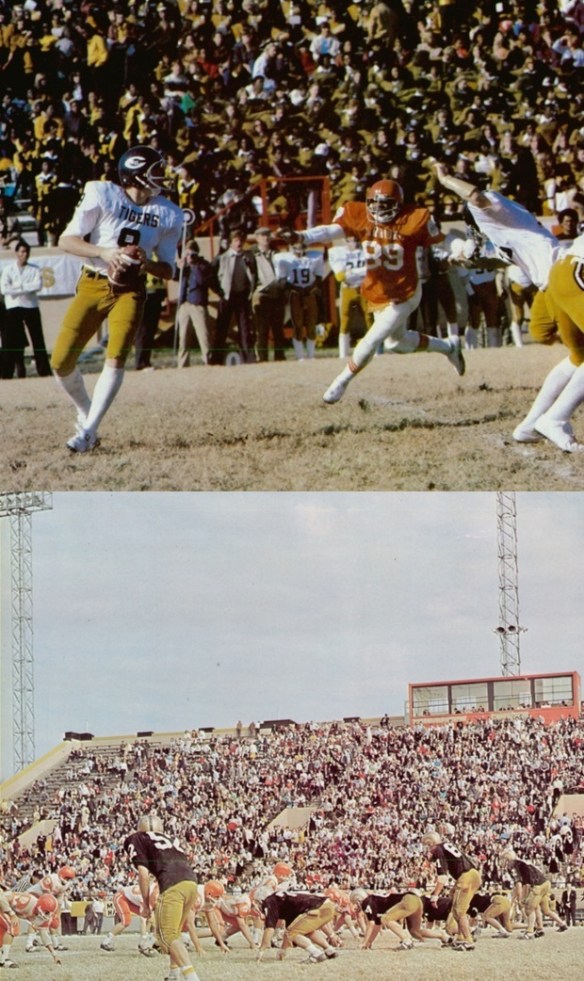
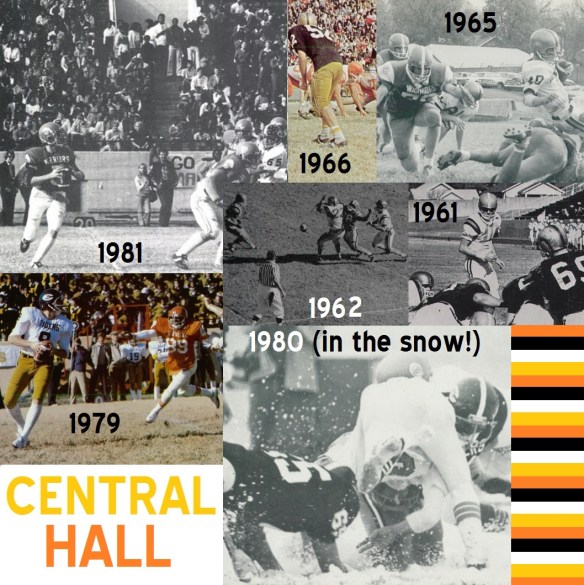
Turkey Bowl LRCH LRHHFor many years Little Rock dominated the state in football. First as Little Rock High School, then as Little Rock Central, the City’s oldest high school won over 20 state championships from the 1910s through the 1950s. With the emergence of Little Rock Hall, the 1960s were dominated by the City’s newer high school.  Together these schools led the state in football for over 60 years.

While the 1970s and 1980s saw less consistency in the quality of gridiron prowess at Little Rock’s two oldest public high schools, it did not matter.  A Hall vs. Central Turkey Day football game was often like a football season unto to itself.  The previous weeks of the football season did not matter – all that mattered was the Warriors against the Tigers.

The games were always played at Quigley Stadium, which was at the time the home stadium for all three of the Little Rock School District’s high schools (the third high school Parkview opened in 1968).  Each year Central and Hall would alternate which was the “Home” team.

The week leading to the game would feature skits and pep rallies at both high schools.  Pranks, rumors of pranks, and threats of retribution would abound between the schools.  Cars wrapped in orange and white would circle the Central campus one day, while black and gold cars would encircle Hall’s campus another day.

On game day there would be special performances at the stadium by the drill teams, cheerleaders and bands of both schools.  The Tiger and Warrior mascots would taunt each other.  Friendships between students at the rival schools were put on hold.  It was all about the tradition and THE GAME.  Church services, family dinners and any other activities were scheduled around the festivities at Quigley.

Hall High opened its doors and started playing football in 1957. As a new school with a largely younger student body, it only played smaller schools that initial season.  The first Hall vs. Central game was set for Thanksgiving 1958.

During the 1958-1959 school year, Little Rock’s high schools were closed for the ill-conceived and ill-advised reason that they would not have to operate as integrated schools.  Though classes were not in session, football teams practiced and played.  The Arkansas Gazette noted that most of those games that season drew only 1,000 spectators, which was down from the usual 5,000 to 8,000 a game.

With the future of Little Rock’s high schools in doubt, there was some hand wringing about whether the 1958 game would be not only the first meeting between Hall and Central, but perhaps also the last.  In only its second year of playing, Hall was undefeated and poised to win the state championship heading into the Thanksgiving game.  Central surprised the Warriors by winning 7-0 before a crowd of 5,000, which cost Hall the undefeated season and the championship (El Dorado became state champs).  This game set the tone for the high stakes of the rest of the series.

The next year classes were back in session at Hall and Central. The future of the series was not in doubt. Hall achieved its first win with a 16-13 victory over the Tigers. Hall also captured a state championship with the win.

Over the years, the Thanksgiving Day game would deliver state championships to Central in 1960, 1975, 1978, 1980 and 1981.  Hall walked away on Thanksgiving Day with championships in 1964, 1966, 1969, 1977, and 1979.  On several other occasions, Central or Hall kept the other team from winning a championship.

Three times the teams fought to ties: 1962, 1963 and 1969. (The latter two games ended in 0-0 ties.)  The 1980 game was notable for being played in snow at Quigley Stadium. While the Thanksgiving Day games at Quigley (and its predecessor Kavanaugh Field) had often been played in the rain, snow was a new experience for the day.

With the changes of state athletic conference classification, the 1982 game was announced as the final Thanksgiving Day game between Hall and Central. The top two classifications were being combined which would necessitate conferences and playoffs to determine the state champion. This would mean that Hall and Central would need to meet before Thanksgiving.  Going into the game Hall led the series with 13 wins to Central’s 8 wins.

The 1982 edition lived up to the hype.  This was the 25th edition of the Hall and Central rivalry. While there was no doubt that Hall would end up with the most wins, Central wanted to make sure that they ended it in the way they started it in 1958 – with a win.

Central boasted a 4-1 record. Pine Bluff and LR Parkview were both 4-1-1. Hall was 3-0-2. As long as Central or Hall won outright, the winner would be state champ. A tie (and there had been three previous ones) would result in a four-way tie for first place.  Hall’s coach C. W. Keopple had led the team since 1964 and amassed a 10-6-1 record against Central.  The Tigers were mentored by Bernie Cox who was 4-3 against the Warriors since taking over in 1975.

Nearly 9,000 fans packed Quigley Stadium for a cold but dry day. As the buzzer sounded after four quarters, the Hall High Warriors were jubilant. They had won the game 14-3 after putting together a nearly flawless offensive effort. The win moved them into first place with a 4-0-2 record. Central, which had sat atop the conference most of the season, ended up in fourth place with a 4-2 record.  The defeat also ended the Tiger’s hopes for a third consecutive championship.  This game, like so many before it, provided high drama and excitement as it confounded some pundits yet also lived up to billing.

And with that, the series concluded.  In the end, Hall had fourteen wins while Central had eight.  There were also three hard-fought ties.  Central achieved four shutouts of Hall, while the Warriors blanked the Tigers three times.  In the twenty-five games, Central scored 228 points, and Hall scored 297 points.


Central Hall Central Hall
1958

7

0

1971

7

28

1959

13

16

1972

7

10

1960

20

0

1973

7

3

1961

6

9

1974

25

24

1962

14

14

1975

26

6

1963

0

0

1976

10

11

1964

0

8

1977

8

18

1965

7

20

1978

17

14

1966

3

7

1979

0

17

1967

0

28

1980

7

0

1968

14

17

1981

15

0

1969

0

0

1982

3

      14

1970

14

35


PIGSKIN TURKEY DAY IN THE ROCK, Part 1 – The Beginning and the End

Turkey Day Header101 years ago, Little Rock High School (then located on Scott Street) kicked off a 69-year tradition of playing football on Thanksgiving Day.  (Though the date of Thanksgiving floats anywhere from the 22nd to the 28th, as with this year, Thanksgiving Day 1914 was on November 26.)

From 1914 until 1933, the Little Rock High School Tigers played a variety of different schools.  Then from 1934 until 1957, they played North Little Rock. From 1958 until 1982, the Little Rock Central Tigers took on the Warriors of Little Rock Hall.

Thanksgiving Day football was a tradition not just for high schools in Little Rock but also all levels throughout the state and country.  The Friday after Thanksgiving, newspapers carried stories and scores for professional, college and high school football.  It was probably the only day of the year to see all three levels of football covered in the paper, and often high school games received the most ink.  This mix of football continued for decades.  In 1969, there were four football games played in Pulaski County on Thanksgiving Day: Little Rock Hall vs. Little Rock Central, Little Rock Catholic vs. North Little Rock, Horace Mann vs. Scipio Jones, and the Arkansas Razorbacks vs. Texas Tech.

By the 1970s, both high school and college football games on Thanksgiving were on the wane.  While college games on Turkey Day have regained some popularity, they are nowhere near approaching the level they once had.  High school football on Thanksgiving disappeared in Arkansas following the 1982 game between Hall and Central.  That rivalry had been the final series on Turkey Day to still be played.

While they lasted, Thanksgiving Day high school football games were civic focal points. They were about bragging rights.  For students who had grown up attending the games, the chance to play or cheer in a Turkey Day classic was a rite of passage.  Alumni home from college or visiting the family for Thanksgiving would descend on the stadium ensuring the largest attendance of the season.

High school football on Thanksgiving Day in Little Rock tells the tale of not just football; it reflects changes in the city and society.  What started out as two small high schools from neighboring cities changed as both schools grew. The addition of a second Little Rock high school reflected the city’s growth.  (Indeed the 1954 Little Rock High School yearbook, in discussing the school’s new designation as Central High, mentions vaguely that the second high school would be built at some yet to be determined location in “west” Little Rock.)

The presence of segregated high schools in separate but unequal football rivalries (lasting nearly two decades after the Supreme Court’s Brown v. Board decision) is an indictment of an unjust parallel education system.  As Little Rock continued to grow and diversify, the two high schools playing on Thanksgiving were no longer always the predominant schools in football – or other activities.  With state championships once again on the line, the last few years of the Hall and Central Thanksgiving rivalry were, in a way, a return to the halcyon days of the early faceoffs (though this time, thankfully, with fully integrated teams). In addition to trading the top spots in football, the two schools were piling accolades. In fact, all three Little Rock public high schools had achieved a stasis that inadvertently rotated areas of excellence academically, athletically and artistically fairly equally among the three.

There were undercurrents at work that hinted at future instabilities to come.  Indeed by 1982, the same year of the final game, Little Rock had filed suit against the North Little Rock and the Pulaski County Special School Districts claiming the schools in those neighboring districts were siphoning off white students from the Little Rock schools. The ensuing realignment of schools and districts would probably have brought an end to Central vs. Hall games even if athletic reclassification had not.

Central is now over twice the size of Hall, Parkview is a magnet school, two formerly county high schools (and several elementary schools and junior highs) were brought into the LR school district in the late 1980s.  Where once the Little Rock high schools were roughly equal in enrollment, they now are so varied they play in three different classifications.

It is up to the alternative historians to envision what continued Turkey Day classics would have looked like after 1982. Little Rock has grown and diversified. There are five public high schools and five private high schools playing football within the Little Rock city limits each season. With all these competing interests it is unlikely to envision the same citywide level of interest in one football game.

But back in the day…

Little Rock Look Back: Mayor Woodrow Mann

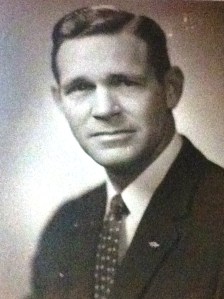
IMG_3231Future Little Rock Mayor Woodrow Wilson Mann was born on November 13, 1916, in Little Rock.

In 1955, he ran as the Democratic nominee for Mayor of Little Rock and defeated two term incumbent Pratt C. Remmel, a Republican.  He took office in January 1956 and immediately set about to make a lot of changes.  In addition to revitalizing the City’s bus system, and removing some color barriers at City Hall, he oversaw the dismantling of the copper dome on top of Little Rock City Hall (as opposed to the repair of the dome championed by Mayor Remmel).

Mayor Mann was caught up in a grand jury investigation into purchasing practices at City Hall as well as within the City government in North Little Rock.  Partially in response to this, Little Rock voters approved a new form of government in late 1956.  Mayor Mann opposed the switch to the City Manager form and refused to set the election for the new officials but was ultimately compelled to do so.

He was also Mayor during the 1957 integration of Little Rock Central High School.  He sought to keep the peace and to broker a deal between President Dwight Eisenhower and Governor Orval Faubus.  His powers within the city were, no doubt, hampered because of his lame duck status as Mayor.  In November 1957 following the election of the new City Board of Directors, he chaired his last City Council meeting and left office.

In January of 1958, a series of articles written by Mayor Mann detailed his perspective on the events at Central High. These were carried by newspapers throughout the US.

Because of ill will toward him due to the Central High crisis (he was criticized by both sides) and grand jury investigation, Mayor Mann felt it would be difficult to maintain his insurance business in Little Rock. He moved to Texas in 1959 and remained there the rest of his life.  He died in Houston on August 6, 2002.

Special Veterans Day concert at the River Market by Central High School Band and Flagline

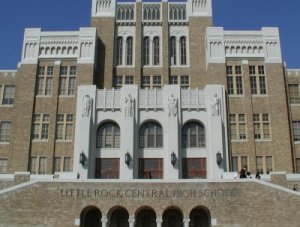
centralentranceIn honor of veterans and those currently serving, the Little Rock Central High School Band and Flagline members will host a free, special concert this Veterans Day, November 11, 2015. The performance will take place at 11 a.m. in the east pavilion of the River Market. The first 100 veterans who attend will receive a commemorative token from Central’s band.

Known for their innovative technique and marching style, Central’s band has been invited to perform across the country, most notably during the last inauguration ceremony of President Barack Obama. They were also featured at the finishing line of this year’s local Susan G. Komen Race for the Cure. Now, they’ve been extended an invitation to participate in a Pearl Harbor Memorial Concert in Hawaii on November 23, 2016. The concert honors military heroes, survivors and veterans of Pearl Harbor. Next year marks Pearl Harbor’s 75th anniversary.

With financial support, the students will be able to experience a “once in a lifetime” opportunity in Hawaii. If you would like to help support the band’s efforts, you may make a tax deductible donation to LRCH’s Band Program, 1500 S. Park Street, Little Rock, AR 72202; or online at http://tinyurl.com/pu8q8lj (a small fee is applied to online donations). You will also be able to make donations during the November 11, 2015 performance at the River Market.

Central’s band will also host a Battle of the Bands fundraiser at Quigley Stadium at noon on November 15, 2015, featuring the University of Arkansas at Pine Bluff’s Musical Marching Machine of the Mid-South, along with invited bands from the Memphis and Dallas areas. Tickets are $10

Little Rock Look Back: LR chosen for Clinton Library

ClintonCenterConstruction-48

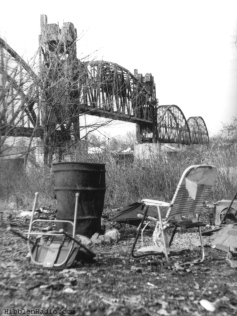
Refuse littered the future site of the Clinton Presidential Center

On November 7, 1997, President Bill Clinton announced his intentions to locate his presidential library in Little Rock at the end of a warehouse district.

The Little Rock City Board met in a special meeting that day to rename part of Markham Street, which would lead to the site, as President Clinton Avenue.

While the announcement was met with excitement in many quarters, there were still some skeptics who had a hard time envisioning a presidential library and park in the middle of a wasteland worthy of a T. S. Eliot poem.

There would be many hurdles between the November 1997 announcement to the December 2001 groundbreaking. But for the moment, City of Little Rock leaders, celebrated the achievement.  Then Mayor Jim Dailey had appointed City Director Dean Kumpuris and City employee Bruce T. Moore to lead the City’s efforts.  Moore and Kumpuris worked with Skip Rutherford and others to narrow the potential sites.

In September 1997, the Clintons were in town for the 40th anniversary of the integration of Central High School.  They surprised Kumpuris and Moore with a decision for a Sunday afternoon visit to the warehouse district proposed site. Secret Service would not let the limousine drive in part of the property, so the Clintons, Moore, Kumpuris, and Rutherford walked up a path to the roof of the abandoned Arkansas Book Depository.  It was there that the Clintons could see the Little Rock skyline which would be visible from the library.

Of course by the time the library had opened in November 2004, the Little Rock skyline was different. Spurred on by the library, several new highrises had been constructed in downtown.

Creative Class of 2015: Kathryn Tucker

KFTuckerFilmmaker Kathryn Tucker returned to her native Little Rock three years ago after spending time in New York (four years) and Los Angeles (six years). In NYC, she worked for Miramax Films. She left Miramax to help make an independent film (Loggerheads) in North Carolina that was accepted at Sundance. She then moved the LA for 6 years and became of member of the Director’s Guild of America (DGA).

During that time she worked with a wide range of movie stars, including Nicole Kidman, Tom Cruise, Jennifer Anniston, Adam Sandler, Al Pacino, Katie Holmes and Ryan Gosling. Among her projects in LA were This Is 40, Oblivion, Gangster Squad, Knocked Up and the TV shows “Glee,” “Private Practice,” “Bones,” “Gilmore Girls,” and “7th Heaven.”

She returned to Little Rock (where she was a 1996 graduate of LR Central High) three years ago and has produced an award winning short (“One Please”) and a feature (All the Birds Have Flown South) written by the Miller brothers. She is currently completing a screenplay for a movie she will direct in 2016 and is under contract with AETN to produce and direct a documentary bio of former Gov. Mike Beebe.


Creative Class of 2015: Allyson Gattin

After a stint in Missouri, Allyson Gattin returned to her native Little Rock and is using her talents in marketing and communication to enrich Little Rock’s cultural scene.

A graduate of Little Rock Central High School and the University of Missouri, she is now Director of Communications and Marketing at the Arkansas Repertory Theatre.  In that capacity, she promotes all the Rep’s mainstage and special productions, education programs and fundraisers.  She also serves as the staff liaison for the theatre’s young professional group, The 601 Club.

Since joining the Rep in 2014, she has increased its presence on social media in a variety of platforms.  In recognition of this, she and her staff recently received the Arkansas Nonprofit Alliance Mission Marketing Award in the Social Media Category.

Prior to her work at the Rep, she worked for Arkansas Business Publishing Group and for the Contemporary Art Museum in St. Louis.