Tonight at Clinton School – Discussion of Thurgood Marshall and 1949 Groveland Boys Case

UACS DevilBefore he was on the Supreme Court, before he supported the Little Rock Nine, before Brown v. Board of Education, Thurgood Marshall was a longtime crusader not just for civil rights, but for human rights.  T

Tonight at the Clinton School, Pulitzer Prize-winning author Gilbert King, Justice Marshall’s son, Thurgood Marshall, Jr., will discuss the 1949 Groveland Boys case.

Gilbert King is the Pulitzer Prize-winning author of Devil in the Grove: Thurgood Marshall, the Groveland Boys and the Dawn of a New America. The book, about four black men falsely accused of raping Norma Lee Padgett, a 17-year-old white woman in Groveland, Fla. in 1949, unearthed a largely forgotten chapter in the long history of racial injustice in the United States, and explored, in painstaking details, the tactics used by Thurgood Marshall, the future Supreme Court Justice, to chip away at the foundations of Jim Crow law.

The program will begin at 6pm at the Clinton School of Public Service.  A book signing will follow.

Arkansas Jazz Festival at Clinton Presidential Center Friday & Saturday

jazzheroThe Clinton Presidential Center celebrates Jazz Appreciation Month with the Arkansas Jazz Festival, featuring “Blue” Lou Marini. Held in partnership with the Arkansas Jazz Educators and the University of Arkansas at Monticello, this FREE, two-day festival will be held at the Clinton Center Park and will showcase the talent of jazz bands from around the state.

Featured artist, Lou Marini, has been a member of Blood, Sweat and Tears, The Saturday Night Live Band, and the Blues Brothers Band. He is an original member of the Blues Brothers Band, since the first appearances on Saturday Night Live, and appeared in both movies, as well as all recordings and tours.

Arkansas Jazz Festival
April 24 – 25, 2015
Clinton Presidential Center Park

Schedule of Performances:

Friday, April 24
3:30 p.m. Central High School Jazz II
4:30 p.m. West Memphis High School
5:30 p.m. Benton Junior High School
6:30 p.m. Harding University
7:30 p.m. Bryant High School

Saturday, April 25
9:00 a.m.  Central High School Jazz II
10:00 a.m. University of Arkansas at Little Rock
11:00 a.m. El Dorado High School
12:00 p.m. Arkansas Tech University
1:00 p.m.  Jonesboro High School
2:00 p.m.  Texarkana, Texas 8th Grade
3:00 p.m.  University of Arkansas at Pine Bluff
4:00 p.m.  Pea Ridge High School
5:00 p.m.  Texas High School
6:00 p.m.  University of Arkansas at Monticello, Featuring Lou Marini

Little Rock Look Back: SOUTH PACIFIC wins Pulitzer Prize for Drama

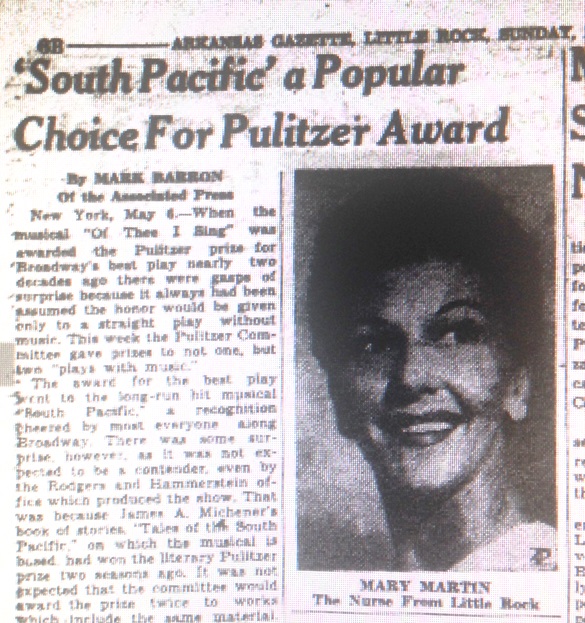
SoPa Pul GazThe Pulitzer Prizes will be announced today.  In 1950, one of the recipients in the “Letters, Drama and Music” categories featured a character from Little Rock.

The 1950 Pulitzer for Drama went to a musical, for only the second time in the history of the awards.  The recipient was South Pacific by Richard Rodgers, Oscar Hammerstein II and Joshua Logan.  The character was the leading lady of Nellie Forbush. She was an Navy ensign and a nurse stationed on an exotic island during World War II.  The musical was based on a Pulitzer Prize winning novel, James Michener’s Tales of the South Pacific.

In the Michener novel, Miss Forbush is not from Little Rock.  She is actually from a small town in Alabama.  The part was written for Mary Martin from Weatherford, Texas.  Rodgers, Hammerstein & Logan did not discuss why they relocated Nellie’s birthplace.

In the musical, Nellie struggles with her own prejudices. This issue of prejudice became an instance of fact meeting fiction. In 1957, a few weeks after Eisenhower sent troops into Little Rock to ensure that Central High would be desegregated, a production of South Pacific on Long Island was temporarily halted when the audience booed and yelled after Nellie mentioned she was from Little Rock.


On Pulitzer Day – Prizing Mount Holly

The Pulitzer Prizes are to be announced today.  Mount Holly Cemetery not only touts that it is the site of a whole host of elected officials, it is also the only place in Arkansas where two Pulitzer Prize recipients are buried. The cemetery is open every day, but a special visit to these two prize winner gravesites can be made next Sunday during the Mount Holly Cemetery Association’s annual “Rest in Perpetuity” fundraiser picnic.

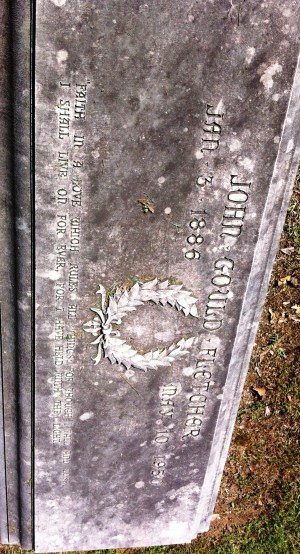
In 1939, John Gould Fletcher became the first Southern poet to win the Pulitzer Prize for Poetry.  He was born into a prominent Little Rock family in 1886.  Fletcher was awarded the prize for his collection Selected Poems which was published by Farrar in 1938.  Two years earlier, he had been commissioned by the Arkansas Gazette to compose an epic poem about the history of Arkansas in conjunction with the state’s centennial.

Fletcher is buried next to his wife, author Charlie May Simon and his parents (his father was former Little Rock Mayor John Gould Fletcher).  Other relatives are buried nearby in the cemetery.

The other Pulitzer Prize winner buried in Mount Holly is J. N. Heiskell, the longtime editor of the Arkansas Gazette.  It was Heiskell, in fact, who asked Fletcher to compose the poem about Arkansas.  Heiskell served as editor of the Gazette from 1902 through 1972.  He died at the age of 100 in 1972.

Under his leadership, the Gazette earned two Pulitzer Prizes for its coverage of the 1957 desegregation of Little Rock Central High.  One was for Harry Ashmore’s editorial writing and the other was for Public Service.

Heiskell remained in charge of the Gazette until his death in 1972.  He is buried alongside his wife with other relatives nearby.  Also not too far from Mr. Heiskell are two of his nemeses, proving that death and cemeteries can be the great equalizer. In the early days of his Gazette stewardship, he often locked horns with Senator (and former Governor) Jeff Davis. Later in Mr. Heiskell’s career, he vehemently disagreed with Dr. Dale Alford, who had been elected to Congress on a segregationist platform.

Little Rock Look Back: Ben Piazza’s Broadway Debut

kataki-playbill-cover1Though he had been an understudy in the short-lived Too Late the Phalarope, Little Rock native Ben Piazza never went on in the production.  He made his Broadway debut in Kataki, which opened 56 years ago today at the Ambassador Theatre on April 9, 1959.

Piazza was the valedictorian of the Little Rock High School class of 1951. While there, he was recognized for his acting and writing abilities.  After being a Little Rock High School Tiger, he became a Princeton Tiger and graduated in 1955 before moving to New York City.

Written by Shimon Wincelberg, Kataki concerned an older Japanese pilot and a young American soldier stranded on an island at the end of World War II.  As was the case of many plays in the late 1950s, it had originally been a television play.  The title is the Japanese word for “enemy.”

Kataki starred Sessue Hayakawa and Piazza. Most of Hayakawa’s dialogue was in Japanese, so in some ways, Piazza acted in a two-character, one-person play – since he was the only one talking for most of the play.  The play was produced by Jay Garon and Bob Sokoler, with Richard Randall serving as associate producer.  David Amram provided the incidental music.  Peter Dohanos designed the island scenery.  Anne Graham provided the costume design, and Paul Morrison was the lighting designer.

The actors received high praise for their performances, but the play’s dramatic structure was criticized as being plodding and trite.  The play was directed by Alan Schneider, who would reunite with Piazza in the original production of Who’s Afraid of Virginia Woolf?  a few years later.  The play would run only 20 performances, but Piazza was recognized with a Theatre World Award for his portrayal of Alvin, the young soldier.

The play was revived in Los Angeles in 2010 to good reviews.

Little Rock Look Back: LR Mayor Werner Knoop

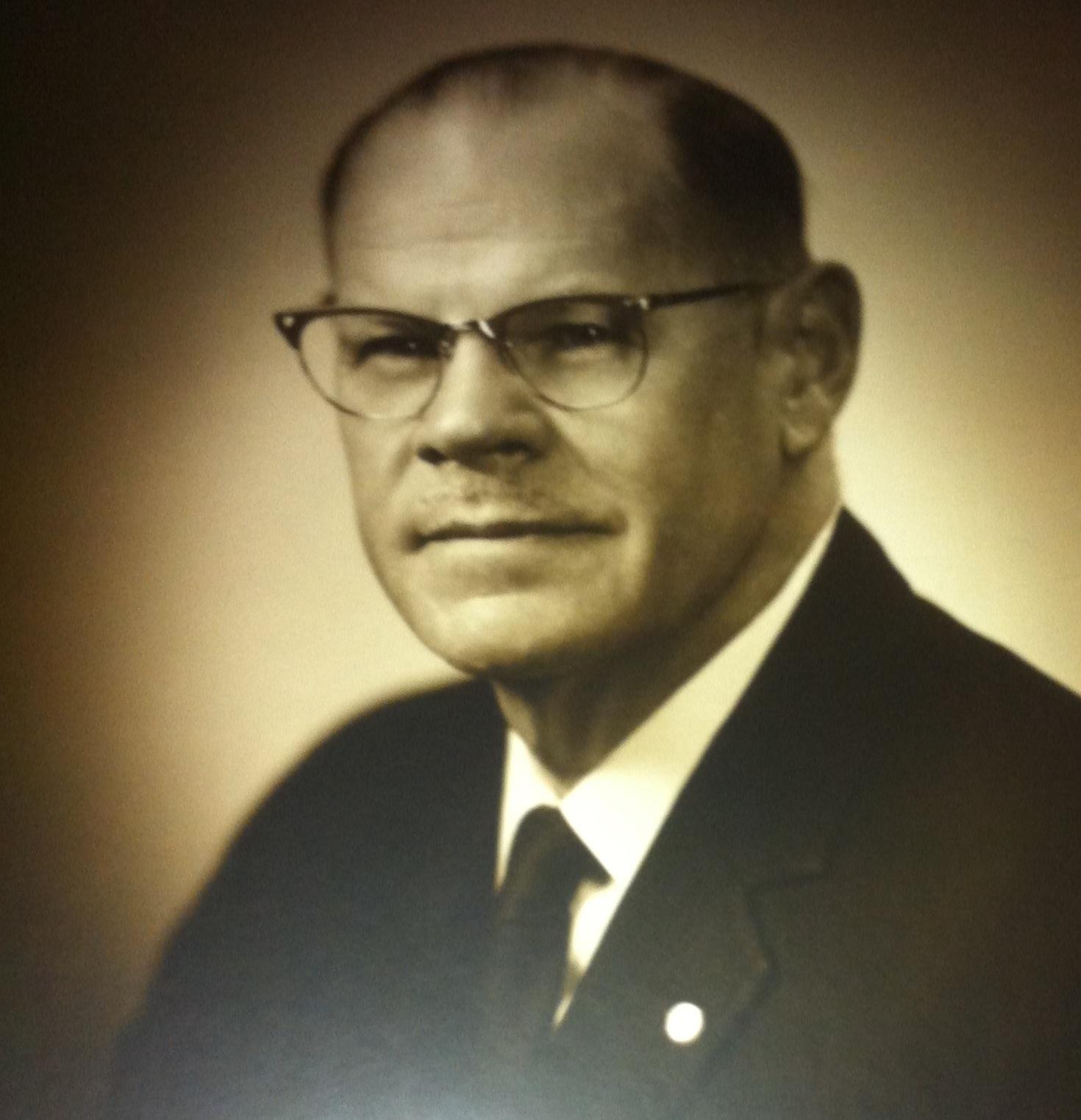
Mayor KnoopTo Little Rock citizens under a certain age, the name Knoop means Knoop Park — a picturesque park tucked away in a pocket of Hillcrest.  There are, however, still many who remember Werner C. Knoop as a business and political leader who helped shape Little Rock as a modern city.

Knoop was born on March 30, 1902.

In 1946, Knoop joined with Olen A. Cates and P. W. Baldwin to form Baldwin Construction Company in Little Rock.  Knoop had previously founded Capital Steel Company and established his business reputation there.  From 1945 through 1951, he served on the Little Rock School Board.

Following a series of political scandals, efforts were undertaken for Little Rock to shift from Mayor-Council to City Manager form of government.  Even before the desegregation of Little Rock Central put the city in the eyes of the world, an election for new leaders had been set for November 1957.  Knoop was on a “Good Government” slate and was one of the members elected.

At the first meeting of the new City Board, Werner C. Knoop was chosen by his fellow directors to serve as Little Rock Mayor.  Knoop served as Mayor until December 1962.  For the first several months in office, Little Rock had no City Manager so Knoop oversaw the transition of City staff as the forms of government changed.

Though City Hall generally stayed out of school district matters, that did not mean that the public viewed the two entities separately.  In September 1959, the Baldwin Construction offices were bombed as part of a series of terrorist activities protesting the desegregated reopening of all Little Rock high schools.

Downtown LR as viewed from Knoop Park

Downtown LR as viewed from Knoop Park

After two terms on the City Board, Knoop decided against seeking a third term.  He concluded his elected public service on December 31, 1962.  Following his time on the City Board, Knoop did not retire from Civic Affairs.  In 1970, he served as Chairman of the Little Rock Chamber of Commerce.   The previous year he served as President of the Arkansas Chapter of Associated General Contractors.

Mayor Knoop died in July 1983.  He is buried at Roselawn Memorial Park next to his wife Faith Yingling Knoop, a renowned author.

In the 1930s, Knoop moved into an Art Moderne house on Ozark Point in Hillcrest.  It was adjacent to Little Rock Waterworks property which was developed around the same time.  Eventually much of the land was deeded to the City for creation of a park.  In 1989, it was named in tribute to long-time neighbor Knoop in honor of his lifetime of service to Little Rock.

Film 14 WOMEN screened today

14womenLittle Rock Central High School National Historic Site, in partnership with the Little Rock Central High School Feminist Alliance, will host a series of film screenings on women’s rights and feminist issues.  The series will run on selected Saturdays in March and April at 2:30 p.m. and will be screened at the National Historic site visitor center. Each screening will be followed by a post-film dialogue moderated by local advocates/activists.  Admission is free.

14 Women will be screened on Saturday, March 21st at 2:30pm at the Central High National Historic Site, 2120 W. Daisy L. Gatson Bates Drive.

Between 1789 and 2006, only 35 of the 1,875 people who were chosen to serve in the United States Senate were women, so 2006 became a banner year when 14 women held seats in the Senate (and two more were elected in the mid-term elections held that year).  14 Women offers an inside portrait of women in politics and allows its subjects a chance to talk about the “glass ceiling” in American politics, the hard work that goes into serving in Congress, and how gender can sometimes trump party allegiances in dealing with their colleagues on Capitol Hill. ~ Mark Deming, Rovi (New York Times)

The screening will have a post-film dialogue moderated by Stephanie Harris, Arkansas Supreme Court’s Communications Counsel and founder of Women Lead Arkansas, a non-partisan non-profit organization whose mission is to empower women and girls to engage in politics, policy and leadership.

For more information, contact Brian Schwieger at brian_schwieger@nps.gov or Sally Goldman (LRCHS Feminist Alliance) at sjgoldman1996@gmail.com