

An LRPD officer talks to bystanders next to a piece of debris
An LRPD officer talks to bystanders next to a piece of debrisThe peaceful morning of March 31, 1960, was interrupted by a horrendous noise over Hillcrest around 6:00am. A six-engine B47 from the Little Rock Air Force Base exploded mid-air.
Flaming debris fell from Allsopp Park all the way to the State Capitol grounds and stretched from Cantrell to 12th Street. Other debris was found as far away as the Country Club of Little Rock. The next day the Arkansas Gazette ran a map which showed the extent of the damage.
Three airmen died in the explosion. The only survivor from the crew, 1st Lieutenant Thomas Smoak, was found dangling from a tree in his parachute at Kavanaugh and Martin. He was treated by a nurse, Jimmye Lee Holeman, in whose yard he had landed.
Two civilians on the ground were killed by falling debris. Many vehicles and homes were damaged, some were destroyed by debris. The damage estimate was put around $4 million.
Police and fire crews were quickly on the scene to secure impacted areas, fight fires and rescue injured persons.
Those who perished were Captain Herbert Aldridge, Lieutenant Colonel Reynolds Watson, Staff-Sergeant Kenneth Brose, and civilians Alta Lois Clark and James Hollabaugh.
Today, a portion of the crash site is part of the Arkansas Children’s Hospital campus. Other sites were removed by the I-630 construction. Other houses were rebuilt or removed.
While there may not be visible reminders of that fateful morning, to those who lost loved ones, there is still a sense of grief over their loss. It is a reminder that History is not just places, names, and dates: but events that happened to actual people.

Arkansas Gazette map of debris and damage

 After over a decade of the Beaux Arts Bal (it was spelled the French way with only one “L”), a change was afoot in 1971. Because of the need to raise more money for the Arkansas Arts Center, the Fine Arts Club decided to replace their evening of dining and dancing with an auction event.
 On January 9, 1866, the new Little Rock City Council held its second meeting after the post-Civil War resumption of municipal government. At that meeting, a special committee was created to meet with Gen. Williams who was the military commander for Arkansas. Mayor J. J. McAlmont, Alderman I. A. Henry, and Alderman Henry Ashley were authorized to discuss the creation of a permanent police force in Little Rock.
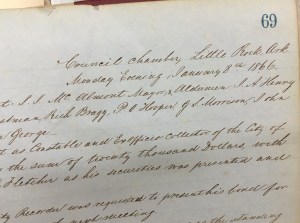 One hundred and fifty three years ago today (on January 8, 1866), Little Rock City Hall resumed functioning after the Civil War. The City government had disbanded in September 1863 after the Battle of Little Rock. From September 1863 through the end of the war (on on through part of Reconstruction), Little Rock was under control of Union forces.
 Little Rock Culture Vulture