Museum of Discovery Science After Dark

20120829-112219.jpgMuseum’s Science after Dark Takes Things to the Extreme

The Museum of Discovery’s monthly program series designed for people ages 21 and older, titled “Science after Dark,” will be Wednesday, August 29, 2012 6-8 pm. This month’s theme, “Taking It to the Extreme,” will take people into the world of adrenaline-laced activities like extreme sports, eating and more. Guests will learn about science in a unique, social setting. Admission will be five dollars, and a cash bar will be available.

There is a psychology behind the need for speed, and the rush some people get from stepping out of his or her comfort zone and seeking the ‘thrill.’ And, physics allows our bodies to adapt to motion, force and speed.

Science after Dark will feature a mountain climbing slack rope where attendees can try their luck. Also, there will be a climbing demonstration complete with gear, and people will learn the technology behind the sport.

For those interested in skateboarding, museum staff will discuss this wildly popular sport and the physics of how tricks are performed. Guests will have the opportunity to decorate mini-skateboards and try them out on the museum’s tiny skateboard park. While there, attendees can see the museum’s latest traveling exhibit, Design Zone, which includes interactive stations including a skateboard design area. Design Zone is a behind the scenes look at how math is used to create music tracks, design roller coasters, make video games and more.

What about water? It holds a mystique all its own, at the surface and certainly below. Enjoy diving presentations, and see first-hand how sophisticated equipment is used. Also, learn about whitewater kayaking and see the equipment needed and the technology used in this fast-paced sport.

Not into sports? What about eating? Join us as we explore the physiological impact of competitive eating on the human body, and we’ll host a competitive eating contest.

Science after Dark occurs the last Wednesday of each month. Museum educators pick a science-related topic, and develop an event around it. The event is for ages 21 and older. General admission is $5 per person. Museum members get in free.

For more information on Science after Dark or the Museum of Discovery, visit http://www.museumofdiscovery.org, follow us on http://www.facebook.com/scienceafterdark or call (501) 396-7050.
DESIGN ZONE, new Museum of Discovery exhibit

20120814-171022.jpg

The Museum of Discovery’s Latest Traveling Exhibit: Getting Behind the Scenes with DESIGN ZONE

What does it take to create an interactive and fun videogame? How many beats per second does a DJ need to get bodies moving on the dance floor? What goes behind creating a roller coaster or a skate park that produces the most fun and biggest thrills? Discover the secrets behind how videogame developers, music producers, roller coaster designers, and other creative problem solvers use math to do what they do in the Museum of Discovery’s new exhibition.

Design Zone is presented at the Museum of Discovery through the Arkansas Discovery Network, a statewide museum consortium funded by the Donald W. Reynolds Foundation, and will be on exhibit through December 2, 2012.

Design Zone is a highly interactive, hands-on exhibition where visitors can explore a variety of creative concepts to learn the processes and tools needed to create a successful design. Design Zone is organized into three thematic zones, all highlighting the importance of science and mathematical thinking in areas critical to building creativity and innovation: art, music, and engineering.

Design Zone’s themed areas include:

ART:
Balancing Art – Discover the math behind mobiles as you create your own balancing art from colorful pieces.
Build a Tower – Choose your challenge and test your abilities to continue a pattern in three dimensions.
Marble Maze – Video game designers use algebra to create games with the right feel and level of challenge. Now it’s your turn. Start with a simple marble maze game controlled by a giant tilt table. Adjust variables and design a high-scoring game.

MUSIC:
Drum Machine – When mixing a new song, DJs have to think about the number of beats in each music track and how they line up with each other. Use the drum machine to pick the sounds and the number of repeats for different tracks.
Light Show DJ – You’re in the control booth at a virtual concert. Your challenge is to put together laser light patterns to match the music and get your friends dancing.
Whack-a-phone – You can make music by whacking tubes of different lengths. The length of the tube determines the pitch. Play the mystery songs, and see if you can name that tune.

ENGINEERING:
Roller Coaster Hills – All roller coasters start with a hill, and the first step in roller coaster design is to understand the relationship between hill height and distance traveled. Start a ball rolling down this exhibit’s ramp, and see how far it can travel – just like a roller coaster.
Fast Tracks – Roller coaster designers try to create tracks so that the coaster travels at different speeds during different points in the ride. This giant magnet wall lets you crate and test your own roller coaster design course.
Design a Skate Park – Skate parks can be modeled as a series of mathematical lines and curves. In this computer simulation, you can manipulate slope to create essential skate park features. Test your design with a virtual skater and ride the course.

The creation of Design Zone was made possible by the generous support of the National Science Foundation. The exhibition was produced and is toured by the Oregon Museum of Science and Industry (OMSI).

The Donald W. Reynolds Science Center at the Museum of Discovery’s mission is to ignite a passion for science, technology and math in a dynamic, interactive environment.

Cool Culture — Beat the Heat at LR Museums

Seeking a daytime escape from the heat of the day, most of Little Rock’s museums offer wonderful climate controlled environments at no charge.

Among those museums in LR which offer escapes to galleries at no charge are the Arkansas Arts Center, MacArthur Museum of Arkansas Military History, Historic Arkansas Museum (fees do apply for tours of historic structures), Mosaic Templars Cultural CenterOld State House Museum, Butler Center Galleries  at the Arkansas Studies Institute, Witt Stephens Jr. Central Arkansas Nature Center and the Little Rock Central High National Historic Site.  In addition, members to the Museum of Discovery can visit it for free.

Museum of Discovery presents TINKERFEST on August 4

The Museum of Discovery will host the first TinkerFest Saturday, August 4, from 10:00 am to 4:00 pm, an Arkansas Discovery Network event. As a member of the six-museum statewide consortium, the museum will showcase local makers and inventors and allow the public to create unique things made from ordinary objects.

Tinkering is free-form experimentation with use of screwdrivers, motors, wires, glue, and more. People can spend hours creating and building. Tinkering allows them to slow down and immerse themselves in a workshop environment.

TinkerFest will feature inventors and artisans from central Arkansas. Nearly 30 work stations will be set up both in- and outside the museum. Visitors will have the opportunity to construct elegant and delicious geometric shapes with gum balls and bamboo skewers; make one-of-a-kind jewelry from junk; take apart appliances and computers to actually see how they were designed and how they operated; repair recycled bicycles; make fun accessories, purses and wallets with duct tape; see a three-dimensional printer in action; disassemble a vehicle, and much more.

“Some of the best inventions have started as tinkering projects. It’s what has helped shape our nation,” said Joel Gordon, visitor experience director for the museum. A tinkerer at heart, Gordon manages the museum’s Tinkering Studio conducting workshops and encouraging imaginative creation. “For example, when the United States battled the Soviet Union for space exploration supremacy during the great ‘space race,’ people literally went into their garages and warehouses and started tinkering and creating. Innovation was the end result. People invented thermal gear, freeze-dried food, microwave ovens, hair dryers and the list goes on. It’s how the National Aeronautics and Space Administration (NASA) got its beginning.”

“Another big tinkering explosion was the integrated circuit board. That one invention has led to the creation of computers, MP3 players and other advancements. And, who were these tinkerers? Future engineers, scientists, mathematicians and teachers. We need another space race, and people are starting to realize the time is now,” he stressed.

One can build just about anything from materials lying around the house, from flying objects to intricate circuit boards. Even movie-making can be considered tinkering. It is the use of imagination, ingenuity and hands-on creativity. The increased popularity of do-it-yourself shows, online tutorials, videos and books has spurred a renewed interest in tinkering.

TinkerFest sponsors are Kroger, FTN Associates, Ltd., Regional Recycling and Waste Reduction District, and Spectra Energy.

Museum partners from around the country, including The Exploratorium in San Francisco, San Diego’s Reuben H. Fleet Science Center and the Fort Worth Museum of Science and History will participate in Saturday’s TinkerFest event. All three have strong working relationships with the Museum of Discovery and the Arkansas Discovery Network.

The Donald W. Reynolds Science Center at the Museum of Discovery’s mission is to ignite a passion for science, technology and math in a dynamic, interactive environment.


About Arkansas Discovery Network

The Arkansas Discovery Network, an innovative network of museums across the state, has received more than $10 million in funding from the Donald W. Reynolds Foundation since 2006. The network strives to make hands-on, interactive museum experiences more accessible to the state’s schoolchildren and their families, especially those in rural areas. Partner museums include the Museum of Discovery in Little Rock, Mid America Science Museum in Hot Springs, Arts and Science Center for Southeast Arkansas in Pine Bluff, Texarkana Museums System in Texarkana, Arkansas Museum of Natural Resources in Smackover and Arkansas State University Museum in Jonesboro.

Science After Dark tomorrow night at Museum of Discovery

The Museum of Discovery’s monthly program series designed for people ages 21 and older, titled “Science after Dark,” will be Wednesday, July 25, 2012 6-8 pm.

This month’s theme, “Science Fiction”, will bring an exciting, interactive evening with multiple stations focused on the science surrounding this entertainment phenomenon. Guests will learn about science in a unique, social setting. Admission will be five dollars, and a cash bar will be available.

Did science inspire science fiction, or was it the other way around? Museum staff will facilitate an open discussion addressing this question, and explore interesting facts about ancient and modern science fiction.

Little Rock resident Leslie Singer, author of Zap! Ray Gun Classics, will bring part of his massive science-fiction memorabilia collection, and provide a fascinating retrospective.

Guests will have the opportunity to build their own unidentified flying object (UFO) and take it for test flights. There will be a delightful, and humorous, discussion on UFOs in history and culture.

Guests will get to race robots on a race track complete with an asteroid field, enemy ship and black hole. Also, they will be able to destroy their “enemies’ ” ship during a laser maze constructed of mirrors.

If so inclined, guests are invited to dress as one of the following: alien, robot, mad scientist or radioactive lizard.

Science after Dark occurs the last Wednesday of each month. Museum educators pick a science-related topic, and develop an event around it. The event is for ages 21 and older. General admission is $5 per person. Museum members get in free.

For more information on Science after Dark or the Museum of Discovery, visitwww.museumofdiscovery.org, follow us on www.facebook.com/scienceafterdark or call (501) 396-7050.

Museum of Discovery Executive Director Nan Selz to retire at end of 2012

Nan Selz, who has led the Museum of Discovery since 2004 and revitalized the once-struggling museum announced her intention to retire at the end of 2012.

Since joining the Museum in February 2004, Selz has used her leadership to ensure that the Museum has become central Arkansas’s premier math, science and technology center. She has nearly 50 years executive, development and teaching experience having worked in corporate, non-profit and education sectors.

“Before I ever thought about working here, I visited the Museum of Discovery with my oldest grandson, Josh. It was then, and remains, a wonderful place for families to play and learn together. I will miss the energy and enthusiasm of our wonderful staff and board, but I am leaving this place in great hands! And I will, of course, be back as a visitor quite often,” said Selz.

Selz has volunteered for numerous organizations and served on many boards for more than 40 years. She plans to continue her community involvement, and enjoy time with her family.

The Museum’s board of trustees has formed a search committee and is conducting a search for Selz’s successor.

Established in 1927, the Museum of Discovery is Little Rock’s oldest museum. Following its closing and a 10-month renovation, the Museum of Discovery re-opened in January 2012. It is central Arkansas’s leading informal educational resource in areas of science, technology, math and engineering. The Museum’s mission is to ignite a passion for science, technology and math in a dynamic, interactive environment.

Architeaser June 27

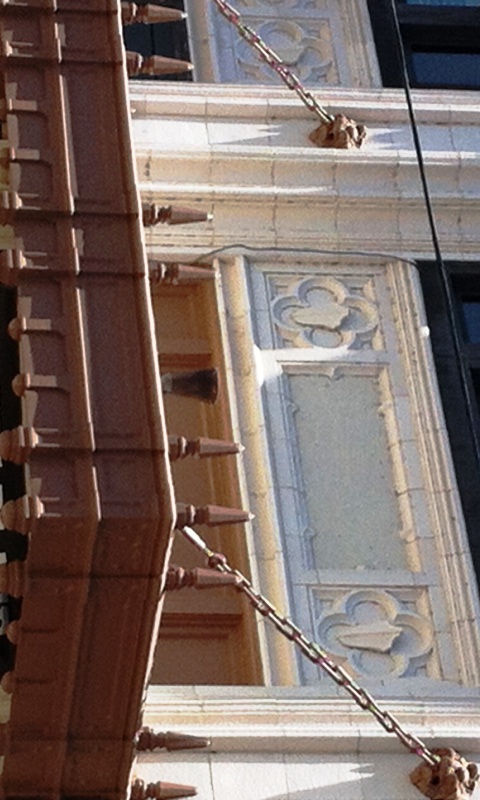
Yesterday’s Architeaser was the awning on the front entrance to the Museum Center building.  One of the key structures in the development of the River Market District, this building formerly housed a train station and presses for the Arkansas Democrat.  It is a unique awning in that it has a rounded shape instead of a being flat.  As many awnings are, it is affixed to the building with cables.

Here is today’s Architeaser.