Heritage Month – Samuel P. Taylor Service Station

Today’s Heritage Month property is the Samuel P. Taylor Service Station.  Built in 1938, it embodies the distinctive characteristics of Art Deco architecture.

The Samuel P. Taylor Service Station is located at the corner of Cross Street and West Third Street in downtown Little Rock. The building was constructed in 1938 on a lot previously owned by the Cross Street Christian Church. The church built a basement in 1935 and had planned to construct a church on the site, however money could not be raised and the church disbanded circa 1937. The land was purchased from the church in 1938 and a man known as Mr. Saunders was hired to build a service station on its present day site. Later that same year the Samuel P. Taylor Service Station opened its doors to motorists.

The Samuel P. Taylor Service Station served motorists as garage and gas station from its opening in 1938 until 1947. In 1947 the building was purchased by Paul Williamson and the name of the business was changed to Cross Town Gulf Service Station. Mr. Williamson served as the owner and operator of the Gulf Oil Company franchise until the business went out of operation in 1972. The building was then purchased by the Safeway Corporation in 1973 and was used as storage by the Safeway Bakery Division located at 1111 West Third Street in Little Rock.  Although the building no longer serves as a service station it still greatly resembles its historic appearance and reminds those passing by of its original use.

It was added to the National Register of Historic Places on November 29, 2000.

Heritage Month – Luxor Apartments

Luxor ApartmentThe Luxor Apartments building is a two-story brick veneered structure designed in the Craftsman style, unique to the Little Rock area in its size.  Located at 1923 South Main, it remained popular for singles and young families from the 1920s to the 1970s because of its proximity to the downtown commercial district.  Now it is part of the South Main community, which is once again a hotbed of activity.

The Luxor Apartments Building was built by Samuel J. Storthz, Sr., member of a Jewish family prominent in the Little Rock business community.  At the time of its construction, the Luxor was considered a very desirable address.  The building featured a uniformed doorman, apparently something of an anomaly in Little Rock at the time.  At a time when most apartments had eight or fewer units, the Luxor Apartments contained 28 units.

Construction of the Luxor Apartment building in 1924 represents the rapid urbanization of Little Rock in the early decades of the twentieth century.  Attention to technology and “modern” conveniences were emphasized.

They were added to the National Register of Historic Places in April 1995.

Heritage Month – Albert Retan House

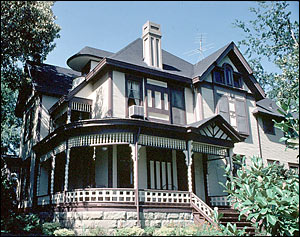
Albert Retan HouseHistoric homes in Little Rock are certainly not limited to downtown.  Today’s is the Albert Retan House, built in 1893 in what would become Pulaski Heights.

Due to geography, by the late 1800s, the land west of Little Rock stood as the only logical direction for the city to expand.  A group of Michigan investors saw the potential of this area of rolling hills and pine forests as sound investment property and conceived the development of Pulaski Heights, Little Rock’s first planned suburb.  In 1891 this investment syndicate organized the Pulaski Heights Land Company and proceeded to purchase 800 acres located three miles west of Little Rock.  Eight of the investors, including Albert Retan, brought their families to Arkansas to settle in the new suburb.

Retan built his house in 1893 and it remains an important symbol of the founding, growth and success of the Pulaski Heights community.  Architecturally, the structure represents a transitional style incorporating the fluent decorative woodwork of the Queen Anne in its sweeping porch with spindle frieze and the stately lines of the Colonial Revival mode in its hip roofs with projecting cross gables and its Palladian windows.  The suburb attracted professionals and businessmen who desired an alternative to living in the central area of the city without forfeiting convenient access to their places of business in downtown Little Rock.

Once established as a popular neighborhood, Pulaski Heights grew steadily.  As a result, it was incorporated as a town in 1905 and soon after, in 1916 the “Heights” was annexed to the city of Little Rock.  Never having suffered the decay that has threatened many of Little Rock’s other older neighborhoods, Pulaski Heights remains a prominent residential area in Little Rock with the Albert Retan House surviving as an important reminder of the origins and history of the city’s first planned suburb.

It was added to the National Register of Historic Places on December 3, 1980.

Heritage Month – U.S. Arsenal Tower Building

MacPark ArsenalToday is Armed Forces Day.  It is an appropriate day to look at the U. S. Arsenal Tower Building.  Construction on the Little Rock Arsenal began in 1838 and was completed in 1840.  The complex grew to include more than thirty buildings. The arsenal building itself was a two story brick building with an unusual central octagonal tower between two wings. The tower was actually used to move munitions between floors of the building. Other buildings included office buildings, a storehouse, a magazine, a guardhouse, a hospital and other service structures. The hospital and service structures were built of wood.

On 25 Jul 1873 the Little Rock Arsenal became the Little Rock Barracks and remained that until the facility was abandoned 25 Sep 1890. The tower building was converted into married officer quarters. Douglas MacArthur was born 26 Jan 1880, in the tower building at the Little Rock Barracks to then Captain Arthur MacArthur, Jr. and his wife.

The site was turned over to the city 23 Apr 1892, stipulated for use as a city park. In return, the City of Little Rock gave the U.S. Government 1,000 acres  on which Fort Logan H. Roots was established by the U.S. Congress on the same date, 23 Apr 1892. All of the remaining buildings on the original site were sold or destroyed except the Arsenal Tower building.

The land became known as City Park and later MacArthur Park.  The Tower Building remained empty and in deteriorating condition until the late 1930s, when the City of Little Rock renovated the building.  For many years, the Aesthetic Club met in the building as the only tenant.  When others refused to pay the utilities, the Aesthetic Club members did.  The organization continues to meet in the building.

In 1942, the Museum of Natural History and Antiquities opened in the building; it had previously been located in Little Rock’s City Hall. The name of the museum changed in 1964 to the Museum of Science and Natural History, and again in 1983 to the Arkansas Museum of Science and History. In 1997, the museum moved to a new location in the River Market, where it now is known as the Museum of Discovery.

In May 2001, the MacArthur Museum of Arkansas Military History opened in the building.

The structure was listed in National Register of Historic Places on July 28, 1970.  It was designated a National Historic Landmark on April 19, 1994.

Heritage Month – Lamar Porter Field

Lamar PorterLamar Porter Athletic Field is located in the Stifft Station neighborhood. Construction started in 1934 and continued for 18 months by the Works Progress Administration on a 10 acre site.

The 1,500 seat grandstand included club rooms, shower and locker rooms and a concession stand. It was first used by Boys’ Club teams in 1936. By 1937, City leagues and American Legion teams used it.  A playground, softball field and tennis courts were constructed next to the baseball field.

Lamar Porter Field is remarkable not only for its architecture, but also for its history.  Thousands of boys growing up in Little Rock played ball here.  One of those was future Baltimore Oriole Hall of Fame third baseman Brooks Robinson.  He has come back numerous times and has aided in fundraising efforts to restore the field.

The baseball sequence from A Soldier’s Story with Denzel Washington was filmed at Lamar Porter Field.

The field is named in memory of Lamar Porter, whose family donated the land and some money to help with the construction.  A Little Rock native, he was killed in May 1934 while he was attending Washington and Lee University.

Today Lamar Porter Field and the multipurpose field are home to RBI (Reviving Baseball in the Inner-city) which is an official program of Major League Baseball. Both Catholic High School and Episcopal Collegiate use Lamar Porter as their home field.

Lamar Porter Field was placed on the National Register of Historic Places on December 6, 1990.

Heritage Month – Joseph T. Robinson House

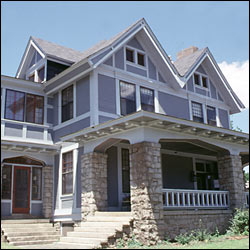
JT Robinson HouseThe Robinson House or the Foster-Robinson House is located at 2122 Broadway.

It was designed by Frank W. Gibb and built in 1904 for lumber man H. H. Foster.  Senator Robinson purchased the home from Foster’s widow and the house remained in the Robinson family until 1972 (following the Senator’s death in 1937 and his widow’s death in 1958). While visiting the state, President Roosevelt stayed at this house.

The Robinson house is a 2-1/2 story wood frame structure resting on a foundation of granite and brick. The exterior is sheathed in clapboards, and the roof is steeply pitched with a complex and irregular plan. There are four chimneys, two of brick and two of granite and brick. The main facade consists of a full-width porch supported by three square granite posts, above which are two pairs of sash windows, topped by a pair of gable ends, each with two small square windows. The gable ends are finished in stucco with decorative half-timbering. The porch is decorated with flattened Tudor-style arches and ornamental brackets, and shelters the main entrance, which is under the right gable, and paired windows under the left gable.

The interior has a wealth of high-quality woodwork, made using some of the choicest and most unusual cuts available at the time.

In addition to the house, the property includes a carriage house built using the same methods as the house. The yard is enclosed by an iron fence on the south and east sides, and a rock wall on the north and west sides.

It was listed in the National Register of Historic Places on March 28, 1975.  On October 12, 1994, it was designated a National Historic Landmark.

Heritage Month – Hotze House

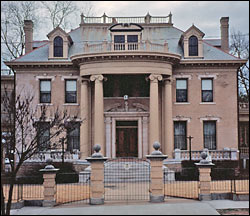
Hotze hosueThe Hotze House, located at 1619 Louisiana in Little Rock’s historic Quapaw Quarter district, was built by one of Arkansas’ most successful and prominent businessmen.  Designed by Charles L. Thompson, Little Rock’s most prominent architect and constructed in 1900, the house reflects the Beaux Arts tradition combined with Georgian influence.  The interior was reputed to have been designed by Tiffany Studios of New York.  The house has been remarkably well preserved and remains practically unaltered.

Peter Hotze was born in Innsbruck, Austria, on October 12, 1836.  He was young at the time of his father’s death, but Mrs. Hotze’s inheritance made it possible for her three sons to attend the University of Innsbruck.  In 1857 Peter Hotze moved to Little Rock and went into the general merchandise business.

Returning to Little Rock after service and imprisonment in the Civil War, Hotze went into a business as a merchant in partnership with Capt. John G. Fletcher, who had been his company commander.  Each man put $2,500 into the business.  After a while, they limited their business exclusively to the cotton trade.  In 1873 it was decided that Hotze should move to New York to handle that end of the firm’s business.  He lived there for 27 years, in a fashionable neighborhood near Central Park.

In 1900, Hotze retired and returned to Little Rock.  Upon his return in 1900 he built the large house in which he lived with his daughter Clara and son Frederick until his death on April 12, 1901.  He chose to build his home directly behind the small frame house he had built about l869 and lived in during his previous residence in Little Rock.

The Hotze House is one of the finer homes remaining in the state which expresses the opulence of the period in which it was constructed, particularly in the interiors, which are extraordinarily rich in quality. Resting on three and one-half lots, the Hotze House is remarkably well preserved and appears practically the same as when it was first constructed.

It was added to the National Register of Historic Places on August 11, 1975.