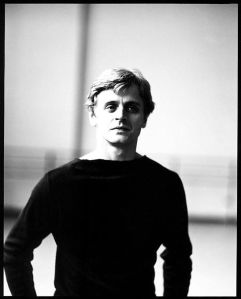
Rock the Oscars: Mikhail Baryshnikov

On July 24, 1983, Mikhail Baryshnikov danced on the stage of Robinson Center under the auspices of Ballet Arkansas.   Nearing the end of his dancing career with American Ballet Theatre, he was leading a summer tour of the Southeast and Midwest US.

In the early spring of 1983, Ballet Arkansas was contacted to see if they would be interested in having him perform in Little Rock.  (The $60,000 sponsorship was paid completely by the ARKANSAS DEMOCRAT.) The performance was announced in April with tickets going on sale shortly thereafter.

Following Baryshnikov’s performance, he and his fellow dancers attended a reception at the Old State House Museum which was hosted by Governor and Mrs. Bill Clinton.

After dancing with the Mariinsky Ballet for several years, he defected to Canada while the ballet was performing there in 1974. He later came to the US to dance with American Ballet Theatre and later New York City Ballet. He returned to ABT in 1980 to take on the role of Artistic Director and continue dancing.  It was in this capacity that he visited Little Rock.

He received a 1977 Oscar nomination for Best Supporting Actor for his role in the ballet-themed film The Turning Point.

Baryshnikov would later be welcomed by the Clintons to the White House when he received a 2000 Kennedy Center Honors.

Rock the Oscars: Gregory Peck

In August 1977, Oscar winner Gregory Peck appeared in Little Rock for the premiere of the film MacARTHUR.  He played the general who had been born in Little Rock but who spent most of his life downplaying (or even denying) that fact.

MacArthur was brought to the screen by Universal Pictures.  It was their attempt to capitalize on the success of the movie Patton, including sharing some of the same members of the production team.

Told entirely in flashback, it starred Peck as the fabled World War II general who was born in Little Rock. It focuses primarily on events in 1942 during the war, his dismissal by Truman in 1952, and his famous address to West Point in 1962.

Peck initially did not care for the subject or the script, but eventually stated that he grew to admire the challenges MacArthur faced.  Peck later called it one of his favorites roles, if not one of his favorite movies.

Producer Frank McCarthy, who worked on both Patton and MacArthur once said of Patton and MacArthur: “Both were complex men but General MacArthur was complex on a much broader scale. Patton had no ambition except to be a soldier and to command a field army. He was strictly command.”

Most of the film was shot on the backlot at the movie studio, which impacted the quality of the film.  The production budget simply would not allow for overseas location filming.

The premiere was a fundraiser for the Museum of Science and History (now the Museum of Discovery).  At the time it was located in the Arsenal Building, in which MacArthur had been born.  Since 1999, that has been home to the MacArthur Museum of Arkansas Military History.  Since MacArthur only spent a few hours in Little Rock as an adult, it is possible that Peck spent more time in the building than the General did.

The evening of August 5, 1977, started with an exclusive reception for 100 people with Gregory and Veronique Peck.  The movie itself was shown at the Cinema 150, where its general run would start on Saturday, August 6.  Following the film, a reception and silent auction brought people back to the museum.  Tickets ran $250 a person for all events, $100 a person for the film and post-show reception, and $25 for the movie.  It sold out.

Governor and Mrs. David Pryor escorted the Pecks into the theatre.  Former Governor (and World War II hero) Sid McMath introduced Mr. Peck to the crowd.  He extolled the virtues of Peck and MacArthur.  (It is interesting that he should admire MacArthur so much, since the General and President Truman had a well-publicized tiff, and McMath and Truman had enjoyed a warm relationship.)  Little Rock City Director Jim Dailey presented Peck with a Key to the City.

MacArthur did not lead to an Oscar nomination for Peck (though he did earn a Golden Globe nomination for the role).  But the actor had enjoyed four nominations prior to his win for To Kill a Mockingbird.  He also received the Jean Hersholt Humanitarian Award from the Academy.  He served as president of the Academy for several years.

 

Rock the Oscars: Leo Robin and Jule Styne

Lyricist Leo Robin with composer Jule Styne working together on the score of Gentlemen Prefer Blondes at the time of the original production in 1949.

Perhaps the most famous song about Little Rock is “(I’m Just a) Little Girl from Little Rock.”  Written by Leo Robin and Jule Styne, it first appeared on Broadway in Gentlemen Prefer Blondes where it was sung by Carol Channing.  When the title was made into a movie, it was sung by Marilyn Monroe and Jane Russell.

Because it was not written for the screen, the song was not eligible for an Oscar.  However, the duo who wrote it had their fair share of Oscar nominations and wins.

Robin, earned ten nominations between 1934 and 1953.  As a lyricist, he collaborated with seven different composers in earning these nominations. His one Oscar came for “Thanks for the Memory” from The Big Broadcast of 1938.  In the film it was sung by Bob Hope and Shirley Ross.  It would be associated with Hope the rest of his life.

Styne also earned ten nominations; his were between 1940 and 1968.  Seven of the nominations were for collaborations with Sammy Cahn.  (There were three other partners with whom he shared nominations, too.)  His win came for “Three Coins in the Fountain” from the film of the same name.  In the movie it was sung by an uncredited Frank Sinatra during the opening title sequence. During the closing credits, an unnamed chorus repeated the song.

Gentlemen Prefer Blondes received no Oscar nominations, though Charles Lederer did receive a Writers Guild of America nomination for screenplay of an American Musical.  Though Jane Russell introduced an Oscar winning Best Song in Paleface (“Buttons and Bows”) and Oscar nominated Best Song in Son of Paleface (“Am I in Love”) she never received an Oscar nomination.  Monroe never received one either.  Only co-star Charles Coburn had any luck with Oscar.  He received three nominations, winning once.

Rock the Oscars: Broncho Billy Anderson

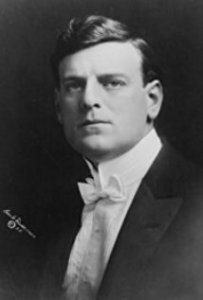
At the 1958 Oscars, GilbertM. “Broncho Billy” Anderson received an Honorary Oscar as a motion picture pioneer.  The citation praised  his contributions to the development of motion pictures as entertainment.

Born in Little Rock in March 1880, he was the son of Esther and Henry Aronson. Both were originally from New York.  Her parents were German-Jewish immigrants and his parents were Russian-Jewish immigrants.

After working as a photographer’s assistant and model, Anderson eventually found his way to vaudeville as a performer and writer.  In 1903, he appeared in the early seminal film The Great Train Robbery in several roles.  He created the western persona of Broncho Billy in front of the cameras.  Behind the scenes, he was a studio owner and director.  Over his career, he directed over 400 films.  By the early 1920s, he retired as an actor and director and devoted himself to owning a Broadway theatre and producing stage shows.

He made occasional film appearances beginning in the 1940s.  In 1958, he appeared in a documentary about Westerns for the TV show “Wide, Wide World.”  Also featured in that special were Little Rock actors Ben Piazza and Gail Davis.  His final screen appearance was in 1965’s The Bounty Killer.  He died in 1971 at the age of 90. He had been married to his wife for sixty years at the time of his death.


Rock the Oscars: Dick Powell

The Oscars are on March 4.  In the days leading up to them, the Little Rock Culture Vulture will look at Little Rock connections to the Academy Awards over the 90 ceremonies.

First up is Dick Powell.  Though not born in Little Rock, he grew up here and graduated from Little Rock High School when it was on Scott Street (now the East Side Lofts).  He started earning money as a singer in Little Rock churches and masonic lodges before transitioning to nightspots which eventually led to him touring the country with dance bands.

When Hollywood beckoned, he first appeared in light musicals as a singer and dancer.  One of his first non-musical roles was in the  all-star A Midsummer Night’s Dream which earned four Oscar nominations and won two.  He starred opposite future Oscar winners Jimmy Cagney and Olivia de Havilland.  Eventually, he transitioned into film noir roles including playing Phillip Marlowe in 1945’s Murder, My Sweet.  

In 1948, Powell hosted the Oscars ceremony. Gentlemen’s Agreement won Best Picture and two other Oscars that year.  (He was not the first Arkansan to host the Oscars.  In 1938, Van Buren native Bob Burns hosted the ceremony.)  In 1959, he and his then-wife June Allyson were two of the presenters at the Oscars.  That ceremony came in at one hour and 40 minutes in length. It was under-time so the presenters and winners took to the stage floor with dancing as a way to fill time before NBC cut away and aired a documentary on target-shooting.

Powell was one of the stars of 1952’s The Bad and the Beautiful.  The film won five Oscars but was not nominated for Best Picture.  It holds the record for the most wins by a film not nominated for Best Picture.

Little Rock Look Back: Jefferson Thomas

Jefferson Thomas was a track athlete at all-black Dunbar Junior High School in Little Rock when he volunteered to integrate all-white Central High School as a sophomore in 1957.  A few days before he entered the school, he celebrated his fifteenth birthday, having been born on September 19, 1942.
Mr. Thomas was a quiet, soft spoken, unique, and special person.  He had a subtle, infectious sense of humor that served him well throughout his life.  He would find that sense of humor and his love for humanity severely tested by the hate and violence directed toward him by some of the white students at Central High School.  Mr. Thomas graduated from Central High School in May 1960.

He served as the narrator of the Oscar winning documentary short, “Nine from Little Rock.”

Mr. Thomas married in 1965 and has one child (Jefferson, Jr.), still living in Los Angeles.  Mr. Thomas, Sr. was inducted into the United States Army in 1966.  He returned to civilian life in the summer of 1968.

After obtaining a Bachelor Degree in Business Administration from Los Angeles State College, Mr. Thomas went to work as an Accounting Clerk and later, Supervisor for Mobil Oil Corporation.  When Mobil Oil moved its Credit Card Operations, Mr. Thomas remained in Los Angeles, and entered Federal Service as an Accounting Clerk with the Department of Defense.  The DOD relocated parts of its LA operations to Columbus, Ohio, in 1989.  He sold his business and moved to Columbus.

After moving to Columbus, Mr. Thomas continued his commitment to serve the local community, Mr. Thomas took time to serve as a volunteer mentor in the Village to Child Program, co-sponsored by Ohio Dominican University.

He was a frequent speaker at numerous high schools, colleges and universities throughout the country, and an eager mentor to young people.  He was the recipient of numerous awards from local and federal governmental agencies.  These awards include the NAACP Spingarn Medal, and Congressional Gold Medal, this Nation’s longest-running tradition of honor, for helping make democracy work.  He was especially proud of the life-size sculpture of the Little Rock Nine at the Arkansas State Capital in Little Rock, the first in the state honoring living citizens.

Jefferson Thomas retired in September 2004, after 27 years of Federal Service. He departed this life in 2010.  His wife, Mary, still resides in Columbus, Ohio.

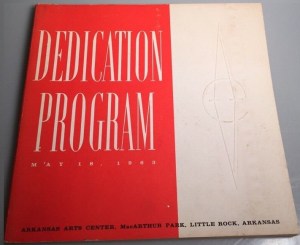
Little Rock Look Back: Opening of the Arkansas Arts Center!

On Saturday, May 18, 1963, amidst fanfare and fans of the arts, the Arkansas Arts Center officially opened its doors.  (This was thirty-five years and three days after the Fine Arts Club had opened the first permanent art gallery in Arkansas in the Pulaski County Courthouse).

The dedication ceremonies on May 18 featured U.S. Senator J. William Fulbright (who was in the midst of championing what would soon be known as the John F. Kennedy Center for the Performing Arts), Congressman Wilbur Mills, Governor Orval Faubus, Little Rock Mayor Byron Morse, Winthrop Rockefeller and Jeanette Rockefeller.

On Friday, May 17, 1963, film star Gordon MacRae performed two separate concerts in the theatre space.  There were other assorted small events and tours on May 16 and 17.

The culmination of the weekend was the Beaux Arts Bal.  This black tie event, featured Oscar winner Joan Fontaine, cartoonist Charles Addams (creator of The Addams Family), James Rorimer of the Metropolitan Museum, and Dave Brubeck.  Chaired by Jeane Hamilton, the event set a new standard for events in Little Rock.

Among the exhibits at the Arkansas Arts Center for the grand opening was a special exhibit from the Metropolitan Museum of Art in New York entitled Five Centuries of European Painting.  In Little Rock for six months, this exhibit featured works by El Greco, Titian, Claude Monet, Odilon Redon, Pierre Renoir, Paul Signac, Edgar Degas, and Paul Gauguin among many others and spanned from the fifteenth century Early Renaissance era to the nineteenth century.

Prior to the opening, a profile on the Arts Center in The Christian Science Monitor touted the building as one of the first regional arts centers in the country to be completed. Benefiting from national ties of the Rockefeller family, the events in May 1963, set a high standard for the institution, and for other regional art museums.