Little Rock Look Back: SOUTH PACIFIC wins Pulitzer Prize for Drama

SoPa Pul GazThe Pulitzer Prizes will be announced today.  In 1950, one of the recipients in the “Letters, Drama and Music” categories featured a character from Little Rock.

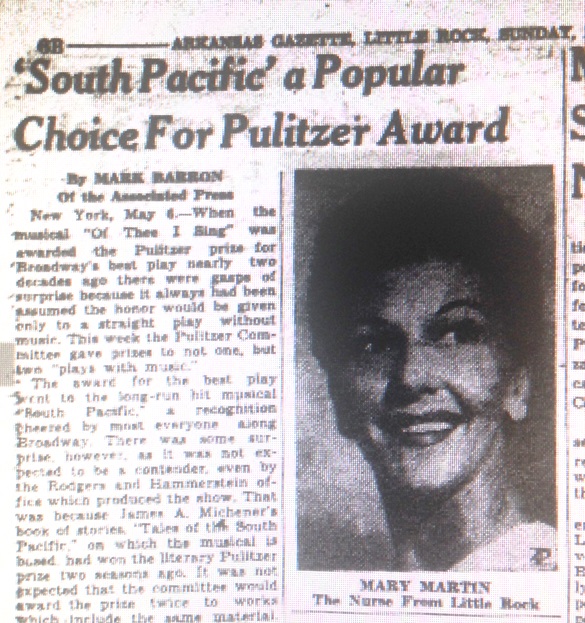
The 1950 Pulitzer for Drama went to a musical, for only the second time in the history of the awards.  The recipient was South Pacific by Richard Rodgers, Oscar Hammerstein II and Joshua Logan.  The character was the leading lady of Nellie Forbush. She was an Navy ensign and a nurse stationed on an exotic island during World War II.  The musical was based on a Pulitzer Prize winning novel, James Michener’s Tales of the South Pacific.

In the Michener novel, Miss Forbush is not from Little Rock.  She is actually from a small town in Alabama.  The part was written for Mary Martin from Weatherford, Texas.  Rodgers, Hammerstein & Logan did not discuss why they relocated Nellie’s birthplace.

In the musical, Nellie struggles with her own prejudices. This issue of prejudice became an instance of fact meeting fiction. In 1957, a few weeks after Eisenhower sent troops into Little Rock to ensure that Central High would be desegregated, a production of South Pacific on Long Island was temporarily halted when the audience booed and yelled after Nellie mentioned she was from Little Rock.


On Pulitzer Day – Prizing Mount Holly

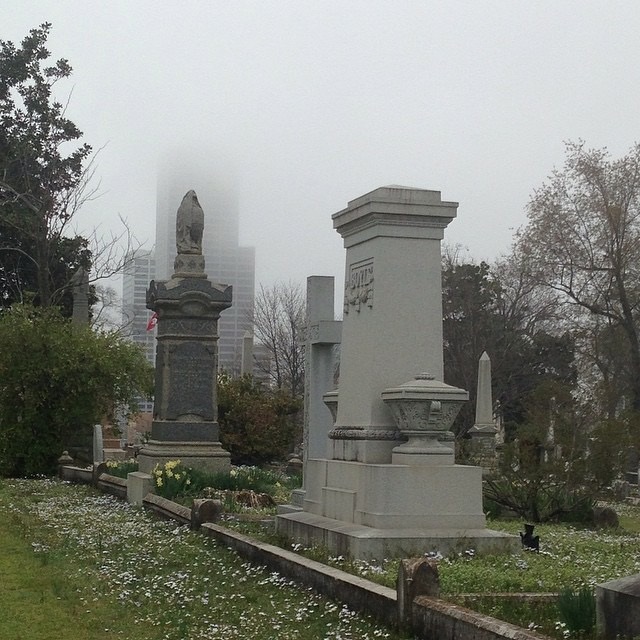
The Pulitzer Prizes are to be announced today.  Mount Holly Cemetery not only touts that it is the site of a whole host of elected officials, it is also the only place in Arkansas where two Pulitzer Prize recipients are buried. The cemetery is open every day, but a special visit to these two prize winner gravesites can be made next Sunday during the Mount Holly Cemetery Association’s annual “Rest in Perpetuity” fundraiser picnic.

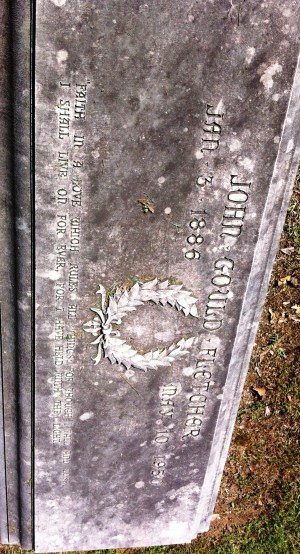
In 1939, John Gould Fletcher became the first Southern poet to win the Pulitzer Prize for Poetry.  He was born into a prominent Little Rock family in 1886.  Fletcher was awarded the prize for his collection Selected Poems which was published by Farrar in 1938.  Two years earlier, he had been commissioned by the Arkansas Gazette to compose an epic poem about the history of Arkansas in conjunction with the state’s centennial.

Fletcher is buried next to his wife, author Charlie May Simon and his parents (his father was former Little Rock Mayor John Gould Fletcher).  Other relatives are buried nearby in the cemetery.

The other Pulitzer Prize winner buried in Mount Holly is J. N. Heiskell, the longtime editor of the Arkansas Gazette.  It was Heiskell, in fact, who asked Fletcher to compose the poem about Arkansas.  Heiskell served as editor of the Gazette from 1902 through 1972.  He died at the age of 100 in 1972.

Under his leadership, the Gazette earned two Pulitzer Prizes for its coverage of the 1957 desegregation of Little Rock Central High.  One was for Harry Ashmore’s editorial writing and the other was for Public Service.

Heiskell remained in charge of the Gazette until his death in 1972.  He is buried alongside his wife with other relatives nearby.  Also not too far from Mr. Heiskell are two of his nemeses, proving that death and cemeteries can be the great equalizer. In the early days of his Gazette stewardship, he often locked horns with Senator (and former Governor) Jeff Davis. Later in Mr. Heiskell’s career, he vehemently disagreed with Dr. Dale Alford, who had been elected to Congress on a segregationist platform.

Poetry Month: John Gould Fletcher & “In Mount Holly”

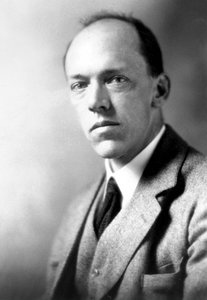
John_Gould_Fletcher poetThe Pulitzer Prizes will be announced tomorrow.  Arkansas poet John Gould Fletcher became the first Arkansan to win a Pulitzer and the first Southern poet to win the Pulitzer for Poetry.

The scion of a leading family of Little Rock, Fletcher was most known for his association with the Imagism movement in poetry.

Below is his 1929 poem “In Mount Holly.”  This cemetery is the final resting place of many members of his family. Fletcher and his wife Charlie May Simon (an award winning children’s author) are buried next to his parents in Mount Holly.

Supporters of Mount Holly will gather next Sunday (April 26) for the Rest in Perpetuity picnic in the cemetery.  It is a fundraiser sponsored by the Mount Holly Cemetery Association.


Mount Holly grey“In Mount Holly”

Here beyond hope is all that death shall hold of me,
This brown Arkansas hillside, dreaming through depth of mid-winter, alone in the southland;
Under the dove-grey low-swung cloud come up from the Gulf to scatter
Its benediction of deep rain, endlessly flashing and pouring;
Here, in the drift of the years,
From the seas I have crossed, and the lands I have known, and the struggles
I have faced with the steady river of time marching on through my vitals,
I have come back to this point of repose, to these stones side by side in the grass,
Turning as the earth turns against far Orion’s fierce whirlwind of stars.

They greet me unseeing, these graves,
Mute symbols of life accomplished, made noiselessly perfect,
Quieted by the cold hands of death that suddenly seize on the body
In an hour unexpected, as a thief in the night, running free with the tale of man’s days;
Yet not to be loosed from the soil till the sphere splits its core and is shattered
Like a ripe seed pod crammed full with thick seed of expectancies, memories, and failures;
Their dumb thought trails on in the soil while I in the high world above them
Lift up thin eager hands to the sky and cry to the sun’s dying splendor.

Here beyond hope is all that death shall take of me,
The blood that is mine, and yet theirs, the tower, the base and the framework;
The building not reared by man’s hands, but shaped in the night and the silence,
The framework of the body fashioned as theirs, for the blood through the generations
Repeats the same tale of Eden lost and Paradise darkly forgotten:
When the stars hang low in the sky and two souls become as one body
Straining past hope and despair to a timeless consummation,
Which is as the wedding-song of God mating the stars without number.
Here does the last life wait,
Crouched in its stronghold of bone behind the slow-vanishing sinew,
A spark without issue, a last ache of lust, a slow tide merging and dying
Into the running of quick hidden sap and the thin dumb flame of the grass.

Out of what chasms of fire,
Out of what lavalike torrents life sprung at the outset neither I nor these graves can remember;
They have become turf-covered dumb mouths opening below to the waters under the earth,
Which burst forth but once in the flood, and since then have ever been silent.
Into what dark seas we flow
I know not at all—I remember
Only the sunlight that lays a soft pencil of shadow to sleep on the grass;
The tramp of the black-clad pallbearers, the words spoken or sung, the lowering of the coffin to earth.

Here beyond hope, beyond dreams,
Under this soft and lazy sky dreaming in depth of midwinter,
Where the sweetgum casts to the earth its brown prickly balls, where the holly
Flashes its scarlet clusters, where the feathery pine sways its thin needles,
Where the red haw blazes with berries threaded bright on long outspraying stems,
Where the conelike fount of the magnolia spreads downwards a billion of star-rayed leaves,
Where the acorn lies split on the stone, its yellow sustenance wasted:
Here was I fashioned and made
By those who now sleep in the earth at my feet, as they by others forgotten.
Their speech was my speech, their dream was my dream, it was given
Beyond the cloud’s arbitrament of rain to create, or the slow earth’s power to destroy.
And I pause ere I go,
And stretch out my hands to these worn stones, smoothing them over and over,
Repeating their names which no one but I now remembers,
Praying that they may somehow bless me;
These who have given me life and so many dreams
On this brown Arkansas hillside, quiet in depth of midwinter:
Out of this army of graves facing eastward I single out but these two stones,
I wailingly beseech them
With the tears of the spirit torn against life and its days,
In this place where so many tears have been shed and mortal lives brought to the awe
Of the open portals of death, beyond hope, beyond dreams;
I kneel and weep as a man weeps,
I cry out loud as a man cries,
Let that which is mine and yet yours, this memory transient, this passion,
Marked by the cross of Christ on those stones, marked in my heart by time’s ebbing,
Be with me now forever wherever I go.

Little Rock Look Back: SOUTH PACIFIC opens on Broadway 66 years ago today

southpacific_obcSixty-six years ago today, a fictional Little Rock heroine took the stage of a Broadway megahit when South Pacific opened at the Majestic Theatre on April 7, 1949. It settled in for a run of 1925 performances. Based on the James Michener Pulitzer Prize winning novel Tales of the South Pacific, it featured a book by Oscar Hammerstein II and Joshua Logan, songs by Richard Rodgers and Hammerstein and direction by Logan. It was produced by Rodgers, Hammerstein, Logan and Leland Hayward. Set in the titular islands, it concerned the relationships of sailors, nurses, island natives and other island inhabitants.

The musical starred recent Tony winner Mary Martin as Little Rock native Nellie Forbush, opera star Ezio Pinza, stage veterans Myron McCormick and Juanita Hall, and stage newcomers William Tabbert and Betta St. John. Cloris Leachman was Martin’s understudy and would later succeed her in the part of Little Rock native Nellie Forbush.

Like other Rodgers and Hammerstein musicals, this show tackled tough themes – this one being prejudice. That did not set well with some theatergoers. Indeed, some potential investors did not put money into the show because of its stance. But Rodgers, Hammerstein, Logan and Hayward persisted. Their diligence paid off when the musical received the 1950 Pulitzer Prize in Drama, only the second musical to receive this designation. It is also the only Pulitzer Prize for Drama winner to be based on Pulitzer Prize winning source material. This was the first Rodgers & Hammerstein musical to not feature big dance numbers. In fact, there was no choreographer. The dance steps which existed were created by Martin, who had taught dance in her native Texas as a young mother.

Opening late in the season, South Pacific was named the 1949 New York Drama Critics Circle Best Musical, but was not part of the Tony Awards until 1950. (Though Jo Mielziner, who designed the set for South Pacific received a Tony for his set designs of shows during the 1948-49 season and South Pacific was one of the titles listed.) At the 1950 Tonys, it received six Tony Awards (sometimes listed as eight because Book and Score were not broken separate from Best Musical that year—but some sources incorrectly separate them.) It was named Best Musical, Actor in a Musical (Pinza), Actress in a Musical (Martin), Featured Actor in a Musical (McCormick), Featured Actress in a Musical (Hall), and Director (Logan). This is the only time that all four acting awards in the musical category went to performers in the same production. In fact, the other two acting trophies that year were incorrectly engraved as being from South Pacific out of habit.

Logan’s win was also the first time that the Director Tony went for a musical, since at the time that award was not separated out among plays and musicals. Hall was the first African American to win a Tony Award for Acting. Martin would reunite with Hayward, Rodgers & Hammerstein ten years later for The Sound of Music. Pinza and Tabbert reunited in 1954 for Fanny which would be the final Broadway credit for each gentleman. McCormick stayed with the show the entire run, except for vacations.

In 1999 for the 50th anniversary and in 2008 for the opening of the first Broadway revival remaining cast members from the original production had reunions in New York City. At the 50th anniversary ceremony, a proclamation from Little Rock Mayor Jim Dailey was read declaring it South Pacific day in Little Rock and honoring the show. It is interesting to note that in 1949, there were two heroines on the Broadway stage from Little Rock: Nellie Forbush from South Pacificand Lorelei Lee from Gentlemen Prefer Blondes.

In 2008, Lincoln Center Theatre produced the first revival of South Pacific on Broadway. It opened on April 3, just four days shy of the musical’s 59th anniversary.  The cast was led by Paulo Szot, Kelli O’Hara (as Little Rock girl Nellie Forbush), Matthew Morrison (before “Glee”), Danny Burstein and Loretta Ables Sayre.  The production restored a song which had been written for the original Broadway production that had been dropped. “My Girl Back Home” was featured in the movie version and in this Broadway revival. In it O’Hara and Morrison sang of their hometowns of Little Rock and Philadelphia.  The production was nominated for 11 Tony Awards and won 7: Best Musical Revival, Actor in a Musical (Szot), Director of a Musical (Bartlett Sher), Scenic Design (Michael Yeargan), Costume Design (Catherine Zuber), Lighting Design (Donald Holder) and Sound Design (Scott Lehrer).

Bartlett and O’Hara are reunited with Lincoln Center right now for a revival of The King and I. The song “Getting to Know You” from that show was originally written for South Pacific as a song called “Suddenly Lucky.”  It was replaced in South Pacific by “(I’m in Love with a) Wonderful Guy.”

Robinson Redux March

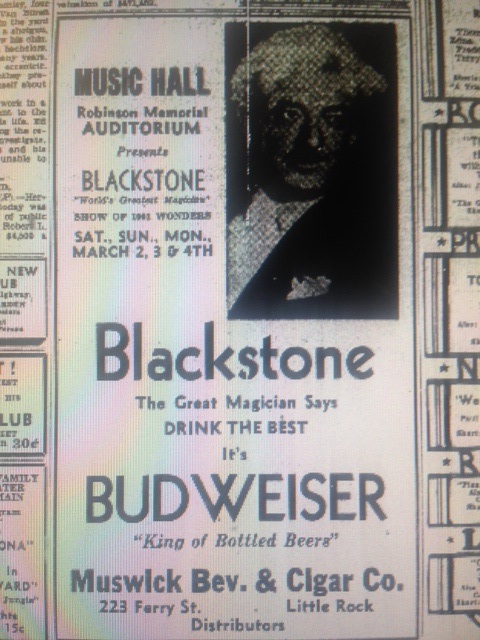
Blackstone adWhile Robinson Center Music Hall is closed for renovations, the Culture Vulture blog is taking a look back at previous bookings in the facility each month.

March 1940 was the first full month that Robinson Auditorium was open.  The month started with Blackstone the magician in performances from March 2 through 4. In addition to his appearance touted by the auditorium, Muswick Beverage & Cigar Company promoted his appearance, and the fact that he endorsed Budweiser beer.  Later that month, appearances included the Shrine Circus, the AAU girls basketball championship, and the Saint Louis Symphony.

March 1950 was a particularly busy month. It featured singer Vaughn Monroe on the 6th and the Arkansas State Symphony playing Beethoven’s Ninth Symphony on the 7th.  On the lower level, a circus took up residency from the 7th through 10th.  Back upstairs in the music hall, Ballet Theatre visited performing Balanchine’s “Theme and Variations” featuring ballerina Nora Kaye and conductor Max Goberman.  The month concluded on the 27th with James Dunn starring in the Pulitzer Prize winning Harvey.

In 1955, Jose Greco and His Spanish Dancers entertained audiences on March 7. Five years later, the Chicago Ballet was featured on March 26, 1960. Earlier that month (the 16th), Max Rudolf conducted the Cincinnati Symphony Orchestra. March 1965 feautured the Chicago Opera Ballet (on the 2nd) and an evening of country music stars including Buck Owens and Kitty Wells (on the 10th).

In March 1970, the national tour of the Broadway musical Mame starring Sheila Smith launched the month on the 6th and 7th. Later that month The Florida Boys were in concert. March 1975 saw much activity at Robinson Center. Guy Lombardo and his orchestra appeared on the 2nd and Richard Fredricks, baritone, gave a recital on the 4th, under the auspices of the Community Concert Series. On March 5 & 6, a statewide touring production of South Pacific played at Robinson. Produced by Vince Insalaco, it starred Judy Pryor (now Judy Trice) as Little Rock native Nellie Forbush. The month closed out with the national tour of Fiddler on the Roof.

March 1980 saw Dawn Wells starring in Neil Simon’s Chapter Two on the 8th. The Arkansas Symphony Orchestra performed on the 15th and 16th with pianist Lorin Hollander as guest artist. Five years later, Marilyn Horne appeared with the ASO on March 2, 1985. At the same time that evening, the Shriners Ball was taking place on the lower level. Later that month a national tour of Sophisticated Ladies stopped by Robinson on the 12th. The ASO returned on March 20 & 21 with pianist Garrick Ohlsson.

The Sharks and the Jets lept on the stage on March 20, 1990, as a tour of West Side Story came to Robinson Center. The month concluded with pianist Jose Carlos Cocarelli in concert with the ASO.

Marilyn Horne returned to Little Rock, ten years and one day after her previous appearance, and performed with the ASO again on March 3, 1995. The month also included The Will Rogers Follies on March 10-12, Jazz Explosion II (with George Duke, Dianne Reeves, Phil Perry, Howard Hewett, and George Howard) on March 15, and the ASO in concert with cellist Jeffrey Solow on March 18 & 19. On March 22, the musical Raisin was performed. The cast included Peabo Bryson, Jeffrey Osborne and Lynette Hawkins.

As the 2000s rolled around, Robinson Center continued to feature an eclectic mix. In March 2000, Ann Hampton Callaway performed with the ASO on March 4 & 5. Later that month the original cast of Red, White & Tuna played at Robinson from March 14 through 19. In 2005, the national tour of Mamma Mia! played at Robinson from March 1-6. Later that month the ASO performed Broadway a la Carte with an eveningn of songs from the Great White Way (on March 18 & 19).

In 2010, the ASO performed a concert version of Porgy & Bess on March 12 & 13. It was the first time that title had ever been performed in its entirity in Arkansas. Irish dance took the stage the next night as Lord of the Dance took up residence at Robinson Center.

A Year Long Party for Arkansas Rep 40th Season

The 2015-2016 season is the 40th one for the Arkansas Repertory Theatre. The audience gets the gifts.

The season kicks off with William Shakespeare’s Scottish play about the Thane of Cawdor and his wife Lady M. It will run September 11-27.

Next up is the Tony winning musical The 25th Annual Putnam County Spelling Bee. This tuneful, witty musical with book by Rachek Sheinkin and songs by William Finn, will play from October 16 to November 8.

Disney’s The Little Mermaid will be the holiday show running from December 4 to January 3.  It will be a regional premiere of this musical featuring a book by Pulitzer and Tony winner Doug Wright and a score by the Oscar winning team of Alan Menken and Howard Ashman, with additional lyrics by Glenn Slater.

2016 will start off with another regional premiere–Peter and the Starcatcher.  This prequel to the Peter Pan stories is by Rick Elice. Though a play, it does have some songs by Wayne Barker and Elice.  This winner of  five Tony Awards will be on stage from January 15 to February 7.

The regional theatre premiere of The Bridges of Madison County will take place on the Arkansas Rep stage from April 8 to May 1.  This musical has a Tony winning score by Jason Robert Brown and a book by Pulitzer and Tony winner Marsha Norman.

The main stage season will conclude with a world premiere play Windfall.  Directed by Tony winner Jason Alexander, this comedy by Scooter Pietsch looks at greed among a group of office workers.  It will run from June 10 to 26.

The Rep also has three special offerings during the 2015-2016 year.

From February 11-14, Rebecca Wells, author of the “Ya-Ya Sisterhood” novels will present a one-woman show about the Ya-Ya Sisterhood.

The Summer Musical Theatre Intensive production will be called Broken Wings and will play from March 1-12 of 2016.

From May 3-15 the Second City will return to Little Rock for Second City: Hooking Up. 

The Rep’s 40th season features comedy, tragedy and musicals spanning from Elizabethan times to world premieres.  It truly is a showcase of the Rep’s mission and the breadth and depth of the Rep’s commitment to bringing great stories to life for Little Rock audiences.

Little Rock Look Back: John Gould Fletcher, LR 32nd Mayor

IMG_4006Future Little Rock Mayor John Gould Fletcher was born on this date in 1831. The son of Henry Lewis and Mary Lindsey Fletcher, he later served as a Captain in the Capital Guards during the Civil War. One of his fellow soldiers was Peter Hotze.

Following the war, he and Hotze began a general merchandise store in Little Rock. They were so successful that they eventually dropped the retail trade and dealt only in cotton. Peter Hotze had his office in New York, while Fletcher supervised company operations in Little Rock. In 1878 Fletcher married Miss Adolphine Krause, sister-in-law of Hotze.

John Gould Fletcher was elected Mayor of Little Rock from 1875 to 1881. He was the first Mayor under Arkansas’ new constitution which returned all executive powers to the office of the Mayor (they had been split under a reconstruction constitution). Following his service as Mayor, he served one term as Pulaski County Sheriff. Mayor Fletcher also later served as president of the German National Bank in Little Rock.

Mayor and Mrs. Fletcher had five children, three of whom lived into adulthood. Their son was future Pulitzer Prize winning poet John Gould Fletcher (neither father nor son used the Sr. or Jr. designation). Their two daughters who lived to adulthood were Adolphine Fletcher Terry (whose husband David served in Congress) and Mary Fletcher Drennan.

In 1889, Mayor Fletcher purchased the Pike House in downtown Little Rock. The structure later became known as the Pike-Fletcher-Terry House. It was from this house that Adolphine Fletcher Terry organized the Women’s Emergency Committee which worked to reopen the Little Rock public schools during the 1958-1959 school year.

In the 1960s, sisters Adolphine Fletcher Terry and Mary Fletcher Drennan deeded the house to the City of Little Rock for use by the Arkansas Arts Center. For several decades it served as home to the Arts Center’s contemporary craft collection. It now is used for special events and exhibitions.

Mayor Fletcher died in 1906 and is buried in Mount Holly Cemetery along with various members of his family. His grandson William Terry (son of Adolphine Fletcher Terry) and members of his family still reside in Little Rock.