
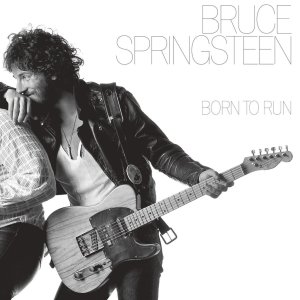
Rocking the Tonys: The Boss in The Rock!

One guaranteed winner at the 2018 Tony Awards is Bruce Springsteen.   His show Springsteen on Broadway continues to sell out at the Walter Kerr Theatre.

His one man show is part concert, part conversation, and all hit.  After previews beginning in early October, it opened on October 27 for a run that was originally to be one month.  It has been extended multiple times, and is now set to conclude in December 2018 – a full 13 months later than the original plan.

He will perform on the Tony Awards and receive an Special Tony Award tonight in recognition of his artistic contributions (and the unspoken financial contributions) to this season.

On May 3, 1976, Springsteen appeared on stage at Robinson Auditorium.  He was on a national tour riding the wave of the success of his August 1975 album Born to Run.  His set list for the concert included:  “Tenth Avenue Freeze-Out,” “Spirit in the Night,” “It’s My Life,” “Thunder Road,” “She’s the One,” “Born to Run,” “Pretty Flamingo,” “Growin’ Up,” “It’s Hard to Be a Saint in the City,” “Backstreets,” “Jungleland,” and “Rosalita (Come Out Tonight).” The encore was “4th of July, Asbury Park (Sandy)” and “Detroit Medley.

The concert sold poorly. Springsteen vowed never to return to Little Rock again.  He did eventually come back, but it would be the year 2000.

Rocking the Tonys: Baryshnikov at Robinson (part 2)

One of the presenters at Sunday’s 72nd Tony Awards is Mikhail Baryshnikov.  Twenty-nine years ago, he himself was a 1989 Tony nominee for Actor in a Play (for playing a man-turned-cockroach in an adaptation of Kafka’s Metamorphosis.
In 1985, Baryshnikov returned to Little Rock to perform again at Robinson Center under the auspices of Ballet Arkansas.   He had performed here two years earlier, as well.

Among the dancers who joined him in the program was future Tony nominee Robert LaFosse.  He would be nominated for a 1989 Tony as well. But he was up for Best Actor in a Musical for his performance in Jerome Robbins’ Broadway.  Other dancers in the company were Cynthia Harvey, Susan Jaffe, Leslie Browne, Elaine Kudo, Cheryl Yeager, Amanda McKerrow, Deirdre Carberry, Bonnie Moore, Valerie Madonia, Ross Stretton, Peter Fonseca, Gil Boggs, John Gardner, and John Turjoman.

The company danced to pieces choreographed by George Balanchine, Jerome Robbins, Marius Petipa, future Tony Award winner Twyla Tharp, Lisa de Ribere, and La Fosse.  The music composers included George Gershwin, Jacques Offenbach, Frederic Chopin, Peter Ilyich Tchaikovsky, Hector Berlioz, as well as composers who wrote songs for Frank Sinatra.

While Ballet Arkansas did not have any dancers perform during the evening, the organization presented it and was able to receive the proceeds which exceeded the expenses.  For several years in the 1980s, the Ballet would either commence or conclude their season with such an performance. In fact, the 1985 Baryshnikov program contained a promotion of a 1986 visit by Alvin Ailey’s dance company.

Whereas the 1983 Baryshnikov appearance had been sponsored by the Arkansas Democrat, this time, the rival Arkansas Gazette was the sponsor.


Little Rock Look Back: The Rices and Little Rock auditoriums

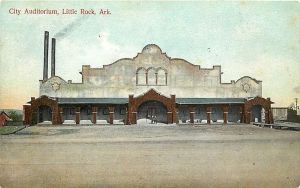
On June 7, 1920, the Little Rock City Council finally authorized the demolition of Little Rock’s 1906 temporary auditorium.  The structure had originally been built as a skating rink which, when chairs were added, could be used for public meetings.  Since the mid 1910’s, the City Council had discussed tearing it down over safety concerns.  But since Little Rock had no other structure as a substitute, the Council kept delaying the decision.

J Rice 1920In 1920, though there was not alternative space available, the Council decided that the structure had to come down.  So City Engineer James H. Rice was authorized to have the building removed.

JimRice RobinsonToday, Rice’s grandson, Jim Rice, is the COO of the Little Rock Convention & Visitors Bureau.

In that capacity he  oversaw the renovation of Little Rock’s 1940 municipal auditorium – Robinson Center Performance Hall.

Little Rock Look Back: Cornice installed at Robinson Auditorium

On June 1, 1939, the cornice was installed on Robinson Auditorium.  This granite slab noted the name of the building as the Joseph Taylor Robinson Memorial Auditorium.  (It is interesting to note that it used the more modern “u” instead of the classical “v” which was often used in buildings during prior decades – as evidenced by the Pvlaski Covnty Covrt Hovse across the street.)

This was a milestone marking the completion of the front facade of the structure.  Much work would continue on the interior of the structure.  This step in the construction was considered major enough that the Arkansas Gazette mentioned it in a news article.

(June 1, 1939, was also the first day on the job for the auditorium’s first director – William T. Clemons.  A former Little Rock resident who came from Rochester NY.  The Auditorium Commission which hired him would not disclose the sources of his salary, but assured Mayor J. V. Satterfield the money did not come from City coffers.)

On this date in 2015 and 2016, the cornice was again surrounded by construction materials and braces. But the restoration of Robinson Center finished in November 2016. Once again, the cornice stands proudly atop the six columns with no impediments around it.

Little Rock Look Back: Final Graduation of Dunbar High School

On May 27, 1955, on the stage of Robinson Auditorium, the Dunbar High School senior class graduated. This academic year marked not only the 25th anniversary of Dunbar’s opening, but it was the last year that the school building would offer junior high through junior college classes.

In the fall of 1955, the new Horace Mann High School would open. Dunbar would continue to be open, but only as a junior high.  (Though no reason was given, the junior college component ended in May 1955.)

The new Mann High School was constructed, in part, as a way to delay any integration plans for the Little Rock School District.  With a new second all-white high school in the works for Little Rock, it was thought that a new African American school would placate the African-American community by not only giving them a new building, but relieving the overcrowding at Dunbar.

But on May 27, 1955, and the days leading up to it, the focus was on celebrating the final graduation class and the 25th anniversary of Dunbar High School.  On May 25, teachers who had taught for 25 years at the school, and original teachers who retired from the school were honored.

The school’s original principal, Dr. John H. Lewis, was the commencement speaker.  The current principal, Dr. L. W. Christophe presided over the awarding of the diplomas and announcements of scholarships.  Among the higher education institutions to which they received scholarships were the University of Michigan, Wiley College, Tennessee State, Arkansas AM&N, Talladega College, and Philander Smith College.

While the Arkansas Gazette and Arkansas Democrat  both DID run stories on the graduation, it was hardly equal to the coverage they gave Central High School.  In fact, on the day after Dunbar’s graduation, the Democrat ran a photo of two Central graduates huddled under an umbrella in the rain – three days after the ceremony took place.

In 1971, Mann ceased its status as a high school as well.  Today, both Mann and Dunbar serve as middle schools within the Little Rock School District.

Little Rock Look Back: Dan T. Sprick

Future Little Rock Mayor Dan T. Sprick was born on May 19, 1902.  He served three terms on the Little Rock City Council (from 1935 to 1941).  In 1945, he was elected Mayor of Little Rock and served one term. During his tenure on the City Council, he was the sole vote against locating Robinson Auditorium at Markham and Broadway.  He had favored another location.

He was not alone, however, in being held in contempt of court and spending part of the day in jail.  On Monday, December 4, a dozen of Little Rock’s aldermen (which included Sprick) reported to the county jail to serve sentences for contempt of court. The previous Monday, the twelve council members had voted against an ordinance which had been ordered by the judge in an improvement district matter. The other aldermen had either voted in the affirmative or had been absent. Because the twelve had refused to change their votes since that meeting, the judge ordered them jailed.  After the aldermen changed their votes later in the day, they were freed.

His tenure as Mayor was relatively quiet. He took office the same month that World War II ended. While in office, the Sprick administration was marked by growth in the city budget and in city positions. As a part of that growth, there were many more new purchases taking place which had prompted extra scrutiny of the City’s purchasing procedures. A thorough investigation toward the end of his tenure found no malfeasance or misfeasance, it did note that the city needed to do a better job of anticipating cash flow. Much of the City’s focus during the Sprick tenure was on growth and keeping up infrastructure needs.

Sprick later served for ten years in the Arkansas State Senate (from 1961 to 1970).  During his tenure in the Senate, Sprick was closely aligned with Gov. Orval Faubus.  When the Little Rock high schools had been closed a year to ensure segregation, Sprick had served on the board of a private school set up by some of the leaders of the segregation movement.

His time in the Senate was also marked by controversy.  He was one of three Senators to opposed Muhammad Ali’s speaking at the University of Arkansas at Fayetteville.  After an Arkansas Gazette editorial lambasted him, Sprick sued the paper for libel. The Gazette settled with him out of court because his health was poor.

One of the landmark pieces of legislation he guided through the Arkansas General Assembly allowed cities to collect advertising and promotion taxes.  The 1972 and 1973 upgrades to Robinson Center were funded by this tax (as have some subsequent upgrades). So the building he voted against while on the LR City Council benefited from legislation he championed while in the General Assembly.

Sprick died in January 1972.

Elvis Has Left the Building (Robinson Center, that is) – May 16, 1956

Photo by Wayne Cranford

After two visits in 1955 where he was down on the bill, Elvis Presley made his third and final appearance at Robinson Auditorium on May 16, 1956.  This time he was the star and Robinson was packed. The tickets were $1.50 in advance at Walgreens and $2.00 at the box office.

The ads featured 8 great acts in “his” variety show which consisted of the Jordonaires; Rick and Emil Flaim and their orchestra; vocalists Frankie Conners and Jackie Little and comedian-magician Phil Maraquin. A second show was added at 9:30 p.m. to accommodate the ticket demand.

About 30 minutes late, due to a missed flight, Elvis appeared on stage in a purple blazer and started singing “Heartbreak Hotel.”  The crowd rushed the stage. Little Rock police officers were able to control them eventually and get the teenagers back to their seats.  While the crowd was impressed, the police officers were less so.  One of the patrolmen told the Arkansas Gazettereporter: “I wouldn’t know him if I saw him. And I wouldn’t be here unless I was being paid.”

Disc jockey Ray Green recorded the concert that night.  Copies of the concert on CD (which also includes an interview with Presley) are prized possessions of Presley collectors.

The Arkansas Democrat-Gazette has a special section on its website containing quotes from some of the concert attendees.