Women’s History Month Throwback Thursday: The Little Rock Musical Coterie


In 1893 Mrs. Elizabeth Pierce Lyman (pictured at left), Mrs. Susie Pierce Stephens, and Mrs. Effie Miller Williams were invited to the home of Mrs. Cora Cross Marshall for tea and the express purpose of forming a music club. From this grew the organization now known as the Little Rock Musical Coterie.

Meetings of the Little Rock Musical Coterie were first held in members’ homes, and by January 1904, the organization had become well enough established to be featured in Arkansas Life magazine in an article marking its first decade as `a notable institution for the promotion of musical talent and higher culture * * * the leading organization of its kind in the Southeast.’

Meetings, with concerts, were held monthly from September through May, and from members’ homes moved to various city locations, including the Masonic Temple, the Christian Temple at Tenth and Louisiana, the Hotel Marion, Robinson Auditorium, and the Arkansas Arts Center.

From its modest beginnings, the coterie was more than just an opportunity for like-minded individuals to get together to make music. Perhaps because the membership has always included a good percentage of music teachers, the main interest and concern has been to foster musical talent in the young and provide financial support wherever possible.

In 1898 similar music clubs around the Nation formed the National Federation of Music Clubs [NFMC], which Arkansas joined in 1915, becoming one of the first States to affiliate with the national organization.

In 1904 the coterie voted to send $25 to the NFMC convention toward prize money for an American composition contest, the first such contribution recorded in the history of American music clubs.

In 1973 the coterie was incorporated as a nonprofit corporation and received tax-exempt status. Over the years, the Little Rock Musical Coterie has been in the forefront of movements that later resulted in the formation of the Arkansas Symphony Orchestra, the Arkansas Choral Society, the Arkansas Opera Theatre, and the Community Concerts organization.

Annually, the coterie sponsors or promotes competitions and awards designed to encourage young musicians. The Hildegard Smith Award, in the amount of $1,000, is given each year to a university student. The Crusade for Strings competition, part of a national program of the same name, is open to elementary and secondary school students, winners receiving cash prizes and an opportunity to perform on a coterie program.

Programs for young musicians are organized and promoted through 11 junior music clubs and junior festivals are held in February.

The coterie contributes to the Butterfield Endowment Fund, which provides scholarships to the opera workshop and festival at Inspiration Point in Eureka Springs, presents the Stillman-Kelly Scholarship quadrennially, and the Wendell Irish Viola Award.

In the of cutbacks and budget constraints, organizations like the Little Rock Musical Coterie fill the void in school music curricula, as well as touch many other areas of the community through its actions in the cause of music.

On the occasion of the 100th anniversary, Senator Dale Bumpers delivered an address on the floor of the Senate extolling the virtues of the LR Musical Coterie. 
Little Rock Look Back: Elvis plays first shows at Robinson Auditorium

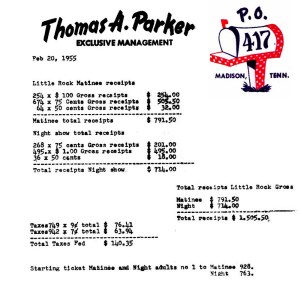
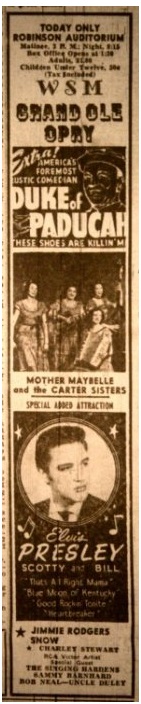
eap feb 55 adSixty years ago today, on February 20, 1955, Elvis Presley made his first appearance on stage in Little Rock. He performed at Joseph Taylor Robinson Memorial Auditorium.

He was billed as “an added attraction” to a Grand Ole Opry Show headlined by the Duke of Paducah.  Others on the bill included Mother Maybelle and the Carter Sisters, Jimmie Rodgers Snow, Charlie Stewart, the Singing Hardens, Sammy Barnhart, Bob Neal, Uncle Dudley and Smilin’ Mac Cyclone. (It is interesting to note that at least some of the advance tickets billed it as The Elvis Presley Show, though the newspaper ads billed the Duke of Paducah as the headliner.)

This concert was part of a weeklong tour of Arkansas and Louisiana.  There were two shows that day – one at 3p.m. and the other at 8:15p.m.  Tickets on the day of the concert were $1.00 for adults and fifty cents for children.  Advanced tickets had sold for 75 cents at Walgreens.

eap receits 05-little.rock_.feb_.55The night before, Elvis played the Louisiana Hayride in Shreveport.  Following his Little Rock appearance (for which he and his band were paid $350 instead of their usual $200), they played in Camden, Hope, and Pine Bluff.

eap 02-little.rock_It is believed that Elvis’ parents attended this concert in Little Rock. Gladys Presley was a big fan of the Duke of Paducah. Elvis apparently also wanted his parents to meet with Colonel Tom Parker, who would become inexorably linked with Elvis’ career.
Little Rock Look Back: Robinson Auditorium officially opens

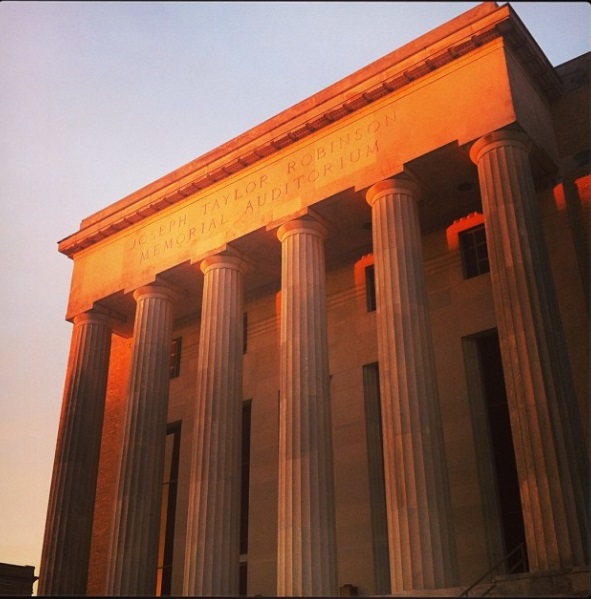
auditoriumduskOn February 16, 1940, after three years of planning and construction, the Joseph Taylor Robinson Memorial Auditorium officially opened. It was a cold, rainy night, but those in attendance did not care.

Searchlights painting arcs in the sky greeted attendees. They were borrowed from the Arkansas National Guard. Newspaper accounts noted that only a few of the men who attended were in tuxedos, most were simply in suits. The work to get the building opened had been so harried, that it was discovered there was not an Arkansas flag to fly in front of the building. Mayor Satterfield found one at the last minute courtesy of the Arkansas Department of the Spanish War Veterans.

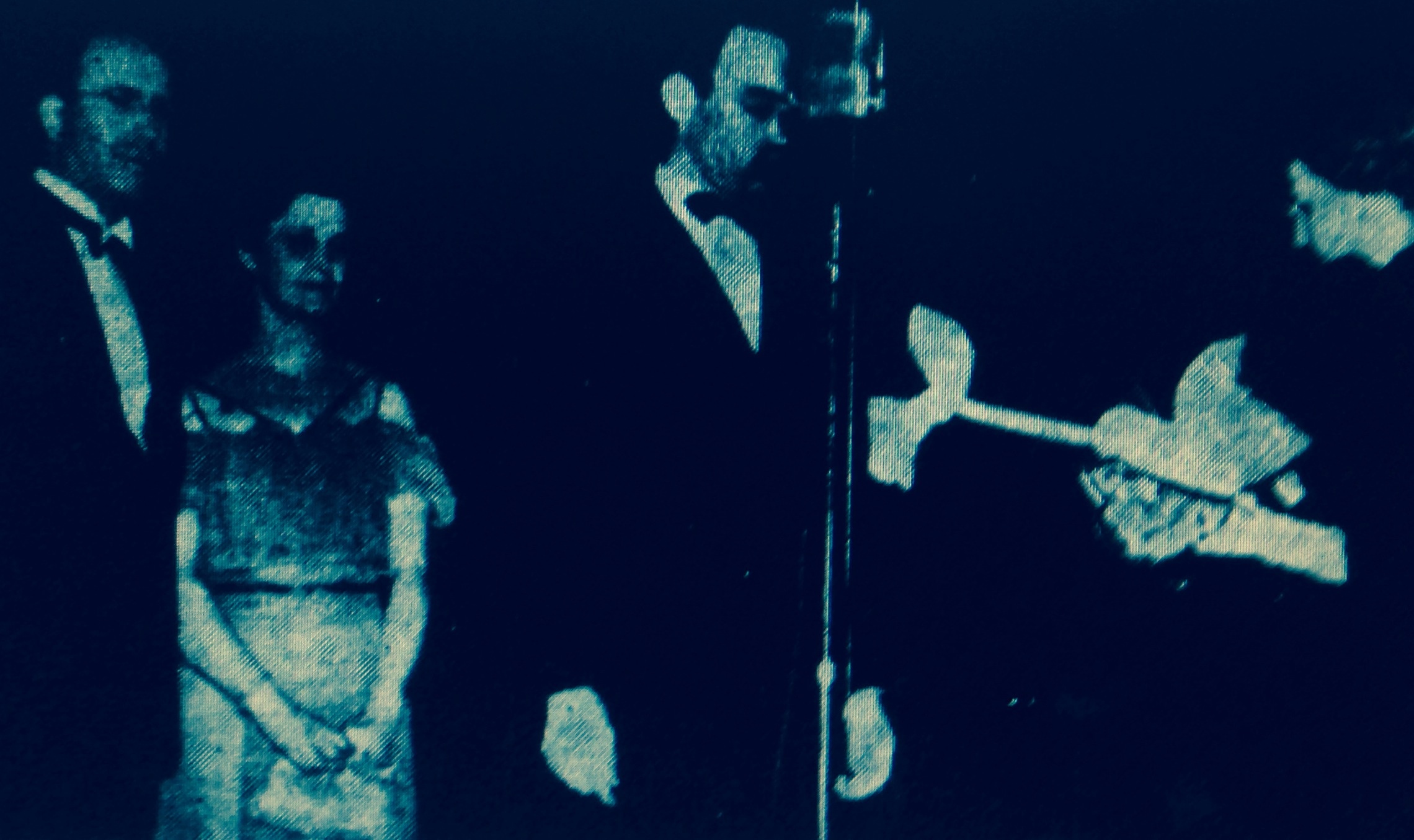
The weather delayed arrivals, so the program started fifteen minutes late. Following a performance of Sibelius’ Finlandia by the fledgling Arkansas State Symphony Orchestra, Mayor J. V. Satterfield, Mrs. Joseph T. Robinson, Mrs. Grady Miller (the Senator’s sister-in-law and a member of the Auditorium Commission) and D. Hodson Lewis of the Chamber of Commerce participated in a brief ribbon cutting ceremony. Mrs Robinson cut the ribbon on her second attempt (once again proving that nothing connected with getting the building open was easy).

The ceremony was originally set to be outside of the building but was moved indoors due to the inclement weather. The ribbon cutting took place on the stage with the ribbon stretched out in front of the curtain. The opening remarks were broadcast on radio station KGHI.

Though he had previously discussed how he had voted against the auditorium in 1937 before entering public life, the mayor’s remarks that evening were appropriately gracious, statesmanlike and a testament to the effort he had invested to get it open upon becoming mayor. “We hope you have a very pleasant evening and hope further that it will be the first in a long series which you will enjoy in this, your auditorium.”

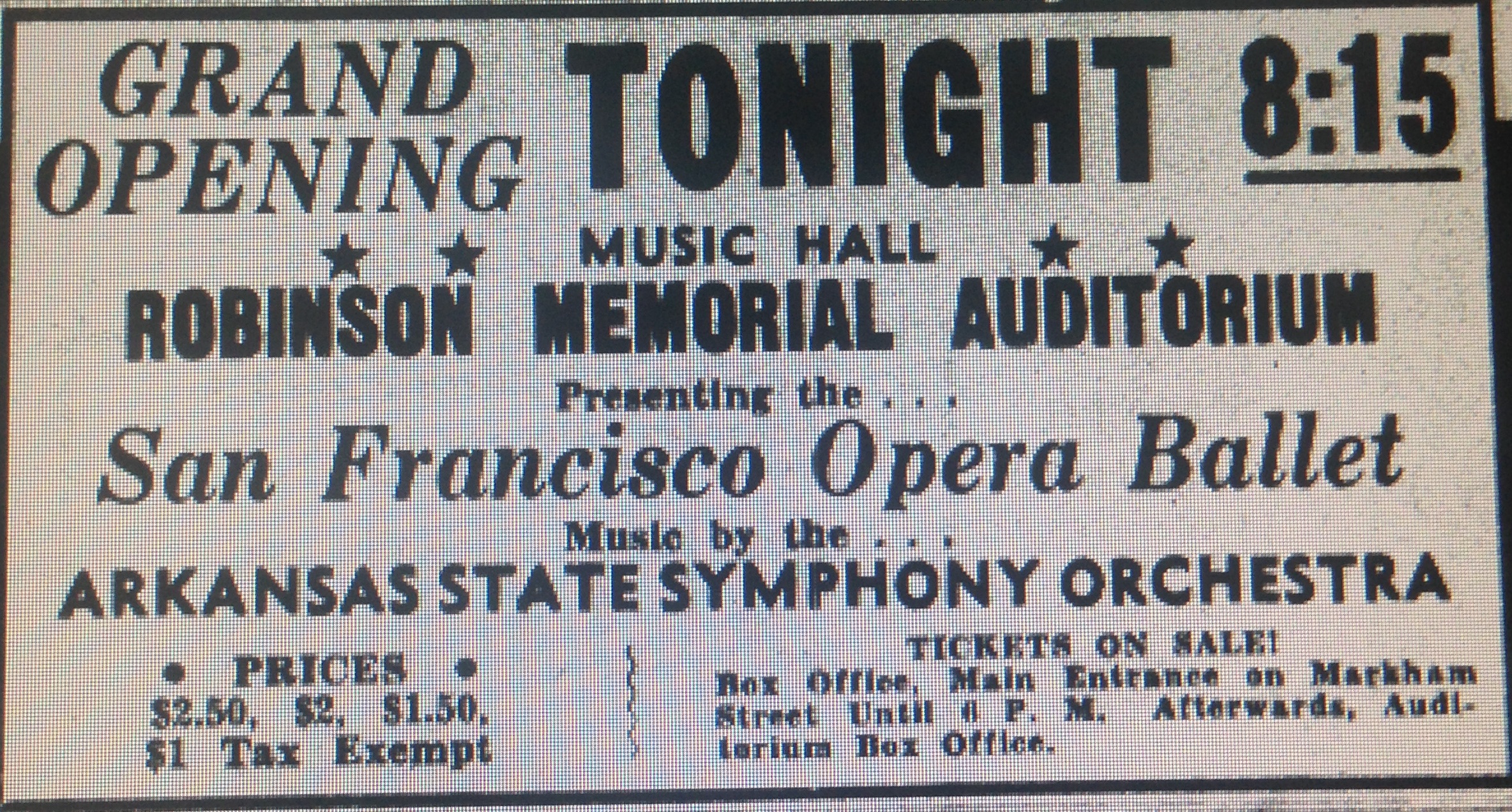
20140215-172047.jpgTickets for the event, advertised as being tax exempt, were at four different pricing levels: $2.50, $2.00, $1.50 and $1.00.

The estimated attendance was 1700. Following the ribbon cutting, the main performance took place. The headliner for the grand opening was the San Francisco Opera Ballet accompanied by the new Arkansas State Symphony Orchestra (not related to the current Arkansas Symphony Orchestra). The featured soloist with the ballet was Zoe Dell Lantis who was billed as “The Most Photographed Miss at the San Francisco World’s Fair.”

At the same time that the gala was going on upstairs in the music hall, a high school basketball double-header was taking place in the downstairs convention hall. North Little Rock lost to Beebe in the first game, while the Little Rock High School Tigers upset Pine Bluff in the marquee game.

Robinson Redux – February

grand opening adHere are some of the highlights from the annals of the Robinson Center Music Hall nee Joseph Taylor Robinson Memorial Auditorium.  This entry looks at bookings from Februarys in years ending with an 0 or 5.

The building was officially dedicated on February 16, 1940.  A few days earlier a children’s theatre troupe had entertained school kids with a performance in the music hall.  Also that month high school basketball continued in the exhibition hall.  The month had kicked off with a much more glamorous event as the Movie Ball took place in the exhibition hall.

The year 1945 featured a ecumenical Christian Youth Rally on February 4, a concert featuring Tito Guizar on February 7, the operetta Blossom Time on February 8 and the long-running comedy Life with Father on February 19.   In 1950, Robinson’s offerings ran from the Grand Ole Opry featuring Hank Williams (February 5), to Dick Contino (February 8) to the magician Blackstone (February 10 & 11) as well as the opera Il Trovatore (February 15) and a recital featuring Mrs. Rece Price (February 21).

By the mid 1950s, the touring business was changing.  The only notable booking at Robinson in February 1955 was on February 20 as it featured the Duke of Paducah and a little known singer from Mississippi named Elvis Presley.  Five years later, Jackie Wilson and Jesse Belvin headlined a concert on February 5, 1960. The Venable Quartet and several other gospel groups performed on February 12 and the Beaux Arts Bal de Tete took place on February 19.  In 1965, Donald Voorhees and the Arkansas Symphony Orchestra were in concert on February 21.

February 1970 showed much more activity.  Husband and wife Phil Ford and Mimi Hines starred in the national tour of I Do! I Do! on February 6 & 7. That show had been a hit on Broadway in the 1966-1967 season. Another hit from that season, Cabaret, played on February 19 & 20 with Tandy Cronyn starring.  In between, contralto Bernadette Greevy presented a recital.

Musician Jerry Jeff Walker performed at Robinson on February 23, 1975.  Earlier that month (February 19), the national tour of Pippin stopped by with Barry Williams (aka Greg Brady) in the title role.  Five years later, Ballet Arkansas welcomed Cynthia Gregory and Patrick Bissell in a performance on February 7, 1980. Later that month Mason Williams and his Bluegrass Band performed with the Arkansas Symphony Orchestra on February 23.  The next two nights, a tour of Jesus Christ Superstar took the stage.

David Copperfield kicked off February 1985 with two shows on the 1st.  The next day the musical The Cotton Patch Gospel was performed.  Musican Carman performed on February 25.  In February 1990, Peabo Bryson and jazz extraordinaire Billy Mitchell shared the stage on February 22.

In 1995, the focus was on music.  There was “An Evening with John Bayless” on February 7 as part of the Greater Little Rock Community Concert Association.  On February 11, the Arkansas Symphony Orchestra presented an evening of music of Rodgers & Hammerstein.  A few days later on February 17, various musical groups presented an evening of gospel music. The next night, Gladys Knight shook the house in a concert.  The month ended on February 28 with Nancy Griffith and the Blue Moon Orchestra. A February 8 concert with Della Reese was cancelled due to poor ticket sales.

Five years later, highlights included a tour of Camelot on February 15 – 18, and a staged concert version of the opera La Boheme presented by the Arkansas Symphony Orchestra.  In 2005, Kenny Loggins performed with the Arkansas Symphony on the 11 & 12. The ASO also presented an all Tchaikovsky concert with Jon Kimura Parker on piano.  Earlier in the month, President George W. Bush hosted a town hall forum on Social Security at Robinson Center.

In 2010, the ASO Valentine Pops concert featured Christiane Noll and Doug LaBrecque.  From February 16-18 STOMP rang out throughout Robinson.  The month ended on a more quieter note as the ASO and Philippe Quint presented the Violin Concerto by Jean Sibelius.

Little Rock Look Back: Jesse Belvin in concert at Robinson Auditorium

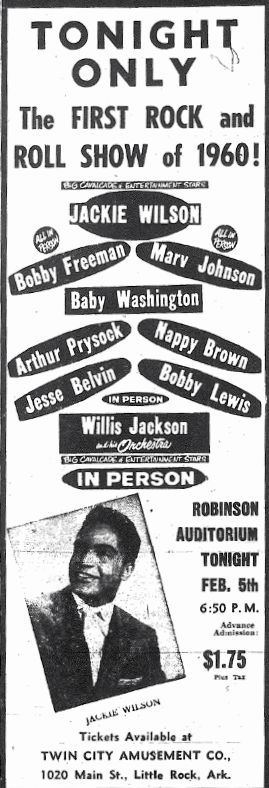
Ark Gazette 60.02.05 (Fri)The name Jesse Belvin is largely forgotten. As a songwriter in the 1950’s he wrote “Earth Angel.” He also had an R&B hit with “Goodnight My Love.”  If he is recalled for anything today, it is tragically for being part of the mythical “27” club of musicians who died at the age 27.

On February 5, 1960, he appeared in a concert at Robinson Auditorium for what was billed as the “First Rock & Roll Concert of 1960.”  The headliner for the concert was Jackie Wilson.  The next morning, Belvin died at age 27 in a car accident outside of Hope on his way to his next concert in Texas.  Also killed in the wreck were Belvin’s wife, the man driving the car, and a couple in another car which Belvin’s car struck.

Many urban legends have sprung up about the concert at Robinson. Some, no doubt, fueled by Little Rock’s racially divided then-recent past in September 1957.  Most of these purport that the concert in which he appeared was the first integrated concert in Little Rock. Most rumors also state that Belvin had received threats leading up to the concert, that a riot took place at the concert or at least was stopped several times by disruptions caused by white agitators, that Belvin and others were run out of town, and that the accident was caused by damage inflicted to his tires before leaving Little Rock.  There are several variations of these purported facts.

While it is true Belvin performed at Robinson Auditorium the night before he died, it was not before a racially mixed audience.  It was not until August 1961 that the first concert took place in Robinson that did not have segregated seating, and that was a one-time only event.  It would not be standard practice at Robinson Auditorium until the 1965 passage of the Civil Rights Act.

Rebecca Miller, in her blog https://jackiewilsonlover.wordpress.com/, goes into great detail debunking many of the supposed “facts” about the February 5, 1960, concert at Robinson.  While the Arkansas Gazette and Arkansas Democrat at the time did not shy away from covering racial issues (each with their own slant), neither paper mentions anything about the discord at the concert.  They do discuss Belvin’s subsequent accident near Hope.  It was apparently caused when the driver of the car containing Belvin and his wife fell asleep at the wheel.

In this day of the internet where it is easy for myths to fester into fact, it is hard to dispel rumors.  What is true is that a life was tragically cut short, and that Jesse Belvin’s last concert was on the stage of Robinson Auditorium.

Little Rock Look Back: Movie Stars Descend on Robinson Auditorium

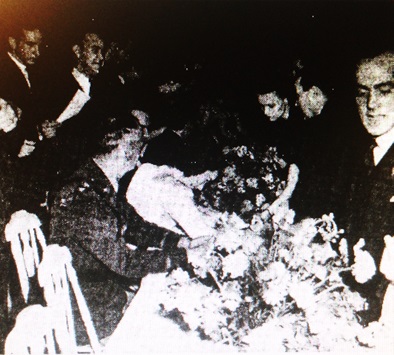
Autograph seekers crowd around the actors at the Movie Ball (photo from Arkansas Gazette)

Autograph seekers crowd around the actors at the Movie Ball (photo from Arkansas Gazette)

As final preparations were being made for the opening of the Joseph Taylor Robinson Municipal Auditorium in early 1940, a glamorous evening took place in Robinson’s lower level convention hall on February 1.

In conjunction with a meeting of film executives and movie theatre owners sponsored by Robb and Rowley Theaters (which later became the United Artists theatre chain), several Hollywood actors were in Little Rock and headlined a Movie Ball. While in Little Rock, Maureen O’Hara, Phyllis Brooks, Arleen Whelan, Tim Holt and Gene Autry had also made a variety of public appearances.

Mr. Autrey had to miss the ball because he had to return to Hollywood early to attend to business matters. Actress Ilona Massey had also been scheduled to attend the events but was unable due to illness.

The quartet who did appear at the Movie Ball caused quite a scene. Upon their entrance, so many of the attendees crowded around for autographs that the evening’s grand march could not take place (a newspaper headline in the Democrat innocently used the word “orgy” to describe the crowd). After two attempts, Little Rock Mayor J. V. Satterfield (who was escorting Miss O’Hara) and the other members of the Little Rock host delegation led the Hollywood foursome to their reserved table. For quite a while that evening, the table was besieged by autograph seekers.

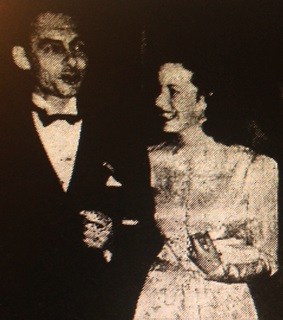
Mayor J V Satterfield escorting actress Maureen O'Hara at the Movie Ball (photo from Arkansas Democrat)

Mayor J V Satterfield escorting actress Maureen O’Hara at the Movie Ball (photo from Arkansas Democrat)

Though it is unknown as to whether he sought an autograph, photos from the evening showed a very satisfied Mayor Satterfield with Miss O’Hara on his arm. Satterfield family lore joked that Mrs. Satterfield (who had stayed home that night to tend to a sick son) was not a fan of Miss O’Hara’s films after that evening.

The Movie Ball showed Little Rock citizens the value of Robinson Auditorium even before it had been officially dedicated. The film industry meetings had taken place at the Albert Pike Hotel which did not feature a ballroom large enough to host the ball. Without the auditorium’s availability for the gala, organizers might not have chosen Little Rock for the meeting.

With the auditorium’s convention hall not attached to any hotel, it opened up the chance for Little Rock to host more events. This had been one of the key arguments for an auditorium since Mayor W. E. Lenon’s first proposal back in 1904. Having a glamorous event this early in the auditorium’s life validated that contention. After having endured the challenges to open the building, it was a nice lagniappe for the auditorium’s proponents who were present.

The actor Tim Holt would again be connected to Little Rock. In September 1951, he tried to obtain a divorce in Arkansas and stated that he had been a resident of the state for at least six weeks. He also had someone else testify to that fact. In October 1951, the divorce was granted. Later Mr. Holt was charged with perjury and fined $200 for falsely representing his length of residence in Arkansas. Judicial sanctions for his legal team, which included a State Senator, were eventually reviewed by the Arkansas Supreme Court.

Little Rock Look Back: FDR

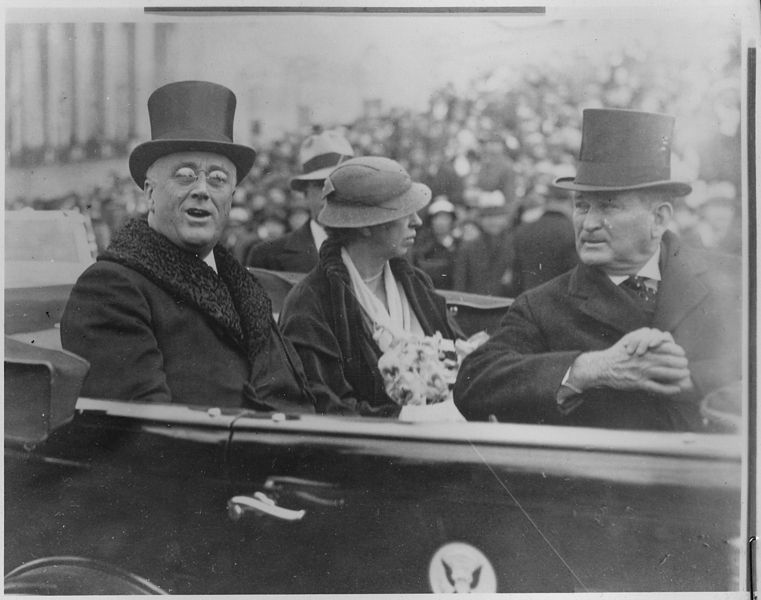
Gov. & Mrs. Roosevelt with Sen. Robinson en route to FDR taking oath as president.

Gov. & Mrs. Roosevelt with Sen. Robinson en route to FDR taking oath as president.

On January 30, 1882, future U.S. President Franklin Delano Roosevelt was born.  In 1936, he visited Little Rock as part of a statewide tour in conjunction with Arkansas’ Centennial celebration.  While in the state he spent time outside of Hot Springs at Couchwood, the vacation home of Arkansas Power & Light founder Harvey Couch, who was the chair of the Centennial activities.

In honor of President Roosevelt’s visit, a portion of Highway 365 in Little Rock was designated Roosevelt Road. He followed part of that road while in the Capital City before making a public appearance.

President Roosevelt’s address on June 10, recounted Arkansas’ territorial and statehood history. At the end he paid tribute to his Senator Joseph Taylor Robinson.  The Senator was a friend and confidant who often led the charge for FDR programs in congress.  Indeed, it would be New Deal programs which would allow for the construction of a municipal auditorium in Little Rock, which would be named in memory of Sen. Robinson after his death in the summer of 1937.  (As the Democratic leader of the Senate, it had been Robinson who accompanied FDR and Eleanor in the motorcade to the 1933 Presidential inauguration ceremony.)

FDR’s visit to Arkansas had political implications as well.  The late Senator Huey Long of neighboring Louisiana had been arguably FDR’s biggest adversary in Washington.  Long was very popular in rural areas of Arkansas and had campaigned for Hattie Caraway when she ran for re-election to the Senate, to the dismay of many of Arkansas’ Democratic establishment.  Harvey Couch had worked to bring about a detente between FDR and Long prior to the latter’s assassination in 1935.  But between a lingering mistrust of FDR by Long supporters and discontent from some sectors based on New Deal programs, it was important for FDR to shore up Democratic support in Arkansas.  At the time the state had nine electoral votes.

FDR would return to Central Arkansas in 1943 to review troops at the military facility named for Sen. Robinson.  That would be his final visit to Arkansas before his death in April 1945.