
Little Rock Look Back: Arkansas Arts Center produces first play at its theatre

The Arts Center Theatre view from the stage in 1963

On May 3, 1963, at 8:30 pm, the curtain rose as the Arkansas Arts Center produced its first show in its own theatre.  Though the building would not be officially dedicated until later in May (more about that later), programming had been taking place in the facility for several months.

In December 1962, a community theatre production was the first play in the Arkansas Arts Center theatre.  Over the ensuing months, it would play host to a variety of concerts and performances.  At the time, the Arkansas Arts Center planned to use the theatre as a house for its own productions (one series geared to adults, the other series geared to kids), other shows produced by Little Rock organizations, and touring shows which might be too small for Robinson Auditorium.

Friday, May 3, 1963, was a momentous evening, as the Arkansas Arts Center presented Rumpelstiltskin.  (Since the theatre space has been focused on children’s theatre since the late 1970s, it seems prescient that the first AAC produced play was a children’s production some fifteen years earlier.)

The production was overseen Joseph N. Carner, who was the theatre director.  It was his hope that the Arts Center plays geared toward children would also encourage other groups throughout the state to produce plays specifically for younger audiences.  Margaret Davies Carner, who taught speech at Little Rock University, directed the play.  She also taught drama classes at the Arts Center.

The cast included Garry White as the title character with Dell Blaine, Michael Hosman, Lesie Smith, Tom Abraham, Dickie Atchison, Butch Lashee, henry Fletcher, Charles McRaven, Ann Thomson, Dannette Joe Baker, Sallie Penn, Paul Motes, Leslie Newell, and Robin Hosman.

In addition to a Friday night performance, there were 2:30 matinees on Saturday and Sunday that were geared toward children’s audiences.

Sculpture Vulture: Michael Warrick’s MOCKINGBIRD TREE installed in 2016

Mockingbird Tree install LRCVB

Photo by LRCVB

On April 21, 2016, Michael Warrick’s Mockingbird Tree sculpture was installed at the corner of Chenal Parkway and Chenal Valley Drive.

The piece was commissioned by Sculpture at the River Market after winning the 2015 Public Monument Sculpture competition.

The eighteen (18) foot tall sculpture is made out of stainless steel. It presents a fanciful version of a tree with cloud-like foliage.  Nestled in the tree are bronze mockingbirds (Arkansas’ state bird).

Warrick is a professor in the Department of Art at the University of Arkansas Little Rock and has been an artist and educator for 30 years. His work has resulted in more than 150 solo and group exhibitions and has been represented in 29 private collections and 34 public venues.

Pulitzers Play Little Rock: A CHORUS LINE on the UALR stage

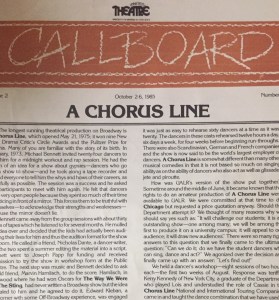
IMG_0274In April 1975 A Chorus Line premiered Off Broadway before transferring to Broadway in July 1975. In 1976, it became only the fifth musical to win the Pulitzer Prize for Drama.
Whereas the composer of the first musical to win the Pulitzer was not honored (apparently because he only wrote music, not actual words), with A Chorus Line’s citation, the Pulitzers recognized not only librettists James Kirkwood and Nicholas Dante, lyricist Edward Kleban, and composer Marvin Hamlisch, but also Michael Bennett who conceived the project and steered its development.

In October 1985, the University of Arkansas at Little Rock became one of the first non-professional organizations to ever perform  A Chorus Line.  The theatre department was planning on producing Chicago, but dropped that show when rights for A Chorus Line became available.  (Chicago was on Broadway at the same time as A Chorus Line and was often overshadowed by it.)

In preparation for the show, UALR (as it was then known) conducted a dance workshop in August 1985 conducted by alum Kerry Kennedy, who had appeared in the national and international tours of the show.  After the workshop, auditions were held and the rehearsal process started.

Many familiar names in the Little Rock theatre scene from the 1970s to the present were involved in A Chorus Line.  The production was directed by Carolyn Curry, choreographed by Dot Callanen, and music directed by Lori Loree.  Jay Jagim provided the scenic and lighting design, while Joy Breckenridge was costume designer.

The cast was led by Tom Crone as Zach, the director of the show within the show, and Janet Ford as Cassie.  Other performers included Lee Borchert, Sara Cole, Missy Cook, Greg Donaldson, Jo Bocage Few, Dennis Glasscock, Leslie Hall (who joined the cast two weeks before opening), John Hartman, William R Holloway, Shawn Lynnette Jackson, Traci Presley, Joey Stocks, Allison Streepey, Joe Terry, Kevin Trippe, and Scarlet White.

Rounding out the company were Paula A. Barr, Kelly Bascue, Melanie Cameron, Caran Curry, Leigh Anne Embrey, James Finch, Tijuana McKnight, Leah McSpadden, Rick Riley, Karissa Rushing, and Curtis B. Tate.

2018 marks the 100th anniversary of the first Pulitzer Prize for Drama being given. To pay tribute to 100 years of the Pulitzer for Drama, each day this month a different Little Rock production of a Pulitzer Prize winning play will be highlighted.  Many of these titles have been produced numerous times.  This look will veer from high school to national tours in an attempt to give a glimpse into Little Rock’s breadth and depth of theatrical history.

Pulitzers play Little Rock – UA Little Rock’s THE FLICK in 2017

In 2UA Little Rock Flick014, Annie Baker’s The Flick won the Pulitzer Prize for Drama. The play mixes dialogue with long moments of no spoken words as the characters perform tasks on stage.

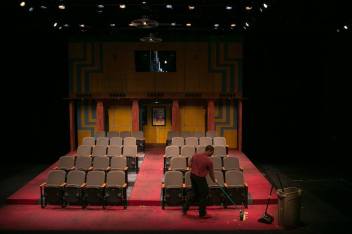
It is set in a run-down Massachusetts movie theatre and focuses on three millennials as they endure modern-day situations of race, class, and economy, all while working as underpaid employees.  The three actors are tasked with performing the cleaning of the set, just as the characters would be doing in between showings.  The original production received mixed reviews and sharply divided the audiences who saw it.  Feelings that were expressed ranged from brilliant to boring.

In February 2017, UA Little Rock’s Theatre and Dance Department presented the play.  It may have been the first production of it in Arkansas, it was certainly the first in Little Rock.  Giving the students the chance to work on such a new and challenging play is an example of the value of educational theatre.

2018 marks the 100th anniversary of the first Pulitzer Prize for Drama being given. To pay tribute to 100 years of the Pulitzer for Drama, each day this month a different Little Rock production of a Pulitzer Prize winning play will be highlighted.  Many of these titles have been produced numerous times.  This look will veer from high school to national tours in an attempt to give a glimpse into Little Rock’s breadth and depth of theatrical history.

LR Women Making History – Betty Fowler

Photo courtesy of the Arkansas Jazz Heritage Foundation

The word “Entertainer” seemed to have been invented for Betty Fowler.

Born in Wynne, her love for music began at age 9, when she started taking piano lessons. Betty began her illustrious career at age 18 after winning a talent contest, which gave her the push she needed to pursue her life’s passion. Betty graduated from Little Rock Jr. College in 1944. She spent most of her life in Little Rock as a popular musician and television entertainer.

Betty began her musical career on a statewide radio show. She moved on to become a television performer in the early 1950’s in Little Rock with what is now known as Channel 7. She was best known for her children’s TV show, “Betty’s Little Rascals”, which began in 1955.

She went on to co-host the “Little Rock Today Show” on Channel 4 with Bud Campbell, where she did live commercials, played the piano and interviewed celebrities who came to town, such as Liberace, Sammy Davis Jr., Bob Hope, Red Buttons and Robert Goulet.

Through the years, Betty maintained a vigorous schedule with her band, “The Betty Fowler Four”, which produced a record album of her music. She was also musical director for The Miss Arkansas Pageant (1960-84), Musical Director for Broadway musicals produced by the Community Theater, Musical Director for the Farkleberry Follies and The Gridiron.

For many years, Betty taught piano and had a recording studio in her home, where she gave voice coaching lessons and made accompany tapes for many aspiring performers.  Betty Fowler will forever be remembered and treasured for her lifetime love and devotion to the world of music, both in performing and in the teaching of music to others.

LR Women Making History – Nancy Rousseau

Though not a graduate of Little Rock Central High School, Nancy Rousseau is a Central High Tiger through and through.

She has been principal of Little Rock Central High School since the summer of 2002. Born in New York, she graduated high school in Tenafly, New Jersey.  After attending Ohio University, she graduated from Adelphi University with a degree in English education.  Her first job was teaching in Port Washington, NY, where she won the “New Teacher of the Year” award.  After teaching in Midwest City, Oklahoma, she arrived in Little Rock in 1976.

From 1976 until 1986, she taught English at Pulaski Academy.  After receiving her master’s degree in educational administration from the University of Arkansas at Little Rock, she was hired by the Little Rock School District as an Assistant Principal at Central High School.  From 1991 until 1998, she served in that capacity. During that time, she worked on the planning for the 40th anniversary of the integration of Central High by the Little Rock Nine.

In 1998, she became principal of Pulaski Heights Junior High School.  She led the school’s transition from a junior high to a middle school.  When the position of Central High School principal became open in 2002, she applied for the job.

Since returning to Central as its principal, Mrs. Rousseau has been a very visible champion of the school, its students, faculty and alumni.  She served as co-chair for the Central High Integration 50th Anniversary Commission.  During her tenure, the school’s physical plant has been upgrade and much of the historic façade and interior has been restored.  A Central High Alumni Association and a Tiger Foundation have been formed.  Through their effort, the arts, academics and athletics have been enhanced.

Mrs. Rousseau also participated in the planning for the 60th anniversary of the school’s integration.  She is one of a very few who worked on the 40th, 50th and 60th anniversaries.

LR Women Making History: Stella Boyle Smith

When Stella Boyle Smith died at the age of 100 in 1994, she was well known for her love of music and philanthropy.  It is a lasting connection of her to a building in which she spent so many hours as an arts patron.

Smith was a Little Rock philanthropist and founder of the Arkansas Symphony Orchestra. She lived to be 100, but ensured that her legacy would continue.  In her lifetime, she donated more than $2.5 million to organizations in the music and medical fields.  Since her death, the Stella Boyle Smith Trust has donated more than $5 million.  One of its most recent gifts was the sculpture In the Wings which graces the front of Robinson Center.

She was born in Farmington, Mo., into a large, musically inclined family, which moved to Arkansas when she was two. She began singing at the age of three and graduated from high school at 14. In 1922, she moved to Little Rock with her first husband, Dandridge Perry Compton, who died in 1935. Her second husband, George Smith, held various business interests and extensive farms in Woodruff and Arkansas counties, which allowed them to engage in philanthropy. Mr. Smith died in 1946.

In 1923, Smith’s love for music inspired her to start The Musical Group in her living room of her residence at 102 Ridgeway Drive in Little Rock, where she lived until she died. Through several iterations, the group eventually became the Arkansas Symphony Orchestra in 1966. Her initial objective was to establish the symphony as an educational tool for children, and, in 1968, she helped establish the Youth Orchestra. In 1972, the symphony board of directors named her an honorary life member. Smith established a trust fund for the symphony’s permanent endowment in 1985. A loyal friend of music and the symphony, she attended nearly every performance and most rehearsals.

Smith was also a pianist. In 1988, she gave UALR a grand piano as well as an endowed trust of $500,000. When she purchased the grand piano for UALR, a Steinway, she later on the same day purchased a Steinway for herself.  She remains the only individual to purchase two Steinway grand pianos in the same day. UALR renamed its concert hall the Stella Boyle Smith Concert Hall as a tribute to her. That year the university also gave her an honorary doctor of humane letters degree. Interest from the trust provides scholarships each year for music students studying string instruments, piano or voice.  After she died, her personal Steinway was given to UALR.  The music faculty and students now lovingly refer to the two pianos as Stella and George (after her and her husband).

Smith enabled many students around the state to attend college through the more than 200 scholarships that she financed.

Other organizations that have benefited from her generosity include Arkansas Arts Center and Historic Arkansas Museum as well as the University of Arkansas.