Creative Class 2016: Christen Burke Pitts

cc16-pittsDancer and choreographer only defines two of Christen Burke Pitts‘s involvement with the arts.  She and her family are also active supporters of the Arkansas film industry and are patrons of all of the performing arts.  But it is in dance that Christen probably makes her largest impact.
Since 1996, she has been the founder and director of the NLRHS Dance Program.  In that capacity, she teaches scores of students each year as well as choreographs musicals, plans workshops, and produces dance performances.  She received the 2012 Governor’s Arts in Education Award from the Arkansas Arts Council and was also named the 2012 Arkansas Communication and Theatre Arts Association Teacher of the Year.

Christen holds her MEd from the University of Arkansas at Little Rock and a BA in Drama/minor in Dance Performance from the University of Arkansas. She studied ballet, tap, jazz, modern, pointe, and musical theatre with various instructors across the country and trained at workshops/intensives with the Alvin Ailey American Dance Theater, MOMIX, Pilobolus, Luigi, Frank Hatchett, Finis Jhung, Bill Hastings, and many others.

Christen has performed in over fifty shows throughout the South including Damn Yankees at the Arkansas Repertory Theatre, the Shoji Tabuchi Show and The Crystal Gayle Show in Branson, and numerous industrial shows. She has appeared in local and national commercials, “The Ernest Green Story” on The Disney Channel, and in television specials on The Family Channel. Christen was a company member of the Memphis Dance Ensemble and the University of Arkansas Dance Company.

She has taught dance workshops for the ARC National Performing Arts Camp, the Arkansas Repertory Theatre (Summer Theater Intensive-Camp Rep), Arkansas Communication and Theatre Arts Association, and Arkansas Dance Network. A co-founder of the Arkansas Dance Network, she has also served been affiliated with ACANSA Arts Festival, the THEA Foundation, Arkansas Festival Ballet, and Argenta Community Theatre, among others.

Little Rock Look Back: Miss America comes to Little Rock

miss america axumToday, Miss America 2017 Savvy Shields comes to Little Rock as part of her official homecoming to Arkansas after winning the crown.  In honor of that, we take a look back to the first visit to Arkansas by Donna Axum, who was the first Miss Arkansas to win the title of Miss America.

A native of El Dorado and a student at the University of Arkansas, during her reign as Miss America Miss Axum (or simply Donna as the newspaper headlines referred to her) made four public visits to Little Rock.  As the first Miss Arkansas to become Miss America, the state’s Capitol City was very interested in giving her a warm welcome.

After being crowned on September 7, 1963, her first visit to Arkansas was November 1 through 3.  In addition to stops in Hot Springs and El Dorado, she appeared in Little Rock to attend events including an Arkansas Razorback football game at War Memorial Stadium.  Her entourage included the top four runners up from the Miss America pageant.

In February 1964, she made a brief appearance in Little Rock which included a press conference.

Donna Axum spent nearly two weeks in Arkansas in May 1964 attending several pageants as well as spending time with family.  During that visit she appeared in Little Rock twice.  The second time she headlined a concert with the Arkansas Symphony (not related to the current Arkansas Symphony Orchestra) and the Arkansas Choral Society. It took place at Robinson Auditorium.

Little Rock Look Back: Final ARKANSAS GAZETTE

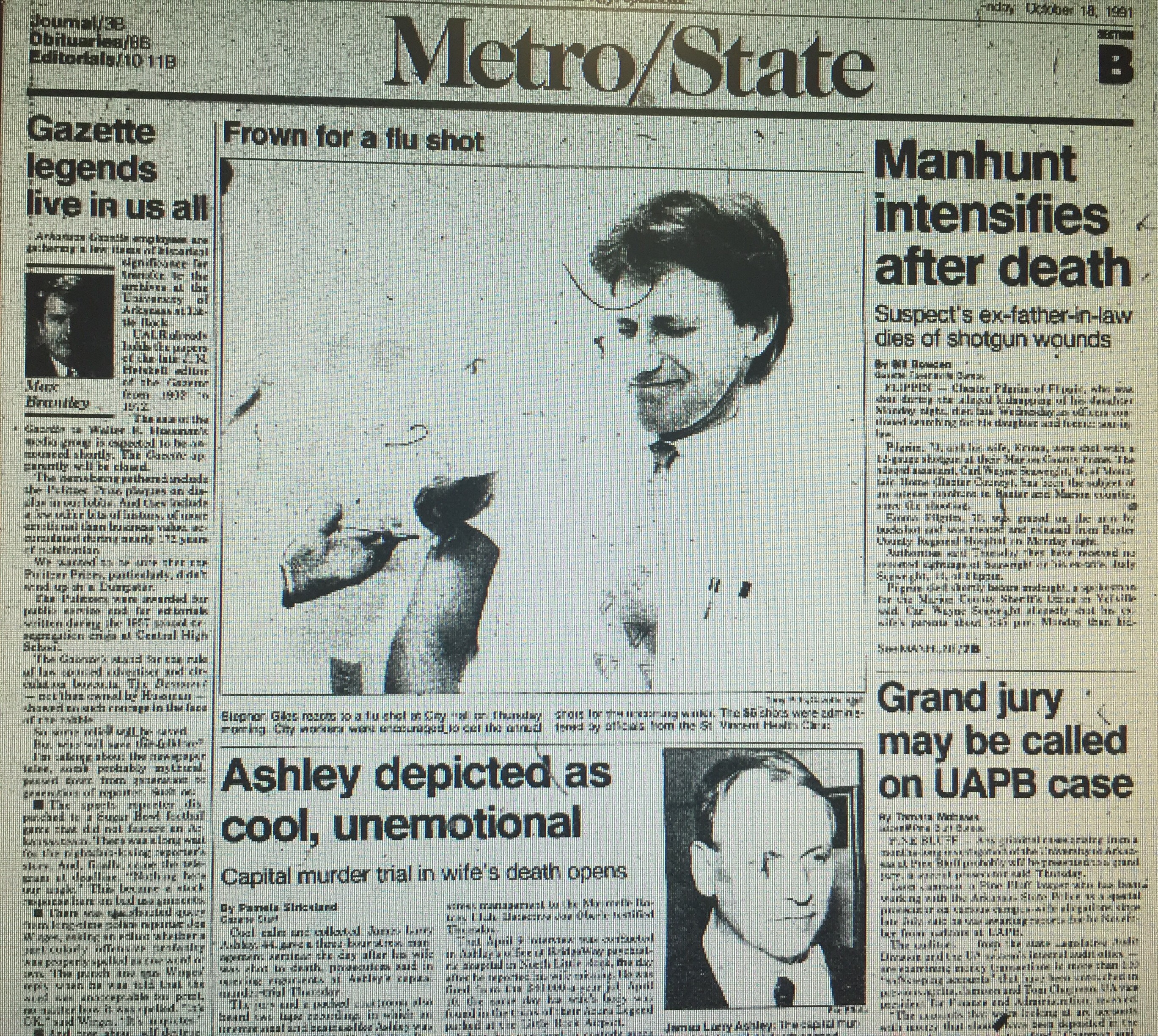
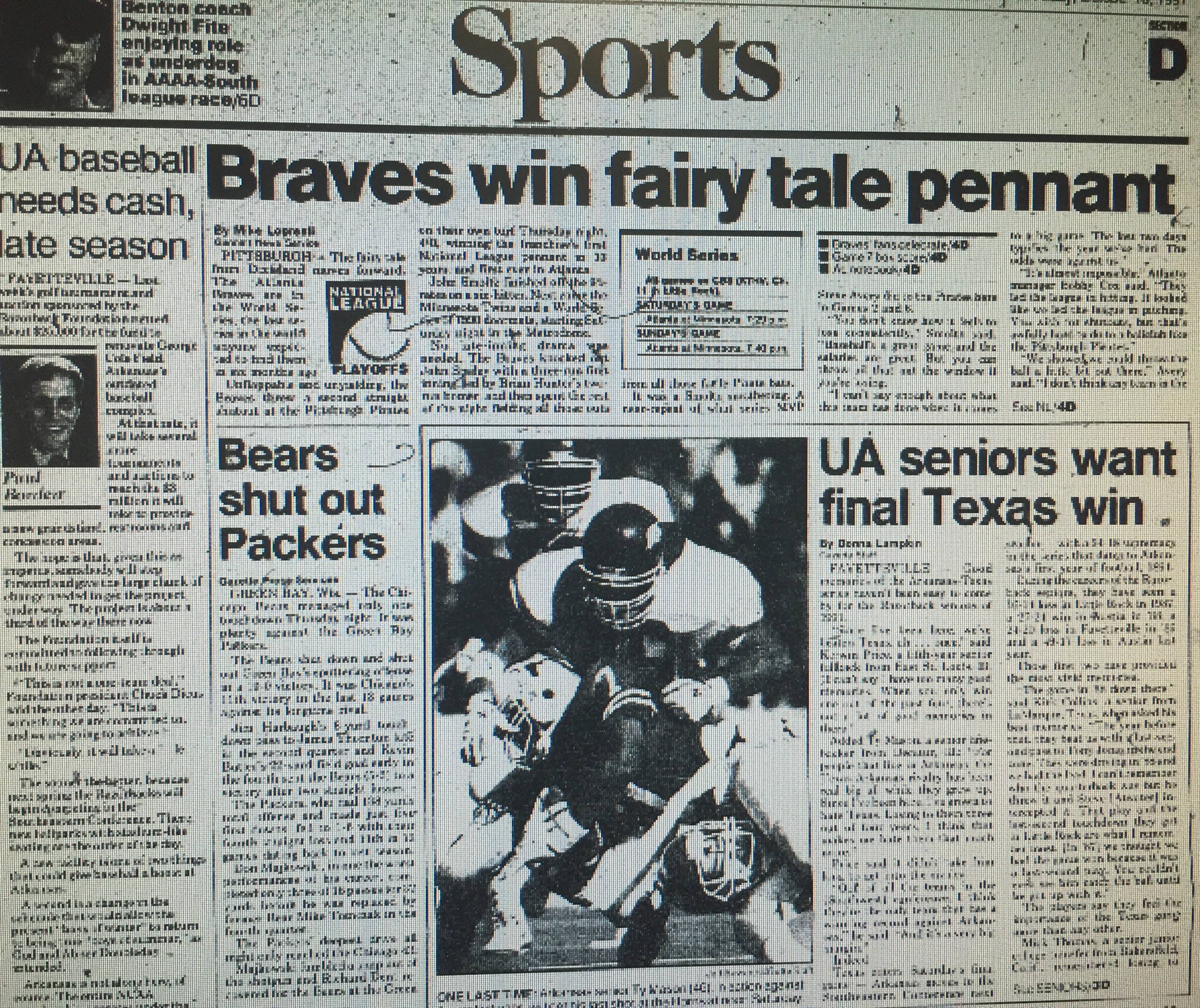
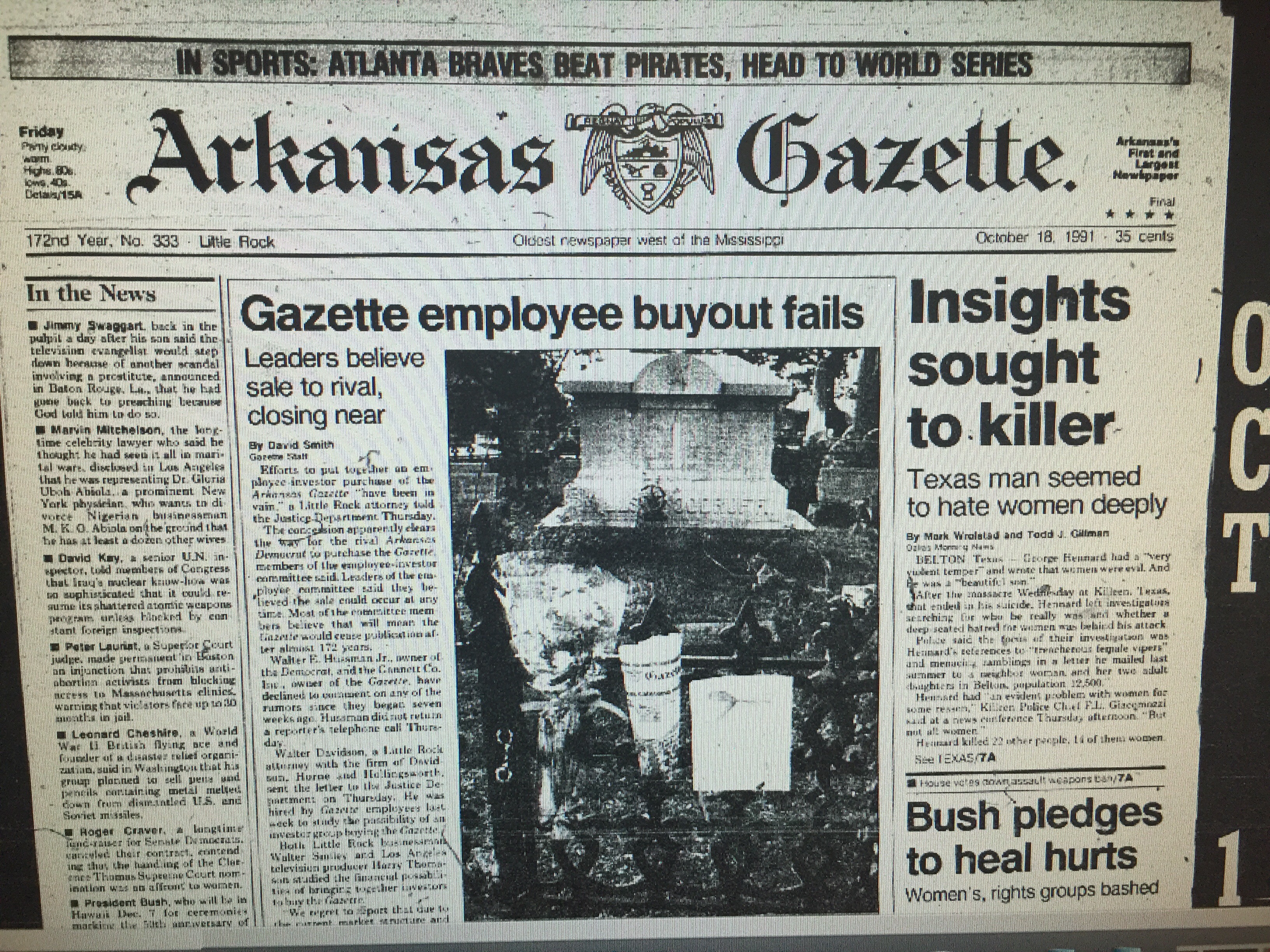
Twenty-five years ago today, on October 18, 1991, the final edition of the Arkansas Gazette was delivered. 

The front page featured a story on the demise of a Gazette employee effort to buy the paper. 

Max Brantley’s column on the front page of the B section also addressed the then-eminent end of the paper. However, as a newspaper all of the sections spent most of their space on the news of the day. While Gazette staffers felt the end was likely near, few felt that the paper on October 18, 1991, would be the final edition.  

The back page of the last section of the Gazette featured an ad for Premiere Pontiac Nissan Audi which was throwing a “Beat Texas” party featuring Craig O’Neill.  The Arkansas Razorbacks were scheduled to play the Texas Longhorns on Saturday, October 19. 

Here are the top halves of the front pages of sections B, C, D, and E for the final Atkansas Gazette.  They tell the storie of trials, football games, corporate earnings, and cultural events. 


Creative Class 2016: Tobi Fairley

cc16-fairleyTobi Fairley is the namesake and creative drive behind Tobi Fairley & Associates, a full-service consulting and design company.  The company provides custom-tailored education, enlightened mentoring, and common-sense tools to help companies and design firms improve their business.

Since establishing her design firm over 15 years ago, Tobi’s projects have spanned the nation, and her award-winning designs for high-profile and celebrity clients have been featured on television, and in top-shelf shelter publications around the globe, including House Beautiful, Traditional Home, Better Homes & Gardens, Southern Living,Coastal Living, and more.  As such, she is an ambassador for Little Rock’s creative community.

Tobi’s design blog, created in September 2008, is currently read in more than 124 countries worldwide. In 2010, Tobi introduced her DIY design service, InBox Interiors, and launched her popular intensive courses and programs, including Design A-to-Z, Designer MBA, and her MasterMind mentoring program.  Designers, business pros, and design enthusiasts alike have attended these programs from across the United States and Canada with rave reviews.

Tobi’s vision for her brand is to empower others to cultivate their strengths and create inspired solutions for business, design, and life. Her unique combination of degrees in interior design and accounting, and an MBA from the Sam M. Walton College of Business, gives her a competitive advantage in the design industry, and offers a creative approach to the world of business.

Little Rock Look Back: Former LR Mayor Sprick takes on Muhammad Ali and Loses

Ali SprickDan T. Sprick was a Little Rock Mayor for two years in the 1940s after having previously served on the City Council.  From 1961 until 1970, he served as a State Senator from Little Rock and was a reliable ally for Governor Orval Faubus. Once Faubus left office and was replaced by Governor Winthrop Rockefeller, Sprick continued to wave the banner of segregation and agitation.  One of his new focuses was boxer Muhammad Ali.

In 1969, the University of Arkansas announced that Ali would be one of the speakers for its public appearance series.  After refusing to be drafted and go to Vietnam, Ali was barred from earning a living as a professional boxer and so was making a living giving lectures.  His refusal to submit to the draft was based on his religious beliefs as a recent convert to the Nation of Islam.

Opposition to Ali’s appearance rose almost immediately, and from Little Rock not Fayetteville. The Pulaski Businessman’s Association sent a letter to UA president David Mullins asking him to bar Ali from speaking. President Mullins insisted that he had the right to speak on campus. When that didn’t work, Senator Sprick and his cohorts in the state’s upper chamber went to work. A resolution calling for Ali to be barred from speaking failed on a voice vote after much debate.

While there were certainly some racial overtones to Sprick’s opposition, he and others seemed to be more concerned over the former Cassius Clay’s conversion to Islam plus his ensuing refusal to be drafted.  Senator Sprick declared that if President Nixon would draft him now he would go to serve in Vietnam.  (Sprick was in his late 60s at the time.)

Ali’s speech on the campus actually caused some controversy on its own.  One of the things he advocated for segregation. He praised Alabama Governor George Wallace.  The Arkansas Gazette which had been following the saga in both news stories and editorials, noted that remarks like that should have endeared Ali to Dan Sprick and others.

Ali, of course, resumed his boxing career and defined that sport in the 1970s with his talent in the ring and his showmanship.

Based on an editorial, Sprick sued the Gazette for libel. The paper settled with him out of court because his health was poor. Sprick died in 1972.

“Disagree to Agree” is topic of February Architecture and Design Network

According to architect  Neil Denari, it’s not unusual for parties to disagree when it comes to making decisions about  matters architectural. Stands taken in response to deeply seated concerns about money or commitment to “a specific direction and outcome” sometimes lead to stalemates. In his lecture, Denari will talk about ways in which NMDA deploys  “potentially disagreeable ideas into a welcoming context of agreement”. Equal amounts of “logic and enthusiasm” are key to resolving  differences between architect and client.
Tonight (February 2) Denari will discuss this at the Arkansas Arts Center at 6pm as part of the Architecture and Design Network series.  A reception at 5:30 will precede the address.
 
A native of Fort Worth, Texas, Denari, who earned a BArch at the University of Houston and a MArch from Harvard, founded the firm that bears his name in 1988, the same year he began a five year teaching stint at Southern California Institute of Architecture (SCI-Arc). Currently, he serves as Professor of Architecture and Vice Chair of Architecture and Urban Development (AUD) at UCLA. Living in New York City during the 1980s,  he worked for James Stewart Polshek Partners as a senior designer. Denari has held visiting professorships at UC Berkeley, Columbia, Princeton, University of Pennsylvania and the University of Texas at Arlington. Author, artist and filmmaker as well as architect, Denari has won a number of prestigious awards, including two from the National Academy of Design. 
 
Architecture and Design Network lectures are free and open to the public. Denari’s participation in ADN’s Little Rock lecture series is made possible by the UA Fay Jones School of Architecture and Design. For additional information contact ardenetwork@icloud.com.
 
Supporters of Architecture and Design Network include the Arkansas Arts Center, the Central Section of the Arkansas Chapter of the American Institute of Architecture, the UA Fay Jones School of Architecture and Design and friends in the community. 

LR Look Back: HAIR flows at Robinson Auditorium in 1972

Ad for the original production of HAIR in Little Rock. Note the ticket prices. And that they could be purchased at Moses Music Shops.

Ad for the original production of HAIR in Little Rock. Note the ticket prices. And that they could be purchased at Moses Music Shops.

Forty-four years ago today, on January 18, 1972, the musical Hair settled in for a week-long run at Robinson Auditorium.  The saga to bring the national tour to Little Rock had actually begun eleven months earlier.

In February 1971, a young Little Rock attorney named Phil Kaplan petitioned the Little Rock Board of Censors to see if it would allow a production of Hair to play in the city. He was asking on behalf of a client who was interested in bringing a national tour to Arkansas’ capital city. The show, which had opened on Broadway to great acclaim in April 1968 after an Off Broadway run in 1967, was known for containing a nude scene as well for a script which was fairly liberally sprinkled with four-letter words. The Censors stated they could not offer an opinion without having seen a production.

By July 1971, Kaplan and his client (who by then had been identified as Southwest Productions) were seeking permission for a January 1972 booking of Hair from the City’s Auditorium Commission which was charged with overseeing operations at Robinson Auditorium. At its July meeting, the Commissioners voted against allowing Hair because of its “brief nude scene” and “bawdy language.”

Kaplan decried the decision. He stated that the body couldn’t “sit in censorship of legitimate theatrical productions.” He noted courts had held that Hair  could be produced and that the Auditorium Commission, as an agent for the State, “clearly can’t exercise prior censorship.” He proffered that if the production was obscene it would be a matter for law enforcement not the Auditorium Commission.

The Commission countered that they had an opinion from City Attorney Joseph Kemp stating they had the authority. One of the Commissioners, Mrs. Grady Miller (sister-in-law of the building’s namesake the late Senator Robinson, she had served on the Commission since 1940), expressed her concern that allowing Hair would open the door to other productions such as Oh! Calcutta!

On July 26, 1971, Southwest Productions filed suit against the Auditorium Commission. Four days later there was a hearing before federal Judge G. Thomas Eisele. At that hearing, Auditorium Commission member Lee Rogers read aloud excerpts from the script he found objectionable. Under questioning from Kaplan, a recent touring production of Neil Simon’s Plaza Suite was discussed. That play has adultery as a central theme of one of its acts. Rogers admitted he found the play funny, and that since the adultery did not take place on stage, he did not object to it. Among those testifying in favor of it was Robert Reddington, who was director of performing arts at the Arkansas Arts Center.

Judge Eisele offered a ruling on August 11 which compelled the Auditorium Commission to allow Hair to be performed. Prior to the ruling, some of the Auditorium Commissioners had publicly stated that if they had to allow Hair, they would close it after the first performance on the grounds of obscenity. To combat this, Judge Eisele stated that the Commission had to allow Hair to perform the entire six day engagement it sought.

Upon hearing of the Judge’s ruling, Commissioner Miller offered a succinct, two word response. “Oh, Dear!”

In the end, the production of Hair at Robinson would not be the first performance in the state.  The tour came through Fayetteville for two performances in October 1971 at Barnhill Arena.

On January 18, 1972, Hair played the first of its 8 performances over 6 days at Robinson Auditorium.  In his review the next day, the Arkansas Gazette’s Bill Lewis noted that Hair “threw out all it had to offer” and that Little Rock had survived.

The ads promoting the production carried the tagline “Arkansas will never be the same.”  Tickets (from $2 all the way up to $8.50) could be purchased at Moses Melody Shops both downtown and in “The Mall” (meaning Park Plaza). That business is gone from downtown, but the scion of that family, Jimmy Moses, is actively involved in building downtown through countless projects. His sons are carrying on the family tradition too.

Little Rock was by no means unique in trying to stop productions of Hair.  St. Louis, Birmingham, Los Angeles, Tallahassee, Boston, Atlanta, Charlotte NC, West Palm Beach, Oklahoma City, Mobile and Chattanooga all tried unsuccessfully to stop performances in their public auditoriums.  Despite Judge Eisele’s ruling against the City of Little Rock, members of the Fort Smith City Council also tried to stop a production later in 1972 in that city. This was despite warnings from City staff that there was not legal standing.

Within a few years, the Board of Censors of the City of Little Rock would be dissolved (as similar bodies also were disappearing across the US). Likewise, the Auditorium Commission was discontinued before Hair even opened with its duties being taken over by the Advertising and Promotion Commission and the Convention & Visitors Bureau staff.  This was not connected to the Hair decision; it was, instead, related to expanding convention facilities in Robinson and the new adjacent hotel.  Regardless of the reasons for their demise, both bygone bodies were vestiges of earlier, simpler and differently focused days in Little Rock.