Little Rock Look Back: Elijah A. More, LR 3rd Mayor

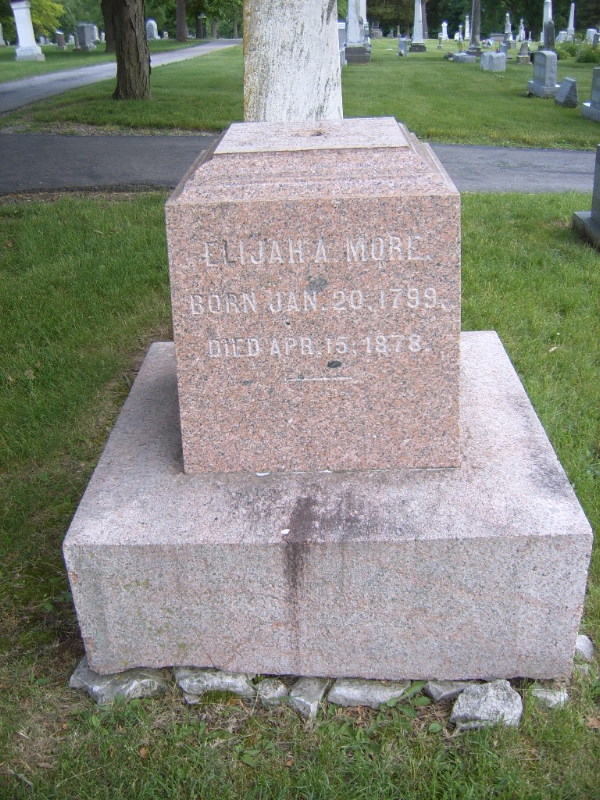
Mayor More Marker in MOOn January 20, 1799, Elijah A. More was born in Kentucky.  By the early 1830s, he was residing in Hempstead County and practicing law. Because of the court system being based in Little Rock, he spent a great deal of time in Pulaski County.

By January 1834, he had obviously established a permanent residence in Little Rock, because he was chosen as the third mayor.  He served from January 1834 until January 1835.  According to records, he apparently continued to alternate between residing near what is now Hope and living in Little Rock.  In 1839, his wife Caroline Owens More died and was buried in Little Rock. Though not originally buried at Mount Holly (it did not open until 1843), she is now buried there.

In 1840, More was the subject of a court case before the Arkansas Supreme Court resulting from actions he had taken as an executor of an estate and subsequently as Pulaski County Probate Judge.

By 1864, More resided in Missouri. There is a record of him swearing a loyalty oath to the Governor of Missouri in that year (presumably in response to actions associated with the Civil War).

He died on April 15, 1878 and is buried in Columbia Cemetery in Columbia, Missouri.

Susan Eisenhower discusses energy policy at the Clinton School this evening

SE-forwebIn 1952, General Dwight Eisenhower visited Little Rock while campaigning for the presidency.  Tonight, one of his grandchildren visits Little Rock on a different type of campaign.  Susan Eisenhower will be speaking at the Clinton School discussing “Energy Infrastructure and Energy Security.”

Susan Eisenhower is the CEO and Chairman of The Eisenhower Group, Inc., a Washington D.C.-based consulting company that provides strategic counsel on business development, public affairs, and communications for Fortune 500 companies around the world.

She currently serves on MIT’s Energy Initiative Advisory Board, as the co-chair of the Department of Energy’s Nuclear Energy Advisory Board and is on the steering committee of the Energy Future Coalition and its Americans for Clean Energy Grid. The granddaughter of President Dwight Eisenhower, Susan has extensive knowledge of the energy industry and is a frequent speaker and author on public policy matters related to energy and national security.

This is a return visit to Little Rock for Ms. Eisenhower. In 2007, she was present for the activities commemorating the 50th anniversary of the desegregation of Little Rock Central High School.

“Young and African-American in 2015” is topic of panel at Clinton School this evening

Clinton-School-of-Public-Service-LogoThe Clinton School and the Clinton School’s Center on Community Philanthropy are hosting a panel discussion: “Young and African-American in 2015″ this evening, Monday, January 19th at 6 p.m. to commemorate the Dr. Martin Luther King Jr. holiday.

This timely discussion follows the deaths of Trayvon Martin in Sanford, Fl.; Michael Brown in Ferguson, Mo.; Eric Garner in New York City; and New York City police officers Wenjian Liu and Rafael Ramos.

Panelists include Clinton School students Quiana Brown; Melvin Clayton; Akaylah Jones; and Clinton School alum Jonathan Dunkley. Brown is a graduate of Clark Atlanta University and has a Master’s Degree in Social Work from the University of Texas; Clayton is a graduate of the University of Arkansas at Pine Bluff and interned with the Congressional Black Caucus in Washington, D.C.; Jones graduated from Henderson State University and served with AmeriCorps; Dunkley grew up in Florida and graduated from Philander Smith College where he was Student Body President. Dunkley is currently the Director of Operations at the Clinton School. Clinton School faculty Dr. Christina Standerfer and Dr. Charlotte Williams will co-moderate.


Honoring Dr. King’s Legacy, the Mosaic Templars Cultural Center hosts a day of service

mtcc mlkIn honor of Dr. Martin Luther King Jr., the Mosaic Templars Cultural Center is hosting its annual MLK Challenge today.

The MLK Challenge is a service program designed to engage youth ages 12-18 in volunteerism with a full day of service projects that challenge them mentally and socially. Participants will travel to various community sites including Little Rock Summer of Solutions, Millennium Adult Day Care, Oakland Fraternal, Helping Hand of GLR, and Dunbar Community Gardens to complete a range of service projects. Participants must register prior to the event.

For more information, call Elvon Reed at 501-683-3592.


LR Look Back: HAIR flows at Robinson Auditorium

Ad for the original production of HAIR in Little Rock. Note the ticket prices. And that they could be purchased at Moses Music Shops.

Ad for the original production of HAIR in Little Rock. Note the ticket prices. And that they could be purchased at Moses Music Shops.

Forty-three years ago today, on January 18, 1972, the musical Hair settled in for a week-long run at Robinson Auditorium.  The saga to bring the national tour to Little Rock had actually begun eleven months earlier.

In February 1971, a young Little Rock attorney named Phil Kaplan petitioned the Little Rock Board of Censors to see if it would allow a production of Hair to play in the city. He was asking on behalf of a client who was interested in bringing a national tour to Arkansas’ capital city. The show, which had opened on Broadway to great acclaim in April 1968 after an Off Broadway run in 1967, was known for containing a nude scene as well for a script which was fairly liberally sprinkled with four-letter words. The Censors stated they could not offer an opinion without having seen a production.

By July 1971, Kaplan and his client (who by then had been identified as local promoter Jim Porter and his company Southwest Productions) were seeking permission for a January 1972 booking of Hair from the City’s Auditorium Commission which was charged with overseeing operations at Robinson Auditorium. At its July meeting, the Commissioners voted against allowing Hair because of its “brief nude scene” and “bawdy language.”

Kaplan decried the decision. He stated that the body couldn’t “sit in censorship of legitimate theatrical productions.” He noted courts had held that Hair could be produced and that the Auditorium Commission, as an agent for the State, “clearly can’t exercise prior censorship.” He proffered that if the production was obscene it would be a matter for law enforcement not the Auditorium Commission.

The Commission countered that they had an opinion from City Attorney Joseph Kemp stating they had the authority. One of the Commissioners, Mrs. Grady Miller (sister-in-law of the building’s namesake the late Senator Robinson, she had served on the Commission since 1940), expressed her concern that allowing Hair would open the door to other productions such as Oh! Calcutta!

On July 26, 1971, Southwest Productions filed suit against the Auditorium Commission. Four days later there was a hearing before federal Judge G. Thomas Eisele. At that hearing, Auditorium Commission member Lee Rogers read aloud excerpts from the script he found objectionable. Under questioning from Kaplan, a recent touring production of Neil Simon’s Plaza Suite was discussed. That play has adultery as a central theme of one of its acts. Rogers admitted he found the play funny, and that since the adultery did not take place on stage, he did not object to it. Among those testifying in favor of it was Robert Reddington, who was director of performing arts at the Arkansas Arts Center.

Judge Eisele offered a ruling on August 11 which compelled the Auditorium Commission to allow Hair to be performed. Prior to the ruling, some of the Auditorium Commissioners had publicly stated that if they had to allow Hair, they would close it after the first performance on the grounds of obscenity. To combat this, Judge Eisele stated that the Commission had to allow Hair to perform the entire six day engagement it sought.

Upon hearing of the Judge’s ruling, Commissioner Miller offered a succinct, two word response. “Oh, Dear!”

In the end, the production of Hair at Robinson would not be the first performance in the state.  The tour came through Fayetteville for two performances in October 1971 at Barnhill Arena.

On January 18, 1972, Hair played the first of its 8 performances over 6 days at Robinson Auditorium.  In his review the next day, the Arkansas Gazette’s Bill Lewis noted that Hair “threw out all it had to offer” and that Little Rock had survived.

The ads promoting the production carried the tagline “Arkansas will never be the same.”  Tickets (from $2 all the way up to $8.50) could be purchased at Moses Melody Shops both downtown and in “The Mall” (meaning Park Plaza). That business is gone from downtown, but the scion of that family, Jimmy Moses, is actively involved in building downtown through countless projects. His sons are carrying on the family tradition too.

Little Rock was by no means unique in trying to stop productions of Hair.  St. Louis, Birmingham, Los Angeles, Tallahassee, Boston, Atlanta, Charlotte NC, West Palm Beach, Oklahoma City, Mobile and Chattanooga all tried unsuccessfully to stop performances in their public auditoriums.  Despite Judge Eisele’s ruling against the City of Little Rock, members of the Fort Smith City Council also tried to stop a production later in 1972 in that city. This was despite warnings from City staff that there was not legal standing.

Within a few years, the Board of Censors of the City of Little Rock would be dissolved (as similar bodies also were disappearing across the US). Likewise, the Auditorium Commission was discontinued before Hair even opened with its duties being taken over by the Advertising and Promotion Commission and the Convention & Visitors Bureau staff.  This was not connected to the Hair decision; it was, instead, related to expanding convention facilities in Robinson and the new adjacent hotel.  Regardless of the reasons for their demise, both bygone bodies were vestiges of earlier, simpler and differently focused days in Little Rock.

LR Look Back: Webb Hubbell, Little Rock 64th Mayor

Mayor HubbellOn January 18, 1948, future Little Rock Mayor Webster “Webb” Hubbell was born. After playing football in high school, he played for the University of Arkansas Razorbacks.  He also received his law degree from the U of A.

At the age of 30, already a successful attorney, Hubbell was appointed to the Little Rock City Board of Directors to fill a vacancy in September 1978.  In 1980, he was elected to a four year term on the City Board.

In June 1979, there was a vacancy in the office of Mayor of Little Rock.  Hubbell was selected by his fellow City Directors to serve as Mayor until December 1980.  In January 1981, he was selected to serve another term as Mayor.  In June 1981, he stepped down as Mayor but continued to serve on the City Board of Directors.

In 1984, Hubbell was appointed to serve as Chief Justice of the Arkansas Supreme Court to finish out the term of Richard B. Adkisson.  Following his service on the court, he returned to the practice of law at the Rose Law Firm.  He later served as the Associate Attorney General in the Justice Department during the Clinton administration.

Hubbell resigned from the Justice Department due to an investigation related to Whitewater.  Following conviction and serving time in prison, he has been an author and management consultant.  His novel, When Men Betray, was published by Beaufort Books in May 2014.  This coming May, his next novel Ginger Snaps will be released.

Tonight at South on Main – Big Piph & Tomorrow Maybe

bigpiph2Tonight at 10pm, join the Oxford American magazine for a special release event for the new Big Piph & Tomorrow Maybe project: Cell Therapy! Tickets are $10 each, cash only at the door. Come celebrate Big Piph’s last Arkansas show before embarking on AMA Overseas Tour for several months.

Big Piph & Tomorrow Maybe is a fusion of funk, soul, and rock mixed nicely over a hip-hop foundation. Six musicians and vocalists with their own bands and followings combined with lead emcee, Big Piph, to form a creation all of their own. Come jam with them one last time before they leave the country for a month long tour in Africa. Their latest project, Cell Therapy: The Unplugged, Unauthorized Session of Big Piph & Tomorrow Maybe will also be newly available for purchase.

Performing as Big Piph & Tomorrow Maybe: Big Piph (lead vocalist), Bijoux (vocalist), Dee Dee Jones (vocalist), Corey Harris (bass), Lucas “Cool Hand” Murray (lead guitar), Dre Franklin (keys), and Paul Campbell (percussion).