
Little Rock Look Back: World Premiere of a movie in Little Rock

Dr Wassell adAll right Mr. DeMille, Little Rock was ready for its close up.

From April 24 to 26, 1944, Cecil B. DeMille was in Little Rock for the world premiere screening of The Story of Dr. Wassell.  This 1944 Paramount Pictures Technicolor release told the story of wartime hero Dr. Corydon Wassell.

Why was Little Rock chosen?  It was the hometown of Dr. Wassell.  His paternal grandfather, John Wassell, was Little Rock’s 27th mayor.  His first cousin, Sam Wassell, was serving on the City Council at the time of the film’s release and would become Little Rock’s 51st mayor.

Based on a book by James Hilton, it was inspired by the heroic efforts of Dr. Wassell, a naval officer, as he led the evacuation of several sailors (and treated their wounds) in Java in February 1942.  President Roosevelt highlighted Dr. Wassell in his May 26, 1942, fireside chat.

Little Rock rolled out the red carpet (literally and figuratively) for DeMille and a contingency from Hollywood.  Dr. and Mrs. Wassell also returned to Little Rock for the festivities.  Unfortunately, Gary Cooper (who played Wassell in the film) was unable to attend due to illness.  His costar, Laraine Day, was making another film and could not attend either.    Those in attendance with DeMille (and Mrs. DeMille) included actresses Signe Hasso and Carol Thurston, and actor Melvin Francis.  The latter played himself; he had actually been one of the sailors saved by Dr. Wassell.

On April 24, 1944, DeMille and Dr. Wassell appeared on a radio program broadcast live from the music hall of Robinson Auditorium.  The next day, the troupe toured Camp Robinson and spoke to the soldiers there.  Later that day, Miss Hasso and Miss Thurston sold war bonds at Pfeiffers and M.M. Cohn’s.

April 26, 1944, was a full day for the DeMilles, the Wassells, and the others.  It started with a luncheon at the Hotel Marion, hosted by the Lions Club and Little Rock Chamber of Commerce.  Governor Homer Adkins presented DeMille with an Arkansas Traveler certificate.  DeMille, in return, presented Governor Adkins with a copy of the script.

When it was Dr. Wassell’s time to speak, he praised Little Rock’s efforts on the home front.  He also asked for a standing tribute to longtime Little Rock school superintendent R.C. Hall, who had died the day before.  Dr. Wassell had taught with Mr. Hall decades earlier.

Following the lunch, there was a parade on Main Street.  It started at 10th and Main and proceeded to Markham before ending at the War Memorial Building (now the Old State House Museum).  Newspaper accounts said that it was four miles long and featured many military units and marching bands.

Dinner that evening was at the Lafayette Hotel before screenings of the movie at the Capitol and Arkansas Theatres. Both screenings were sold out.  On April 27, 1944, a regular run of the movie started at the Capitol Theatre.  It would be released nationally on July 4, 1944, which also happened to be Dr. Wassell’s birthday.
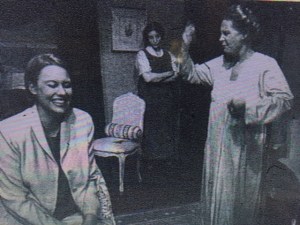

Pulitzers Play Little Rock: THREE TALL WOMEN at the Weekend Theatre

IMG_0277

Photo by Karen E. Segrave

Edward Albee received his third Pulitzer Prize in 1994 for THREE TALL WOMEN.  It not only marked his return to the Pulitzer fold, it was his first critical success in nearly two decades.

In April 2001, the Weekend Theatre presented the play.  Directed by John Haman, the play featured Glenda Hope Fortenbury, Deb Lewis and Sue Diaz as C, B, and A, respectively — the trio of the title.   The relationships between the characters may or may not change in the play.  As with most Albee plays, much is enigmatic.

2018 marks the 100th anniversary of the first Pulitzer Prize for Drama being given. To pay tribute to 100 years of the Pulitzer for Drama, each day this month a different Little Rock production of a Pulitzer Prize winning play will be highlighted.  Many of these titles have been produced numerous times.  This look will veer from high school to national tours in an attempt to give a glimpse into Little Rock’s breadth and depth of theatrical history.

The Toes Will Go On

Ballet ArkansasAs previously scheduled, Ballet Arkansas will present its “Ballet Arkansas in Concert” the weekend of May 4 through 6 at the Arkansas Repertory Theatre.

Though the Rep is suspending operations effective immediately, that is not altering the Ballet’s planned performances.

Join Ballet Arkansas as they present paramount works by international choreographers, excerpts from beloved classics, and a collaboration with world renowned Van Cliburn award winning pianist, Dr. Drew Mays. 

Featuring works by TONY AWARD winner Agnes de Mille, TONY AWARD winner Christopher Wheeldon, and Michael Fothergill’s WORLD PREMIERE

Tickets for the Ballet are still available for purchase on the Rep’s website.

And don’t forget Ballet Arkansas presents DanceWorks this Saturday from 10am to 4pm at the studio on Main Street.

DanceWorks is a free event that celebrates the impact of dance and the arts in the Little Rock community. Join them for open dance classes in a variety of disciplines, stop in for an open rehearsal and chat with the Artistic Directors, and enjoy a preview of Ballet Arkansas In Concert: With Drew Mays and a new work by Company Artist Paul Tillman to conclude the event. Visit balletarkansas.org to learn more!

Open Dance Classes 10 am- 3 pm
Open Rehearsal and Informal Chat with the Artistic Directors 3-4pm
LIVE Performance 3:30pm!
*Colonial Wine & Spirits will be generously providing celebratory libations at the performance preview!

Pulitzers Play Little Rock: ‘NIGHT, MOTHER on Arkansas Rep stage with Oscar winner Mercedes McCambridge

MercedesIt is not often that an Oscar winner has appeared in a play on a Little Rock stage.  But in the spring of 1986, Mercedes McCambridge starred in Marsha Norman’s ‘night, Mother at Arkansas Repertory Theatre.

She had moved to Little Rock a few years prior to live full time to be close to family. From time to time, she and Cliff Baker (the Rep’s founder) would have conversations about potential projects. But it was not until 1986, that the stars aligned.  By this point, she had moved away from Little Rock, but was still back from time to time to visit family.  (In an interview with the Arkansas Gazette, she also praised Fred Poe and noted that he was her travel agent for her many excursions.)

Appearing on stage with McCambridge in Norman’s two-hander was Rep veteran Cathey Crowell Sawyer.

Though noted for her film work, McCambridge had appeared on Broadway several times including opposite Little Rock native Ben Piazza in Who’s Afraid of Virginia Woolf? and receiving a Tony nomination for her work in the play The Love Suicide at Schofield Barracks.

Prior to appearing at the Rep, she had recently toured in the play Agnes of God.  She related to the Gazette that she had been approached to do that play prior to Broadway but did not feel the character she was to play was believable.  When the national tour came about, a conversation with playwright John Pielmeier changed her mind.

Her last Broadway appearance was in Neil Simon’s Pulitzer Prize winning Lost in Yonkers.

2018 marks the 100th anniversary of the first Pulitzer Prize for Drama being given. To pay tribute to 100 years of the Pulitzer for Drama, each day this month a different Little Rock production of a Pulitzer Prize winning play will be highlighted.  Many of these titles have been produced numerous times.  This look will veer from high school to national tours in an attempt to give a glimpse into Little Rock’s breadth and depth of theatrical history.

The Mourning After

Ark Rep ER RE Apr11

Theater or Theatre? (pre-renovation Arkansas Rep signage) – April 2011

On Tuesday night, as I scrolled through a variety of comments about the Rep on websites and social media, I’ve been struck by the deep affection people feel for it.  But it is not a simple “let’s roll up our sleeves,”  to use football parlance, raising the needed $750,000 only gets the Rep back to the line of scrimmage.  It does not win the game.

For the Rep to survive, it must be a sustainable organization.  What does a sustainable Rep look like?  Does it continue to have a contract with Actors Equity?  Does it produce six shows a year?  Does it provide education offerings? Does it share space with other arts organizations? Regardless of the answers to the questions (and many others), what it has to have is a dedicated audience and consistent donor base.

It is not enough to say “we need a live professional theatre in Little Rock.”  There must be a commitment to attending and continually financially supporting it.  As a youth, my ever-wise father frustrated me to no end if I said I did not have time to do something.  He would respond, “You didn’t have time or you did not want to make the time?”  Yes we are busy, but in order for the Rep to survive, we have to make the time to attend it and support it with our dollars.  And it’s not just the Rep that needs our support. It’s the Symphony, the Ballet, exhibits at the Arts Center and Museum of Discovery, Wildwood, the Zoo, and the list goes on.

The subscription model for arts organizations seems to be on its way out.  But theatres still rely on it.  (As do symphonies and opera companies.)  If people are only interested in three of the season shows, or have no idea if they’ll be in town for several shows, or are uncertain about attendance because they don’t know what their obligations will be in six months, they are not likely to subscribe.  For the financial well-being of the Rep, this will need to be examined in looking at the future.  There are a few other models that are out there. It is scary to try something new. But with the Rep in a mode of self-examination, maybe now is the time.

I’ve read a lot over the past year about the last days of the Arkansas Gazette. There were some well-intentioned efforts to keep the paper going. But nothing was financially sustainable. The players finally had to admit they could not make it work.  Emotions gave way to reason.  While I definitely hope this situation plays out differently for the Rep and results in it being a continuing organization, the fundamentals are the same.  Emotion and enthusiasm can only sustain so much.

When the Rep started, Little Rock had two daily newspapers, three locally owned TV stations, and several locally owned large banks as well as savings and loans. The utilities were either locally owned or had local control of their philanthropy.  Plus there was potential funding from locally owned hospitals, major insurance carriers, etc., etc., etc.  AND the number of non-profits seeking dollars from the sources outlined above was significantly smaller than today.  (Between 1976 and 2018, there seems to be an inverse relationship between the available pools of money and the organizations requesting said money.)  In the mid-1970s, the National Endowment for the Arts and the Arkansas Arts Council were both looking to fund theatres, and like Little Rock’s donors had fewer organizations requesting funds.  It was a different day. One that is long in the past.

It is not fiscally prudent for the Rep, or any organization, to rely solely on one or two major funding sources.  This has plagued certain Arkansas arts organizations over the years.  It creates the sense that your contribution doesn’t matter because there is always someone else who will make up the difference.  What happens when that funding source closes? or dies? or changes interests?

A future Rep must have a long-term and deep-seated commitment by a wide swath of patrons in order to survive.  It cannot live on an occasional audience member’s nostalgia for that fun evening six years ago.  It cannot make it on simply ticket sales (even if every show was a sell out). It needs a mid-term and long-term plan for both itself and its audience members.  If there is only a burst of enthusiasm now which peters out in six to sixteen months, we’ll be back where we are now.

If the Rep is our theatre, it is our responsibility to bring it back and support it. Not just tomorrow, but next year and next decade.

A Pause for The Rep

The announcement today that the Arkansas Repertory Theatre was suspending operations was a sad, if not completely unexpected one.

Over the past months, the Rep has been struggling financially.  Theatre is expensive.  Professional theatre has expectations and requirements that make it even more expensive.

For 42 years, the Arkansas Rep has been presenting live theatre in Little Rock. First in an old church in MacArthur Park and then on Main Street in an old department store.  These were the sites of first dates, anniversaries, birthdays, and celebrations.  Sometimes they provided escapes from the stresses of daily life.

There is no argument that Arkansas Rep has contributed enormously to the cultural life of Little Rock and Arkansas.  But that value has not always translated to dollars in the coffers.

And that is the problem.

Musicals tend to be more popular with Little Rock audiences.  They are also much more expensive to produce employing more actors, musicians, more settings.  The additional actors wear more costumes and carry more props.  (Little Rock’s preference for musicals is not unique; most cities are that way.)

I’ve heard it said that a play can sell at about 80% of capacity and clear more money than a musical selling at 95%.   Over the past few years the Rep has programmed more musicals (sometimes three out of six shows on top of a classic play with a large cast). Did that create more excitement in the community?  Yes.  Did it put more money in the Rep’s pockets?  Apparently not.

Over the past year, I’ve heard finger pointing and bemoaning.  Some have said the excitement over shows at Robinson have taken away entertainment dollars from local groups.  Since it reopened Robinson has certainly seen more events — but the past few years have also seen Verizon Arena book a lot more large acts.  This is a bonanza time for the touring industry.  And because it alternates between feast and famine, when it is feast time, operators seize the day.

When the Rep started, there were only two other local theatres programming for general audiences – Murry’s Dinner Playhouse and the Community Theatre of Little Rock.  Now the options also include the Studio Theatre, Weekend Theatre, Argenta Community Theatre, and Benton’s Royal Players.  There are weekly improv performances at the Joint.  Plus programming in Conway.  Last weekend Praeclara presented Into the Woods.  In other words, a whole lot of alternatives for live performances.  Are the other alternatives the same types of theatre (non-profit, union professional theatre) as the Rep?  No.  But they are part of the mix when competing for resources.  That is all a good thing. But it does mean that people have to make choices for their time and money.

The “Next Act” for the Rep will have to take this new environment into account.  It can be a scary but also exciting time to see what happens.

As the Rep’s board reassesses its future, it is important for the Little Rock community to come together to support live, professional theatre in Little Rock.  We must also redouble our efforts to support other cultural institutions.  For people who came to Little Rock after 1980, they do not not remember a time without the Rep, the Symphony, the Arts Center,  the Ballet.  But there were times without them.  We cannot take them for granted.

Over the years, many other cultural anchors in Little Rock have faced uncertain financial futures.   This spring marks 50 years that the Arts Center faced closing its doors if it did not take drastic measures. To keep afloat, It dropped its unsustainable model (very expensive degree granting programs) which eventually gave rise to the establishment of the Museum School, the Children’s Theatre, and a combination of permanent and temporary exhibits.  (When the degree granting program was underway, it basically took over all the spaces for academic purposes.)  In 1968, there was much hand-wringing and uncertainty.  But, as was pointed out in newspaper articles at the time, this decision allowed for it to return to its original mission.  And look what we have today!

Other theatres across the country have taken these steps the Rep took to stop.  Some have restarted.  Most have not. (I don’t have numbers in front of me, this is based on anecdotal memory from about 30 years of reading many national theatre publications).  It is up to us to put the Rep in the “Re Start” category.

I certainly hope this is a Reset for the Rep, not an RIP.

Pulitzers Play Little Rock: DOUBT at the Studio Theatre

TST DoubtIn 2016, the Studio Theatre presented John Patrick Shanley’s Pulitzer Prize winning Doubt. It was not the first theatre in Little Rock to present the play in the 12 years since it had debuted.  But the taut, riveting, and somewhat ambiguous story is one that offers audiences plenty of reasons to return to it.

As the Studio Theatre summarized it:

Did he or didn’t he? Doubt, a Parable, follows the story of the staff at a Catholic school in the Bronx, New York. It begins when Sister James, a young sister who recently started teaching at the school, becomes concerned that the relationship between a priest, Father Flynn and a student may have become inappropriate. Sister James confides this fear to the principal, Sister Aloysius, who becomes determined to find out the truth about what happened and to protect the boy.

Bob Bidewell directed the play. The quartet of actors in the cast were Karen Q. Clark (cast against type), James Norris, Angela Bloodworth-Collier, and Jessica Lawson.  Brandon Nichols was the assistant director and Andrew Jordan designed the lighting.

2018 marks the 100th anniversary of the first Pulitzer Prize for Drama being given. To pay tribute to 100 years of the Pulitzer for Drama, each day this month a different Little Rock production of a Pulitzer Prize winning play will be highlighted.  Many of these titles have been produced numerous times.  This look will veer from high school to national tours in an attempt to give a glimpse into Little Rock’s breadth and depth of theatrical history.