
 The Arkansas Repertory Theatre put it all on the line — the chorus line when they presented the 1976 Pulitzer Prize winning A CHORUS LINE in 2006. Directed by Cliff Fannin Baker, this was one of the last productions allowed before a Broadway revival.
The musical, set in an audition for an unnamed musical, featured a cast of 25 triple threats. Bob Gaynor and Kathryn Mowat Murphy played the leading roles of Zach and Cassie. The latter had played the role three times previously, each directed by a member of the original Broadway production of the show.
Others in the cast were Joi Chen, Case Dillard, Allison Stodola, Steven Baker, Darryl Calmese Jr., DJ Chase, Tony Falcon, Matt Gibson, Colleen Hawks, Hollie Howard, Kolina Janneck, Christina LaDuca, Deborah Leamy, Miguel A. Romero, Michael Susko and Melanie Waldron.
Rounding out the cast were Dennis Glasscock, Matthew D. Brooks, Lauren Farrell, Joey Murray, Cameron Wade, Eric T. Mann and Kim Scott.
The creative team included choreographer Lynne Kurdziel Formato (in her second collaboration with Baker at the Rep), Kristy Nicholson (musical director), Mike Nichols (scenery), Yslan Hicks (costumes), M. Jason Pruzin (sound) and Ken White (lighting).
The production played from June 2 through July 2 of 2006.
 One hundred and nine years ago today (October 24, 1909), William Howard Taft became the third sitting president to visit Little Rock. His visit is the shortest presidential visit to the city, to date.
 Fourteen years after graduating from Little Rock Hall High School, David Auburn received the 2001 Pulitzer Prize in Drama for his play Proof. In September 2002, Arkansas Repertory Theatre produced Proof while the original Broadway run was in its final months.
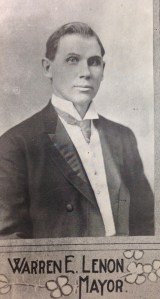 In April 1903, Warren E. Lenon took the oath of office and became Little Rock Mayor. He had previously served a decade on the City Council. A native of Iowa, Mr. Lenon was a banker and real estate developer.
 In June 2003, the Arkansas Rep went back to the dying days of vaudeville when it presented Gypsy. Written by Arthur Laurents, Jule Styne and Stephen Sondheim, this musical fable looks at the end of vaudeville and the rise of Gypsy Rose Lee. It was directed by Rep founder Cliff Fannin Baker.
 The Arkansas Rep concluded its 25th season with the Cole Porter musical Anything Goes. Directed by Rep founder Cliff Fannin Baker, it featured an onstage orchestra led by then-Arkansas Symphony maestro David Itkin. (Rep Producing Artistic Director Bob Hupp and Itkin had been trying for a while to find a project for collaboration.)
 A comedy about truth and trust, deception and decisions, Douglas Carter Beane’s As Bees in Honey Drown marked the first production of the 1999-2000 season for Arkansas Repertory Theatre. It also signified the transition between Rep founder Cliff Fannin Baker and Bob Hupp as artistic director.
 Little Rock Culture Vulture