
Unknown's avatar

About Scott

A cultural thinker with a life long interest in the arts and humanities: theatre, music, architecture, photography, history, urban planning, etc.

Tonight – opening reception for Arkansas Arts Council’s Small Works on Paper exhibit at Mosaic Templars Cultural Center

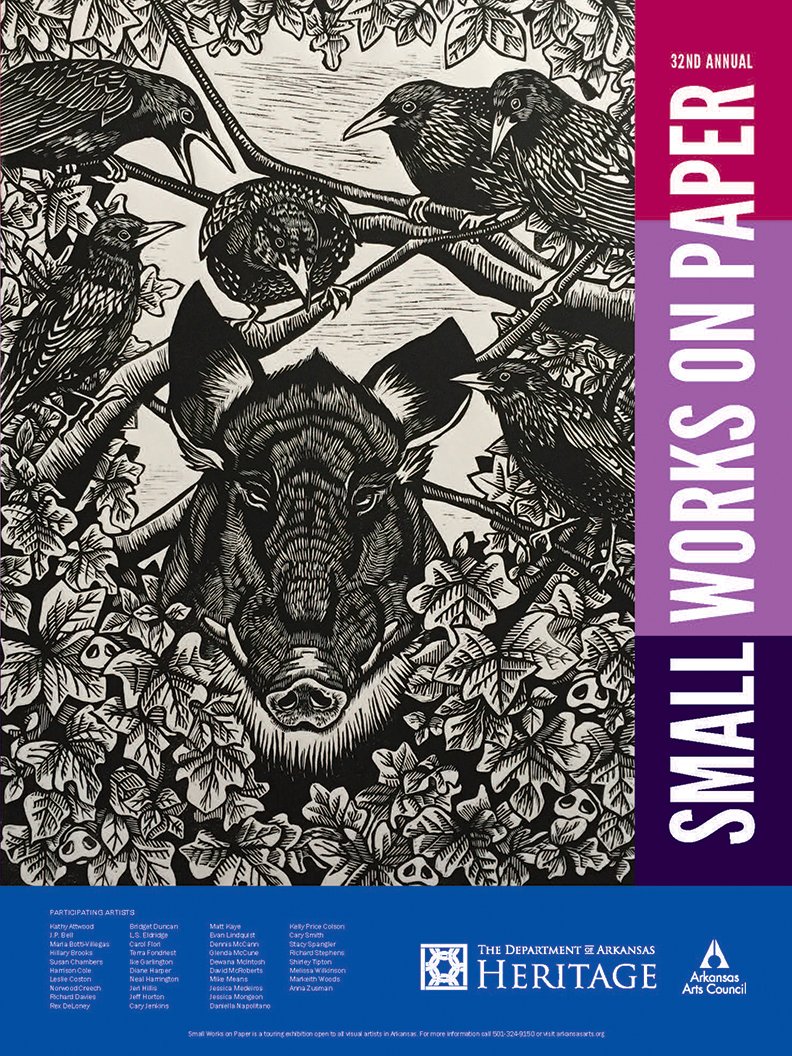
Image result for arkansas arts council small works on paperThe Arkansas Arts Council, a division of Arkansas Heritage, is pleased to announce 35 Arkansas artists will be represented in the 2020 Small Works on Paper touring exhibition. The opening reception will take place tonight (January 9) at Mosaic Templars Cultural Center from 5:30pm to 7:30pm.

Thirty-nine artworks will be on display in nine galleries statewide during the yearlong tour. Featured artists will speak during the opening reception. Both the exhibition and the reception are free. The exhibition will run through Jan. 25

The following artists’ work will be on display:

1. Oluwatobi K. Adewumi, of McNeil
2. John Ahlen, of Little Rock
3. Martin Balsam, of Little Rock
4. Ebony Blevins, of Little Rock
5. Win Bruhl, of Little Rock
6. Brian Cormack, of Little Rock
7. Anais Dasse, of Little Rock
8. Terra Fondriest, of St. Joe
9. B. Jeannie Fry, of Cabot
10. Catherine Goenner, of Bella Vista
11. Diane Harper, of Little Rock
12. Diana Michelle Hausam, of West Fork
13. Karlyn S. Holloway, of Austin
14. Jeff Horton, of Little Rock
15. Cary Jenkins, of Little Rock
16. Hannah Jeremiah, of Van Buren
17. Kimiara L. Johnson, of Pine Bluff
18. Kathleen Keefe, of Little Rock
19. John P. Lasater, IV, of Siloam Springs
20. Sigrid Lorfing, of Russellville
21. Lisa Martin, of Clarksville
22. Ray Ogar, of Little Rock
23. Karen Perry, of Hot Springs Village
24. Michael Preble, of Hot Springs
25. Lynn Reinbolt, of Searcy
26. Charlotte Bailey Rierson, of Fairfield Bay
27. Jane Rockwell, North Little Rock
28. Sabine Schmidt, of Fayetteville
29. Dominique Simmons, of Little Rock
30. Gary Simmons, of Hot Springs
31. Thomas Quinton Stanford, of Siloam Springs
32. Joe Stewart, of Bentonville
33. Brian Wolf, of North Little Rock
34. Terry Wright, of Little Rock
35. Anna Zusman, of Magnolia

Small Works on Paper is a juried visual art exhibition that showcases artwork no larger than 18-by-24 inches. The work is by Arkansas artists who are members of the Arkansas Artist Registry, an online gallery. The exhibition features new and established artists and offers those artists the opportunity to have their work seen by patrons all over the state.

This year’s entries were juried by Jamie Adams, associate professor of art at the Sam Fox School of Design and Visual Arts at Washington University in St. Louis. Adams reviewed nearly 300 submitted artworks to pick the 39 works in the exhibit. He also selected the following works to receive purchase awards, which are cash prizes equivalent to the value of the artwork. Purchase award pieces become part of the Small Works on Paper permanent collection.

“Proud Tower,” acrylic and collage, by John Ahlen of Little Rock
“Self-Portrait,” charcoal, by Martin Balsam of Little Rock
“Ozark Gaming,” photograph, by Terra Fondriest of St. Joe
“Post,” photograph, by Cary Jenkins of Little Rock
“Reflections of Winter Series 1, Winter’s Kiss,” watercolor by Charlotte Bailey Rierson of Fairfield Bay
“Jonathan,” graphite, by Jane Rockwell, of North Little Rock
“Palm Hours,” acrylic on paper, by Brian Wolf of North Little Rock

Thea Foundation Insider Kick-Off Happy Hour

thea-logo-rgb.pngStart off the new year with art-filled plans! Join the Thea Foundation  on Thursday, January 9, for a special Insider Kick-Off Happy Hour beginning at 5:30 p.m.
Find out how you can stay involved with Thea Foundation and receive great perks. When you become a Thea Insider, your annual gift gives you access to four of their Art Department exhibition openings with a special, advance meet and greet with each artist as well as 25% off their annual fundraisers, including Into the Blue and Blue Plate Special. In addition to these event benefits, you’ll receive a quarterly update on our recently-funded Art Closet projects, giving you an inside look at their impactful programming and how your contribution helps inspire young minds to think creatively across the state of Arkansas. No matter when you sign up, your Insider status continues for a full year upon joining.

Drinks and hors d’oeuvres sponsored by ROXOR Artisan Gin and Bonefish Grill will be available during this special mix and mingle about their new club opportunity.

To sign up for Thea Insiders directly, visit theafoundation.org/support and click ‘Join Today!’ under the the Thea Insider details.

Elvis at 85

Photo by Wayne Cranford

Eighty-five years ago today, Elvis Presley was born in Tupelo, Mississippi. He would, of course, grow up to become a cultural phenomenon.

Elvis performed in Little Rock throughout his career. In April 1972, he played at Barton Coliseum (with tickets on the arena floor going for a whopping $10!). In the 1950s, he played three at Robinson Auditorium. His first appearance was as his career was just starting to take off. The final appearance on that stage, a mere 15 months later, was when he had become a national icon.

His first appearance at Robinson was on February 20, 1955. Billed as the “WSM Grand Ole Opry” show, Elvis Presley was third on the bill behind the Duke of Paducah and Mother Maybelle and the Carter Sisters as he began week long tour of Arkansas and Louisiana. On this date there were a pair of shows, at 3:00 and 8:15 p.m., at Robinson Auditorium. Tickets were 75-cents in advance, $1.00 at the box office and 50-cents for kids. It is believed that Gladys and Vernon Presley attended this performance, invited by Elvis who wanted to introduce them to the Colonel. Gladys was a big fan of the Duke of Paducah. Elvis Presley, Scotty Moore, and Bill Black receive $350 for these two shows instead of their usual $200 per day. In August 1955, he returned and played Robinson as part of the All-Star Jamboree.

His third and final appearance at Robinson Auditorium was on May 16, 1956. This time, the Auditorium was packed. The tickets were $1.50 in advance at Walgreens and $2.00 at the box office. The ads featured 8 great acts in “his” variety show which consisted of the Jordonaires; Rick and Emil Flaim and their orchestra; vocalists Frankie Conners and Jackie Little and comedian-magician Phil Maraquin. A second show was added to accommodate the ticket demand.

About 30 minutes late, due to a missed flight, Elvis appeared on stage in a purple blazer and started singing “Heartbreak Hotel.” The crowd rushed the stage. Little Rock police officers were able to control them eventually and get the teenagers back to their seats. While the crowd was impressed, the police officers were less so. One of the patrolmen told the Arkansas Gazette reporter: “I wouldn’t know him if I saw him. And I wouldn’t be here unless I was being paid.”

First documented theatrical performance in Little Rock on January 8, 1835

On January 8, 1835, the Little Rock Town Council passed an ordinance granting the Society of Thalians a one year franchise to conduct performances in Little Rock.
That same day, the Thalians performed She Stoops to Conquer, Oliver Goldsmith’s 1773 comedy.

The following week, on January 17, they performed the comedy Ways and Means (by George Colman, Jr.) and David Garrick’s farce The Lying Valet.

The cost of the license to perform was $10 for the year. That would be the equivalent of $287 today. The ordinance also instructed the Town Constable to attend, by himself or a deputy, all theatrical performances to keep and preserve order.

There may well have been theatrical troupes come through Little Rock prior to January 1835, but records do not exist to any performances they may have given.  The performances by the Thalians are the first documented theatrical productions in Little Rock.

Resumption of City of Little Rock government in post-Civil War era

One hundred and fifty four years ago today (on January 8, 1866), Little Rock City Hall resumed functioning after the Civil War.  The City government had disbanded in September 1863 after the Battle of Little Rock.  From September 1863 through the end of the war (on on through part of Reconstruction), Little Rock was under control of Union forces.

Following the April 1865 conclusion of the Civil War, plans were made to restart local government in Little Rock.  Even though Arkansas would not have Congressional representation in Washington until June 1868 (becoming the second Confederate state after Tennessee), the establishment of local government took place in January 1866.  (It was supposed to have started earlier, but the local elections set for November 1865 were cancelled on the day they were originally set to take place.)

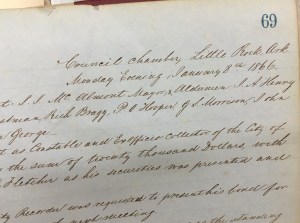
The first City Council meeting took place on Monday, January 8, 1866. The council met again on Tuesday, January 9 and Monday, January 15 as they were trying to establish committees and rules for the new government.

The first post-Civil War mayor was Dr. J. J. McAlmont, who was a physician and pharmacist. Following his service as the city’s chief executive, he would later be a co-founder of what is now UAMS.  The initial aldermen were I.A. Henry (who had been on the City Council when it ceased in 1863), Henry Ashley, M. H. Eastman, Rick Bragg, Dr. P. O. Hooper, G. S. Morrison, John Collins and Alexander George.

Their first action was to approve the bond of Thomas C. Scott as Constable and City Collector.  Vouching for him were S. H. Tucker and future LR mayor John Gould Fletcher.  The Recorder was asked to present his bond and the next meeting.

The Mayor then established several committees of the City Council and named his appointments. Among the committees were Finances, Streets, Ordinances, Mount Holly Cemetery, Fire Department and Police.

That meeting and the following two meetings, the City continued to approve motions, resolutions and ordinances to set up the duties and responsibilities of a government.

Ordinance Number 1 established the rates of Licenses for 1866.  Among those were:

  • $100 for the privilege of selling goods at auction
  • $20 for a one-horse wagon, paid quarterly
  • $35 for a two-horse wagon, paid quarterly
  • $50 for a four-horse wagon, paid quarterly
  • $25 to run a cab or bus (which would have been in some horse drawn conveyance), paid quarterly
  • $40 a month to sell liquor, wine, ale, beer, etc., by the glass or bottle to be consumed in a store, tavern, shop or store
  • $25 each quarter for each billiard table
  • $50 each quarter for each ten pin alley

Off the Grid: Nature, Black Power, & Freedom on the AR Frontier is topic of today’s CALS Legacies & Lunch

Image may contain: tree, outdoor and waterLegacies & Lunch kicks off 2020 with a program today at 12 noon, entitled “Off the Grid: Nature, Black Power, & Freedom on the AR Frontier.”

Through images, stories, and botanical specimens from the field, historian Story Matkin-Rawn and ecologist Theo Witsell will share their research on the challenges of frontier life and use of wild resources among newly freed African Americans in the Natural State following the Civil War.

Story Matkin-Rawn serves as vice-president of the Arkansas Historical Association and is an associate professor of history at the University of Central Arkansas, where she teaches courses on Arkansas, Southern, and Civil Rights history. She received her PhD in history from the University of Wisconsin in 2009. Her article “The Great Negro State of the Country: Arkansas’s Reconstruction and the Other Great Migration,” which appeared in the Arkansas Historical Quarterly in 2013, won the Violet B. Gingles Prize. This presentation on African American life on the Arkansas frontier is part of her current project, a book manuscript titled “A New Country: An African American History of the South’s Last Frontier, 1865–1940.”

Theo Witsell is the ecologist and chief of research for the Arkansas Natural Heritage Commission, a division of the Department of Arkansas Heritage. Prior to that, he served as a botanist for the agency for nineteen years, researching and protecting rare species and habitats across the state. His research interests include the historical ecology of Arkansas and the intersections of human history and our natural heritage.

Legacies & Lunch is a free monthly program of CALS Butler Center for Arkansas Studies about Arkansas related topics. For more information, please contact 320-5744.