Unknown's avatar

About Scott

A cultural thinker with a life long interest in the arts and humanities: theatre, music, architecture, photography, history, urban planning, etc.

An early Christmas present in 1937, Robinson Auditorium groundbreaking on Christmas Eve

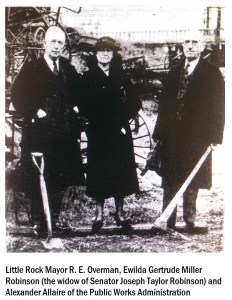
On December 24, 1937, at 11:30 a.m., Little Rock Mayor R. E. Overman, Ewilda Gertrude Miller Robinson (the widow of Senator Joseph Taylor Robinson) and  Alexander Allaire of the PWA turned dirt to participate in the brief groundbreaking ceremony for Little Rock’s municipal auditorium.

That morning, the Arkansas Gazette ran a brief story on the upcoming groundbreaking.  The story mentioned that the building would be named in memory of the late beloved Arkansas politician.  This appears to be the first public pronouncement of the Robinson name for this civic structure.

Among others in attendance at the groundbreaking were Mrs. Charles Miller (sister-in-law of Mrs. Robinson), Mr. and Mrs. Grady Miller (brother and sister-in-law of Mrs. Robinson), the mayor’s wife, the three architects (George Wittenberg, Lawson Delony and Eugene John Stern), and D. H. Daugherty and Will Terry of the City’s Board of Public Affairs.

Construction had to start by January 1, 1938, in order to receive PWA funds.  By breaking ground on December 24, there was over a week to spare.  The site had been selected in late October 1937, and the purchase had not been finalized.  But the PWA did give permission for the City to let a contract for excavation, demolition and filling on the site.

The groundbreaking took place at the corner of Garland and Spring Streets which was on the northeast corner of the block set aside for the auditorium.  Today, Spring Street does not extend north of Markham; the street was closed to make way for the parking structure and what is now the Doubletree Hotel.  That section of Garland Street is basically an alley that runs parallel to Markham north of City Hall, Robinson Auditorium and the Doubletree Hotel.

Little Rock chosen as 2020 Hottest Foodie City!

Little Rock has been named “America’s Next Hottest Foodie Destination 2020” by the Foodie Flashpacker blog. Little Rock won 39% of public votes, beating out 32 other cities from around the country including Walla Walla, WA, Albuquerque, NM, Dallas, TX and Minneapolis, MN.

No other city even came close to Little Rock!

Food and travel bloggers, and general public were invited to vote for Little Rock.  Voting started on December 16 and ran for a week.

Foodie Flashpacker Nathan Aguilera has spent the past six years traveling and eating dishes across 60+ countries on 5 continents. Nathan shares his experiences with people everywhere through the Foodie Flashpacker blog.

Happy Festivus! Prepare for those Feats of Strength and Airing of Grievances

In honor of Festivus 2019, here is a photo of Jason Alexander (aka George Costanza) when he was at Arkansas Rep in January 2016 to conduct auditions for the play WINDFALL which he directed at the Rep.  He is pictured with Bob Hupp, who was then Producing Artistic Director of Arkansas Rep.

Alexander has continued collaborating with Hupp at Syracuse Stage, where the latter went in 2016.

Little Rock resident Judge Reinhold was not in THAT “Seinfeld” episode, but did star in another iconic epsiode as “The Close Talker.”

Birth of Little Rock’s 16th Mayor – Roswell Beebe

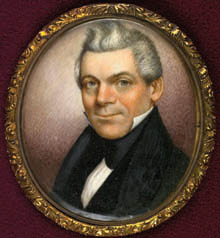
On December 22, 1795, future Little Rock Mayor Roswell Beebe was born in Hinsdale, New York.  His family were wealthy English immigrants.  At seventeen, Beebe went to New Orleans and fought with Andrew Jackson in the 1815 Battle of New Orleans.  He stayed in the Crescent City for the next two decades building successful lumber and brick businesses.

Due to health concerns, he moved north to a drier climate in 1834.  After first stopping in Fulton, Arkansas, he settled in Little Rock in 1835 at the age of forty.  He stayed at the home of Chester Ashley and married Ashley’s sister-in-law, Clarissa Elliott.  He and Clarissa had two children, Roswell and Cora.

For nearly 30 years, Little Rock had a complicated history of deeds, titles and land ownership.  In 1839, Beebe went to Washington DC and received the original patent from President Martin Van Buren.  He then set about clearing up the land and title issues, as well as drawing up a plan for the city and laying off blocks and streets.  Beebe deeded the streets and alleys to the City for a dollar.  He also donated the land on Markham Street for a new State Capitol building (now home of the Old State House Museum).  Along with his brother-in-law Chester Ashley, he donated the land for the establishment of Mount Holly Cemetery.

In 1848, Beebe was elected to the Little Rock City Council.  The following year, he was elected Mayor.  He served as Mayor of Little Rock from April 1849 to February 1850.

While his primary business focus in the 1840s had been real estate, in the 1850s he focused on railroads.  Beebe was named president of the Cairo and Fulton Railroad Company in 1853.

While on a visit to New York, Beebe died on September 27, 1856.  His body was returned to Little Rock, and Roswell Beebe was buried at Mount Holly Cemetery.  The town of Beebe, Arkansas, is named in his honor.

63 years since the Aluminum Bowl in Little Rock

Courtesy of Paul Edwards to the Encyclopedia of Arkansas History and Culture

Bowl season is upon us!  In 1956, Little Rock was home to the inaugural (and only) Aluminum Bowl.

On December 22, 1956, the city hosted the NAIA national championship game between Montana State University and St. Joseph’s College (of Indiana).  This was the first time the NAIA had a football championship.

Originally the game was set to be played in Shreveport, Louisiana.  But because some NAIA schools were integrated, teams with integrated rosters were forbidden by a state law passed by the Louisiana legislature.

The Little Rock Chamber of Commerce and others worked to bring the game to War Memorial Stadium.  Because of the importance of the aluminum industry in Central Arkansas, the name Aluminum Bowl was chosen.  Both ALCOA and Reynolds were major sponsors of the event.

The game, which was aired on CBS TV and radio, was played on a rain-soaked muddy field and turned into a defensive slugfest. Both teams only got close to scoring once.  The score ended up a 0 to 0 tie, so the teams were declared co-champions.  The rain kept the crowds away as only 5,000 people showed up leaving 33,000 empty seats in the stadium.  Miss Arkansas Barbara Banks, who had been wearing a dress made entirely out of aluminum, spent the game covered up to keep the dress dry.

The next year, the game went to Saint Petersburg, Florida, where it was rechristened the Holiday Bowl.  The Little Rock outing would mark the only appearance by either team in the NAIA championship game.  Both teams subsequently switched to NCAA competition.  As of the spring of 2017, St. Joseph’s has suspended operations because of financial shortcomings.

It has been said that Little Rock leaders had wanted to get the Aluminum Bowl game to showcase that Little Rock was a progressive Southern city when it came to race relations. By 1956 the buses and the public library were integrated.  However, both teams were faced with their African American players having to stay at separate hotels while in Central Arkansas (one in Little Rock, the other team in Hot Springs).

For more on the Aluminum Bowl, visit the Encyclopedia of Arkansas History and Culture.

Kevin! The Arkansas Symphony Orchestra is presenting HOME ALONE with live orchestra this weekend!

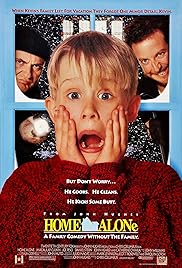
Home Alone PosterThe Arkansas Symphony Orchestra presents the first concert of the 2019-2020 Acxiom Pops! Live concert series: Home Alone: Film with Orchestra, Saturday, December 21th at 7:30 p.m. and Sunday, December 22th at 3:00 p.m. in the Robinson Center. The Pops! Live concert series is sponsored by Acxiom.

A true holiday favorite, this beloved comedy classic features renowned composer John Williams’ charming and delightful score performed live to picture by the Arkansas Symphony Orchestra.

Macaulay Culkin stars as Kevin McCallister, an 8-year-old boy who’s accidentally left behind when his family leaves for Christmas vacations, and who must defend his home against two bungling thieves. Hilarious and heart-warming, Home Alone is holiday fun for the entire family!

The Symphony, under the direction of Geoffrey Robson, will be playing John Williams’ Oscar-nominated score as the film plays.

Joining Culkin (whose aunt Bonnie Bedelia is a star in another Christmas move: DIE HARD) in HOME ALONE are a group of seasoned veterans.  While the adults are meant to be more cartoonish, they still keep the film grounded.  Joe Pesci and Daniel Stern have wonderful chemistry as the Wet Bandits.  John Heard’s slightly befuddled father is an apt foil for Catherine O’Hara’s intense mother. The latter displays much warmth when needed, as well. John Candy turns in a fun cameo in the first film. If you blink, you may miss future Tony nominee and The Newsroom actress Hope Davis as a French ticket agent.

Tickets are $16, $36, $57, and $70; active duty military and student tickets are $10 and can be purchased online at www.ArkansasSymphony.org; at the Robinson Center street-level box office beginning 90 minutes prior to a concert; or by phone at 501-666-1761, ext. 1. All Arkansas students grades K-12 are admitted to Sunday’s matinee free of charge with the purchase of an adult ticket using the Entergy Kids’ Ticket, downloadable at https://www.arkansassymphony.org/freekids.