
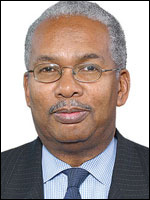
Little Rock Look Back: Happy Birthday to Ernest Green

Ernest Green’s sixteenth birthday was probably more memorable than most people’s.  It was not about getting a car, it was about wondering if he would ever get to attend Little Rock Central High School.

Born on September 22, 1941, he was the son of Lothaire S. and Ernest G. Green.  In 1957, his birthday was on a Sunday.  The next day, the Little Rock Nine would spend a few hours in Central High School before being escorted out for their own safety.  However, three days after his birthday, escorted by members of the 101st Airborne Division of the US Army, he finally entered Central to complete the school year.

In May 1958, he became the first African American to graduate from Little Rock Central High School.  At the age of seventeen he was awarded the NAACP’s Spingarn Medal, as one of the Little Rock Nine.  He then obtained a  B.S. in Social Science and Masters in Sociology from Michigan State University.

Featured in the 2006 list of Black Enterprise Magazine’s “75 Most Powerful Blacks on Wall Street”, Ernest has served as senior investment banker on transactions for such key clients as the City of New York, State of New York, City of Chicago, Port of Oakland, City of Atlanta, State of Connecticut, Detroit Wayne County Airport, Denver Airport, and the Washington Metropolitan Airport Authority.

He served as Assistant Secretary of Labor for Employment and Training during the Carter Administration.  President Clinton appointed him to serve as Chairman of the African Development Foundation.  Secretary of Education Richard W. Riley, appointed him Chairman of the Historically Black Colleges and Universities Capital Financing Advisory Board.

In 1995, he was awarded the Distinguished Eagle Scout Award.  Ernest Green is also a recipient of the Urban League’s Frederick Douglass Freedom Medal, and the John D. Rockefeller Public Service Award. On November 9, 1999, with the Little Rock Nine, he was presented by President Clinton with the Congressional Gold Medal. He holds honorary doctorates from Michigan State University, Tougaloo College, and Central State University.

Several books, movies and documentaries have chronicled his and his eight classmates’ historic year at Central High School in Little Rock — the most recent being the “Ernest Green Story”, produced and distributed by the Walt Disney Corporation.

He and his wife Phyllis live in Washington, D. C.  He is the proud father of Adam, Jessica and McKenzie Ann.


Sculpture Vulture: Clay Enoch’s UNITED installed on Sept 22, 2017

Clay Enoch’s sculpture UNITED was dedicated to kick off the public events for the commemoration of the 60th Anniversary of the Central High School integration by the Little Rock Nine.

The piece, which depicts two figures working together to close two circles, is located in front of Little Rock Central High School.

Enoch was joined at the dedication by several members of the Little Rock Nine, City of Little Rock officials, and current Central High School personnel.

City Director Dean Kumpuris and Little Rock Nine member Ernest Green (who was celebrating a birthday that day) made remarks about the importance of the message of United.  Enoch discussed his process in creating the sculpture.

Principal Nancy Rousseau accepted the sculpture on behalf of the school.  Then Mr. Enoch, Mr. Green, and current Central High students unveiled the sculpture.

The sculpture was installed by Little Rock Parks and Recreation staff.  The Central High School PTSA has landscaped the area around the sculpture and maintains it.

Enoch was chosen through a national public monument commission process sponsored by Sculpture at the River Market.

Little Rock Look Back: LR City Hall Suspends Operations in 1863

A few days after the defeat at the Battle of Little Rock, the City of Little Rock ceased operations on September 21, 1863.

Planning for this had started in August, which would suggest that civic leaders were none too confident in the ability of Confederate forces to hold on to the city.  At the August 24, 1863, City Council meeting it was reported that the City’s funds (presumably Confederate) had been “placed in the hands of a reliable party who is well known to the Council.”  The identity of this “reliable party” has never been disclosed.

On September 21, the Council met and took three votes.  The first was to suspend the operation of City police (which at the time was not an official police force, it was a constable and some volunteers). The second was to suspend the collection of City taxes.  The final vote was to adjourn.

There is no record of Mayor William Ashley being present at this meeting.  Recorder A. J. Smith (the equivalent of City Clerk today) was not present.  The minutes were signed by “J. Ash, Deputy.” Records do not indicate if that gentleman was officially Deputy Recorder or if he had simply been deputized to take minutes at the meeting.  The five City Council members present were C. P. Bertrand (a former mayor and step-son of Little Rock’s first Mayor, Matthew Cunningham), S. H. Tucker, W. B. Walt, I. A. Henry (would would also serve on the first City Council after the war in 1866), and Lou George.

Little Rock Look Back: CALS Opens New Downtown Main Library

On September 20, 1997, the Central Arkansas Library System debuted its new main library building.  The building had previously been the Fones Brothers Warehouse building and was repurposed by the Polk Stanley Yeary architectural firm.

The grand opening festivities included storytellers for children throughout the day as well as various special activities.  Linked balloons made to resemble bookworms greeted visitors to the front entrance.

The move and expansion were the dream of then-CALS Director Bobby Roberts.  The previous library space had limited parking and was in a confined (and confining) space with no room for expansion.

To prepare for the move from the old location at 7th and Louisiana Streets, the library’s main branch had closed in July.  They had to inventory the existing materials in anticipation of the move.  The actual transport of the 250,000 books was accomplished in three 16-hour work days by the 65 member staff.

The project cost $13 million dollars, most of which came from a millage approved by voters. The 200 seat auditorium was funded by overdue book fines and areas for the employees were financed by a patron bequest.

At the time it opened, the fifth floor remained undeveloped.

Since September 1997, the fifth floor has been developed and CALS has ultimately developed over one city block in what is now known as Library Square.

Little Rock Look Back: War Memorial Stadium opens on Sept 18, 1948

On September 18, 1948, the Arkansas Razorbacks took on Abilene Christian and won the game by a score of 40 to 6.  It was the first game of the season, and the Razorbacks went into the game ranked #13. They maintained that ranking for four weeks before falling out of national standings.  The team ended up with a season record of five wins and five losses. Playing four of their games at War Memorial that season, they were two and two in Little Rock. They were one and two in Fayetteville and amassed a 2-1 record on the road.
Dedication ceremony in 1948. Photo courtesy of the War Memorial Stadium Commission.

Dedication ceremony in 1948. Photo courtesy of the War Memorial Stadium Commission.

Prior to the game, the stadium was dedicated to the veterans of World War I and World War II in a ceremony led by former Razorback standout and Medal of Honor recipient Maurice “Footsie” Britt.

Though Britt would later be known for entering politics and becoming Arkansas’ first Republican Lieutenant Governor, in his college days he was known statewide as an outstanding Razorback football and baseball athlete.  During World War II, his bravery and courage allowed him to become first person in American history to earn all the army’s top awards, including the Medal of Honor, while fighting in a single war.

Also participating in the opening ceremony were a mass of high school marching bands from across the state. Reports indicate up to forty bands were on the field to play the National Anthem as part of the event.

The construction of the stadium had been the brainchild of Razorback coach John Barnhill and Arkansas Secretary of State C. G. “Crip” Hall.  The duo shepherded it through the 1947 Arkansas General Assembly.   As a student at the University, Hall had been a team manager for the Razorbacks and had remained a longtime, active supporter.

In August of 1947, Little Rock was chosen as the location over Hot Springs and North Little Rock. West Memphis had abandoned its bid when it was unable to secure the necessary financial pledges.  Construction started in 1947 and continued up until opening day.  On the day of the game, newspaper photos showed heavy equipment grading the parking lot prior to paving.

The park in which the stadium sat would be renamed War Memorial Park in June 1949 and dedicated by President Harry S. Truman in a nationally-broadcast ceremony from War Memorial Stadium.

Little Rock Look Back: Satchmo Criticizes Ike over Little Rock

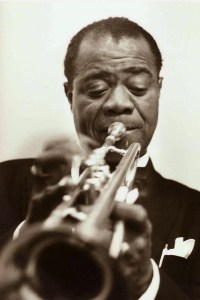
As the Civil Rights movement started taking hold in the mid-1950s, many African American entertainers were vocal in their support.  Louis Armstrong generally stayed silent.  Until, that is, September 17, 1957.

That night, in Grand Forks, North Dakota, Armstrong blasted President Dwight Eisenhower for his lack of action to make Governor Orval Faubus obey the law.  This was in an interview conducted by a 21 year old University of North Dakota journalism student named Larry Lubenow.

Journalist David Margolick wrote about the incident in The New York Times in September 2007 in conjunction with the 50th anniversary of the integration of Little Rock Central High School.  He recounted how the story, written for the Grand Forks Herald, was picked up all over the country.  The entire Margolick piece can be read here.  Margolick tells that when Armstrong was given the chance to back off the comments, he asserted that he meant all of it.

On September 24, 1957, the night that the 101st Airborne was being mobilized to come into Little Rock, Armstrong sent Eisenhower a telegram again criticizing him for lack of action. (It appears this was sent by Armstrong without knowledge of the President’s plans for intervention.) Armstrong used colorful language which sarcastically spoofed the “Uncle Tom” moniker which some of his critics had bestowed when they felt he was not doing enough for Civil Rights.  The Eisenhower Presidential Library has a copy of that telegram.

The incident between Satchmo and Ike was the basis for two different plays: Terry Teachout’s Satchmo at the Waldorf and Ishmael Reed’s The C Above C Above High C.

Little Rock Look Back: First Meeting of the WEC

Vivion Brewer, Adolphine Terry, and Pat House with an award presented to the WEC around the time the group disbanded.

On Tuesday, September 16, 1958, the first meeting of the Women’s Emergency Committee to Open Our Schools took place at the Pike-Fletcher-Terry House in downtown Little Rock.  Fifty-eight women were in attendance at the initial meeting.

The group had been envisioned four days earlier, on September 12. At the time, Adolphine Fletcher Terry had invited Vivion Lenon Brewer and Velma Powell to her house to discuss the current school situation. Terry and Brewer were both daughters of former Little Rock mayors.  They were frustrated with the stalemate that was taking place with the Little Rock School District, the State, and the Federal Government.

In a conversation about the group with her friend Arkansas Gazette editor Harry Ashmore, Mrs. Terry stated, “The men have failed, it’s time to call out the women.”

The same day the trio met, an immediate concern superseded their general discontent.

On September 12, Governor Faubus had signed several segregationist bills into law. One of them gave him the authority to temporarily close schools in order to keep the from being integrated. After signing the bills, he issued an order closing Little Rock’s four high schools. He set October 2 as the election day for Little Rock voters to ratify or reject the closing.

The closure of the schools and impending election, gave an urgency and an immediate focus for the WEC. The women sprung into action.

The way the election law was written, keeping the schools open would require a majority of all registered voters — not just those voting in the election.  There were several other requirements written into the law that made it all but impossible to reject the closure.  Nonetheless the WEC went to work.  They wrote letters, made phone calls, made personal pleas, raised money, and placed newspaper ads.

Their need for a quick and efficient organization became even more paramount with the Governor moved the election forward to September 27.  His public reason was to remove the uncertainty; but privately he was likely concerned that there was organized opposition.

Though the voters approved keeping the high schools closed, the WEC was undaunted. They continued to work throughout the 1958-59 school year in a variety of ways. They backed candidates in the December 1958 school board elections, and succeeded in getting three moderates elected.  In May 1959, they were a crucial bloc in the campaign to recall of three segregationist school board members.

Following the reopening of the schools in 1959, the WEC continued to focus on social issues until disbanding in 1963.

The membership of the WEC was kept a secret. No official roll was kept.  With a membership which swelled to over 1,300, obviously not all attended meetings at once. There were well organized phone trees which quickly got the word out to the membership.  During elections, they would create files on all registered voters with codes for Saints, Sinners and Savable.

In an effort of intimidation (as if anyone could intimidate Adolphine Fletcher Terry), there were efforts to force the WEC to disclose membership lists. The officers and their legal counsel replied that there were no lists in existence, so there was nothing to disclose.

On March 13, 1998, the names of the WEC were made public for the first time when they were published in the Arkansas Democrat-Gazette.  This was done in conjunction with the 40th anniversary of the year of the founding.  Later in the year, the names were etched in glass in the solarium of the Pike-Fletcher-Terry House.  (In the 1970s, the house was given by the family to the City of Little Rock for use by the Arkansas Arts Center.)

A ceremony at the house in October 1998 celebrated the 40th anniversary and the names permanently etched there.  First Lady Hillary Rodham Clinton came back to Little Rock to deliver remarks at the ceremony.

Sara Murphy, a member of the WEC wrote a book about the organization which was published in 1997, shortly after her death.  Around the same time, Sandra Hubbard produced a documentary called The Giants Wore White Gloves.  A sold out screening of the film is scheduled today at the CALS Ron Robinson Theatre as a presentation of the Clinton School Speaker Series in conjunction with the Butler Center for Arkansas Studies.