Little Rock Look Back: Frederick G. Kramer

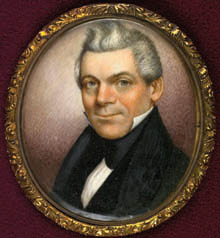
Mayor KramerOn December 29, 1829, future Little Rock Mayor Frederick G. Kramer was born in Halle, Prussia.  In 1848, he immigrated to the United States.  Kramer enlisted in the United States Army and served in the Seventh Infantry until his discharge at Fort Gibson, Indian Territory, in July 1857. After his discharge, Kramer settled in Little Rock, and became a citizen in 1859. He married Adaline Margaret Reichardt, an emigrant from Germany, in 1857. They had six children Louisa, Mattie, Emma, Charles, Fred, and Henry.

From 1869 to 1894, Kramer served on the Little Rock School Board.  He was the first School Board president.  Among his other civic activities were serving as president of the Masonic Mutual Relief Association, a founder of the Mount Holly Cemetery Commission, and a founder of Temple B’nai Israel.  In 1875 he and F. A. Sarasin opened a mercantile business. Kramer later became the president of the Bank of Commerce.

Frederick Kramer was elected Mayor of Little Rock in November 1873.  He served until April 1875, when a new Arkansas Constitution took effect.

From November 1869 through March 1875, the City Council President presided over City Council meetings and signed ordinances, performing many of the duties formerly ascribed to the Mayor.  As such, during his Mayoral tenure from 1873 to 1875, Kramer was the Chief Executive of the City but did not preside over Council Meeting.  When he had served on the City Council, however, Kramer had been elected President of the Council and had presided over Council meetings from October 1871 to May 1872

Kramer was returned to the Mayoralty in April 1881 and served three more terms leaving office in April 1887.  His tenure as an Alderman and as Mayor overlapped with his service on the school board.

A new Little Rock elementary school which opened in 1895 on Sherman Street was named the Fred Kramer Elementary School in his honor.  Though the building’s bell tower was removed in the 1950s, the structure still stands today.  It now houses loft apartments.

Frederick G. Kramer died on September 8, 1896, in Colorado Springs, Colorado.  A few months earlier, he had traveled there with his wife and daughter Emma to recuperate from an illness. He is buried in Oakland Cemetery.

Little Rock Look Back: Boxing Day remembrance of Muhammad Ali vs. Dan Sprick

Ali SprickDan T. Sprick was a Little Rock Mayor for two years in the 1940s after having previously served on the City Council.  From 1961 until 1970, he served as a State Senator from Little Rock and was a reliable ally for Governor Orval Faubus. Once Faubus left office and was replaced by Governor Winthrop Rockefeller, Sprick continued to wave the banner of segregation and agitation.  One of his new focuses was boxer Muhammad Ali.

In 1969, the University of Arkansas announced that Ali would be one of the speakers for its public appearance series.  After refusing to be drafted and go to Vietnam, Ali was barred from earning a living as a professional boxer and so was making a living giving lectures.  His refusal to submit to the draft was based on his religious beliefs as a recent convert to the Nation of Islam.

Opposition to Ali’s appearance rose almost immediately, and from Little Rock not Fayetteville. The Pulaski Businessman’s Association sent a letter to UA president David Mullins asking him to bar Ali from speaking. President Mullins insisted that he had the right to speak on campus. When that didn’t work, Senator Sprick and his cohorts in the state’s upper chamber went to work. A resolution calling for Ali to be barred from speaking failed on a voice vote after much debate.

While there were certainly some racial overtones to Sprick’s opposition, he and others seemed to be more concerned over the former Cassius Clay’s conversion to Islam plus his ensuing refusal to be drafted.  Senator Sprick declared that if President Nixon would draft him now he would go to serve in Vietnam.  (Sprick was in his late 60s at the time.)

Ali’s speech on the campus actually caused some controversy on its own.  One of the things he advocated for segregation. He praised Alabama Governor George Wallace.  The Arkansas Gazette which had been following the saga in both news stories and editorials, noted that remarks like that should have endeared Ali to Dan Sprick and others.

Ali, of course, resumed his boxing career and defined that sport in the 1970s with his talent in the ring and his showmanship.

Based on an editorial, Sprick sued the Gazette for libel. The paper settled with him out of court because his health was poor. Sprick died in 1972.

Little Rock Look Back: Mayor Eli Colby

LR sealOn Christmas Day in 1814, future Little Rock Mayor Eli Colby was born in Warner, New Hampshire.

At the age of 23, he moved to Little Rock in 1838.  After arriving, he soon became the editor and publisher of the Times and Advocate newspaper.  As a publisher and printer, Colby also had the contract to print official state notifications and documents in the early 1840s.

Politically, Colby served as a Justice of the Peace for several years.  In September 1843, he was elected Mayor of Little Rock in a special election to fill a vacancy. He left office in January 1844.  He died March 15, 1844, at the age of 29 after a long illness and was buried with Masonic honors.

Little Rock Look Back: Robinson Auditorium Groundbreaking

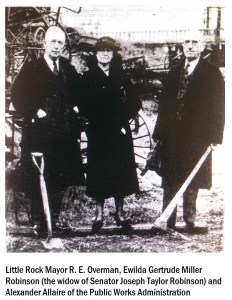
122437 GroundbreakOn December 24, 1937, at 11:30 a.m., Little Rock Mayor R. E. Overman, Ewilda Gertrude Miller Robinson (the widow of Senator Joseph Taylor Robinson) and  Alexander Allaire of the PWA turned dirt to participate in the brief groundbreaking ceremony for Little Rock’s municipal auditorium.  That morning, the Arkansas Gazette ran a brief story on the upcoming groundbreaking.  The story mentioned that the building would be named in memory of the late beloved Arkansas politician.  This appears to be the first public pronouncement of the Robinson name for this civic structure.

Among others in attendance at the groundbreaking were Mrs. Charles Miller (sister-in-law of Mrs. Robinson), Mr. and Mrs. Grady Miller (brother and sister-in-law of Mrs. Robinson), the mayor’s wife, the three architects (George Wittenberg, Lawson Delony and Eugene John Stern), and D. H. Daugherty and Will Terry of the City’s Board of Public Affairs.

Construction had to start by January 1, 1938, in order to receive PWA funds.  By breaking ground on December 24, there was over a week to spare.  The site had been selected in late October 1937, and the purchase had not been finalized.  But the PWA did give permission for the City to let a contract for excavation, demolition and filling on the site.

The groundbreaking took place at the corner of Garland and Spring Streets which was on the northeast corner of the block set aside for the auditorium.  Today, Spring Street does not extend north of Markham; the street was closed to make way for the parking structure and what is now the Doubletree Hotel.  Garland Street is basically an alley that runs parallel to Markham north of City Hall, Robinson Auditorium and the Doubletree Hotel.

Little Rock Look Back: Roswell Beebe

Roswell Beebe, Little Rock's 16th Mayor

Roswell Beebe, Little Rock’s 16th Mayor

On December 22, 1795, future Little Rock Mayor Roswell Beebe was born in Hinsdale, New York.  His family were wealthy English immigrants.  At seventeen, Beebe went to New Orleans and fought with Andrew Jackson in the 1815 Battle of New Orleans.  He stayed in the Crescent City for the next two decades building successful lumber and brick businesses.

Due to health concerns, he moved north to a drier climate in 1834.  After first stopping in Fulton, Arkansas, he settled in Little Rock in 1835 at the age of forty.  He stayed at the home of Chester Ashley and married Ashley’s sister-in-law, Clarissa Elliott.  He and Clarissa had two children, Roswell and Cora.

For nearly 30 years, Little Rock had a complicated history of deeds, titles and land ownership.  In 1839, Beebe went to Washington DC and received the original patent from President Martin Van Buren.  He then set about clearing up the land and title issues, as well as drawing up a plan for the city and laying off blocks and streets.  Beebe deeded the streets and alleys to the City for a dollar.  He also donated the land on Markham Street for a new State Capitol building (now home of the Old State House Museum).  Along with his brother-in-law Chester Ashley, he donated the land for the establishment of Mount Holly Cemetery.

In 1848, Beebe was elected to the Little Rock City Council.  The following year, he was elected Mayor.  He served as Mayor of Little Rock from April 1849 to February 1850.

While his primary business focus in the 1840s had been real estate, in the 1850s he focused on railroads.  Beebe was named president of the Cairo and Fulton Railroad Company in 1853.

While on a visit to New York, Beebe died on September 27, 1856.  His body was returned to Little Rock, and Roswell Beebe was buried at Mount Holly Cemetery.  The town of Beebe, Arkansas, is named in his honor.

Little Rock Look Back: Bonds sold for Robinson Center in 1937

clr-res-1418On December 20, 1937, the Little Rock City Council adopted Resolution 1,418 which authorized the sale of municipal bonds to fund the municipal auditorium.

Earlier that year, Little Rock voters had authorized the sale of $468,000 of Municipal Auditorium Bonds.  Since that January election, city leaders had been undertaking various steps to plan for the project.  Finally, they were ready to sell the bonds.  On December 20, a public sale was held.  The US federal government made a bid for the purchase of $418,000 of the bonds. It was the only bid received.

The sale was accompanied by an Emergency Clause so that it would go into effect immediately.  The clause noted: “It is ascertained and declared that by reason of the present economic conditions many citizens of the City are out of work, and the improvements herein provided would furnish work for a large number of persons and thereby add to the peace and happiness of the City; further, that the City has no Municipal Auditorium or facilities for large conventions or gatherings…”

The offer by the US Government to purchase the bonds was in addition to an outright grant of $342,000 to help fund the auditorium.

While there would be other issues in financing and funding the project, the sale of the bonds on December 20, 1937, set things in motion which led to the February 16, 1940, opening.

Susan Altrui is new director of Little Rock Zoo

cc15 altruiSusan Altrui will take the helm as the Little Rock Zoo’s new director, City Manager Bruce T. Moore announced today.  Altrui, who has been with the state’s only accredited zoo since 2005, fills the position left open by the retirement of longtime director Mike Blakely in October.

“Our goal is for the Little Rock Zoo to become one of the top mid-sized city zoos in the country,” Moore said. “Susan is the person to get us there because of her experience, dedication and vision. I’m excited to have her leading the Zoo as it continues its growth as a world-class institution focused on education, conservation and recreation.”

Altrui began her career at the Zoo as the director of marketing and development and executive director of the Arkansas Zoological Foundation. In July 2015, she was named the Zoo’s assistant director. She has been responsible for marketing, public relations, special events, development, government relations, and fundraising for the Zoo and has helped to maintain the Zoo’s accreditation.

“I couldn’t be more thrilled to take on this important new role as the next director of the Little Rock Zoo. I’m ready to work hard with our city leaders, staff, volunteers, board members and other members of the community to grow and develop our Zoo,” Altrui said. “The Zoo is a place that nurtures our passion for animals and encourages respect for all living things. It’s a place where learning lives.”

Under Altrui’s guidance, the Zoo has raised funds for the Laura P. Nichols Penguin Pointe exhibit, the Laura P. Nichols Cheetah Outpost, Diamond Express Train and the Arkansas Heritage Farm exhibit, which opened in April of this year.

Altrui served as project manager for a new master plan and strategic plan. She also worked on the Zoo accreditation by attending hearings on three separate occasions before the Association of Zoos and Aquariums Accreditation Committee. She has developed several successful fundraisers, including Zoo Brew and the annual Wild Wines event, which is now one of Arkansas’s largest food and wine festivals.

Altrui holds a master’s degree in Applied Studies in Communication from Colorado State University and a bachelor’s degree in the same area from Arkansas State University.

Ninety years ago, the Little Rock Zoo brought wildlife to the citizens of Arkansas with just two animals: an abandoned timber wolf and a circus-trained bear. Today, the Zoo is one of Arkansas’ most attended attractions, with approximately 300,000 visitors annually. It cares for more than 700 animals representing 200 different species, many endangered.

The Zoo is part of the AZA Species Survival Plan aimed at saving threatened/endangered species through cooperative breeding, a program that Altrui seeks to expand.

My goal as Zoo director is to enhance our conservation education efforts and to provide an engaging experience for every guest every time they walk through our gate,” Altrui said. “Updating and renovating the Zoo is essential and we have already begun the planning process for the next major animal exhibit. We are also revamping education efforts to provide exciting, engaging programming that helps inspire who you want to be and who you can become. We will help cultivate the next generation of biologists, wildlife scientists and conservationists.”