
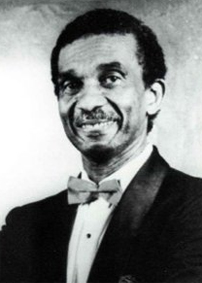
A Celebration of Art Porter Sr. tonight at the Ron Robinson Theater

Arthur Lee (Art) Porter Sr. was a pianist, composer, conductor, and music teacher. His musical interest spanned from jazz to classical and spirituals.

Tonight at the CALS Ron Robinson Theatre, Arkansas Sounds is hosting a special presentation of rare video and audio clips and photographs, as well as a panel discussion celebrating the continued legacy and eighty-fifth birthday of Arkansas pianist, composer, conductor, and music teacher Art Porter Sr. This event is co-sponsored by AETN.

Admission is free, but reservations are suggested. They can be made here.

Born on February 8, 1934 in Little Rock, he began his music education at home. He played in church at age eight; played his first recital at twelve; and, by fourteen, hosted a half-hour classical music radio program on KLRA-AM. He earned a bachelor’s degree in music from Arkansas AM&N College (now UAPB) in May 1954.

He began his teaching career at Mississippi Valley State University in 1954.  When he was drafted into the Army, his musical talents were responsible for him being assigned as a chaplain’s assistant in New York.  In the late 1950s he returned to Little Rock and taught at Horace Mann High School, Parkview High School and Philander Smith College.

He also started playing piano jazz in the evenings. This led to the creation of the Art Porter Trio, which became THE music group for events.  Many musicians who came to Arkansas to perform in Little Rock or Hot Springs would often stop by and join in with Porter as he played.  From 1971 to 1981 he hosted The Minor Key musical showcase on AETN.  His Porterhouse Cuts program was shown in 13 states.

Often encouraged to tour, he instead chose to stay based in Arkansas.  He did, from time time, perform at jazz or music festivals.   He also performed classical piano with the Arkansas Symphony Orchestra, founded the Art Porter Singers, and created a music group featuring his four oldest children.  Though Porter received many honors and awards, he found particular satisfaction in the “Art Porter Bill” enacted by the state legislature, which allowed minors to perform in clubs while under adult supervision. Porter’s children thus were able to perform with him throughout the state. Governor Bill Clinton, at the time a huge fan and friend of Porter, often joined Porter’s group on his saxophone.

In January 1993, Porter and his son Art Porter, Jr., performed at festivities in Washington DC for the Presidential Inauguration of his friend Bill Clinton.  In July 1993, he died of lung cancer.  Today his legacy lives on in the Art Porter Music Education Fund as well as in the lives of the many musicians and fans he touched.  He was posthumously inducted into the Arkansas Black Hall of Fame in 1994.

Ron Robinson Silver on Silver film: PULP FICTION

Pulp Fiction PosterLast week John Travolta from the 1970s was on the CALS Ron Robinson screen.  This week, a 1990s version of Travolta takes the screen.

Twenty-five years ago, PULP FICTION was released. In honor of its silver anniversary, the CALS Ron Robinson Theatre is showing the movie tonight.  The lives of two mob hitmen, a boxer, a gangster’s wife, and a pair of diner bandits intertwine in four tales of violence and redemption.

The film starred Travolta, Uma Thurman, Samuel L. Jackson, Bruce Willis, Tim Roth, Amanda Plummer, Frank Whaley, Ving Rhames, Eric Stoltz, and Rosanna Arquette.

The movie was nominated for eight Oscars and took home the statue for Original Screenplay (Quentin Tarantino and Roger Avary).

The showing starts at 6:30.  Admission is $5.00.

Free tickets to Arkansas Symphony weekend concerts for Federal Employees.

No photo description available.

The Arkansas Symphony Orchestra is offering free tickets to federal government employees (with valid ID) who want to attend this weekend’s concert “Chopin & Mendelssohn” on Jan. 26th & 27th.  The concerts are at Robinson Center Performance Hall.

Please call 501-666-1761 ext. 100 or email tickets@arkansassymphony.org to order.

Little Rock Look Back: A 1956 attempt at integrating LR schools

Arkansas Democrat photo by staff photographer Mr. Bisgood

Arkansas Democrat photo by staff photographer Mr. Bisgood

On Monday, January 23, 1956, twenty-seven African American students attempted to integrate four Little Rock schools.  By the end of the day, all four school principals had refused entry and some of the students had met with LRSD Superintendent Virgil Blossom.

Eight girls who were students at Horace Mann High School arrived at Central High at 9:30 am accompanied by Daisy Bates and Frank W. Smith both of the NAACP.  One male student attempted to integrate Little Rock Technical High School.  Four students arrived at Forest Heights Junior High (accompanied by three adults) and fourteen students attempted to integrate Forest Park Elementary (accompanied by four adults).  Neither the Arkansas Gazette nor the Arkansas Democrat broke down the age or gender of the junior high and elementary students.

Though all were referred to meet with Mr. Blossom, only the young women from Horace Mann visited with him.  After the conversation both he and Mrs. Bates declared the conversation had been friendly.   Mr. Blossom, in denying the request, noted that the Little Rock School District had a plan for integration. To allow them to integrate immediately would have been going against the plan.  The integration plan was connected to the completion of the new high school.  If it were ready to open in the fall of 1957, then integration at the high schools would start then.  The newspapers noted that there was no timeline for when it would extend down to the junior high and elementary levels.

That evening, Rev. J. C. Crenchaw, the president of the Little Rock NAACP, issued a statement.  In it he expressed frustration that the LRSD was vague on its timeline for integration.  He noted that the students lived near the schools which they tried to integrate and were therefore forced to travel several extra miles each day to attend school.  He also commented that the young man who attempted to enroll at Tech was not afforded the training available there at his current school.

The Arkansas Democrat ran a photo of the meeting with Mr. Blossom.  It identified the seven students who were pictured.  No mention was made as to whether the eighth student was present but not photographed, or if she did not attend the meeting.  As was the practice at the time, the addresses of the students were listed by their names.  Based on those addresses, the students lived between 0.4 and 0.9 miles from Central High School and were between 2.1 and 3.2 miles away from Horace Mann High School.  Of the seven students in the photo, two were seniors, three were juniors, and three were sophomores.  None of the students named became part of the Little Rock Nine who did integrate Central High twenty-one months later.

On January 24, the Gazette editorial writer opined they were glad for the amicable nature of the conversations. They hoped it did not affect the good race relations in Little Rock.  The writer concluded by saying they did not want it to incite extremists (but did not specify if they viewed the extremists as being for or against integration.)

Clinton School Speaker at noon today – UA Little Rock Bowen Law Professor John DiPippa on recent Affordable Care Act Ruling

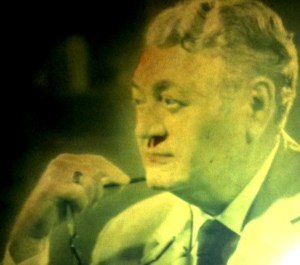
Image result for john dipippaWhile his SCOTUS previews are a highlight of Clinton School programming in the the early fall, legal scholar John DiPippa will be making a special return to the Clinton School Speaker Series in January.
In December, a federal judge in Texas said that the Affordable Care Act’s individual coverage mandate is unconstitutional and that the rest of the law therefore cannot stand. The ruling throws into doubt the future of health coverage for millions of Americans, and sets up another cliffhanger in which the fate of the law will likely once again lie with the Supreme Court.

John DiPippa is a constitutional law scholar who served as a William J. Clinton Distinguished Lecturer at the Clinton School and Dean Emeritus at the UA Little Rock William H. Bowen School of Law. He is an Inaugural Professor of Public Service at the University of Arkansas Clinton School of Public Service and teaches two core courses: The Foundations of Public Service and The Legal and Ethical Dimensions of Public Service.

All Clinton School Speaker Series events are free and open to the public. Reserve your seats by emailing publicprograms@clintonschool.uasys.edu or by calling (501) 683-5239.

Haco Hijacked, or 50 years ago this month Little Rock’s Mayor made an unscheduled trip to Havana

Less than a week after being selected Little Rock’s 58th mayor, Haco Boyd made an unscheduled stop in Cuba when the Eastern Airlines Boeing on which he was flying was hijacked.
The seventy passengers, including 44 from Arkansas, were hijacked to Cuba on January 9 on a flight that was originally scheduled to go from Miami to Nassau for an insurance convention.

Shortly after takeoff, a passenger, who described himself as a student at Purdue University, sat next to a flight attendant, told her the plane was going to Cuba, and showed her a knife.

After landing in Cuba, the plane, its crew, and two passengers (Mr. and Mrs. Keith Thrash of Little Rock) were allowed to return to Miami. The Thrashes were allowed to stay on the plane due to illness.  Several hours later, another plane picked up the remaining passengers and returned them to Miami.

Eastern Airlines then flew the passengers on to Nassau without further incident. Mayor Boyd’s wife was flying with him on the plane.

Once the media found out that Little Rock’s mayor was on the plane, he became of great interest to reporters.  “They treated us real well in Havana.” Boyd told the press. “They gave us the blue plate special treatment.” Boyd said everything was “just fine, no sweat, it’s just one of those things.” He went on to describe the hijacker (who stayed in Cuba) as “a rather decent looking person, except for his nose and his mouth, which were a little weak.

Mayor Boyd was back at City Hall to preside over the January 20, 1969, City Council meeting. It appears that the reminder of his airline flights went to their appropriate destinations.  During World War II, he had been a decorated pilot for the Army Air Corps.

Little Rock Look Back: Opening of 1868 LR City Hall

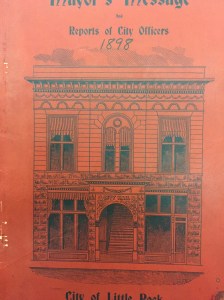
The 1868 City Hall as featured on a city report.

On January 22, 1868, a charity ball (including a supper) was the first special event held in the new Little Rock City Hall located at 120 to 122 West Markham.

The two story building featured city offices downstairs, including an engine house for the volunteer fire department. Upstairs was the council chambers and a special event space. The facility was the width of two storefronts. The upstairs was accessed by a central staircase which went from street level through an archway directly up to the second floor. The first floor had a stone exterior and the second floor was a combination of brick and woodwork.

Records do not indicate when the first city council in the new building took place. At the January 21, 1868, meeting, the body formally accepted the building and cancelled any clauses in the contract about penalties should the contractor not meet the construction deadline. But there is no indication whether that meeting took place in the new building or in the previous city hall. (The location of that prior city hall is a mystery.). The minutes from the council meetings just prior to and just after the January 21 meeting give no indication as to which building was the site for the meeting.

It IS known that March 30, 1908, was the date of the final council meeting in the 1868 City Hall. After that meeting, city offices completed their move to the edifice at Markham and Broadway, which still serves as Little Rock City Hall.

As early as November 1867, the City Council was getting requests for special events to be held in the new city hall. In November and December the council refused to take action on any requests because the building was still under construction.

The January 22, 1868, event was created to help the destitute in Little Rock. The ARKANSAS GAZETTE encouraged people to be generous and purchase tickets. Even the day before the event, the weekly version of the GAZETTE (which at the time had added daily editions in addition to its weekly issue) was assuring people there would be plenty of space in the splendid new building so there was still room for additional ticket purchases. Tickets were $5 to admit a lady and a gentleman.  (That would be the equivalent of $83.71 today. While cheap for two people to attend a Little Rock event in 2018, in the post-Civil War era, it was a definite hit to the pocketbook.)

The unnamed organization which put on the charity event was led by W. W. Wilshire (president), George W. Clark (secretary), Joseph Meyer (treasurer) and a standing committee of Dr. C. M. Taylor, Dr. P. O. Hooper, A. Adams, F. H. Moody, and E. Langley.  Donations could be made to any of the officers.  The arrangements for the event were handled by Joseph Meyer, A. Adams, J. P. Jones, Alexander George, Jr., Joseph W. Bossert, and Daniel Ottenheimer.  The reception committee was W. D. Blocher, H. C. Ashley, A. McDonald, P. W. McWhorter, T. Lafferty, and F. H. Moody.   Tickets could be purchased at the stores of J. E. Reardon, G. H. Gibbs, Joseph Meyer, Lafferty & Raleigh, S. L. Griffith, McAlmont & Stillwell, Beideman & Co., and Dodge & Co as well as at the Anthony and Commercial Houses.  (It is interesting to note how so many people at the time were publicly listed by only their first initial.)

The building stood for 56 years after City Hall vacated it.  It housed a variety of businesses over the years.  The building was torn down in 1964 as part of Urban Renewal.  Today it is the site of part of the Statehouse Convention Center.  It is directly across from the One-Eleven restaurant side of the Capital Hotel.