Little Rock Look Back: FDR at ARK 100

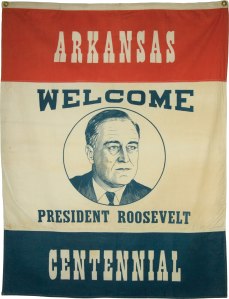
On June 10, 1936, President Franklin D. Roosevelt visited Little Rock as part of a day-long series of appearances in conjunction with the Arkansas Centennial celebration.  (The actual statehood dates is June 15.)

His day started in Memphis before he journeyed by train to Hot Springs. After events there that morning and lunch at Couchwood (his longtime friend Harvey Couch was chairman of the Centennial celebration).  He then traveled to Rockport and Malvern for appearances before arriving in Little Rock.  He made his remarks at the State Fairgrounds in a temporary structure called “Centennial Stadium.”

The street he traveled to get to the fairgrounds had been renamed Roosevelt Road in February 1935 in anticipation that he would visit Little Rock in 1936 as part of the state centennial and would likely use that route.  The street was officially named Franklin D. Roosevelt Road.  But given the unwieldy street signs that would be required to bear that name, the ordinance was amended to note that the signs would bear the name “Roosevelt Road.”

Following his remarks, which officially kicked off the six month Arkansas Centennial celebration, he retired to Senator Joseph T. Robinson’s house on South Broadway.  He dined with the Robinsons in the house before departing with the Senator at 8:45 that evening.  The Presidential entourage then journeyed to Texas for the next day.

Rocking the Tonys: Baryshnikov at Robinson (part 2)

One of the presenters at Sunday’s 72nd Tony Awards is Mikhail Baryshnikov.  Twenty-nine years ago, he himself was a 1989 Tony nominee for Actor in a Play (for playing a man-turned-cockroach in an adaptation of Kafka’s Metamorphosis.
In 1985, Baryshnikov returned to Little Rock to perform again at Robinson Center under the auspices of Ballet Arkansas.   He had performed here two years earlier, as well.

Among the dancers who joined him in the program was future Tony nominee Robert LaFosse.  He would be nominated for a 1989 Tony as well. But he was up for Best Actor in a Musical for his performance in Jerome Robbins’ Broadway.  Other dancers in the company were Cynthia Harvey, Susan Jaffe, Leslie Browne, Elaine Kudo, Cheryl Yeager, Amanda McKerrow, Deirdre Carberry, Bonnie Moore, Valerie Madonia, Ross Stretton, Peter Fonseca, Gil Boggs, John Gardner, and John Turjoman.

The company danced to pieces choreographed by George Balanchine, Jerome Robbins, Marius Petipa, future Tony Award winner Twyla Tharp, Lisa de Ribere, and La Fosse.  The music composers included George Gershwin, Jacques Offenbach, Frederic Chopin, Peter Ilyich Tchaikovsky, Hector Berlioz, as well as composers who wrote songs for Frank Sinatra.

While Ballet Arkansas did not have any dancers perform during the evening, the organization presented it and was able to receive the proceeds which exceeded the expenses.  For several years in the 1980s, the Ballet would either commence or conclude their season with such an performance. In fact, the 1985 Baryshnikov program contained a promotion of a 1986 visit by Alvin Ailey’s dance company.

Whereas the 1983 Baryshnikov appearance had been sponsored by the Arkansas Democrat, this time, the rival Arkansas Gazette was the sponsor.


Little Rock Look Back: Ben D. Brickhouse, LR mayor and state representative

On June 8, 1873, future Little Rock Mayor Ben D. Brickhouse was born in Virginia.  He moved to Texas as a child before his family settled in Arkansas.

His first job was with the Missouri Pacific Railroad.  He eventually attended law school at the University of Arkansas.  As an attorney, he remained interested in labor relations throughout the rest of his life.

In 1914, Brickhouse was elected to the Little Rock City Council.  He was reelected in 1916.  In 1918, he was appointed Labor Commissioner for the State of Arkansas by Governor Charles Brough.

Brickhouse was elected Mayor of Little Rock in 1919.  He was relected twice (1921 and 1923). Though other Little Rock mayors in the 1920s to 1950s would seek a third consecutive term, Brickhouse was the last who succeeded prior to the change to the City Manager form of government in 1957.

Mayor Brickhouse ran for a fourth term as Mayor but was defeated.  In 1923, he had openly opposed the Ku Klux Klan, which was then a major player in Democratic politics in Little Rock, in Arkansas and in the nation. In the next Democratic primary for Mayor, Brickhouse did not secure the nomination.

During Mayor Brickhouse’s tenure the City purchased the land to make Fair Park (now War Memorial Park).  He also served as chair of the State Fairgrounds. After leaving office Brickhouse remained active in civic affairs, often speaking out in favor or opposition to local issues.

Brickhouse retired from public life in 1925 but returned in 1938 when he was elected to the Arkansas House of Representatives.  He was reelected in 1940.  On June 1, 1941, not long after the conclusion of the legislative session, Brickhouse died.

Little Rock Look Back: 50 years of Arkansas Arts Center community art classes

AAC Logo in 1963

Though it was not yet officially called the Museum School, the Arkansas Arts Center’s first day of community art classes started on June 3, 1968.

To call it the first day of community art classes is a bit of a misnomer.  When the institution opened in May 1963, there were community art classes.  But once the degree-granting program launched in autumn 1964, the consistent, regular offering of those classes went away.

With the January 1968 announcement that the degree-granting program would end by May 31, 1968, plans were underway to bring back community arts classes.  Monday, June 3, 1968, started that program. Since that day, the Arkansas Arts Center has consistently offered arts classes to the community.

The session which began on June 3, 1968, was six weeks in length.  There were fourteen faculty members teaching 48 different classes for both adults and children.  The registration ranged from $10 to $22, depending on the course.   Among the course topics were painting, drawing, print-making, sculpture, crafts, design, children’s and teenage theatre, and art appreciation.  The faculty came from local artists.

Plans were already underway to offer twelve week sessions in the autumn of 1968 and spring of 1969 in a variety of art and dramatic disciplines.

Today there are 48 faculty in the Museum School with seven additional staff members.  There are approximately 50 classes for adults, over a dozen additional workshops for adults, and nearly twenty art classes for youth.  This does not include the theatre classes, or the annual Junior Arts Academy and Summer Theatre Academy.

Little Rock Look Back: Cornice installed at Robinson Auditorium

On June 1, 1939, the cornice was installed on Robinson Auditorium.  This granite slab noted the name of the building as the Joseph Taylor Robinson Memorial Auditorium.  (It is interesting to note that it used the more modern “u” instead of the classical “v” which was often used in buildings during prior decades – as evidenced by the Pvlaski Covnty Covrt Hovse across the street.)

This was a milestone marking the completion of the front facade of the structure.  Much work would continue on the interior of the structure.  This step in the construction was considered major enough that the Arkansas Gazette mentioned it in a news article.

(June 1, 1939, was also the first day on the job for the auditorium’s first director – William T. Clemons.  A former Little Rock resident who came from Rochester NY.  The Auditorium Commission which hired him would not disclose the sources of his salary, but assured Mayor J. V. Satterfield the money did not come from City coffers.)

On this date in 2015 and 2016, the cornice was again surrounded by construction materials and braces. But the restoration of Robinson Center finished in November 2016. Once again, the cornice stands proudly atop the six columns with no impediments around it.

Little Rock Look Back: Brown v. Board II Decision from the US Supreme Court

On May 31, 1955, the U.S. Supreme Court issued its ruling in Brown vs. Board of Education of Topeka II.  

One year after the landmark Brown v. Board decision which declared state laws establishing separate public schools for black and white students to be unconstitutional, the Supreme Court took up the case again.  This time the focus was on the implementation of desegregation

The original Brown v. Board grew out of a class action suit filed in Topeka, Kansas, by thirteen African American parents on behalf of their children.  The District Court had ruled in favor of the Board of Education, citing Plessy v. Ferguson.  When it was appealed to the Supreme Court, Brown v. Board was combined with four other cases from other jurisdictions.

After handing down the 1954 decision, the Supreme Court planned to hear arguments during the following court session regarding the implementation.  Because the Brown v. Board case was actually a compilation of several cases from different parts of the US, the Supreme Court was faced with crafting a ruling which would apply to a variety of situations.

In the arguments before the court in April 1955, the NAACP argued for immediate desegregation while the states argued for delays.

The unanimous decision, authored by Chief Justice Earl Warren, employed the now-famous (or infamous?) phrase that the states should desegregate “with all deliberate speed.”

In making the ruling, the US Supreme Court shifted the decision-making to local school districts and lower-level federal courts. The rationale was that those entities closest to the unique situation of each locality would be best equipped to handle the distinct needs of those schools and communities.

The Supreme Court did make it clear that all school systems must immediately starting moving toward racial desegregation.   But again failed to provide any guideposts as to what that meant.

In anticipation of the Supreme Court’s Brown II ruling, earlier in May the Little Rock School Board had adopted a draft of what became known as the “Blossom Plan” (named for the superintendent, Virgil Blossom).  The thought process seems to have been that if the LRSD had a plan in place prior to a Supreme Court decision, it might buy it more time had the court ruled that things had to happen immediately.

The Blossom Plan called for phased integration to start at the senior high level.  It anticipated the new Hall High School as having an attendance zone in addition to zones for Central and Mann high schools. But the way the zones were created, the only school which would be integrated at first would be Central High.  The junior highs and elementary schools would be integrated later.

With no immediate remedy from the US Supreme Court, the NAACP – both nationally and locally – had little recourse other than expressing their unhappiness continuing to verbally protest the lack of immediate desegregation. (This is an oversimplification of the NAACP efforts, but points out that there options were very limited.)

Little Rock Look Back: May 31, 1968 – a day of transition for the Arkansas Arts Center

AAC Logo in 1963

An arts organization in financial crisis.
Programming abandoned
Summer education programming for students
Staff laid off
A challenge grant from donors
A community fundraising drive

Sound familiar?

In January 1968, the Arkansas Arts Center made the decision to cease operating a degree-granting education program effective May 31 of that year.  Sixteen faculty members lost their jobs, though a couple were retained for other positions within the organization.

After opening in May 1963 and beginning the degree-granting program in September 1964, the Arkansas Arts Center found itself operating at a deficit each year.  While Jeannette and Winthrop Rockefeller made up the deficits, it was not a sustainable model.  (Mrs. Rockefeller had been the president of the AAC board for several years after she and her husband played leadership roles in the statewide fundraising efforts to establish the AAC.)

Though the degree-granting programs were bringing national recognition to the AAC, they had essentially taken over the entire facility.  The theatre was rarely available for children’s programming or community groups. The galleries were given over largely to the displaying the works of the students and faculty.  What had been envisioned as a facility melding world-class arts with community arts, was not functioning that way.

As such, the statewide membership program was suffering. Without the creation of programming in Little Rock, it was difficult to take any substantial arts offerings out to the membership clusters throughout the state. This resulted in the decline of memberships being purchased.

Following the announcement of the cessation of the degree-granting program, the AAC Board sought ways to more fully engage the public.  Part of this was due to the fact that the Arts Center had a deficit of $295,216 (the equivalent of $2.15 million today).  The only profitable part of the AAC operation was the gift shop.  With that level of deficit, the permanent closure of the AAC was certainly a possibility on people’s minds.

A committee studying the future of the AAC decided to focus on five (5) areas.  (And of course, AAC founding mother Jeane Hamilton was part of this effort.)  The areas were Education (community classes for children and adults), Exhibits (a return to a mix of permanent and traveling exhibitions), Theatre (partnerships with Community Theatre of Little Rock and the creation of children and teen theatre productions), State Services (refocusing the Artmobile to include educational instruction), and Membership. This would result in a net budget of $260,000.

In April 1968, a fund drive was announced led by former Little Rock Mayor Byron Morse.  The goal was $130,000, to be matched dollar-for-dollar by the Rockefellers.  As of May of that year, it had raised $108,731.

There are many parallels between the AAC in 1968 and the Arkansas Repertory Theatre’s current predicament. While the causes of the financial woes may be different, the cures are very much the same.

Then, as now, the citizens of Little Rock and Arkansas had to step up and financially support an arts organization in financial crisis.  Whereas the Rockefellers were matching gifts in 1968, the Windgate Foundation is matching gifts now.  Just as the Arts Center renewed its focus on the community and redefined the way it did business, the Rep is now facing these same processes and predicaments.

What the future Rep will look like in terms of numbers and types of productions remains to be seen.  But the core leadership team is touting a mantra of Professional, Affordable, and Sustainable.  All of these are laudable. All are attainable. But all will require continued community commitment year in and year out.

An interesting side note: a key Arts Center Board member in 1968 was William Rector, the father of longtime Rep Board member Bill Rector who is currently part of the interim leadership team at the Rep.  Let’s hope Bill has the same success in his endeavor as his father did.

Viva Center Artium
Repertorium Praeter Theatrum