Little Rock Look Back: Robinson Auditorium groundbreaking 80 years ago today


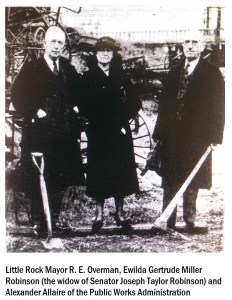
122437 GroundbreakOn December 24, 1937, at 11:30 a.m., Little Rock Mayor R. E. Overman, Ewilda Gertrude Miller Robinson (the widow of Senator Joseph Taylor Robinson) and  Alexander Allaire of the PWA turned dirt to participate in the brief groundbreaking ceremony for Little Rock’s municipal auditorium.  That morning, the Arkansas Gazette ran a brief story on the upcoming groundbreaking.  The story mentioned that the building would be named in memory of the late beloved Arkansas politician.  This appears to be the first public pronouncement of the Robinson name for this civic structure.

Among others in attendance at the groundbreaking were Mrs. Charles Miller (sister-in-law of Mrs. Robinson), Mr. and Mrs. Grady Miller (brother and sister-in-law of Mrs. Robinson), the mayor’s wife, the three architects (George Wittenberg, Lawson Delony and Eugene John Stern), and D. H. Daugherty and Will Terry of the City’s Board of Public Affairs.

Construction had to start by January 1, 1938, in order to receive PWA funds.  By breaking ground on December 24, there was over a week to spare.  The site had been selected in late October 1937, and the purchase had not been finalized.  But the PWA did give permission for the City to let a contract for excavation, demolition and filling on the site.

The groundbreaking took place at the corner of Garland and Spring Streets which was on the northeast corner of the block set aside for the auditorium.  Today, Spring Street does not extend north of Markham; the street was closed to make way for the parking structure and what is now the Doubletree Hotel.  Garland Street is basically an alley that runs parallel to Markham north of City Hall, Robinson Auditorium and the Doubletree Hotel.

Little Rock Look Back: The Central High Chili Incident

Minnijean Brown Trickey & Dent Gitchel at 2006 chili cook-off (Richelle Antipolo/ Flickr)

On December 17, 1957, a chili bowl was dropped in the Central High cafeteria.

It was, of course, not just any chili bowl.  It was dropped by Minnijean Brown as she was being harassed by white students who were trying to make it difficult for her to navigate the cafeteria.

Balancing food on a cafeteria tray and maneuvering around narrow paths around chairs and tables can be difficult in the best of circumstances. But doing it when you are being harassed for the umpteenth time that day makes it even more of a challenge.

Reports differ as to whether she dropped the tray or let it slip. In the pandemonium of the moment, it may be six of one, half-dozen the other.  But what is not disputable is that the chili fell on a junior who was sitting at a table and not taking part in the harassment. That junior was future attorney and UA Little Rock Bowen School of Law professor Dent Gitchel.

While no one had stepped in to stop the pestering, after Minnijean had dropped the chili on Dent, officials swooped in and sent both students to the principal’s office.  Dent was sent home to change clothes.  Minnijean was suspended for six days.  This incident and suspension would be fodder for her foes who pressed for her eventual expulsion in February 1958.  (The student other student involved in that incident – a white female – was only suspended and later returned for the remainder of the school year.)

Minnijean and Dent went their separate ways.  While many knew about the chili episode, the name of the student who was on the receiving end had become forgotten.  It was not until many years later that his name was once again attached to it.  In 2005, he was named in an article in an historical journal.  By that time, he was a retired law school professor.  Later that year, he gave a brief interview to the Arkansas Democrat-Gazette about it.

In March 2006, the Central High Museum Inc. board organized a chili cook-off as a fundraiser.  Minnijean and Dent reunited for the first time since December 1957 to serve as co-chairs and judges of the cook-off.  The other judge was Central High principal Nancy Rousseau.  There were nine chilies made by Little Rock area celebrities:  Mark Abernathy of Loca Luna and Bene Vita, “Broadway” Joe Booker of Citadel Communications, Dave Williams of Dave’s Place, Max Brantley of Arkansas Times, Michael Selig of Vermillion Water Grille, Pamela Smith of KATV, Channel 7, Sanford Tollette of the Joseph Pfeifer Kiwanis Camp, Scott McGehee of Boulevard Bread Co. and state Sen. Tracy Steele.

Ten years ago – on the fiftieth anniversary of the incident — NPR did a story and interviewed by Minnijean and Dent.  In various interviews, Minnijean has commented that she told officials that day she knew that Dent was an innocent bystander.  In the few public statements he has made, Dent has commented that while he did not cause problems for the Nine, he also was not one of the very,very few white students who befriended them.  Today, they both focus their comments on the continued need for reconciliation as well as facing up to the issues in order to move forward.

So have a bowl of chili today. And think about how far we have come.  And how very far we still have to go.

Little Rock Look Back: Launch of the 1944 USS Little Rock

Today (December 16, 2017) in Buffalo, New York, the new USS Little Rock (LCS) will be commissioned.  Only yards away from the new ship will be the original USS Little Rock.  It is now a museum in Buffalo since it retired from the US Naval fleet.

On August 27, 1944, the first USS Little Rock was launched in Philadelphia at the Cramp Shipbuilding Company shipyards.  A 10,000 ton Cleveland Class light cruiser, it first touched water in the Delaware River.

The sponsor of the ship (who broke the champagne bottle on the hull) was Mrs. Ruth May Wassell, the wife of Little Rock alderman Sam Wassell.  The main address was delivered by Congressman Brooks Hays, whose district included Little Rock.  A crowd of 5,000 was gathered to witness the launch.

According to the Associated Press Congressman Hays called light cruisers, “the hottest item of naval combat.”

The congressman further elaborated:

The people of Little Rock are proud to have such a ship as this bear their city’s name.” said Mr. Hays. “Even those of us who know little about the classification of naval vessels know that the cruisers have distinguished themselves in the Pacific war and that this is the outstanding type of combat vessel for that area. The navy men tell us that the cruiser is the ‘work horse of the navy.’ big enough to go into any battle, fast enough to lead any task force.

Carrying, as it has, the heaviest load in the Pacific where the greatest battles have taken place, the cruisers have added luster to naval history. We hope that, in the time remaining before our enemies are put down, the Little Rock will take her place along side the Boise, the San Francisco, the Helena,and the Chicago, preserving the prestige of the cruisers.

We are glad to honor the workmen and the company for which they work.  I am sure we are all impressed with the spirit of teamwork which produced the results we observe today.  In March 1943, the keel was laid and for 18 months materials for the ship have come from everywhere. The taxes to pay for it will be assessed against men and women of great and little resources. Teamwork from beginning to end did the job.

So with the war.  A glorious victory lies ahead, but there is much remaining to be done. Only teamwork can supply the dynamic power yet needed to complete that victory. Every ship launching is a reminder of the power that comes to a people who work together to achieve.”

Other guests at the ceremony included United States Senator John L. McClellan and Congressman and senator-elect J. William Fulbright. Alderman Sam Wassell was also present.  He and his wife hosted a dinner for the Arkansas delegation and other dignitaries the night before the christening while they were in Philadelphia.

At the request of the Secretary of the Navy, Little Rock Mayor Charles Moyer designated Mrs. Wassell for the honor of sponsoring the USS Little Rock. There are not details as to why Mayor Moyer made the designation.  A first cousin of Alderman Wassell, Dr. Corydon Wassell had been an early World War II hero and was a favorite of President Franklin Roosevelt.  Paramount had released a movie about him earlier in 1944. That may have been a reason for the designation.

The Little Rock City Council sent a bouquet of roses to the ceremony, fitting since the city’s nickname at the time was “City of Roses.” After the launch, Mrs. Wassell sent a telegram to Mayor Moyer and the Council

Thanks a million for the beautiful bouquet of red roses. They made the christening of the cruiser Little Rock perfect. I wish it could have been possible for you to have been present.  The cruiser is 600 feet long and will have a crew of 1,200 men.  I was so proud of our city.  Little Rock has something to be proud of.

The USS Little Rock (CL-92) was commissioned at the Philadelphia Navy Yard, on 17 June 1945.  After service during the end of World War II and the post-war era, it was decommissioned on June 24, 1949. After being refit, it was recommissioned on June 3, 1960. It was permanently decommissioned on November 22, 1976.  The following year it was towed to Buffalo where it has been a museum since then.

Little Rock Look Back: STAR WARS opens in Little Rock

As a third grade boy, I remember devouring the novelized version of Star Wars in 1977. I read everything I could about the movie. I owned the two disc London Symphony Orchestra soundtrack on LP.

I was a few months late to Star Wars figures, but Christmas of 1977 and birthday of 1978 did feature them as gifts. (I promptly lost my Sandcrawler weapon at my grandparents’ house on Christmas day.)

In those early days, I was excited by the idea of NINE Star Wars movies. Then, I gave up hope when George Lucas abandoned them after Return of the Jedi. When the prequels were announced during my adulthood, I was excited. Only to be disappointed by the actual movies (though admittedly they did get better by episode 3).

Then in 2015, the day my eighth grade self dreamed of, is here! What happens AFTER Return of the Jedi.  I saw The Force Awakens and flashed back to those early days. (Cynics might say it was because so much of Episode 7 was a retread of Episode 4.)  And today (after sneak peaks last night), The Last Jedi opens.

In honor of Star Wars: The Last Jedi opening day, here is a flash back to the Arkansas Gazette ad in June 1977 when the first film hit Little Rock (a full month after it first opened in New York).

It did not reach Little Rock until June 24, 1977. Given its status as a sleeper hit, it is no surprise that it came into Little Rock largely unnoticed.

In that day, major films opening on a Friday would be heralded the previous Sunday with a substantial advertisement. The first Star Wars ad ran on Thursday, June 23, 1977, the day before it opened. By contrast, Herbie Goes to Monte Carlo, which would play at the same theatre, had a large ad on Sunday, June 19.

While Star Wars would seem like the perfect movie for the great UA Cinema 150, it did not play there. The film playing at the 150 was A Bridge Too Far, which was, at least an action movie. Star Wars did not even open at a UA theatre. It opened at the ABC Cinema 1 & 2 (located at Markham and John Barrow) and at the McCain Mall Cinema. (The ABC Cinema location is now home to discount cellphone and discount clothing businesses; a cinema has returned to McCain Mall but in a different location.)

The day it opened, there was a fairly large ad which incorporated the familiar beefcake Luke, Leia in flowing gowns, and Darth Vader mask. On the Sunday after it opened, there was a slightly smaller ad with the same artwork. McCain Mall also ran a small add for both Star Wars and Herbie. It noted that Star Wars was a film that management “does not recommend for children.”

Little Rock Look Back: First meeting of Central and Hall in football

lrchs-lrhhsHall High opened its doors and started playing football in 1957. As a new school with a largely younger student body, it only played smaller schools that initial season.  The first Hall vs. Central game was set for Thanksgiving 1958 (November 27).

During the 1958-1959 school year, Little Rock’s high schools were closed for the ill-conceived, ill-advised reason to keep them from being integrated schools.  Though classes were not in session, football teams practiced and played.  The Arkansas Gazette noted that most of those games that season drew only 1,000 spectators, which was down from the usual 5,000 to 8,000 a game.

With the future of Little Rock’s high schools in doubt, there was some hand wringing about whether the 1958 Thanksgiving Day game would be not only the first meeting between Hall and Central, but perhaps also the last.

In only its second year of playing, Hall was undefeated and poised to win the state championship heading into the Thanksgiving game.  Central surprised the Warriors by winning 7-0 before a crowd of 5,000, which cost Hall the undefeated season and the championship (El Dorado became state champs).  This game set the tone for the high stakes of the rest of the series.

Little Rock Look Back: Clinton Center opens in 2004

wjc library openingIt has been thirteen years since the Clinton Presidential Center opened on a wet, cold Thursday.
The days leading up to it has been glorious.  And while the weather may have literally dampened spirits a bit, it was still an important day for Little Rock and Arkansas.

The events leading up to the opening included a concert by Aretha Franklin with the Arkansas Symphony Orchestra and an appearance by Senator John Glenn at the Museum of Discovery.  Events were hosted by the Arkansas Arts Center, Arkansas Repertory Theatre, Historic Arkansas Museum, and Old State House Museum.  There were scores of receptions and parties as Hollywood, New York, and DC descended on Little Rock.

November 18 dawned rainy and cool.  As the day continued on the precipitation continued while the temperature did not warm up.  Years of planning for a grand opening ceremony came down to this.  But at the appointed time, festivities began.

On the site of an abandoned warehouse district and unofficial dump which had previously been a train station, many leaders of the free world were gathered.  They rubbed shoulders with thousands of Arkansans from probably every county in the state.

It had been seven years and eleven days since Bill Clinton had announced the site of his presidential library.  It had been five years since artifacts and articles started arriving from Washington DC in Little Rock.  There had been lawsuits, threats of lawsuits, the threat of a Counter-Clinton Library, and countless meetings.

After speeches from Presidents Carter, Bush 41 and Bush 43, remarks from President Clinton and then-Senator Clinton (who was made even wetter by water pouring off an ill-placed umbrella), and even a musical performance by Bono and The Edge, Chelsea Clinton turned over the ceremonial key from the Clinton Foundation to the National Archives to officially open the Clinton Presidential Center.

In his capacity leading the Clinton Foundation, Skip Rutherford oversaw the planning for the Clinton Library and the grand opening festivities.  He, along with the foundation’s Executive Director Stephanie Streett, oversaw a phalanx of volunteers and staff to anticipate every detail.  The 1,000 days countdown sign that had been on the construction site (the brainchild of Tyler Denton) finally reached 0.

Isabelle Rodriguez, Shannon Butler, Mariah Hatta, Jordan Johnson, Lucas Hargraves, and Ben Beaumont — among others — had been putting in twelve plus hour days for months on end to get ready for the opening.  City Manager Bruce T. Moore led a team of City officials who had assisted on the planning and execution of the site preparation and making sure Little Rock was ready to welcome the world.  Moore and City Director Dean Kumpuris had been appointed by Little Rock Mayor Jim Dailey to lead Little Rock’s efforts to land the library.  After Clinton’s announcement of the site, Dailey, Kumpuris and Moore continued to work together to ensure the library would be successful.

While the weather on November 18, 2004, may have been a disappointment, the people who were gathered knew they were witnesses to history.  And thirteen years later, is a day people still talk about.

Happy 186 to Little Rock!

With the stroke of Territorial Governor John Pope’s pen, Little Rock was officially chartered as a town on November 7, 1831. This followed approval by the Arkansas legislature a few days earlier.

As a chartered, officially recognized municipality, the Town of Little Rock was authorized to create a government and to plan for a Mayor and Aldermen to be elected. That election would take place in January 1832 with the initial council meeting later that month.

There are several earlier and later days which could be used to mark Little Rock’s official birth (La Harpe sighting in 1722, first settler in 1812, permanent settlement in 1820, selection of trustees in 1825, chartered as a City in 1835, chartered as a City of First Class in 1875) — but it is November 7, 1831, which has been the officially recognized and accepted date.

In 1931, Little Rock celebrated her centennial with a series of events.  Likewise, in November 1981, Little Rock Mayor Charles Bussey signed and City Clerk Jane Czech attested Resolution 6,687 which recognized the Little Rock sesquicentennial.