Happy 188 to Little Rock!

With the stroke of Territorial Governor John Pope’s pen, Little Rock was officially chartered as a town on November 7, 1831. This followed approval by the Arkansas legislature a few days earlier.

As a chartered, officially recognized municipality, the Town of Little Rock was authorized to create a government and to plan for a Mayor and Aldermen to be elected. That election would take place in January 1832 with the initial council meeting later that month.

There are several earlier and later days which could be used to mark Little Rock’s official birth (La Harpe sighting in 1722, first settler in 1812, permanent settlement in 1820, selection of trustees in 1825, chartered as a City in 1835, chartered as a City of First Class in 1875) — but it is November 7, 1831, which has been the officially recognized and accepted date.

In 1931, Little Rock celebrated her centennial with a series of events.  Likewise, in November 1981, Little Rock Mayor Charles Bussey signed and City Clerk Jane Czech attested Resolution 6,687 which recognized the Little Rock sesquicentennial.

CALS Legacy & Lunch explores New Madrid Earthquake at noon today

Learn about “The New Madrid Earthquakes and Their Aftermath in Quapaw Country, 1811-1833” today (11/6) at 12 noon at the CALS Butler Center’s Legacies and Lunch program.  It will take place in the CALS Main Library.
The New Madrid Earthquakes of 1811–1812 were the strongest earthquakes in the North American interior in the last six centuries. Across the vast expanse of land the seismic events affected, people struggled to address the earthquakes’ religious meaning and material impact. This talk focuses on the earthquakes in Quapaw country, where the events featured in recorded Quapaw oral histories and became a factor in Quapaw territorial dispossession through the New Madrid Relief Act of 1815.

Jonathan Hancock is an associate professor of history and environmental studies at Hendrix College in Conway. He has published work in the Journal of the Early RepublicThe Princeton Companion to Atlantic History, and Warring for America: Cultural Contests in the Era of 1812 (University of North Carolina Press, 2017) and has held research fellowships from the Bright Institute at Knox College, the Huntington Library, the Newberry Library, and the University of North Carolina Royster Society of Fellows. He is currently completing a book, Convulsed States: Earthquakes, Prophecy, and the Remaking of Nations in Early America, and beginning research for a new book project, “The Indigenous Lowcountry: A 4,000-Year History of Native Communities near Charleston.”

Legacies & Lunch is a free monthly program of CALS Butler Center for Arkansas Studies about Arkansas related topics.  Program are held from noon to 1 pm on the first Wednesday of the month.  Attendees are invited to bring a sack lunch; drinks and dessert are provided.  A library parking discount is available upon request

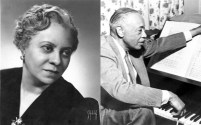
Arkansas composers Florence Price and William Grant Still topic of noon Clinton School program today

In advance of the Beethoven & Blue Jeans concert, join conductor Andrew Grams and Linda Holzer, professor of music at University of Arkansas at Little Rock, on a discussion about the music of Arkansas composers William Grant Still and Florence Price.

It will take place at 12 noon at the Clinton School of Public Service.

American conductor Andrew Grams has steadily built a reputation for his dynamic concerts, ability to connect with audiences, and long-term orchestra building. He’s the winner of 2015 Conductor of the Year from the Illinois Council of Orchestras and has led orchestras throughout the United States. Now in his 7th ESO season, Andrew Grams became music director of the Elgin Symphony Orchestra after an international search.

Florence Price was the first African-American female composer to have a symphonic composition performed by a major American symphony orchestra. Born in Little Rock in 1887, she was valedictorian of her class at Little Rock’s Capitol Hill School.  After college, she returned to Little Rock, was married, and established a music studio, taught piano lessons, and wrote short pieces for piano.

The Prices moved to Chicago, Illinois, in 1927. There, Price seemed to have more professional opportunity for growth despite the breakdown and eventual dissolution of her marriage.  In 1928, G. Schirmer, a major publishing firm, accepted for publication Price’s “At the Cotton Gin.” After winning several composition awards, she had a piece premiere with the Chicago Symphony Orchestra on June 15, 1933.

Price’s art songs and spiritual arrangements were frequently performed by well-known artists of the day. For example, contralto Marian Anderson featured Price’s spiritual arrangement “My Soul’s Been Anchored in the Lord” in her famous performance on the steps of the Lincoln Memorial in Washington DC on Easter Sunday, April 9, 1939. European orchestras later played Price’s works.

William Grant Still was long known as the Dean of African American composers. Though not born in Little Rock, he spent much of his youth in the city.

Dr. Still, who wrote more than 150 compositions ranging from operas to arrangements of folk themes, is best known as a pioneer. He was the first African-American in the United States to have a symphonic composition performed by a major orchestra.

He was the first African American to conduct a major symphony orchestra in the US; the first to conduct a major symphony in the south; first to conduct a white radio orchestra in New York City; first to have an opera produced by a major company. Dr. Still was also the first African-American to have an opera televised over a national network


Town of Little Rock becomes City of Little Rock on Nov. 2, 1835

On November 2, 1835, the Town of Little Rock became the City of Little Rock upon the signature of Territorial Governor William S. Fulton.  The Town of Little Rock had been established on November 7, 1831.

The new charter deemed that the election of officers (including a mayor and eight aldermen) would be on November 10 at the Pulaski County Courthouse. To be eligible to serve, candidates had to be free white men who were aged 30 and above.

The charter established a constable and a court system, gave the City the ability to levy fees and fines, and provided the fact that the City would not have responsibility for maintaining county roads.

This transformation cut short David Fulton’s term as mayor of Little Rock by two months. Mayor Fulton was the father of Governor Fulton. So the governor signed legislation which shortened his father’s term as mayor.  James Pitcher would be elected the first mayor of the City of Little Rock.

One final chance to see SOUVENIR with Christine Donahue and Timothy Smith presented by Opera in the Rock

Image may contain: 1 person, text and outdoor

Opera in the Rock presents the Tony-nominated play Souvenir: a Fantasia on the Life of Florence Foster Jenkins as a one-night only benefit encore performance of their smash hit!

The performance starts at 7:30pm on the Arkansas Repertory Theatre stage.

1964: Greenwich Village. Cosmé McMoon flashes back to the musical career of Florence Foster Jenkins, a wealthy New York socialite with an infamous prestige for singing out of tune. In 1932, she met McMoon and the two teamed up to foster Jenkins’ love for singing in the hopes of achieving success. Over the next dozen years, their bizarre partnership yielded hilariously off-key recitals that became the talk of the town and earned them cultish fame.

Christine Donahue and Timothy Smith take on these two spectacular characters for the last time one night only as a benefit performance for Opera In The Rock at The Rep.

Christine Donahue, soprano, has performed with numerous opera companies throughout the United States, Canada and abroad including New York City Opera, Cleveland Opera and Houston Grand Opera. She is presently Assistant Professor of Voice at University of Central Arkansas.

Mr. Smith is a professor of piano and music theory at Arkansas Tech University and has performed in numerous community musicals throughout the country. As an accomplished pianist, he has also played in orchestras for shows including Anything Goes, West Side Story, The King and I, and South Pacific.