Heritage Month – Corydon Wassell House

Corydon WassellThe Corydon Wassell House is a one-and-one-half story wood framed Victorian cottage.. The 1882 house is located at 2005 South Scott Street, outside both the Governor’s Mansion and MacArthur Park Historic Districts. There are quite a few Victorian cottages in the vicinity, but it was added to the National Register of Historic Places on June 2, 2000, in recognition of it being the birthplace and residence of Dr. Corydon Wassell.

Born in Little Rock on July 4, 1884, Corydon McAlmont Wassell (called “Cory”) was born to Albert and Leona Wassell. A grandson of Little Rock Mayor John Wassell, he graduated from what is now UAMS in 1909. In 1911, he married Mary Irene Yarnell, with whom he would have four children.  In 1914, the couple volunteered to be Episcopal missionaries in China.  He served there until 1927. Following Mary’s death and his remarriage, he and new wife Madeline Edith Day Wassell returned to Arkansas in 1927.

Dr. Wassell resumed his medical practice. Given his experience with malaria in China, he proved to be an asset fighting malaria among Civilian Conservation Corps members in Arkansas. He was subsequently called to active duty in the Navy in 1936 and stationed in Key West.

After the outbreak of World War II, he was stationed in Indonesia. In early 1942, he refused to abandon his patients after the Japanese started invading Indonesia. Instead, he was able to evacuate a dozen severly wounded men over 150 miles to get to a ship. It took ten days for the ship to get to Australia, during which time it was attacked numerous times.  His official Navy Cross citation notes that he disregarded personal safety while caring for others.

He became an instant international hero. During the early days of the war, his heroism was one of the few bright spots. James Hilton wrote a biography of him; President Roosevelt praised him in a fireside chat; Cecil B. DeMille filmed a movie with Gary Cooper playing him.

Dr. Wassell’s first cousin, Sam Wassell, was serving on the Little Rock City Council at the time. He would later serve as Little Rock Mayor.

After retiring from the navy with the rank of rear admiral, Dr. Wassell worked for a time without pay at a charity hospital in Hawaii. He eventually returned to Key West, Florida. Later, he returned to Arkansas to be near family. He died on May 12, 1958, in Little Rock at the age of seventy-four. He is buried at Arlington National Cemetery.

Little Rock Look Back: Harry S. Truman

HST in LR2

Truman speaking at War Memorial Park

On May 8, 1884, future US President Harry S. Truman was born in Lamar, Missouri.

Truman spent most of his youth on the family farm.  Serving in World War I, he saw combat in France and rose to the rank of Captain.  After the war, he returned to Missouri and became involved in Democratic Party politics.  After serving as a county official, he was elected US Senator in 1935 backed by the powerful Kansas City Pendergast machine.

In 1941, he headed a Senate Committee which exposed corruption and fraud in wartime contracts.  He also worked to show he was not just a puppet of the Pendergast machine (which was crucial once Pendergast went to prison).  In 1944, Democratic leaders were trying to knock the incumbent Vice President, Henry Wallace, off the ticket as FDR’s running mate.  Wallace was viewed as too far to the left.  Truman was a compromise candidate and was chosen to serve as FDR’s running mate.

He took office as Vice President in March 1945.  When President Roosevelt died in April 1945, they had spent little time together.  He oversaw the dropping of the atomic bomb on Japan in his hopes of ending World War II with fewer soldier casualties.

Following the war, he supported the creation of the United Nations, sought to contain communism through the Truman Doctrine, and worked to rebuild Europe.  In his quest to stem the spread of communism, he involved the US in the Korean War.

Domestically, he struggled with civil rights issues (including integrating the military) and labor issues (including the threat to draft striking railway workers into the military). His election in 1948 for a full four-year term is often seen as the biggest upset in US Presidential political history.

At the time he became President, Truman was still living in a small apartment with his wife and daughter.  Though they lived in the White House for a bit, they later vacated it for the Blair House so that the structure could be completely renovated.

By the approach of the 1952 presidential election, Truman’s popularity had waned again.  He half-heartedly ran in the New Hampshire primary because he did not like any of the candidates currently in the field.  After finishing second to Sen. Estes Keafauver, he announced he would not be a candidate.  He left office in 1953 and returned to Missouri.

From 1953 onward, he served as the senior statesman and father confessor of the Democratic Party.  Many political leaders made pilgrimages to visit him.  In 1965, President Johnson signed the bill establishing Medicare at the Truman Library with President and Mrs. Truman in attendance.

He died on December 26, 1972, after having been admitted to the hospital earlier in the month for pneumonia.

Truman made two visits to Little Rock while President.  In June 1949, he attended an Army division reunion and spoke at the dedication of War Memorial Park.  In 1952, he visited Little Rock while in the state to speak at the dedication of Bull Shoals Dam and Norfork Dam.


Sandwich in History today at the Dan Stowers Building

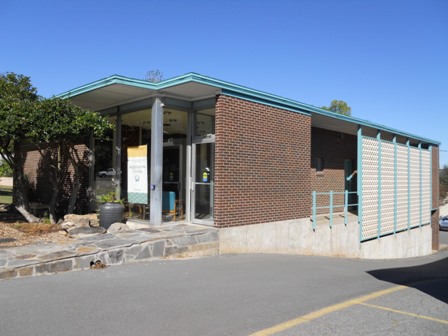
Dan Stowers Office Building_tour_tnThe monthly architectural history program “Sandwiching in History” visits the Dan Stowers Office Building, located at 1516 West Third Street.

Architect Dan F. Stowers, Sr., designed this Mid-century Modern building in 1960 to house his firm. Somewhat unassuming from Third Street, the Stowers Building was oriented to take advantage of the view to the north and provide natural light for the drafting room.

Although the majority of the building’s walls are solid masonry, the northern elevation is composed of a glass curtain wall. This provided the perfect amount of indirect light for the drafting room. Panels of screen block on the building’s eastern side shield an exterior staircase and create an interesting detail.

Sandwiching in History is a program of the Arkansas Historic Preservation Program, an agency of the Department of Arkansas Heritage.


Heritage Month – Chisum House

Chisum HouseBuilt in 1894, the Chisum House (located at 1320 Cumberland Street) is a significant example of modified Queen Anne architecture.  It is notable for its architectural oddity in relation to other buildings in Little Rock.  The Chisum House embodies many of the Victorian period characteristics of irregular shape, towers, and multiple gales and bays.  The Chisum House represents the eclectic manner of late nineteenth-century architectural style in America through its use of these characteristics.

The house was built by and has since been associated with families of long social prominence in Little Rock.  Jason Sowell, who built the house, came from a family who had already been leaders in social life in Little Rock for many years; the family had been one of Little Rock’s earliest families.  Jason Sowell’s daughter married into the Chisum family, who were also among the favored social class in Little Rock and were to remain so for many years.

Sowell’s daughter married Oscar Clifton Chisum in 1892.  Chisum was born in Austin, Arkansas, in 1860.  He was associated with a drug firm in Memphis, Tennessee, until he moved to Little Rock in 1892.  Upon moving to Little Rock he assumed the position of Arkansas-Texas representative of a Louisville, Kentucky, hardware firm.

In 1894 Jason Sowell built a house for himself, his daughter, and her husband at 1320 Cumberland Street in Little Rock.  In 1894, Cumberland Street was considered the “elite” section of town, and residence in the area symbolized social and/or financial success.

The Chisums had one son, O. C. Chisum, Jr., who was born June 13, 1899.  He attended the University of Illinois and later was employed with the Internal Revenue Service.  O. C. Chisum, Jr., was the first member of the Arkansas Industrial Board which was created in 1927 by the Arkansas General Assembly.

O. C. Chisum, Sr., lived in the Chisum House until his death in 1924; his son, O. C. Chisum, Jr., lived in the same house until his death in 1937.

The Chisum House is a significant structure in its architectural style.  It has always been one of the most unusual residences in Little Rock.  The aristocratic style of the house reflects the tastes of the man who built it and of the family it housed for many years.

It was added to the National Register of Historic Places on December 4, 1975.

Heritage Month – Choctaw Station

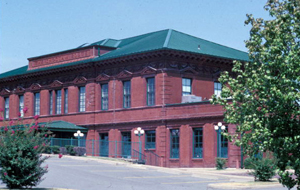
Choctaw StationForty years ago today, on May 6, 1975, Little Rock’s Choctaw Route Station was added to the National Register of Historic Places.

This turn-of-the-century railroad depot is one of the finest examples of railroad, architecture in Arkansas.  This red brick with terra cotta elements building is a two story rectangular structure with one story wings projecting from both the north and south elevations.  A long one story porch covers the passenger loading area along the entire east elevation, with a smaller porch over the entry on the west elevation.

The Choctaw Route Station was built between 1899 and 1901 (records vary) by the Choctaw, Oklahoma and Gulf Railroad.  This railroad amalgamated with many small lines in Oklahoma and extended into Arkansas in the early 1890’s.  Used as a passenger station, the Little Rock terminal building housed two waiting rooms, a baggage room, restaurant and dining room.

When the Choctaw, Oklahoma and Gulf Railroad was sold in 1902, the Choctaw Route Station became the property of the Rock Island Railroad.  Until the mid 1950’s it continued to serve as a passenger station for the Rock Island.  It later served as a warehouse, restaurant and nightclub.

Since 2004, it has been the home to the Clinton School for Public Service as well as Clinton Foundation offices.  Restoration was underwritten by the Roy and Christine Sturgis Foundation. In recognition of this, it is now known as Sturgis Hall.  Former Clinton School Dean David Pryor referred to it as “the little red school house.”

On Earth Day (April 22, 2015), it was announced that Sturgis Hall had received Gold LEED certification from the US Green Building Council.  In August 2009, the Clinton School received a stimulus grant from Governor Mike Beebe to implement sustainable and maintenance practices for reducing the environmental impact of the building. Utility bills costs have already been lowered by $38,000 annually and water usage has been significantly curtailed.

This designation made it the oldest building in Arkansas to be LEED certified and one of the oldest university buildings in the world.  The LEED certification had been a goal of Clinton School Dean Skip Rutherford and Clinton Foundation Executive Director Stephanie Streett.

Little Rock Look Back: Rabbi Ira Sanders

SandersIraE_fOn May 6, 1894, Ira Eugene Sanders was born in Missouri.  After receiving an undergraduate degree and rabbinate degree in Cincinnati, he was ordained a rabbi in 1919.  He served congregations in Pennyslvania and New York before coming to Little Rock in September 1926.

Shortly after arriving to lead the B’nai Israel congregation, Rabbi Sanders became active in the Little Rock community.  Among his projects were the Little Rock Community Fund, Little Rock School of Social Work (which he founded), Central Council of Social Agencies, and University of Arkansas Extension Department. During the Great Depression, he helped organize the Pulaski County Public Welfare Commission.  Other areas of involvement over his career included the Arkansas Human Betterment League, Urban League of Greater Little Rock and Arkansas Lighthouse for the Blind.  On November 3, 1930, Rabbi Sanders debated Clarence Darrow about the existence of God in front of a packed house at Little Rock High School.

For his many involvements, he received an honorary Doctor of Humanities degree in 1951 from the University of Arkansas.  Three years later he received an honorary Doctor of Divinity degree from Hebrew Union College’s Jewish Institute of Religion.

A lifelong supporter of a Jewish state, he participated in nineteen bond drives for the state of Israel.  In August 1963, he retired as the leader of B’nai Israel after over 35 years. He would remain as Rabbi Emeritus until his deal in 1985.

In January 1978, Rabbi Sanders tendered his resignation from the Central Arkansas Library board of directors.  The City Board of Directors passed resolution 5873 which noted that he had served for 51 years on the Library Board. He was first appointed in 1926.  He served during 19 different Mayoral administrations from Charles Moyer’s first term through Donald Mehlburger’s.

On April 8, 1985, Rabbi Ira Eugene Sanders died of natural causes.  He is buried in the City’s Oakland Jewish Cemetery.  The Central Arkansas Library System honors his memory with an annual distinguished lecture series.

Heritage Month – Boyle Park

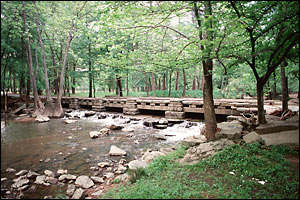
Boyle ParkLocated near the intersection of the western and southwestern neighborhoods of the city of Little Rock, Boyle Park is an approximately 250-acre tract of largely-unimproved woodland donated to the city by Dr. John F. Boyle in 1929. The warranty deed authorizing the transfer of title to the land explicitly stipulated that the park be used for “recreational purposes” only and that should this property ever cease to be used as such the title would revert back to the family and its heirs. At the time of its donation it was only the third public park in the city of Little Rock (the others being MacArthur Park and Allsopp Park).

The park remained largely unimproved until the mid-1930s, when the Civilian Conservation Corps boys arrived (though there seems to be some uncertainty about exactly when the actual construction work began, two different contemporaneous sources reveal that as of the spring of 1935 work had not yet begun, but that by the spring of 1937 work was complete and the unit involved in finishing the work within the park — the 3777th company, originally from West Fork, where they were supposed to be involved in the ongoing construction at Devil’s Den State Park — were wondering where they would be shipped next).

The CCC boys camped at Fair Park (approximately one mile to the northeast) and worked on such improvements to Boyle Park as walls, signage, rest room facilities and a concession building in addition to the resources that survive. Boyle Park forms an historic district that is significant by virtue of its associations with the men that built it, the enrollees of the Civilian Conservation Corps Company 3777, and by virtue of their being outstanding and remarkably intact examples of the Rustic architectural style.

Boyle Park was added to the National Register of Historic Places on September 22, 1995.