
Light Up the Night This Weekend with LANTERNS! at Wildwood

Don’t miss THE MOON! at this year’s LANTERNS! Festival March 6 – 8. You can check out our giant moon balloon, delight in a moon-pie, and sip on a Blue Moon beer. Visit six locations spread throughout the park!

Located in Wildwood’s award-winning Asian Woodland Garden, the Asian Vista is a perennial highlight of LANTERNS! Don’t miss the wide variety of foods, including sushi, dumplings, egg rolls and fried rice. Sake and beer will be available as well as hot jasmine tea. Two bands, The Lemon Drops and The News Kids will perform in the garden’s Tea House while a Chinese harpist and a calligrapher will be on hand to showcase their art!

Wildwood is alive with the sound of music! Austria comes to Arkansas in the lobbies of Wildwood’s Cabe Theatre. Piping hot Viennese beef soup with crepe slivers will be served with apple strudel and delectable pastries. Be on the lookout for bands of gypsy vagabonds. The theatre’s south lobby has been transformed into a Alpine winter wonderland – complete with gourmet chocolate shoppe, mountain goats and polka band!

There is a literal pot of gold at the end of Wildwood’s Ireland rainbow, and a bit o’ gold for everyone who makes it through the leprechaun’s maze. Traditional Irish dancers entertain while festival goers dine on two Irish staples: beer and potatoes. For those looking to stay warm, there’s a steaming cup of Irish coffee waiting for you, and there’s Fizzy Leprechaun punch for the kids! Be careful where you step! Daffodils are a’bloom and William Wordsworth, one of Ireland’s greatest poets, will be on hand to tell you all about them!

Are you ready to live la vida LANTERNS!? All the tastes of Mexico can be found in Wildwood’s gazebo. Beer and tequila shots will be on hand, while a mariachi and DJ get the party started. The festival’s famed floating lanterns are launched from the gazebo, piñatas will be broken nightly!

It is England in 1600 in Wildwood’s Studios, and Shakespeare’s greatest works are being performed on the hour! Smoked turkey legs and brats are for sale and you’ll find a few lovely ladies hawking cherry tarts to passers by. Make your way down High Street and be on the lookout for carnival performers of all kinds. If you’re visiting with someone special, get them a fresh orange – these rare fruits are the ultimate symbol love!

Visit America in the 1950s as the Greatest Generation is home and ready to rock! Stop by your local soda shop to enjoy a Coke Float and snack on some classic American treats. Grab your poodle skirt and get on the dance floor where Elvis, Chuck Berry, and the Supremes are waiting for you. When you’re ready for a break, sit bit and enjoy a show by amazing performance artists!

Buy your tickets at http://bit.ly/1v4DDa4.
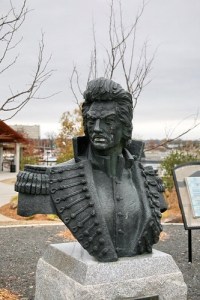
Little Rock Look Back: Casimir Pulaski

On March 6, 1745, Casimir Pulaski was born in Poland. A Polish nobleman and military commander he has been called a “father of the American cavalry.”

Born in Warsaw, he followed in his father’s footsteps he became involved in the military and the revolutionary affairs in Poland. Pulaski was one of the leading military commanders for the Bar Confederation and fought against Russian domination of Poland. When this uprising failed, he was driven into exile.

Following a recommendation by Benjamin Franklin, Pulaski emigrated to North America to help in the cause of the American Revolutionary War. He distinguished himself throughout the revolution, most notably when he saved the life of George Washington.

Pulaski became a general in the Continental Army, created the Pulaski Cavalry Legion and reformed the American cavalry as a whole. At the Battle of Savannah, while leading a daring charge against British forces, he was gravely wounded, and died shortly thereafter.

Pulaski is one of only eight people to be awarded honorary United States citizenship. He never married and had no descendants.

Arkansas is one of several states to have a county named in honor of Count Pulaski.  Pulaski County was Arkansas’s fifth county, formed on December 15, 1818. 

Women’s History Month Throw Back Thursday: The Aesthetic Club


One of the founders of the Aesthetic Club.

Since March is Women’s History Month, this month there will be a special “Throw Back Thursday” feature on a women’s organization which has shaped Little Rock’s cultural landscape. Up first is The Aesthetic Club

Founded in 1883, the Aesthetic Club is one of the oldest women’s clubs west of the Mississippi River.  The club first met on January 15, 1883 with founders Cynthia Polk, Sallie Martin, Ida Martin, Fannie Jabine, Jane Georgine Woodruff, Mary Knapp, Gertrude Hempstead, Harriet Jabine, and Virginia Hamilton.

Their purpose was “to present programs of a literary, artistic, musical, and timely trend” in order to “assist in educational uplift, and to bring its members together for social enjoyment.”

By 1894, the membership had increased to 100, and the group could no longer meet in members’ homes.  a new meeting place had become necessary. In 1893, the group started meeting in the Arsenal Tower Building, where they continue today. For several years they were the only tenant of the building and paid the utility bills for the structure when no other entity would.

The Aesthetic Club worked with the Arkansas Federation of Women’s Clubs to secure library legislation from the state of Arkansas in 1902. This allowed for cities to create municipal libraries.

The Aesthetic Club’s objective is “to present programs at various meetings of a literary, artistic, musical, and timely trend; to assist in educational uplift; and to bring its members together for social enjoyment.” A member of the Aesthetic Club may read a paper, play a musical instrument, sing, or be appointed chairman of the day and be responsible for introducing speakers and musicians or greeting members. Membership of the Aesthetic Club is still limited so that its active members total no more than 100, not including inactive and associate members.

Amelia Smith, an active Aesthetic Club member between 1940 and 1960, summed up the club’s strength: “It has always been a body of women who stood for and lived up to its motto, ‘The Good, the True, and the Beautiful.’ Never once, whether there were good times, wars, a Great Depression, or social changes, has it departed from remarkable standards.”

Over the years many of the members were wives, daughters and mothers of Luttle Rock leaders. As the role of women has changed, now he leaders are actual members–not relatives of leaders.

Legacies & Lunch Looks at “The Way It ‘Wuz’ Back Then”    

Lonoke County native Aretha Dodson attended segregated public schools and worked for the same school district during and after integration. She details these experiences in her memoir, That’s the Way It “Wuz” Back Then, which she will discuss at Legacies & Lunch, the Butler Center’s monthly lecture series, on Wednesday, March 4, noon-1 p.m., in the Main Library’s Darragh Center, 100 Rock Street. Books will be available for purchase, and Dodson will sign copies after her talk.
Dodson is a school improvement educational consultant who worked nearly forty years for the Lonoke public schools. That’s the Way It “Wuz” Back Then uses Dodson’s experiences, interviews she conducted, and clippings from the Lonoke Democrat to depict “the hardship and suffering of black families during the early twentieth century, segregated schools in the South, and the unrest experienced in the South during the desegregation of schools.”

Legacies & Lunch is free, open to the public, and sponsored in part by the Arkansas Humanities Council. Attendees are invited to bring a sack lunch; drinks and dessert are provided. For more information, call 501-918-3033.

Little Rock Look Back: Arkansas Territory Authorized 


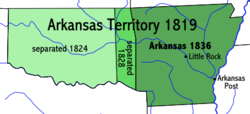
On March 2, 1819, the Arkansas Territory was authorized by an act of Congress, to take effect  on July 4, 1819.

The Arkansas Territory was created from the portion of the Missouri Territory. It originally encompassed all of what is now Arkansas and much of what is now Oklahoma. The westernmost portion of the territory was removed on November 15, 1824, a second westernmost portion was removed on May 6, 1828, reducing the territory to the extent of the present state of Arkansas.

The Territorial capital was Arkansas Post from July 1819 until June 1821. At that point in time it was moved to Little Rock. In 1819, there was no permanent settlement in Little Rock. It would my be until early 1820 that a permanent settlement would be established.  On 1818, the Quapaw Treaty had anticipated a future settlement in Little Rock. 

Black History Month Spotlight: Ozell Sutton

Ozell Sutton has been a writer and eyewitness to history, while making some of his own too.

Born in Gould, he moved with his family to Little Rock and graduate from Dunbar High School and Philander Smith College. In 1950, he became the Arkansas Democrat‘s first African American reporter.

He was at Central High when the Little a Rock Nine integrated, marched with Dr Martin Luther King Jr. in Washington in 1963 and was with Dr King when he was assassinated in 1968.

He served as an aide to Gov. Winthrop Rockefeller from 1968 to 1970. From 1972 to 2003 he work for the U.S. Department of Justice Community Relations Service in Atlanta. In that capacity he was often on the forefront in efforts to diffuse racially tense situations.

In 1962, he received an honorary doctorate from Philander Smith in recognition of his political activism in the civil rights movement. He was awarded the Distinguished Service Award by the Department of Justice in 1994.
He also was awarded the Medallion of Freedom by the National Association for the Advancement of Colored People (NAACP).

In 2012, he was presented with the Congressional Gold Medal in recignition for his being one of the first African Americans to serve in the Marine Corps. His book “From Yonder to Here:” A Memoir of Dr. Ozell Sutton was publiahed in 2009.

Ozell Sutton was inducted into the Arkansas Black Hall of Fame in 2001. For more on Ozell Sutton and the other inductees, visit the exhibit at Mosaic Templars Cultural Center, an agency of the Department of Arkansas Heritage.

Little Rock Look Back: Byron Morse, 55th Mayor of Little Rock

On February 23, 1917, future Little Rock Mayor Byron R. Morse was born.
A founder of the real estate firm of Rector-Phillips- Morse, he was long active in civic affairs of Little Rock.

Mayor Morse was first elected to the City Board of Directors in November 1960. In 1963, he was chosen as Little Rock Mayor. After serving two years as Mayor, he chose to not seek re-election to the City Board.

In 1980, he was appointed to the City Board to fill out an unexpired term. He was later asked to fill another unexpired term but declined.

In 1983, he was elected national president of the Society of Industrial and Office Realtors. Mayor Morse also served as president of the Little Rock Chamber of Commerce, the Little Rock United Way, the Little Rock Red Cross, and was a member of the Board of Directors of the Little Rock Boy’s Club. He was a member of the Fifty for the Future.

On July 25, 2001, Mayor Morse died.

IMG_5431