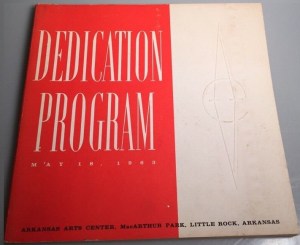
Little Rock Look Back: Plans for Arkansas Arts Center unveiled on May 22, 1961

In a dinner at the Hotel Sam Peck, plans for the new Arkansas Arts Center were unveiled on Monday, May 22, 1961.

It was estimated the project would cost $600,000. A total of $646,000 (the equivalent of $5.5 million in 2019) had been raised by the Junior League of Little Rock, Fine Arts Club, and the Board of the Museum of Fine Arts.

At the time the project was getting underway, it was one of the first types of multidisciplinary arts facilities in the United States.

Ground was broken in August 1961 and the building would open officially in May 1963 (though parts of it were already in use by December 1962).

The firm of Ginocchio, Cromwell, Carter & Neyland did the architectural design.  Pickens-Bond Construction Company was the general contractor.

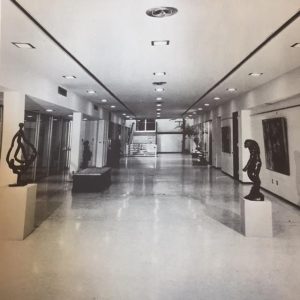
The May 1961 plans featured a slight expansion of existing gallery space (which was the 1937 Museum of Fine Arts building). It included the addition of a theatre, classrooms, administrative offices, a library, and more gallery space.  While the original entrance would be kept, the main focus of the building would be shifted from 9th Street into MacArthur Park with a new south entrance.

Over the years, the building underwent several additions.  These were tacked on to the existing edifice without truly linking it into one building.  On July 1, 2019, the facility will be closed to begin the work on the re-imaging and renovation. That process will unite the existing and new spaces into one seamless structure.

176 years of Mount Holly Cemetery

Mount Holly Cemetery in January 2013.

2019 marks the 176th year of Mount Holly Cemetery in Little Rock.

The land was donated by Roswell Beebe and Chester Ashley in February 1843.  From March through October 1843, the Little Rock City Council would pass a variety of ordinances and resolutions governing the cemetery and making other provisions for it.

Though the opening day sale of lots and picnic would not take place until May 1843, the first burial appears to have been on April 8, 1843.  William Cummins was buried will full Masonic orders on that day.  The service was conducted by Little Rock’s second mayor, Rev. W. W. Stevenson.

On May 1, 1843, it became illegal to bury persons in Little Rock any location other than Mount Holly.  This ordinance had been adopted on March 7, 1843.

The prior cemetery had been at Capitol and Gaines Streets (on which a portion of the Federal Courthouse now stands). Skeletal remains have also been found at Seventh and Rock Streets, in what was probably a family burial plot.  Other small plots were in existence until action in 1834 by the Little Rock Town Council which prohibited private cemeteries.

During the Civil War and years following it, the City would establish other cemeteries and allow additional cemeteries to be created.  But the creation of Mount Holly marked another step in Little Rock’s development as a city.

From 1843 until 1877, Mount Holly was governed by a City Council Committee.  Upset by the lack of attention given to the cemetery, a group of civic leaders asked the City Council to create a separate Commission to govern the cemetery. This was done on March 20, 1877.  It was possibly the first City Board or Commission composed of non-elected officials.

By 1914, the cemetery was once again being neglected.  This time a group of Little Rock’s leading women decided it was time to band together to address it.  In June 1915, the Little Rock City Council disbanded the Cemetery Commission for Mount Holly and designated the Mount Holly Cemetery Association as the governing body.  103 years later, the ladies of the Mount Holly Cemetery Association continue this outstanding work.

Little Rock Look Back: Dan Sprick

Future Little Rock Mayor Dan T. Sprick was born on May 19, 1902.  He served three terms on the Little Rock City Council (from 1935 to 1941).  In 1945, he was elected Mayor of Little Rock and served one term. During his tenure on the City Council, he was the sole vote against locating Robinson Auditorium at Markham and Broadway.  He had favored another location.

He was not alone, however, in being held in contempt of court and spending part of the day in jail.  On Monday, December 4, a dozen of Little Rock’s aldermen (which included Sprick) reported to the county jail to serve sentences for contempt of court. The previous Monday, the twelve council members had voted against an ordinance which had been ordered by the judge in an improvement district matter. The other aldermen had either voted in the affirmative or had been absent. Because the twelve had refused to change their votes since that meeting, the judge ordered them jailed.  After the aldermen changed their votes later in the day, they were freed.

His tenure as Mayor was relatively quiet. He took office the same month that World War II ended. While in office, the Sprick administration was marked by growth in the city budget and in city positions. As a part of that growth, there were many more new purchases taking place which had prompted extra scrutiny of the City’s purchasing procedures. A thorough investigation toward the end of his tenure found no malfeasance or misfeasance, it did note that the city needed to do a better job of anticipating cash flow. Much of the City’s focus during the Sprick tenure was on growth and keeping up infrastructure needs.

Sprick later served for ten years in the Arkansas State Senate (from 1961 to 1970).  During his tenure in the Senate, Sprick was closely aligned with Gov. Orval Faubus.  When the Little Rock high schools had been closed a year to ensure segregation, Sprick had served on the board of a private school set up by some of the leaders of the segregation movement.

His time in the Senate was also marked by controversy.  He was one of three Senators to opposed Muhammad Ali’s speaking at the University of Arkansas at Fayetteville.  After an Arkansas Gazette editorial lambasted him, Sprick sued the paper for libel. The Gazette settled with him out of court because his health was poor.

One of the landmark pieces of legislation he guided through the Arkansas General Assembly allowed cities to collect advertising and promotion taxes.  The 1972 and 1973 upgrades to Robinson Center were funded by this tax (as have some subsequent upgrades). So the building he voted against while on the LR City Council benefited from legislation he championed while in the General Assembly.

Sprick died in January 1972.

On Armed Forces Day, visit the MacArthur Museum of Arkansas Military History

Today is Armed Forces Day.

The third Saturday of May is designated each year as a day to celebrate the men and women who serve in the various branches of the United States armed forces.

On Saturday, May 19, 2001 (which was Armed Services Day that year), the City of Little Rock opened the MacArthur Museum of Arkansas Military History.  Tomorrow, the museum celebrates its 18th birthday.

Though the museum is only 18 years old, the building in which it is located, is 171 years old.  Last year, the building was closed for several months as it received a much needed refurbishment.

Today, the Museum’s exhibits include

  • Vietnam, America’s Conflict
  • Fiction and Fantasy
  • From Turbulence to Tranquility: The Little Rock Arsenal
  • Capital In Crisis: Little Rock and the Civil War
  • Alger Cadet Gun
  • Camden Expedition
  • David Owen Dodd Story
  • First Call: American Posters of World War I
  • The Sun Never Sets on the Mighty Jeep: The Jeep During World War II
  • Through the Camera’s Eye: The Allison Collection of World War II Photographs
  • Conflict and Crisis: The MacArthur-Truman Controversy
  • Duty, Honor and Country: General Douglas MacArthur
  • By the President in the Name of Congress: Arkansas’s Medal of Honor Recipients

Visitors to MacArthur Park today can also interact with the various outdoor memorials and monuments which pay tribute to various phases of Arkansas’ military history.

MADAMA BUTTERFLY this weekend presented by Opera in the Rock

Opera in the Rock at The Rep | Pucccini | Madama Butterfly | May 17, 2019, 7:30 PM | May 19, 2019, 2:30 PMOpera in the Rock presents Madama Butterfly this weekend.

1904: Nagasaki. Pinkerton, a U.S. naval officer, rents a house on a hill for himself and his soon-to-be bride, the 15-year-old “Butterfly.” Bound to be a brief marriage of convenience for Pinkerton, love and heartbreak ensue for the young Cio-Cio San.

Starring the world-class soprano Francesca Mondanaro as Butterfly, a singing actress with rave reviews for performances that are “electric” (Opera News) and “entirely riveting” (Washington Post), Opera In The Rock’s production of Puccini’s Madama Butterfly, a staple of the operatic repertoire, is not to be missed!

Directed by David Ward and featuring musicians from the Arkansas Symphony Orchestra conducted by Geoffrey Robson, the cast also includes Daniel Foltz-Morrison, Sarah Stankiewicz Dailey and Dallas’ Theodor Carlson, among others, including 15-year-old Tania Kelley making her operatic debut.

Performances are Friday, May 17, 2019 at 7:30 PM, and Sunday, May 19, 2019 at 2:30 PM.  The Opera in the Rock performances will be at the Arkansas Repertory Theatre.