
Rock the Oscars 2019: Gregory Peck

In August 1977, Oscar winner Gregory Peck appeared in Little Rock for the premiere of the film MacARTHUR.  He played the general who had been born in Little Rock but who spent most of his life downplaying (or even denying) that fact.

MacArthur was brought to the screen by Universal Pictures.  It was their attempt to capitalize on the success of the movie Patton, including sharing some of the same members of the production team.

Told entirely in flashback, it starred Peck as the fabled World War II general who was born in Little Rock. It focuses primarily on events in 1942 during the war, his dismissal by Truman in 1952, and his famous address to West Point in 1962.

Peck initially did not care for the subject or the script, but eventually stated that he grew to admire the challenges MacArthur faced.  Peck later called it one of his favorites roles, if not one of his favorite movies.

Producer Frank McCarthy, who worked on both Patton and MacArthur once said of Patton and MacArthur: “Both were complex men but General MacArthur was complex on a much broader scale. Patton had no ambition except to be a soldier and to command a field army. He was strictly command.”

Most of the film was shot on the backlot at the movie studio, which impacted the quality of the film.  The production budget simply would not allow for overseas location filming.

The premiere was a fundraiser for the Museum of Science and History (now the Museum of Discovery).  At the time it was located in the Arsenal Building, in which MacArthur had been born.  Since 1999, that has been home to the MacArthur Museum of Arkansas Military History.  Since MacArthur only spent a few hours in Little Rock as an adult, it is possible that Peck spent more time in the building than the General did.

The evening of August 5, 1977, started with an exclusive reception for 100 people with Gregory and Veronique Peck.  The movie itself was shown at the Cinema 150, where its general run would start on Saturday, August 6.  Following the film, a reception and silent auction brought people back to the museum.  Tickets ran $250 a person for all events, $100 a person for the film and post-show reception, and $25 for the movie.  It sold out.

Governor and Mrs. David Pryor escorted the Pecks into the theatre.  Former Governor (and World War II hero) Sid McMath introduced Mr. Peck to the crowd.  He extolled the virtues of Peck and MacArthur.  (It is interesting that he should admire MacArthur so much, since the General and President Truman had a well-publicized tiff, and McMath and Truman had enjoyed a warm relationship.)  Little Rock City Director Jim Dailey presented Peck with a Key to the City.

MacArthur did not lead to an Oscar nomination for Peck (though he did earn a Golden Globe nomination for the role).  But the actor had enjoyed four nominations prior to his win for To Kill a Mockingbird.  He also received the Jean Hersholt Humanitarian Award from the Academy.  He served as president of the Academy for several years.
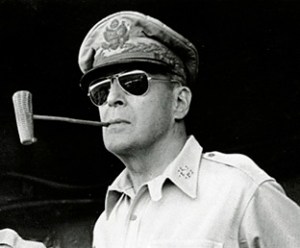
Little Rock Look Back: Birth of a General

On January 26, 1880, Douglas MacArthur was born in the Arsenal Building while his father was stationed at the Little Rock Barracks.  Though he left Arkansas a few weeks later when his father was transferred, he returned to his birthplace on March 23, 1952. On that day he was greeted by crowds welcoming one of the USA’s most famous military figures.

Though Gen. MacArthur spent only a few weeks in Little Rock, he was baptized at Christ Episcopal Church.  The location of the baptism remains a mystery today because the church was meeting in temporary locations due to the first structure having been lost to a fire.

When the General returned to Little Rock in 1952, he did pay a brief visit to Christ Church.  He also spoke at the Foster Bandshell in the park which bore his name.

When General MacArthur died, he was granted a state funeral.  He was one of the few non-Presidents to have been given this honor.

Today, the MacArthur Museum of Arkansas Military History is located in the Arsenal building.  It was created to interpret our state’s military heritage from its territorial period to the present.

Located in the historic Tower Building of the Little Rock Arsenal–the birthplace of General Douglas MacArthur–the museum preserves the contributions of Arkansas men and women who served in the armed forces.

Exhibits feature artifacts, photographs, weapons, documents, uniforms and other military items that vividly portray Arkansas’s military history at home and abroad.

Little Rock Look Back: LR finally takes possession of Robinson Auditorium

On January 25, 1940, the City of Little Rock officially took complete possession of the Joseph Taylor Robinson Memorial Auditorium. By assuming custody of the structure from the contractor and the PWA, the City accepted responsibility for any of the remaining work to be completed.

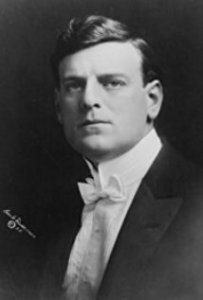
This event happened one day shy of the third anniversary of the election which approved plans to issue bonds for an auditorium.  The act took place only about five months behind schedule.

E. E. Beaumont, the Auditorium Commission chairman, stated that an opening date could not be set until more work was completed. A major unfinished task was the laying of the front sidewalk which had been delayed due to cold weather.

The night before Little Rock took possession, Robinson Auditorium had been a topic of discussion at the Little Rock Chamber of Commerce annual meeting. The new Chamber president Reeves E. Ritchie (who as an Arkansas Power & Light executive had been engaged in the lengthy discussions about the installation of the steam line and transformers of the building) pledged that the Chamber would work to bring more and larger conventions to Little Rock at the Joseph Taylor Robinson Memorial Auditorium.

Arkansas Preservation Awards tonight

No photo description available.

The Arkansas Preservation Awards will honor outstanding achievements in historic preservation from all over the state, including this year’s recipients of the Parker Westbrook Award for Lifetime Achievement, Hot Springs architects Anthony Taylor and Bob Kempkes.

The awards are presented by Preserve Arkansas. Rex Nelson will be the emcee for the awards. The evening will begin with a reception at 5:30pm at the Albert Pike Masonic Center.

Anthony Taylor and Bob Kempkes founded Taylor/Kempkes Architects, P.A. in Hot Springs in 1986. Over the years, Taylor and Kempkes have demonstrated a strong commitment to the preservation of our state’s built environment and the revitalization of downtown Hot Springs. Their notable Hot Springs projects include the restoration and/or rehabilitation of the Mountain Valley Spring Company Building, Old Post Office, Quapaw Bathhouse, and the Thompson Building.

Other award recipients are:

Excellence in Heritage Preservation – Ginger Sandy – “Cedar Grove/Mobley Historical Preservation” Facebook page

Excellence in Preservation through Rehabilitation
– Des Arc Public Library (Historic First Presbyterian Church), Des Arc
– Griffin Auto Company Building, El Dorado
– ScholarMade Achievement Place, Ivy Hill Academy of Scholarship (Historic James Mitchell School), Little Rock

Excellence in Preservation through Restoration
– Brunson House, Historic Washington State Park
– Methodist Manse, Cane Hill
– Shiloh Meeting Hall, Springdale

Outstanding Achievement in Preservation Education – University of Arkansas Fay Jones School of Architecture + Design, Department of Landscape Architecture for “Rising Above – Rohwer Reconstructed: Interpreting Place through Experience” website

Outstanding Achievement in Preservation Advocacy – U.S. Congressman Bruce Westerman, Representing Arkansas’s 4th District, for his efforts to save the Federal Historic Tax Credit during tax reform

Ned Shank Award for Outstanding Preservation Publication – University of Arkansas Press for “It’s All Done Gone”: Arkansas Photographs from the Farm Security Administration Collection, 1935-1943 by Patsy G. Watkins

Excellence in Personal Projects

  • Commercial: Mary Ann Lee, Indigo Blue Coffeehouse, Pine Bluff
  • Residential: Greg Gallagher, 1919 Beech Street, Texarkana
  • Honorable Mention: Cecil and Denise Ennett, Kleinschmidt House, Little Rock


Rock the Oscars 2019: Leo Robin and Jule Styne

Lyricist Leo Robin with composer Jule Styne working together on the score of Gentlemen Prefer Blondes at the time of the original production in 1949.

Lyricist Leo Robin with composer Jule Styne working together on the score of Gentlemen Prefer Blondes at the time of the original production in 1949.

Perhaps the most famous song about Little Rock is “(I’m Just a) Little Girl from Little Rock.”  Written by Leo Robin and Jule Styne, it first appeared on Broadway in Gentlemen Prefer Blondes where it was sung by Carol Channing.  When the title was made into a movie, it was sung by Marilyn Monroe and Jane Russell.

Because it was not written for the screen, the song was not eligible for an Oscar.  However, the duo who wrote it had their fair share of Oscar nominations and wins.

Robin, earned ten nominations between 1934 and 1953.  As a lyricist, he collaborated with seven different composers in earning these nominations. His one Oscar came for “Thanks for the Memory” from The Big Broadcast of 1938.  In the film it was sung by Bob Hope and Shirley Ross.  It would be associated with Hope the rest of his life.

Styne also earned ten nominations; his were between 1940 and 1968.  Seven of the nominations were for collaborations with Sammy Cahn.  (There were three other partners with whom he shared nominations, too.)  His win came for “Three Coins in the Fountain” from the film of the same name.  In the movie it was sung by an uncredited Frank Sinatra during the opening title sequence. During the closing credits, an unnamed chorus repeated the song.

Gentlemen Prefer Blondes received no Oscar nominations, though Charles Lederer did receive a Writers Guild of America nomination for screenplay of an American Musical.  Though Jane Russell introduced an Oscar winning Best Song in Paleface (“Buttons and Bows”) and Oscar nominated Best Song in Son of Paleface (“Am I in Love”) she never received an Oscar nomination.  Monroe never received one either.  Only co-star Charles Coburn had any luck with Oscar.  He received three nominations, winning once.

Rock the Oscars 2019: Broncho Billy Anderson

At the 1958 Oscars, Gilbert M. “Broncho Billy” Anderson received an Honorary Oscar as a motion picture pioneer.  The citation praised  his contributions to the development of motion pictures as entertainment.

Born in Little Rock in March 1880, he was the son of Esther and Henry Aronson. Both were originally from New York.  Her parents were German-Jewish immigrants and his parents were Russian-Jewish immigrants.

After working as a photographer’s assistant and model, Anderson eventually found his way to vaudeville as a performer and writer.  In 1903, he appeared in the early seminal film The Great Train Robbery in several roles.  He created the western persona of Broncho Billy in front of the cameras.  Behind the scenes, he was a studio owner and director.  Over his career, he directed over 400 films.  By the early 1920s, he retired as an actor and director and devoted himself to owning a Broadway theatre and producing stage shows.

He made occasional film appearances beginning in the 1940s.  In 1958, he appeared in a documentary about Westerns for the TV show “Wide, Wide World.”  Also featured in that special were Little Rock actors Ben Piazza and Gail Davis.  His final screen appearance was in 1965’s The Bounty Killer.  He died in 1971 at the age of 90. He had been married to his wife for sixty years at the time of his death.

Little Rock Look Back: A 1956 attempt at integrating LR schools

Arkansas Democrat photo by staff photographer Mr. Bisgood

Arkansas Democrat photo by staff photographer Mr. Bisgood

On Monday, January 23, 1956, twenty-seven African American students attempted to integrate four Little Rock schools.  By the end of the day, all four school principals had refused entry and some of the students had met with LRSD Superintendent Virgil Blossom.

Eight girls who were students at Horace Mann High School arrived at Central High at 9:30 am accompanied by Daisy Bates and Frank W. Smith both of the NAACP.  One male student attempted to integrate Little Rock Technical High School.  Four students arrived at Forest Heights Junior High (accompanied by three adults) and fourteen students attempted to integrate Forest Park Elementary (accompanied by four adults).  Neither the Arkansas Gazette nor the Arkansas Democrat broke down the age or gender of the junior high and elementary students.

Though all were referred to meet with Mr. Blossom, only the young women from Horace Mann visited with him.  After the conversation both he and Mrs. Bates declared the conversation had been friendly.   Mr. Blossom, in denying the request, noted that the Little Rock School District had a plan for integration. To allow them to integrate immediately would have been going against the plan.  The integration plan was connected to the completion of the new high school.  If it were ready to open in the fall of 1957, then integration at the high schools would start then.  The newspapers noted that there was no timeline for when it would extend down to the junior high and elementary levels.

That evening, Rev. J. C. Crenchaw, the president of the Little Rock NAACP, issued a statement.  In it he expressed frustration that the LRSD was vague on its timeline for integration.  He noted that the students lived near the schools which they tried to integrate and were therefore forced to travel several extra miles each day to attend school.  He also commented that the young man who attempted to enroll at Tech was not afforded the training available there at his current school.

The Arkansas Democrat ran a photo of the meeting with Mr. Blossom.  It identified the seven students who were pictured.  No mention was made as to whether the eighth student was present but not photographed, or if she did not attend the meeting.  As was the practice at the time, the addresses of the students were listed by their names.  Based on those addresses, the students lived between 0.4 and 0.9 miles from Central High School and were between 2.1 and 3.2 miles away from Horace Mann High School.  Of the seven students in the photo, two were seniors, three were juniors, and three were sophomores.  None of the students named became part of the Little Rock Nine who did integrate Central High twenty-one months later.

On January 24, the Gazette editorial writer opined they were glad for the amicable nature of the conversations. They hoped it did not affect the good race relations in Little Rock.  The writer concluded by saying they did not want it to incite extremists (but did not specify if they viewed the extremists as being for or against integration.)