Rock the Oscars 2019: Arkansan and Oscar Host Bob Burns

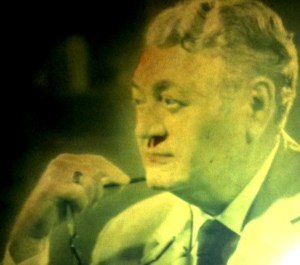
Bob Burns was a well-known national radio and film personality during the 1930s and 1940s. He was known such as “The Arkansas Traveler” and “The Arkansas Philosopher” because he wove tales of life in the Arkansas hills with his musical performances.

On March 10, 1938, he hosted the tenth Oscar ceremony, becoming the first Arkansan to do so.  At that ceremony the big winner was The Life of Emile Zola. The first version of A Star Is Born became the first color motion picture nominated for Best Picture. It was also the first time the Irving Thalberg Award was presented.  At the time, Burns had made a few movies and was ruling the airwaves as a popular radio star.  Since the Oscars were broadcast on the radio, he was an appropriate choice to host the awards.

He earned his nickname, “Bazooka,” from an instrument he invented and named as a young man in a plumbing shop.  The instrument, which was a simple device made of spare gas fittings and a whiskey funnel, eventually lent its name to the World War II anti-tank weapon due to its similar looks and Burns’ popularity among the troops who employed it in combat.

Burns was born in Arkansas (there are conflicting sources as to where) and grew up in Van Buren. As a youth, he started playing in bands. Among the instruments he played was his Bazooka invention. Eventually he came to the attention of a radio program in California. His originally non-paying assignment as a radio comic eventually led to appearances on Paul Whiteman’s coast-to-coast radio program and regular appearances on Rudy Vallee’s shows.

He eventually starred on NBC’s Kraft Music Hall radio program with Bing Crosby while also making more movies. From 1941 to 1947 he starred in his own radio show – The Arkansas Traveler which eventually became The Bob Burns Show.  During the same time period, he wrote a column for Esquire and syndicated newspaper column.

He was feted several times when he returned to Arkansas in the 1930s and 1940s.  In 1956, Burns died of cancer and is buried in California.

Haco Hijacked, or 50 years ago this month Little Rock’s Mayor made an unscheduled trip to Havana

Less than a week after being selected Little Rock’s 58th mayor, Haco Boyd made an unscheduled stop in Cuba when the Eastern Airlines Boeing on which he was flying was hijacked.

The seventy passengers, including 44 from Arkansas, were hijacked to Cuba on January 9 on a flight that was originally scheduled to go from Miami to Nassau for an insurance convention.

Shortly after takeoff, a passenger, who described himself as a student at Purdue University, sat next to a flight attendant, told her the plane was going to Cuba, and showed her a knife.

After landing in Cuba, the plane, its crew, and two passengers (Mr. and Mrs. Keith Thrash of Little Rock) were allowed to return to Miami. The Thrashes were allowed to stay on the plane due to illness.  Several hours later, another plane picked up the remaining passengers and returned them to Miami.

Eastern Airlines then flew the passengers on to Nassau without further incident. Mayor Boyd’s wife was flying with him on the plane.

Once the media found out that Little Rock’s mayor was on the plane, he became of great interest to reporters.  “They treated us real well in Havana.” Boyd told the press. “They gave us the blue plate special treatment.” Boyd said everything was “just fine, no sweat, it’s just one of those things.” He went on to describe the hijacker (who stayed in Cuba) as “a rather decent looking person, except for his nose and his mouth, which were a little weak.

Mayor Boyd was back at City Hall to preside over the January 20, 1969, City Council meeting. It appears that the reminder of his airline flights went to their appropriate destinations.  During World War II, he had been a decorated pilot for the Army Air Corps.

Little Rock Look Back: Opening of 1868 LR City Hall

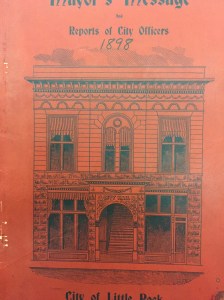
The 1868 City Hall as featured on a city report.

On January 22, 1868, a charity ball (including a supper) was the first special event held in the new Little Rock City Hall located at 120 to 122 West Markham.

The two story building featured city offices downstairs, including an engine house for the volunteer fire department. Upstairs was the council chambers and a special event space. The facility was the width of two storefronts. The upstairs was accessed by a central staircase which went from street level through an archway directly up to the second floor. The first floor had a stone exterior and the second floor was a combination of brick and woodwork.

Records do not indicate when the first city council in the new building took place. At the January 21, 1868, meeting, the body formally accepted the building and cancelled any clauses in the contract about penalties should the contractor not meet the construction deadline. But there is no indication whether that meeting took place in the new building or in the previous city hall. (The location of that prior city hall is a mystery.). The minutes from the council meetings just prior to and just after the January 21 meeting give no indication as to which building was the site for the meeting.

It IS known that March 30, 1908, was the date of the final council meeting in the 1868 City Hall. After that meeting, city offices completed their move to the edifice at Markham and Broadway, which still serves as Little Rock City Hall.

As early as November 1867, the City Council was getting requests for special events to be held in the new city hall. In November and December the council refused to take action on any requests because the building was still under construction.

The January 22, 1868, event was created to help the destitute in Little Rock. The ARKANSAS GAZETTE encouraged people to be generous and purchase tickets. Even the day before the event, the weekly version of the GAZETTE (which at the time had added daily editions in addition to its weekly issue) was assuring people there would be plenty of space in the splendid new building so there was still room for additional ticket purchases. Tickets were $5 to admit a lady and a gentleman.  (That would be the equivalent of $83.71 today. While cheap for two people to attend a Little Rock event in 2018, in the post-Civil War era, it was a definite hit to the pocketbook.)

The unnamed organization which put on the charity event was led by W. W. Wilshire (president), George W. Clark (secretary), Joseph Meyer (treasurer) and a standing committee of Dr. C. M. Taylor, Dr. P. O. Hooper, A. Adams, F. H. Moody, and E. Langley.  Donations could be made to any of the officers.  The arrangements for the event were handled by Joseph Meyer, A. Adams, J. P. Jones, Alexander George, Jr., Joseph W. Bossert, and Daniel Ottenheimer.  The reception committee was W. D. Blocher, H. C. Ashley, A. McDonald, P. W. McWhorter, T. Lafferty, and F. H. Moody.   Tickets could be purchased at the stores of J. E. Reardon, G. H. Gibbs, Joseph Meyer, Lafferty & Raleigh, S. L. Griffith, McAlmont & Stillwell, Beideman & Co., and Dodge & Co as well as at the Anthony and Commercial Houses.  (It is interesting to note how so many people at the time were publicly listed by only their first initial.)

The building stood for 56 years after City Hall vacated it.  It housed a variety of businesses over the years.  The building was torn down in 1964 as part of Urban Renewal.  Today it is the site of part of the Statehouse Convention Center.  It is directly across from the One-Eleven restaurant side of the Capital Hotel.

Rock the Oscars 2019: Dick Powell

Oscars nominations are announced today.  In the days leading up to the ceremony, this blog will look at Arkansas to the Academy Awards.

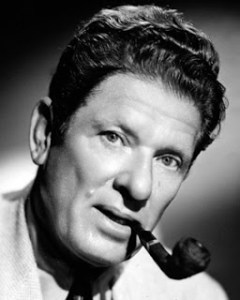
First up is Dick Powell.  Though not born in Little Rock, he grew up here and graduated from Little Rock High School when it was on Scott Street (now the East Side Lofts).  He started earning money as a singer in Little Rock churches and masonic lodges before transitioning to nightspots which eventually led to him touring the country with dance bands.

When Hollywood beckoned, he first appeared in light musicals as a singer and dancer.  One of his first non-musical roles was in the  all-star A Midsummer Night’s Dream which earned four Oscar nominations and won two.  He starred opposite future Oscar winners Jimmy Cagney and Olivia de Havilland.  Eventually, he transitioned into film noir roles including playing Phillip Marlowe in 1945’s Murder, My Sweet.  

In 1948, Powell hosted the Oscars ceremony. Gentlemen’s Agreement won Best Picture and two other Oscars that year.  (He was not the first Arkansan to host the Oscars.  In 1938, Van Buren native Bob Burns hosted the ceremony.)  In 1959, he and his then-wife June Allyson were two of the presenters at the Oscars.  That ceremony came in at one hour and 40 minutes in length. It was under-time so the presenters and winners took to the stage floor with dancing as a way to fill time before NBC cut away and aired a documentary on target-shooting.

Powell was one of the stars of 1952’s The Bad and the Beautiful.  The film won five Oscars but was not nominated for Best Picture.  It holds the record for the most wins by a film not nominated for Best Picture.

Little Rock Look Back: Tornado lays waste to parts of Little Rock on January 21, 1999

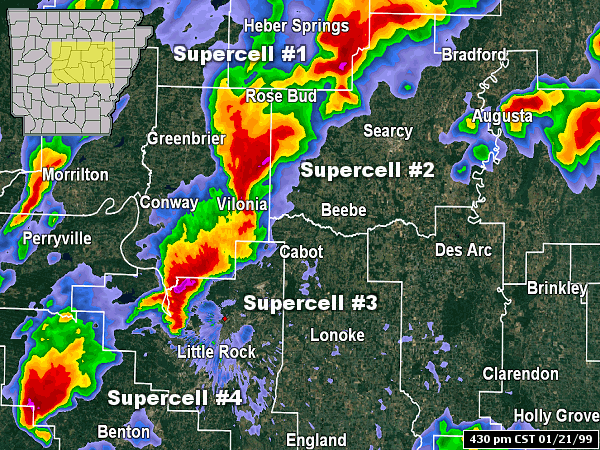
Image result for january 1999 tornado little rockIn their 5pm and 6pm forecasts, Little Rock TV station meteorologists had warned of the potential for severe weather on the evening of January 21, 1999.

But no one seemed prepared for what happened.

A tornado cut through a huge swath of Little Rock stretching from the southwest portion of the city up through the Quapaw Quarter and beyond.  At least four people died in Pulaski County and over 150 houses were destroyed.

A Harvest Foods collapsed trapping people inside the store as storms pummeled survivors with rain and wind.  Stories were ripped off buildings. Sides of houses were peeled back.  Cars and trees were tossed about as if they were made of papier mache.

While not short-changing all of the devastation throughout the city – and there was a great deal – there were several cultural institutions and historic sites which were hit by this system.

  • A portion of the roof of Daisy Bates’ home was ripped off. Some of her books and papers were sucked up by the wind and scattered throughout the storm’s path.
  • The Governor’s Mansion sustained damage in addition to losing power and phones.
  • The original Fire Station 2 in MacArthur Park, then still serving as a museum storage facility, lost a portion of its roof and sustained water damage
  • The Arsenal Building, in the process of being prepared to become the MacArthur Museum of Arkansas Military History, lost a portion of its roof.  The storm’s impact also set off the sprinkler system in the building causing flooding throughout the interior of the building.
  • The Arkansas Arts Center sustained minor damage. The museum was hosting a reception that night for the opening of an exhibit. Many trees in MacArthur Park fell that evening, including several on cars of patrons present for the party.

It would take months and years for the areas hit by this storm to be rebuilt and recover.

The Museum of Discovery – which would have been impacted by the tornado if it had not relocated to the River Market District two years earlier – has an exhibit which allows persons to relive this night.  Tornado Alley Theater provides a riveting seven-minute experience for museum visitors as they relive the tornado that devastated the Governor’s Mansion district area of downtown Little Rock in January 1999. Hear the stories of people who survived the storm and see TV footage of the event as broadcast on THV 11 that fateful evening.

MLK in Little Rock

Ernest Green, Dr. King and Daisy Bates share a relaxed moment — which was probably rare for the three in 1958

Today is the Martin Luther King Jr. Holiday.  It is an apt time to think about Dr. King and Little Rock.

A friend of L. C. and Daisy Bates, he attended the 1958 Central High School graduation to witness Ernest Green receiving a diploma. Each senior only received eight tickets to the ceremony at Quigley Stadium, and he was one of Green’s. Dr. King was in the state to address the Arkansas AM&N (now UAPB) graduation earlier in the day.

His attendance was briefly mentioned in the local press, but there was no media photo of him at the ceremony.  The Little Rock School District limited the press to one Democrat and one Gazette photographer. Other press were limited to the press box.

There is a photo of Ernest Green with Daisy Bates and Dr. King (pictured on this entry).

In 1968, when Dr. King was assassinated, Little Rock did not see the unrest that many cities did.  Part of that was probably due to quick action by Governor Winthrop Rockefeller. The Governor released a statement fairly quickly expressing his sorrow at the tragedy and calling for a day of mourning. He also made the State Capitol available for the NAACP to have a public memorial, as well as worked with a group of ministers to host an interdenominational service.

Little Rock Mayor Martin Borchert issued a statement as well:

We in Little Rock are disturbed about the incident in Memphis. We are disturbed regardless of where it had happened.  Killing is not the Christian solution to any of our problems today.

In Little Rock, we feel we have come a long way in 10 years toward solving some of our problems of living and working together regardless of race, creed or color.

The city Board of Directors in Little Rock has pledged itself toward continuing efforts to make Little Rock a better place in which to live and work for all our citizens.

We feel the efforts of all thus far have proved we can live in harmony in Little Rock and are confident such an incident as has happened will not occur in Little Rock.  We will continue our most earnest efforts toward the full needs of our citizens.

The day after Dr. King was assassinated, a group of Philander Smith College students undertook a spontaneous walk to the nearby State Capitol, sang “We Shall Overcome” and then walked back to the campus.  President Ernest T. Dixon, Jr., of the college then hosted a 90 minute prayer service in the Wesley Chapel on the campus.

On the Sunday following Dr. King’s assassination, some churches featured messages about Dr. King.  As it was part of Holy Week, the Catholic Bishop for the Diocese of Little Rock had instructed all priests to include messages about Dr. King in their homilies. Some protestant ministers did as well. The Arkansas Gazette noted that Dr. Dale Cowling of Second Baptist Church downtown (who had received many threats because of his pro-integration stance in 1957) had preached about Dr. King and his legacy that morning.

Later that day, Governor Rockefeller participated in a public memorial service on the front steps of the State Capitol. The crowd, which started at 1,000 and grew to 3,000 before it was over, was racially mixed. At the conclusion of the ceremony, Governor and Mrs. Rockefeller joined hands with African American ministers and sang “We Shall Overcome.”

That evening, Trinity Episcopal Cathedral was the site of an interdenominational service which featured Methodist Bishop Rev. Paul V. Galloway, Catholic Bishop Most Rev. Albert L. Fletcher, Episcopal Bishop Rt. Rev. Robert R. Brown, Rabbi E. E. Palnick of Temple B’Nai Israel, Gov. Rockefeller, Philander Smith President Dixon, and Rufus King Young of Bethel AME Church.

Earlier in the day, Mayor Borchert stated:

We are gathered this afternoon to memorialize and pay tribute to a great American….To achieve equality of opportunity for all will require men of compassion and understanding on the one hand and men of reason and desire on the other.

Mayor Borchert pledged City resources to strive for equality.

Another Little Rock Mayor, Sharon Priest, participated in a ceremony 24 years after Dr. King’s assassination to rename High Street for Dr. King in January 1992.  The name change had been approved in March 1991 to take effect in January 1992 in conjunction with activities celebrating Dr. King’s life.  At the ceremony, Daisy Bates and Annie Abrams joined with other civil rights leaders and city officials to commemorate the name change.

Little Rock Look Back: Elijah A. More

On January 20, 1799, Elijah A. More was born in Kentucky.  By the early 1830s, he was residing in Hempstead County and practicing law. Because of the court system being based in Little Rock, he spent a great deal of time in Pulaski County.

By January 1834, he had obviously established a permanent residence in Little Rock, because he was chosen as the third mayor.  He served from January 1834 until January 1835.

According to records, he apparently continued to alternate between residing near what is now Hope and living in Little Rock.  In 1839, his wife Caroline Owens More died and was buried in Little Rock. Though not originally buried at Mount Holly (it did not open until 1843), she is now buried there.

In 1840, More was the subject of a court case before the Arkansas Supreme Court resulting from actions he had taken as an executor of an estate and subsequently as Pulaski County Probate Judge.

By 1864, More resided in Missouri. There is a record of him swearing a loyalty oath to the Governor of Missouri in that year (presumably in response to actions associated with the Civil War).

He died on April 15, 1878 and is buried in Columbia Cemetery in Columbia, Missouri.