Little Rock Look Back: Founding Fathers of Little Rock

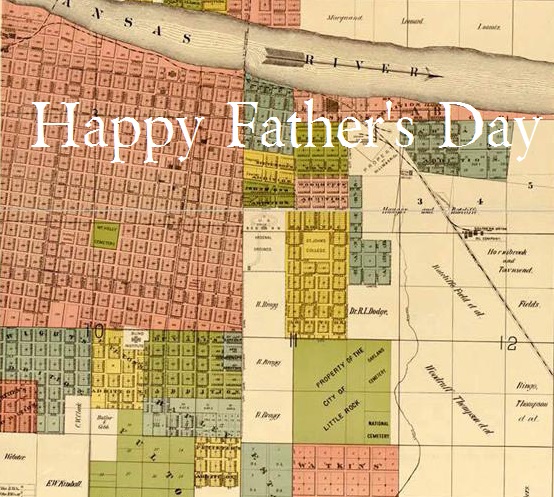
Fathers DayThere are several men who can be considered founding fathers of Little Rock: William Lewis, the first settler, who stayed for a few months in 1814; Roswell Beebe, who acquired most of the land and laid out streets as well as providing land for public buildings and a cemetery; Amos Wheeler, who was the first postmaster and later a land agent; Jesse Brown, who founded the first school and later served as mayor; and William Woodruff, the founder of the Arkansas Gazette.

There are three other men who were not only founding fathers, but also actual fathers to other leaders. They are: Dr. Matthew Cunningham, Major Nicholas Peay and Chester Ashley.

Dr. Cunningham was one of the first residents of Little Rock. He arrived in 1821 and was shortly joined by his family.  Dr. Cunningham would be Little Rock’s first physician. His son Chester was the first child born in Little Rock.  Dr. Cunningham later served as Little Rock’s first mayor from January 1832 to January 1833.  His stepson, Charles P. Bertrand, later served as Mayor of Little Rock from January 1855 to January 1857.  This is the closest Little Rock has ever had to a father and son both serving as Mayor.

Major Nicholas Peay arrived in Little Rock in 1825.  He quickly became engaged in civic affairs and served as a trustee of Little Rock (a precursor to a city council).  In the 1830s, Major Peay served on the Little Rock City Council. In that capacity, he also served as Acting Mayor of Little Rock.  His son, Gordon Neill Peay, would serve as Mayor of Little Rock from 1859 to 1861.  A grandson son, Ashley Peay, was a Little Rock alderman in the 1920s. A great-great-grandson, Joseph B. Hurst, served on the Little Rock City Board from 1967 to 1970.

Chester Ashley never served on the Little Rock council or as mayor.  He was, however, an early leader of Little Rock.  He actually arrived in 1820 and brought his new wife here in late 1821 (a few months after Mrs. Cunningham arrived).  One of Little Rock’s first attorneys, he was instrumental in the settlement of a competing land ownership disputes. In 1844, he was appointed to be one of Arkansas’ U.S. senators. He served in the Senate until his 1848 death.  His son William E. Ashley, served as Little Rock’s mayor from January 1857 to January 1859 and again from January 1861 until September 1863.

With Bertrand, Ashley, Peay and Ashley in the office of Mayor, from January 1855 until September 1863, Little Rock was governed by second generation leaders.

Descendants of the Cunningham and Peay families still reside in Little Rock today.

Flag Day with QQA at Curran Hall tonight

american-flag-wavy.jpgTonight at 5pm, bring the family, meet Uncle Sam and visit Historic Curran Hall for a southern picnic to celebrate Flag Day. The Little Rock Visitor Foundation recently acquired the original 1859 square grand piano that belonged to the Woodruff family and sat in Curran Hall from the 1860s to the 1990s. Come take a look and listen to Arkansas music from the past 150 years.  
This is part of the Quapaw Quarter Association’s Summer Suppers program.

MENU: BBQ, traditional summer side dishes, beer, and ice cream

HOSTS: (Little Rock Visitor Foundation and Board of Directors): Aaron Ruby, Lauren Bridges, Joanne Hinson, Shannon Treece, Larry Carpenter, Brendan Monaghen, Jim Montgomery, Jim Rule, Barry Travis, Carolynn Coleman, Cherry Light, Jason Campbell

Stars & Stripes & Rock

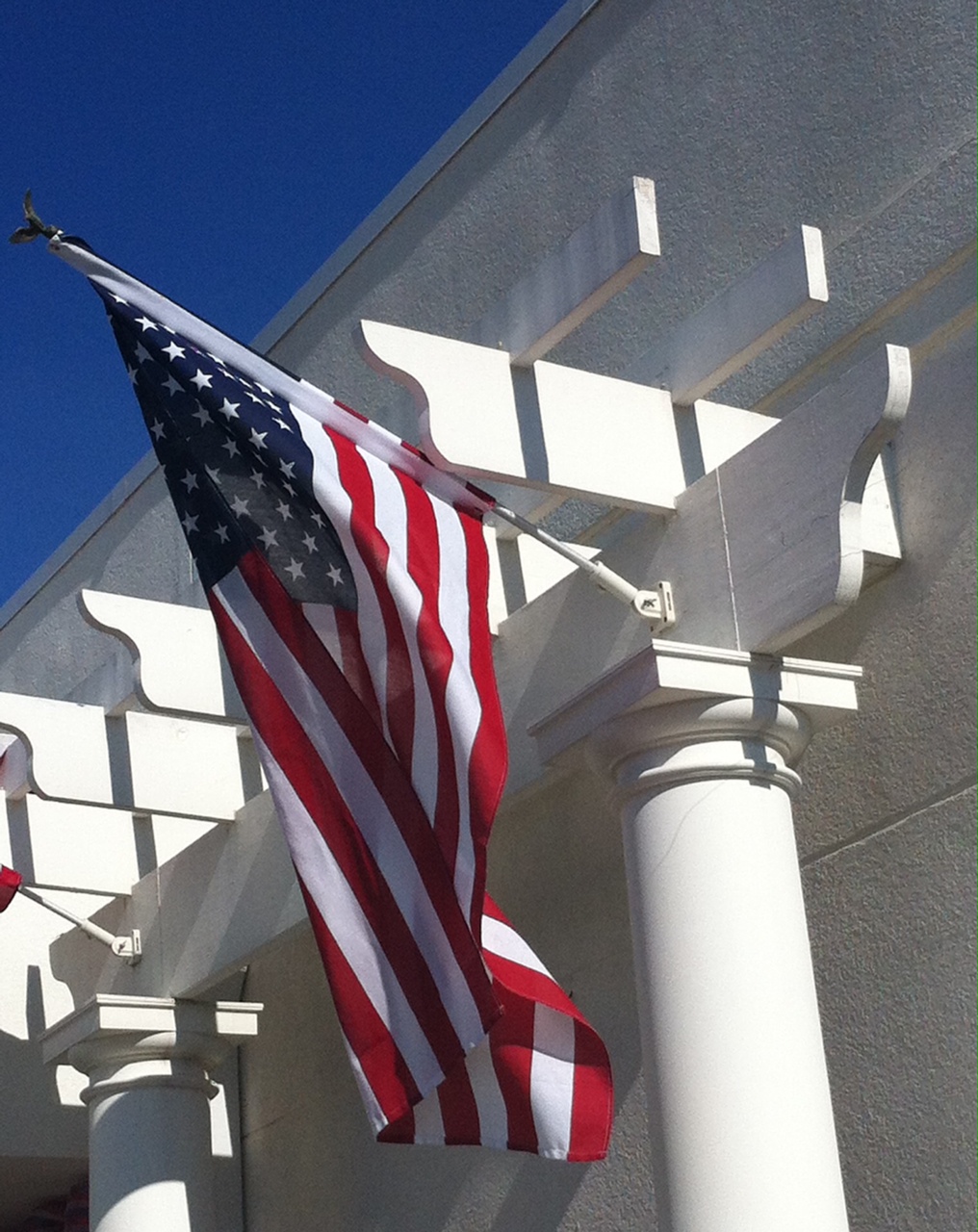
Today is Flag Day.  Here are a few of my favorite photos of the Stars and Stripes taken in Little Rock.

Flag outside of Tipton & Hurst main store in Heights

The red, white and blue stand out against the night sky and limestone of the Arkansas State Capitol.

The stars and stripes unfurled from the balcony of the Capital Hotel.

Flag Day 4

Red, White & Music – Wind Symphony Flag Day Concert

The Little Rock Wind Symphony’s annual Flag Day concert will take place this evening in MacArthur Park at 7pm.  Sponsored, in part by the MacArthur Museum of Arkansas Military History, the concert is the LRWS’s annual salute to the red, white, and blue.  Picnics are encouraged. There will also be free ice cream and free American flags to wave throughout the concert.

The musicians of the Little Rock Wind Symphony will perform the following selections:

arr. John Higgins: Back in the Good Old Days
Adam Gorb: Away Day
Aaron Copland : A Lincoln Portrait
      Brent Walker, narrator
John Philip Sousa: Washington Post
Edwin Eugene Bagley: National Emblem
Edwin Franko Goldman: The Chimes of Liberty
John Philip Sousa: Fairest of the Fair
Henry Fillmore: Americans We
Edwin Franko Goldman: On the Mall
Bob Lowden: Armed Forces Salute
Samuel Ward / Carmen Dragon: America the Beautiful
John Philip Sousa: The Stars and Stripes Forever

In case of rain, the concert will be played tomorrow evening.

Celebrate Arkansas’ Statehood today at Historic Arkansas Museum and Old State House Museum

Statehood Day

Statehood Day

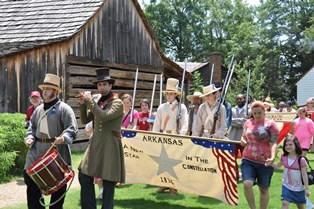
The Old State House Museum and Historic Arkansas Museum will celebrate Arkansas’ Statehood today. A joint living history event, “The Quest for Statehood: From The Delta To The Hills,” will mark 179 years of statehood at both locations.

Costumed interpreters will transform The Old State House and Historic Arkansas Museum into the daily life and work of people representing all sections of 1836 Arkansas with games, talks and activities from 10 to 4 on June 13th.

Pick up a packet of clues about which historical figure you are, where you’re traveling from and why you are in Little Rock on this special day; use these clues to complete a task specific to your character and win a prize! You can participate as an individual, a couple or as a family! All activities are free and open to the public.

The museums are both agencies of the Department of Arkansas Heritage.

Little Rock Look Back: John Fitzgerald Kennedy

JFK LROn October 3, 1963, President John F. Kennedy delivered remarks at the Arkansas State Fairgrounds.  Only a few weeks later, he would be felled by an assassins bullet in Texas.  In the speech, the President praised Arkansas’ congressional delegation including Senators John McClellan and J. William Fulbright and Congressmen Took Gathings, Bill Trimble, Wilbur Mills and Oren Harris.  Each of these men held senior leadership positions in key committees.  The main focus of the speech was to discuss President Kennedy’s vision for a new economy in the South.

The President was actually in the state to speak at the dedication of the Greers Ferry Dam. He agreed to make that appearance as a part of a negotiation with Congressman Mills as they were deadlocked over changes to the tax code.  He had previously visited Little Rock in 1957 when he came to the state to address the Arkansas Bar Association meeting in Hot Springs.

John Fitzgerald Kennedy was born on May 29, 1917, the second of nine children. Groomed for leadership by his father Joe and mother Rose, he was thrust even more into the path of political greatness following the World War II death of his elder brother Joe Jr.  A war hero himself, following his leadership after the attack of PT-109, he was first elected to Congress from Massachusetts in 1946. He would be re-elected in 1948 and 1950.  In 1952, he challenged incumbent Senator Henry Cabot Lodge and beat him.  He was re-elected to the Senate in 1958.

Kennedy had been seen as a strong potential Vice Presidential candidate for the Democrats in 1956. But his father discouraged this fearing that a loss to Eisenhower/Nixon would set him back in the future.  In 1960, the young, dashing Senator from the Bay State sought the Democratic nomination.  After a contentious primary season where he often ran against senate colleagues, Kennedy headed into the Democratic convention with the most delegates.  He added his chief rival, Texas Senator Lyndon Baines Johnson as his running mate.

After a close election, the Kennedy-Johnson ticket bested Vice President Richard Nixon and his running mate Henry Cabot Lodge (the selfsame former Senator who had been defeated by Kennedy 8 years earlier).

Following the oldest President (at the time), the young Kennedy administration seemed to captivate the country.  During his 1000 days in office, Kennedy faced many challenges both foreign (Bay of Pigs, Cuba missile crisis, start of Vietnam) and domestic (civil rights, organized crime). His ambitious “New Frontier” focused on education, additional services to rural areas and medical care for the elderly.  He also focused on getting the US to the moon.

On the personal front, in 1953 he married Jacqueline Bouvier. In addition to their daughter Caroline and son John Jr., who survived their father, the Kennedy’s had a miscarriage, a stillborn daughter, and son Patrick who died after two days.

Together with Franklin Roosevelt and Ronald Reagan, JFK embodied not only his generation but the mood of the country.  And his quotes resonate today including:

My fellow Americans, ask not what your country can do for you, ask what you can do for your country.

Let every nation know, whether it wishes us well or ill, that we shall pay any price, bear any burden, meet any hardship, support any friend, oppose any foe to assure the survival and the success of liberty.

Ich bin ein Berliner


On Memorial Day pay tribute to Veterans who paid the ultimate price at Mount Holly or other cemeteries

MountHolly Memorial DayToday is Memorial Day – a time to pay tribute to the men and women in uniform who died in service to their country.

As a way to give this recognition, today would be a good day to visit a cemetery. One of Little Rock’s most storied cemeteries is Mount Holly Cemetery. There are veterans from all wars: Revolutionary, War of 1812, Mexican, Civil War, Spanish-American, World War I and II, Korean, Vietnam and Desert Storm.

Founded in 1843, Mount Holly has been called “The Westminster Abbey of Arkansas.” Thousands of visitors come each year. Those interested in history come to see the resting places of the territorial citizens of the state, including governors, senators, generals, black artisans, and even a Cherokee princess. For others the cemetery is an open air museum of artistic eras: Classical, Victorian, Art Deco, Modern––expressed in gravestone styles from simple to elaborate. Some come to read the epitaphs that range from heartbreaking to humorous to mysterious.

Though a City of Little Rock facility, the cemetery is maintained by the Mount Holly Cemetery Association, a non-profit organization with a volunteer Board of Directors. The cemetery is located at 1200 South Broadway in Little Rock. Gates are open from 8 a.m. until 5 p.m. in the summer and from 8 a.m. until 4 p.m. in the winter.

Interred within the rock walls of Mount Holly are 11 state governors, 15 state Supreme Court justices, four Confederate generals, seven United States senators and 22 Little Rock mayors, two Pulitzer Prize recipients, as well as doctors, attorneys, prominent families and military heroes.  Proving that death is the great equalizer (and the J. N. Heiskell lived a very long time) longtime Gazette owner and publisher J. N. Heiskell is buried near two different nemeses: Senator, Governor and demagogue Jeff Davis; and segregationist Congressman Dr. Dale Alford.