Little Rock Look Back: Open House at Robinson Auditorium

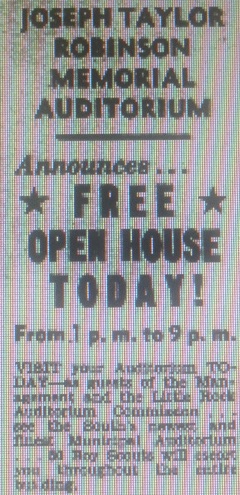
open house adOn March 31, 1940, the City of Little Rock and the Auditorium Commission threw open the doors of Joseph Taylor Robinson Memorial Auditorium to the public for an open house.

The building had officially opened in February 1940, and events had been taking place in the lower level since October 1939. But this was the first time that the public could tour the entire facility from top to bottom.

The event took place on a Sunday from 1pm to 9pm.  Curiously, it took place two days before a special election to approve the bonds to finish the auditorium. Though no one at the time was cynical enough to comment on the connection.

Members of various Little Rock Boy Scout troops led 4,000 visitors on tours of the auditorium.  Visitors were shown all over the building; one scout calculated that the walking tour equated to two miles.  Though most people were from Little Rock, the guest registry indicated visitors from California and Pennsylvania.  Among the last guests to sign the register were Mayor J. V. Satterfield and his family.

The idea for the open house had first been floated in December by Alderman E. W. Gibb after taking a tour of the construction site. He had enthusiastically professed that everyone should be able to tour and see what a magnificent structure it was going to be.  Mayor Satterfield had to tamper the alderman’s enthusiasm. Hagreed with Mr. Gibb that it was a fine building but stated that a public open house could not be scheduled for a few weeks because there was still much work to be done.  Mayor Satterfield noted that the seats in the music hall were going to have to be removed and then reinstalled because they needed to be anchored bette

Little Rock Look Back: B47 Bomber explodes over Little Rock

An LRPD officer talks to bystanders next to a piece of debris

An LRPD officer talks to bystanders next to a piece of debris

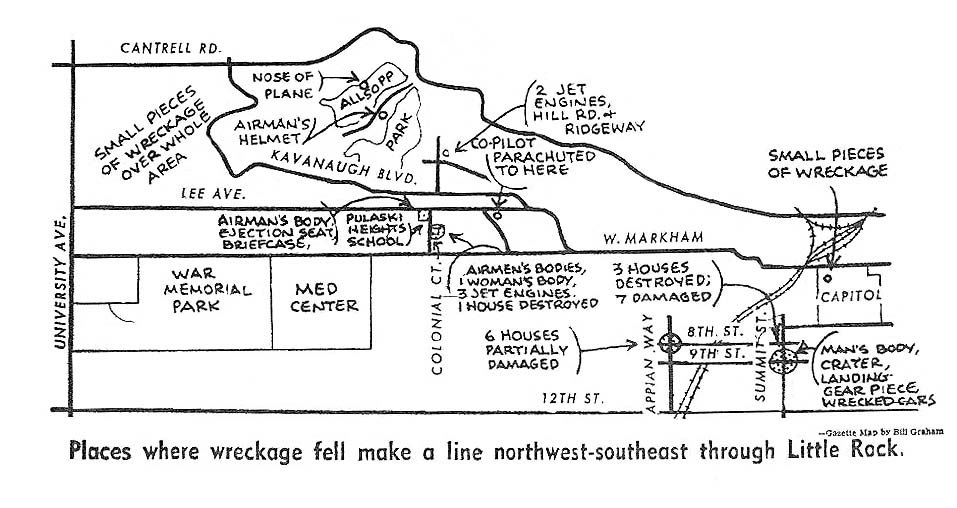
The peaceful morning of March 31, 1960, was interrupted by a horrendous noise over Hillcrest around 6:00am.  A six-engine B47 from the Little Rock Air Force Base exploded mid-air.

Flaming debris fell from Allsopp Park all the way to the State Capitol grounds and stretched from Cantrell to 12th Street.  Other debris was found as far away as the Country Club of Little Rock.  The next day the Arkansas Gazette ran a map which showed the extent of the damage.

Three airmen died in the explosion and two civilians were killed when debris fell on their homes.  The only survivor from the crew, 1st Lieutenant Thomas Smoak, was found dangling from a tree in his parachute at Kavanaugh and Martin.  He was treated by a nurse, Jimmye Lee Holeman, in whose yard he had landed.

Many vehicles and homes were damaged, some were destroyed by debris.  The damage estimate was put around $4 million.

Police and fire crews were quickly on the scene to secure impacted areas, fight fires and rescue injured persons.

The Strategic Air Command’s edited account of the incident noted:

A B-47 was climbing after takeoff in day VFR weather.  At about 15,000 feet, the copilot suddenly realized that the aircraft was in a very steep left bank, that the nose was well below the horizon, and that the airspeed was excessive.  He pulled the throttles to idle, punched the interphone button and shouted at the aircraft commander.

Almost immediately, the nose came up, the wings leveled, and the aircraft disintegrated.  In the cockpit section, which had separated intact from the rest of the aircraft, the copilot tried to eject, but the clamshell initiator pin had not been removed.  The copilot then unfastened his seat belt.  The canopy blew off at about 10,000 feet.  The unconscious copilot was thrown out at 4,000 feet and his parachute opened automatically.

The aircraft commander ejected at 2,000 feet, but his parachute had been fused by fire and he died upon impact.  The fourth man was found near the wreckage and did not survive.  The navigator was killed in his position.  The falling wreckage killed two civilians and caused serious damage to property.”

Those who perished were Captain Herbert Aldridge, Lieutenant Colonel Reynolds Watson, Staff-Sergeant Kenneth Brose, and civilians Alta Lois Clark and James Hollabaugh.

Arkansas Gazette map of debris and damage

Arkansas Gazette map of debris and damage

Little Rock Look Back: LR Mayor Werner Knoop

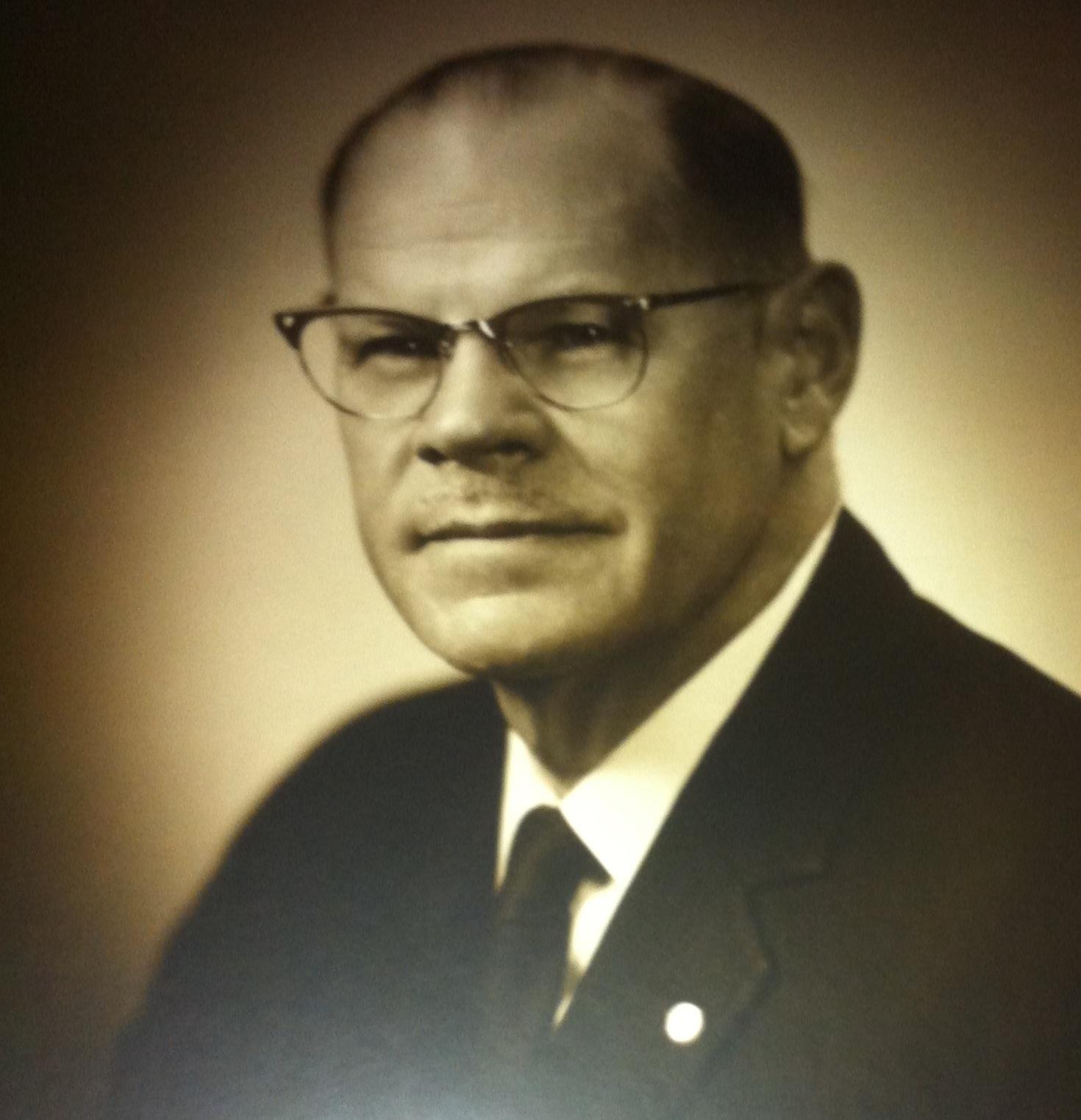
Mayor KnoopTo Little Rock citizens under a certain age, the name Knoop means Knoop Park — a picturesque park tucked away in a pocket of Hillcrest.  There are, however, still many who remember Werner C. Knoop as a business and political leader who helped shape Little Rock as a modern city.

Knoop was born on March 30, 1902.

In 1946, Knoop joined with Olen A. Cates and P. W. Baldwin to form Baldwin Construction Company in Little Rock.  Knoop had previously founded Capital Steel Company and established his business reputation there.  From 1945 through 1951, he served on the Little Rock School Board.

Following a series of political scandals, efforts were undertaken for Little Rock to shift from Mayor-Council to City Manager form of government.  Even before the desegregation of Little Rock Central put the city in the eyes of the world, an election for new leaders had been set for November 1957.  Knoop was on a “Good Government” slate and was one of the members elected.

At the first meeting of the new City Board, Werner C. Knoop was chosen by his fellow directors to serve as Little Rock Mayor.  Knoop served as Mayor until December 1962.  For the first several months in office, Little Rock had no City Manager so Knoop oversaw the transition of City staff as the forms of government changed.

Though City Hall generally stayed out of school district matters, that did not mean that the public viewed the two entities separately.  In September 1959, the Baldwin Construction offices were bombed as part of a series of terrorist activities protesting the desegregated reopening of all Little Rock high schools.

Downtown LR as viewed from Knoop Park

Downtown LR as viewed from Knoop Park

After two terms on the City Board, Knoop decided against seeking a third term.  He concluded his elected public service on December 31, 1962.  Following his time on the City Board, Knoop did not retire from Civic Affairs.  In 1970, he served as Chairman of the Little Rock Chamber of Commerce.   The previous year he served as President of the Arkansas Chapter of Associated General Contractors.

Mayor Knoop died in July 1983.  He is buried at Roselawn Memorial Park next to his wife Faith Yingling Knoop, a renowned author.

In the 1930s, Knoop moved into an Art Moderne house on Ozark Point in Hillcrest.  It was adjacent to Little Rock Waterworks property which was developed around the same time.  Eventually much of the land was deeded to the City for creation of a park.  In 1989, it was named in tribute to long-time neighbor Knoop in honor of his lifetime of service to Little Rock.

Little Rock Look Back: John Tyler

640px-WHOportTylerOn March 29, 1790, future US President John Tyler was born.

Upon the death of President William Henry Harrison, as Vice President he assumed the office of President.  The language in the U.S. Constitution was open to interpretation as to whether he was President or merely acting as President.  He insisted he was President which established the precedent (until a subsequent amendment formalized the procedure he had put into place).  His detractors, including many in his own Whig Party, referred to him as “His Accidency.”

Tyler was a strong proponent of Manifest Destiny and westward expansion.  He actively sought to bring the Republic of Texas into the U.S.  Because of his interest in this, the Tyler Administration was a benefit to Arkansas. As the western border of the US (and a neighbor to Texas), Arkansas was an important stop for commercial and political leaders on the road to and from Texas.

He is memorialized in Little Rock with Tyler Street.  An easy way to remember which street is Tyler and which is Taylor (a couple of blocks away): Tyler Street has Saint John’s Seminary as a terminus. So the street named after John Tyler, ends at the Saint John’s campus.

As of this writing, two of his grandsons are still alive.  Born in 1924 and 1928, they make Tyler the earliest U.S. President with living grandchildren.  Many of his successors do not have living grandchildren.

Robinson Redux March

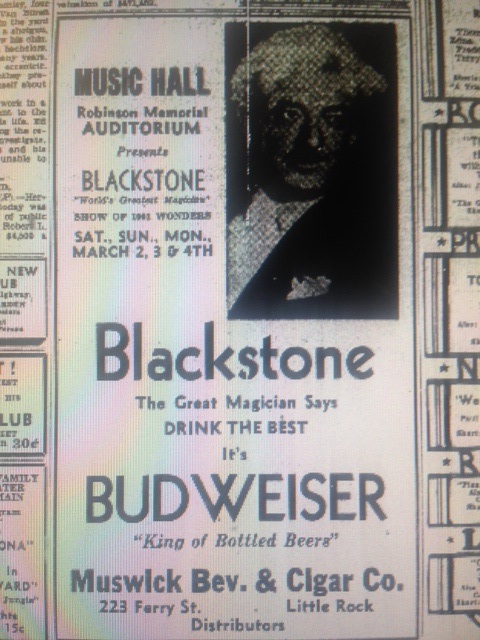
Blackstone adWhile Robinson Center Music Hall is closed for renovations, the Culture Vulture blog is taking a look back at previous bookings in the facility each month.

March 1940 was the first full month that Robinson Auditorium was open.  The month started with Blackstone the magician in performances from March 2 through 4. In addition to his appearance touted by the auditorium, Muswick Beverage & Cigar Company promoted his appearance, and the fact that he endorsed Budweiser beer.  Later that month, appearances included the Shrine Circus, the AAU girls basketball championship, and the Saint Louis Symphony.

March 1950 was a particularly busy month. It featured singer Vaughn Monroe on the 6th and the Arkansas State Symphony playing Beethoven’s Ninth Symphony on the 7th.  On the lower level, a circus took up residency from the 7th through 10th.  Back upstairs in the music hall, Ballet Theatre visited performing Balanchine’s “Theme and Variations” featuring ballerina Nora Kaye and conductor Max Goberman.  The month concluded on the 27th with James Dunn starring in the Pulitzer Prize winning Harvey.

In 1955, Jose Greco and His Spanish Dancers entertained audiences on March 7. Five years later, the Chicago Ballet was featured on March 26, 1960. Earlier that month (the 16th), Max Rudolf conducted the Cincinnati Symphony Orchestra. March 1965 feautured the Chicago Opera Ballet (on the 2nd) and an evening of country music stars including Buck Owens and Kitty Wells (on the 10th).

In March 1970, the national tour of the Broadway musical Mame starring Sheila Smith launched the month on the 6th and 7th. Later that month The Florida Boys were in concert. March 1975 saw much activity at Robinson Center. Guy Lombardo and his orchestra appeared on the 2nd and Richard Fredricks, baritone, gave a recital on the 4th, under the auspices of the Community Concert Series. On March 5 & 6, a statewide touring production of South Pacific played at Robinson. Produced by Vince Insalaco, it starred Judy Pryor (now Judy Trice) as Little Rock native Nellie Forbush. The month closed out with the national tour of Fiddler on the Roof.

March 1980 saw Dawn Wells starring in Neil Simon’s Chapter Two on the 8th. The Arkansas Symphony Orchestra performed on the 15th and 16th with pianist Lorin Hollander as guest artist. Five years later, Marilyn Horne appeared with the ASO on March 2, 1985. At the same time that evening, the Shriners Ball was taking place on the lower level. Later that month a national tour of Sophisticated Ladies stopped by Robinson on the 12th. The ASO returned on March 20 & 21 with pianist Garrick Ohlsson.

The Sharks and the Jets lept on the stage on March 20, 1990, as a tour of West Side Story came to Robinson Center. The month concluded with pianist Jose Carlos Cocarelli in concert with the ASO.

Marilyn Horne returned to Little Rock, ten years and one day after her previous appearance, and performed with the ASO again on March 3, 1995. The month also included The Will Rogers Follies on March 10-12, Jazz Explosion II (with George Duke, Dianne Reeves, Phil Perry, Howard Hewett, and George Howard) on March 15, and the ASO in concert with cellist Jeffrey Solow on March 18 & 19. On March 22, the musical Raisin was performed. The cast included Peabo Bryson, Jeffrey Osborne and Lynette Hawkins.

As the 2000s rolled around, Robinson Center continued to feature an eclectic mix. In March 2000, Ann Hampton Callaway performed with the ASO on March 4 & 5. Later that month the original cast of Red, White & Tuna played at Robinson from March 14 through 19. In 2005, the national tour of Mamma Mia! played at Robinson from March 1-6. Later that month the ASO performed Broadway a la Carte with an eveningn of songs from the Great White Way (on March 18 & 19).

In 2010, the ASO performed a concert version of Porgy & Bess on March 12 & 13. It was the first time that title had ever been performed in its entirity in Arkansas. Irish dance took the stage the next night as Lord of the Dance took up residence at Robinson Center.

Women’s History Month Throw Back Thursday: Mount Holly Cemetery Association

Mt Holly ProfileThe Mount Holly Cemetery is a treasure trove of history, architecture and horticulture on the edge of downtown Little Rock.

It was established in 1843 when Chester Ashley and Roswell Beebe donated the land to the city of Little Rock. Feeling the town fathers were not giving the cemetery the attention it deserved, a group of Little Rock businessmen formed a cemetery commission on March 20, 1877. Charter members of the commission were J. H. Haney, Fay Hempstead, James Austin Henry, Philo O. Hooper, and Frederick Kramer. However the private group of men did no better in maintaining the cemetery.

In 1914, a contingent of the town’s women became critical of the cemetery’s unkempt appearance and took over the reins from the men. Following adoption of City Ordinance No. 2199 in June 1915, the ladies’ Mount Holly Cemetery Association was incorporated on July 20, 1915. (It should be noted this action by the women came at a time when women did not have the right to vote.)

The Mount Holly Cemetery Association grew out of a meeting which took place on June 9, 1914 at the home of Mrs. A. H. Scott. Thirty-six women gathered for the purpose of improving the cemetery.

An executive committee was formed, and the women started working on improvements to the cemetery. Though first viewed by some men as an auxiliary to the Cemetery Commission, it quickly became apparent that the women were in no mood to take a back seat in matters pertaining to Mount Holly.

The first executive board (from June 1914 to July 1915) included Mrs. A. H. Scott, Mrs. B. S. Johnson, Mrs. George Thornburgh, Mrs. Moorhead Wright, Mrs. H. M. Bennett, Mrs. George Worthen, Mrs. W. E. Green, Mrs. George Stratman, Miss Louise Gibson and Miss Clara Hotze.

The July 1915 incorporators were Mrs. Scott as well as Julia E. Bennett, Eva C. Shields, Rosa M. Miller, Ruby P. Ratcliffe and Marguerite R. English. Mrs. Bennett, known affectionately as “Scrap” would serve as the first president, and Miss Miller was the first secretary.

Over the years the Association has undertaken countless projects large (construction of a mausoleum) and small (signs on the lanes) to improve Mount Holly Cemetery for its residents and for visitors.

In 1993, the Association published a history of the first 150 years of the cemetery.  More recently, they launched the annual RIP (Rest in Perpetuity) picnic held the last Sunday in April on the grounds.  They have also published a cookbook–Recipes in Perpetuity.

Today, the Mount Holly Cemetery Association is still going strong!

Little Rock Look Back: MacArthur Returns….to Little Rock

General MacArthur and Mayor Remmel

General MacArthur and Mayor Remmel

On Sunday, March 23, 1952, General Douglas MacArthur made his only post-infancy visit to Little Rock. He had previously been scheduled to visit Mississippi, and Little Rock Mayor Pratt Remmel had persuaded him to add a visit to Little Rock to the agenda. The fact that Little Rock now had a Republican mayor had apparently piqued the General’s interest.

General MacArthur, accompanied by his wife and son as well as several journalists and members of his military retinue, arrived at Little Rock Airport at 10:40 am. He was met by a delegation of civic leaders including Mayor Remmel. Alderman James Griffey made welcoming remarks on behalf of the city. Then the General and Mayor boarded an open car and led a motorcade from the airport to downtown.

The motorcade’s destination was Christ Episcopal Church at Capitol and Scott streets. It was at this church that MacArthur had been baptized as an infant. The delegation was greeted by the Episcopal Bishop R. Bland Mitchell, Rector J. Hodge Alves, and Rector Emeritus W. P. Witsell. (While he had been Rector, Dr. Witsell had garnered national attention by issuing an Easter blessing to Gen. MacArthur as he had been evacuating the Philippines at the height of World War II.) In order to gain admittance to the church that morning, church members and guests had to have tickets.

Following the worship service, the General and his party went to three events in the park named in his honor. The first was a tour of the Museum of Natural History (now the Museum of Discovery and located in the River Market; the current tenant of the building is the MacArthur Museum of Arkansas Military History), which was located in the building in which the General had been born. After the tour, he spoke at a dedication of a small rose garden adjacent to the museum. It was sponsored by the Little Rock City Beautiful Commission and the Garden Clubs of Greater Little Rock.

Though every stop of the General’s visit had featured crowds, the largest was at the third location in MacArthur Park. A crowd of several thousand greeted the General as he spoke from the Foster Bandshell in the park’s southwest corner. Chamber of Commerce president Richard C. Butler (brother-in-law of Mayor Remmel) was the master of ceremonies. Following an invocation by Methodist Bishop Paul Martin, the only other speaker was the General. In his remarks he spoke of his Southern heritage and of his appreciation for the support of the citizens of Little Rock over the years.

Several gifts were bestowed upon the MacArthurs at the ceremony. The City of Little Rock presented Mrs. MacArthur with an engraved silver serving tray.

Following the events in MacArthur Park, the family retired for a brief respite to the Hotel Marion. They then attended a luncheon buffet in their honor at the home of Howard and Elsie Stebbins on Edgehill Road. The General and Mrs. MacArthur circulated through the house greeting guests and then eschewed a special table in favor of balancing their plates on their laps and sitting in wingback chairs. Meanwhile Arthur MacArthur stayed upstairs and discussed stamp collecting and other hobbies with the Stebbins’ two teenage sons.

Following the luncheon, the MacArthur party went back to the airport and by 4:00pm, the plane was in the air.

Though this visit was coming at the end of a whirlwind of activities, by all accounts, the General and Mrs. MacArthur were very gracious and accommodating. The General was being mentioned as a potential GOP candidate for President, but purposefully steered clear of any political comments in his remarks. He and Mrs. MacArthur dutifully posed for photos not only for the media but also for amateur photographers. At lunch, the General even asked a Gazettephotographer to take a photo of him with his Little Rock Police motorcycle escorts so that they could have a souvenir of the visit.