Central High Integration 56th Anniversary Event This Evening

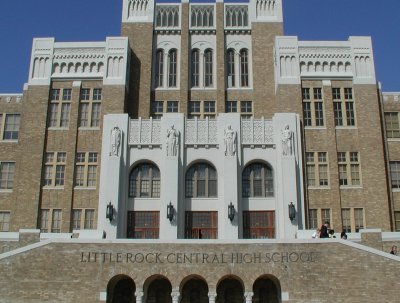
centralentranceIt was 56 years ago today that the Little Rock Nine entered Little Rock Central High School and finally started their school year.  Each year this date is commemorated both at Little Rock Central High as well as by the National Park Service through its Little Rock Central High National Historic Site.

In keeping with the anniversary day of the 1957 Little Rock Central High School crisis, the National Park Service will be honoring Little Rock’s own Annie Abrams (who also celebrates a birthday today), a nationally recognized civil rights activist.  She will be lauded for her service to Little Rock and for her dedication to movements around the United States of America.

In the spirit of the work done by activists worldwide fighting for freedom and putting their lives on the line, the Park Service is presenting keynote speaker, Myrlie Evers-Williams. She is the widow of civil rights activist Medgar Evers who was assassinated in the driveway of his home in Mississippi 50 years ago. Evers-Williams will address the accomplishments of her late husband and the work she continues as an agent for social justice.

Tonight at the Kendall Center on the campus of Philander Smith College, Annie Abrams, Reena Denise Evers-Everette (daughter of Medger and Myrlie Evers), and Myrlie Evers-Williams will receive the Soul of Humanity Award, given in recognition of outstanding commitment and service to social justice and lifelong action in the struggle for civil rights.

The program is free and open to the public.  It will take place at 6pm at the Kendall Center on the campus of Philander Smith College.
Six Pioneers, Other Leaders honored by National Park Service Tonight

NPSLRCHTomorrow, September 25, marks the 56th anniversary of the desegregation of Little Rock Central High School.  Each year the school and the National Park Service schedule a series of events to commemorate this.

This year, commemoration activities start this evening.  At 6pm at Philander Smith College, there will be a panel to discuss the Six Pioneers. These were the first six African-American students to desegregate the University of Arkansas at Fayetteville (U of A) School of Law.  The descendants of the Six Pioneers will discuss the role of moral courage and the change that occurred in the hills of northern Arkansas over 65 years ago.  George Haley, the sole living pioneer will give remarks as well.

Their footsteps on the foothills of conviction cleared a path for the desegregation of Hoxie Elementary in 1955 and Little Rock Central High School in 1957. The U of A School of Law was the first southern white university to accept African-American students since Reconstruction.

The Six Pioneers, The Honorable Rodney Slater, Attorney John W. Walker, Sr., Judge Wiley A. Branton, Jr., Sanford Tollette IV, Dr. Sybil Jordan Hampton and Robin Woods Loucks will all be recipients of the Soul of Humanity Award given in recognition of outstanding commitment and service to social justice and lifelong action in the struggle for civil rights.

The evening will close with remarks from Reena Denise Evers-Everette, daughter of civil rights activist and martyr Medgar Evers.

The event will take place at the Kendall Science and Health Mission Center on the Philander Smith College campus.


Little Rock Look Back: City Government Closes Up

Final 1863 minutesOn September 21, 1863, the City of Little Rock government shut down.  Following the occupation of Little Rock by federal troops (on September 10, 1863), the city was now under control of the United States Army.

The City Council met on September 21 and voted to disband the police force and to suspend the collection of taxes.  Mayor William E. Ashley was not present.  The five aldermen present were Charles P. Bertrand (a former mayor and stepson of Little Rock’s first mayor Dr. Matthew Cunningham), S. H. Tucker, W. B. Wait, I . A. Henry, and Louis George.  Following the actions regarding the police and taxes, the council adjourned.

The month before, on August 24, 1863, the City’s funds were “placed in the hands of a reliable party that was well known to the Council.”  Records in City Hall do not indicate who that was or if those funds were ever returned following the war. (Or if those funds were in Confederate dollars which would have been rendered useless.)

Following the September 21, 1863 meeting, there was not a City Council meeting until January 8, 1866.  I. A. Henry, who had been at the final 1863 City Council meeting was also an alderman on January 8, 1866.

LR Look Back: Fifty Years of Desegregated Downtown Little Rock

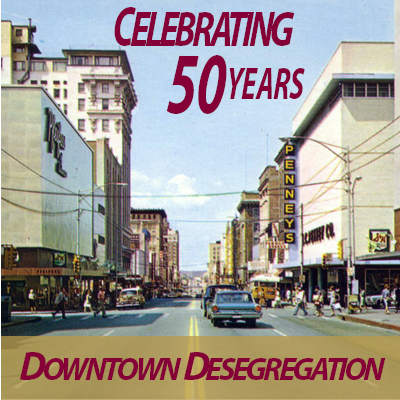
widget_2013commerationThe UALR Institute on Race and Ethnicity is partnering with the Little Rock Regional Chamber of Commerce to mark the 50th anniversary of the desegregation of downtown Little Rock businesses from 10:30 a.m. – 2 p.m. Saturday, Sept. 21, 2013, at the Chamber.

This event is part of the Chamber’s 31st Annual Minority Enterprise Development Week and will include a public unveiling of the markers, reception, and the seminar, “Developing Future Leaders: How Strong Mentors Can Increase Diversity in Leadership Positions.”

Eleven  individuals from the Council on Community Affairs, Downtown Negotiating Committee, and Philander Smith College, will be honored with bronze markers placed on the Arkansas Civil Rights Heritage Trail in front of the Chamber. This will mark the third year of the Civil Rights Heritage Commemoration.

In 1963, this diverse group made up of members from COCA, DNC, and students from Philander Smith College worked together to plan a peaceful integration of downtown retail and restaurant establishments. Because of their efforts and others, by the end of 1963 most of the downtown retail businesses and restaurants had integrated.

2013 Arkansas Civil Rights Heritage Trail Honorees
The following individuals will be honored:

    • Dr. Garman P. Freeman, COCA
    • Dr. Morris A. Jackson, COCA
    • William Starr Mitchell, DNC
    • James H. Penick, DNC
    • Arthur Phillips, DNC
    • Rev. Negail Riley, Pastor, Wesley Chapel at Philander Smith College; COCA
    • Bert Strauss, Philander Smith College student; DNC
    • Ozell Sutton, COCA
    • Dr. William H. Townsend, COCA
    • Dr. Evangeline Upshur, COCA
    • B. Finley Vinson, DNC

Public Commemoration Ceremony – 10:30 a.m.
Civil Rights Heritage Markers Unveiling

Reception – 11 a.m.

Little Rock Look Back: Mayor John Elliott Knight

Jno E Knight sigOn September 20, 1816, future Little Rock Mayor John Elliott Knight was born in Newburyport, Massachusetts. In 1843 he married Hannah Donnell in New York, and came to Little Rock that same year.

Knight was editor of the Arkansas Democrat from 1846 to 1850. He was also associated with the Arkansas Gazette and published the short-lived Chronicle. In 1851, Knight served as Mayor of Little Rock. In 1855, he served as a member of the City Council.

In 1858 a song was published entitled “I Am Near to Thee” which featured music by Arkansan Benjamin Scull and lyrics by Knight.  The song was dedicated to Mary Woodruff.

During the Civil War, he served as a Colonel.  During the 1850, 1860 and 1880 census, he was listed as an attorney.

He had one daughter, Elizabeth Knight, who married James S. Pollock, a banker in Little Rock. Knight died in Little Rock, Arkansas, on October 28, 1901, and was buried in Mount Holly Cemetery. Elizabeth Knight Pollock died in 1910.

As an attorney and newspaper editor, John E. Knight collected documents about the settlement of Little Rock. Those papers are now part of a collection at the Arkansas History Commission.  The majority of these papers are from William Russell to Chester Ashley, pertaining to pre-emption claims in and around Little Rock. Other material concerns the 1819-1822 dispute related to the the New Madrid Certificate and pre-emption claims of James Bryant, Stephen F. Austin, and William M. O’Hara.

Little Rock Look Back: Mayor Henry Lewis Fletcher

Mayor H L FletcherOn September 15, 1833, future Little Rock Mayor Henry Lewis Fletcher was born in Saline County.  His parents were Henry Lewis and Mary Lindsey Fletcher.  One of his siblings was future Little Rock Mayor John Gould Fletcher.  The Fletcher brothers are the only set of siblings to serve as Mayors of Little Rock.

Though the life of John Gould Fletcher is fairly well documented, not much information is out there on his brother Henry Lewis (and some of what is out there is incorrect).  He married Susan Bricelin August 30, 1855, in Pulaski County.  During the Civil War, he served as a sergeant in the cavalry for the Confederate Army in Captain Ed Nowland’s Company.

As a civic leader, Fletcher oversaw Arkansas’ contribution to the Philadelphia Centennial Exposition in 1876. The building received as a prize a cast-iron fountain still standing in front of the Old State House Museum.

Fletcher served as Mayor of Little Rock from 1891 to 1893.  When Fletcher became Mayor he appointed a new Police Chief (as most Mayors did) and the entire police force was dismissed.  A new police force was hired by E. H. Sanders, who served as chief for 18 months.  Upon his resignation, Frank MacMahon (who had been dismissed from the force when Fletcher came to office), was appointed Chief by Mayor Fletcher.  He would serve from 1892 until 1905.

Mayor Fletcher died on June 30, 1896 and is buried at Oakland Cemetery next to his wife (who died in 1911).

Little Rock Look Back: Mayor Charles E. Taylor

Mayor TaylorOn September 15, 1868, future Little Rock Mayor Charles E. Taylor was born in Austin, Mississippi.  After locating to eastern Arkansas, his family moved to Little Rock around 1880.

Taylor graduated from Scott Street High School in Little Rock and proceeded to work for various hardware stores and other businesses.  In 1895 he married Belle Blackwood, with whom he would have four children.

In 1910, Taylor announced his intention to run for Mayor of Little Rock.  Though he had never held elective office, he had been involved in several civic organizations.  Taylor was the main challenger to Alderman John Tuohey.  Seen as a reformer, Taylor initially lost to Tuohey but after an investigation of voter fraud and a subsequent runoff, Taylor was elected Mayor.

Upon taking office in August 1911, Mayor Taylor focused on improving health conditions in the city, upgrading the fire department and enhancing the overall moral tone of the city.

As a progressive of the era, he fought against gambling, drinking and prostitution.  He created a Health Department and enhanced the City Hospital.  His efforts led to a decrease in the death rate in Little Rock.  As Mayor, Taylor introduced motorized vehicles to the Fire Department.  He also led the City Council to establish building and electrical codes.  Mayor Taylor also oversaw the construction of the 1913 Beaux Arts Central Fire Stations (which today serves as the City Hall West Wing).

Under his leadership, the City of Little Rock annexed Pulaski Heights. One of the selling points to Pulaski Heights residents was Mayor Taylor’s ability to provide modern services such as paved streets, water mains, fire hydrants and street lights.

Though neither his 1911 Parks Master Plan nor his dreams for a civic auditorium came to fruition, they paved the way for future successes in both of those areas.

Funding for projects continued to be a problem throughout Mayor Taylor’s four terms in office.  He believed that one obstacle to city funding was the prohibition by the state constitution against cities issuing bonds.  Though that ban has since been lifted, Taylor tried three times unsuccessfully to get it changed while he was Mayor.

In April 1919, Taylor left office after having served eight years.  He was the longest serving Mayor of Little Rock until Jim Dailey served in the 1990s and 2000s.  Following several business ventures, Taylor moved to Pine Bluff and led their chamber of commerce from 1923 through 1930.

Mayor Charles E. Taylor died in Pine Bluff in 1932. He was buried at Oakland Cemetery in Little Rock.

During his time in office, Mayor Taylor was presented with an unofficial flag of Little Rock by a group of citizens.  During Mayor Dailey’s tenure, that flag was restored by some private citizens and presented to the City.  It is framed on the 2nd Floor of Little Rock City Hall.