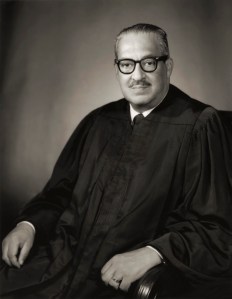
 On August 30, 1967, Thurgood Marshall was confirmed as the first African American to serve on the Supreme Court of the United States.
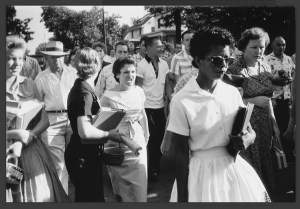
Ten years earlier, Marshall had been spending much time in Little Rock as he fought for the Little Rock Nine to be allowed to integrate Little Rock Central High School.
While he was in town, he would stay at the home of L. C. and Daisy Bates. One can tour the home today and see the bedroom in which he, Dr. Martin Luther King Jr., Ossie Davis & Ruby Dee, and other Civil Rights leaders stayed while visiting Little Rock.
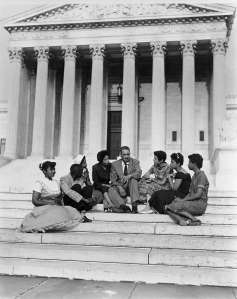
Thurgood Marshall, of the NAACP, sits on the steps of the Supreme Court Building after he filed an appeal in the integration case of Little Rock’s Central High School. The students are, from left: Melba Pattillo, Jefferson Thomas, Gloria Ray, escort Daisy Bates, Marshall, Carlotta Walls, Minnijean Brown, and Elizabeth Eckford. (AP Photo, file)
His involvement with the Little Rock Nine came about from his role with the NAACP. In had been in that capacity that he was lead attorney for the Brown v. Board of Education decision which paved the way for the Little Rock schools to be integrated. He worked with local attorneys such as Wiley Branton Sr. and Chris Mercer on the Little Rock efforts.
In May 1961, President John F. Kennedy named Marshall to a seat on the US Court of Appeals. Unsurprisingly, a group of segregationist senators tried to hold up the appointment. In 1965, he was named to the position of Solicitor General by President Lyndon B. Johnson.
Regrettably there is another Arkansas connection to Thurgood Marshall’s appointment to the Supreme Court. As he had with the 1961 appointment to the Court of Appeals, Arkansas Senator John L. McClellan vigorously opposed the nomination of Marshall. As a member of the Judiciary Committee he tried to hold it up. In the end, McClellan did not vote on Marshall’s appointment when it came before the full Senate.
The final vote was 69 for and 11 against with 20 not voting. Of the 11 former states of the Confederacy, Arkansas’ J. William Fulbright, Tennessee’s Howard Baker & Al Gore Sr., Texas’ John Tower & Ralph Yarborough, and Virginia’s William Spong were the only six votes for yes. There were six who did not vote, and 10 Nay votes.
The remaining Nay vote came from West Virginia’s Robert Byrd. Among those outside the South who did not vote were future Democratic presidential candidates Eugene McCarthy, Edmund Muskie and George McGovern as well as Republican former actor George Murphy. Montana was the only state with neither senator casting a vote one way or the other.
Marshall served on the US Supreme Court until October 1991, when he retired due to failing health. He died in January 1993, just four days after Bill Clinton became president.




 Little Rock Culture Vulture