
Thanksgiving Football 1969 in Little Rock: Hogs, Tigers, Warriors, Bearcats and Rockets

The Hogs stop Texas Tech at War Memorial Stadium

On Thanksgiving 1969 (November 27), four Little Rock high schools AND the University of Arkansas all played football games in Central Arkansas.  It was a day for football in the Rock!

It appears this was the only time this feat has happened.

It was a cool and misty day which seems to have made balls slippery and grass fields sloppy. But the precipitation seemed to be more an annoyance than a barrier for the players and fans.

The Arkansas Razorbacks, ranked Number 2 in the nation, played host to the Texas Tech Red Raiders at War Memorial Stadium.  The two teams played before a crowd of 35,287.  This was the smallest crowd in LR that season, likely due to it being Thanksgiving and the presence of the Central/Hall football game the same day.  It would have been hard to fit in two football games, Thanksgiving meals, and a possible church service all within one day.

The Hogs were 16 point favorites for the game with a 1:50 kickoff.  It was broadcast on ABC, and fans were encouraged to wear red to show up well on the color telecast.

The Hogs beat the Red Raiders by a score of 33 to 0 in their penultimate regular season game.  Turnovers were the key with the Hogs recovering a fumble and intercepting five passes.

This game set the stage for the final Hogs regular season game, which was the December 6, 1969, shootout against the Number 1 Texas Longhorns in Fayetteville.

Earlier in the day, Little Rock Catholic took on NLRHS north of the river with a 10am kick off. The Rockets, under head coach George Loss, were 9-2 heading into the game. The Wildcats (coached by Ken Stephens) were 5-4 and had won four in a row. At the end of the game, NLR was triumphant by a score of 21 to 12.

Later that day, Jones High hosted Horace Mann at the same stadium. This game, with a 2pm kickoff, would be the final game between Jones and Mann. Jones was being closed at the end of the year.

The teams had met earlier in the season with Mann triumphing 13 to 8. Mann had a record of 2-8, playing in the larger AAAA classification. Jones, with a record of 4-6, played in the AA classification. For years these all African American schools were not allowed to play in the Arkansas Activities Association. But by the late 1960s, they were now playing in AAA conferences.

Jones scored an upset victory over the Bearcats by a score of 19-8.

Quigley Stadium was less than three miles from War Memorial Stadium. With a 10am kickoff before a sold out crowd, people who had wanted to go to both the Hogs game and Hall/Central game also had the option of listening to the high school gridiron competition on KARK radio (now KARN).

Prior to the game, Hall had captured the AAAA State Championship by virtue of its record. (The top classification did not participate in playoffs until 1983.) C. W. Keopple was the Warriors’ coach, while Gene Hall was the Tigers’ mentor.  The damp field and high stakes of the game turned it into a defensive slugfest.  Hall had 2 fumbles while Central fumbled four times.

At the end of the fourth quarter the scoreboard showed a 0 to 0 tie. And that one went into the record books.  Hall’s season record was 9-0-1, while Central’s was 6-2-2.  It was the best season record Hall had amassed in its 13 years of football.

Four football games within a few miles of each other were a peek into Little Rock life:

  • The Hogs were riding the crest of their 1960s football superiority in the Southwest Conference.
  • The final Thanksgiving football game in Arkansas between two segregated public schools.
  • Continued alternating dominance by Hall and Central in the state’s largest school sports classification.  Soon, Parkview would be added to the mix. Throughout the 1970s, all three Little Rock public high schools would rotate winning state championships.

Little Rock Look Back: Final Thanksgiving Day High School football game in Arkansas

Since the early 1960s, the Arkansas Activities Association had been discouraging the playing of games on Thanksgiving Day.  With the advent of state playoffs, these Thanksgiving games were an interruption. By 1982, only one such rivalry still existed. The Little Rock Central vs. Little Rock Hall game.  Both schools were in the largest classification (5A) which did not have playoffs.

With the changes of state athletic conference classification, the 1982 game was announced as the final Thanksgiving Day game between Hall and Central. The top two classifications were being combined which would necessitate conferences and playoffs to determine the state champion. This would mean that Hall and Central would need to meet before Thanksgiving.  Going into the game Hall led the series with 13 wins to Central’s 8 wins.

The 1982 edition lived up to the hype.  Played on November 25, 1982, this was the 25th edition of the Hall and Central rivalry. While there was no doubt that Hall would end up with the most wins, Central wanted to make sure that they ended it in the way they started it in 1958 – with a win.

Central boasted a 4-1 record. Pine Bluff and LR Parkview were both 4-1-1. Hall was 3-0-2. As long as Central or Hall won outright, the winner would be state champ. A tie (and there had been three previous ones) would result in a four-way tie for first place.  Hall’s coach C. W. Keopple had led the team since 1964 and amassed a 10-6-1 record against Central.  The Tigers were mentored by Bernie Cox who was 4-3 against the Warriors since taking over in 1975.

Nearly 9,000 fans packed Quigley Stadium for a cold but dry day. As the buzzer sounded after four quarters, the Hall High Warriors were jubilant. They had won the game 14-3 after putting together a nearly flawless offensive effort. The win moved them into first place with a 4-0-2 record. Central, which had sat atop the conference most of the season, ended up in fourth place with a 4-2 record.  The defeat also ended the Tiger’s hopes for a third consecutive championship.  This game, like so many before it, provided high drama and excitement as it confounded some pundits yet also lived up to billing.

And with that, the series concluded.  In the end, Hall had fourteen wins while Central had eight.  There were also three hard-fought ties.  Central achieved four shutouts of Hall, while the Warriors blanked the Tigers three times.  In the twenty-five games, Central scored 228 points, and Hall scored 297 points.

From 1983 until 2005, Hall and Central continued to play each other in football. This time, they played for the ceremonial bell in what became known as “The Battle for the Bell.”  Today, the bell is proudly displayed at Quigley Stadium.  After 2005, Hall moved into a lower classification than Central. This put them on separate trajectories facing different sets of teams.

Little Rock Look Back: C. P. Bertrand

On November 23, 1808, future Mayor Charles P. Bertrand was born in New York.  He was the son of Pierre and Eliza Wilson Bertrand; his father died in 1809 in an uprising in Haiti and his mother eventually remarried.  With her new husband, Dr. Matthew Cunningham, she and the family moved to Little Rock in 1820.

After apprenticing with family friend William Woodruff at the Arkansas Gazette, Bertrand opened the Arkansas Advocate newspaper.  He later studied law under Robert Crittenden and entered the legal profession.

In 1835-1836, he served as State Treasurer for the Arkansas Territory, and in 1836 as secretary for the first constitutional convention. He was a member of the Arkansas House of Representatives from 1840-1841 and 1844-1849.

Bertrand followed in his stepfather’s footsteps and became Mayor of Little Rock.  (Dr. Cunningham had been the first Little Rock Mayor in 1831.)  He was in office from January 1855 through January 1857, serving two one-year terms.  He later served on the City Council and filled in as acting mayor. (Another influence on his upbringing was studying under future Mayor Jesse Brown who taught at the first school in Little Rock.)

Bertrand, as acting mayor, was involved in the negotiations of the surrender of Little Rock to federal troops in 1863.  He also later corresponded with President Lincoln on behalf of Little Rock citizens

.

Though a staunch Confederate, his good will toward the Union soldiers and federal officials is credited with helping to save Little Rock from the destruction which befell many other Southern cities.  He is also credited with delaying the start of the Civil War.

Prior to the attack on Fort Sumner, members of the Arkansas Militia were planning to attack the Federal Arsenal at Little Rock during the absence of Governor Rector.  This would have been viewed as an act of war.  Bertrand was able to dissuade them from the attack.  Had he been unsuccessful, the Civil War would have likely started in Arkansas instead of South Carolina.

He had put his considerable fortune into Confederate money during the war. At the Civil War’s conclusion, the family was financially ruined. Though they had vast land holdings, those would be sold off in parcels to pay for taxes.

Bertrand died August 27, 1865, shortly after the conclusion of the Civil War.  He, like his mother, step-father, and several other relatives, is buried in Mt. Holly Cemetery.

Little Rock Look Back: The 2004 opening of the Clinton Presidential Center

wjc library openingIt has been fourteen years since the Clinton Presidential Center opened on a wet, cold Thursday.
The days leading up to it had been glorious.  And while the weather may have literally dampened spirits a bit, it was still an important day for Little Rock and Arkansas.

The events leading up to the opening included a concert by Aretha Franklin with the Arkansas Symphony Orchestra and an appearance by Senator John Glenn at the Museum of Discovery.  Events were hosted by the Arkansas Arts Center, Arkansas Repertory Theatre, Historic Arkansas Museum, and Old State House Museum.  There were scores of receptions and parties as Hollywood, New York, and DC descended on Little Rock.

November 18 dawned rainy and cool.  As the day continued on the precipitation continued while the temperature did not warm up.  Years of planning for a grand opening ceremony came down to this.  But at the appointed time, festivities began.

On the site of an abandoned warehouse district and unofficial dump which had previously been a train station, many leaders of the free world were gathered.  They rubbed shoulders with thousands of Arkansans from probably every county in the state.

It had been seven years and eleven days since Bill Clinton had announced the site of his presidential library.  It had been five years since artifacts and articles started arriving from Washington DC in Little Rock.  There had been lawsuits, threats of lawsuits, the threat of a Counter-Clinton Library, and countless meetings.

After speeches from Presidents Carter, Bush 41 and Bush 43, remarks from President Clinton and then-Senator Clinton (who was made even wetter by water pouring off an ill-placed umbrella), and even a musical performance by Bono and The Edge, Chelsea Clinton turned over the ceremonial key from the Clinton Foundation to the National Archives to officially open the Clinton Presidential Center.

In his capacity leading the Clinton Foundation, Skip Rutherford oversaw the planning for the Clinton Library and the grand opening festivities.  He, along with the foundation’s Executive Director Stephanie S. Streett, oversaw a phalanx of volunteers and staff to anticipate every detail.  The 1,000 days countdown sign that had been on the construction site (the brainchild of Tyler Denton) finally reached 0.

Isabelle Rodriguez, Shannon Butler, Mariah Hatta, Jordan Johnson, Lucas Hargraves, Ben Beaumont, Denver Peacock — among others — had been putting in twelve plus hour days for months on end to get ready for the opening.  City Manager Bruce T. Moore led a team of City officials who had assisted on the planning and execution of the site preparation and making sure Little Rock was ready to welcome the world.  Moore and City Director Dean Kumpuris had been appointed by Little Rock Mayor Jim Dailey to lead Little Rock’s efforts to land the library.  After Clinton’s announcement of the site, Dailey, Kumpuris and Moore continued to work together to ensure the library would be successful.

Among those present were Oscar winning actors Barbara Streisand, Robin Williams, and (of course) Arkansan Mary Steenburgen.  Future Oscar winner Morgan Freeman was also in attendance. Among the Oscar nominees who were present were Bono and The Edge (who performed at the ceremony) and Alfre Woodard.  It was the first public appearance by Senator John Kerry after his loss earlier in the month to President George W. Bush. Scores of Senators and members of Congress as well as countless Clinton Administration staffers were also in attendance.

While the weather on November 18, 2004, may have been a disappointment, the people who were gathered knew they were witnesses to history.  And fourteen years later, is a day people still talk about.


Little Rock Look Back: Aretha Franklin with the Arkansas Symphony Orchestra at Robinson Center

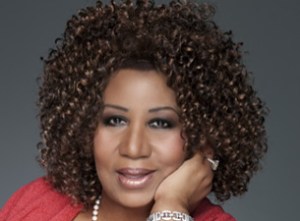
On November 16, 2004, the rafters of Robinson Center Music Hall were shaken by the vocal prowess of Aretha Franklin.
She shared the Robinson stage with the Arkansas Symphony Orchestra.  The ASO brought Miss Franklin to town as part of the festivities surrounding the opening of the presidential library.  Long a favorite of the Clintons, Miss Franklin sang at his 1993 inaugural festivities the night before he took the oath of office.

Resplendent in a series of white dresses, Miss Franklin was in top form feeding off the love from the audience.  While backstage she may have been dealing with back and knee issues (which the Culture Vulture saw first hand), when she stepped on to the stage she was giving her all as she rolled through hit after hit from her starry career.  She sang, she played the piano, she entertained!

It was a sold out house and her voice and energy reached the last row of the balcony.

Prior to her appearance, the ASO played a few selections including variations on “Hail to the Chief” and “America.”

Earlier in the day, I had the privilege of picking up several copies of Bill Clinton’s autobiography for her to get signed by him.  I delivered them to her as she was resting between rehearsals. She was preparing for an interview with Craig O’Neill, and I hated disturbing her. But I wanted to be sure she got the books.  She was gracious and very appreciative.

Little Rock Look Back: Robinson Auditorium Commission abolished; Duties transferred to LRCVB

aud-com-abol

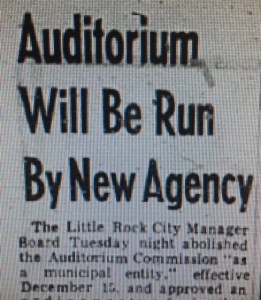
On November 16, 1971, the City of Little Rock Board of Directors abolished the Auditorium Commission which oversaw Robinson Auditorium and transferred duties to the Advertising and Promotion Commission.

This was done with the full support of both commissions.  The transfer took place immediately, with all assets and loose ends to be wrapped up by December 15, 1971.

With the adoption of a hospitality sales tax, by state statute, Little Rock had to have an A&P Commission.  By 1971 plans were afoot to use the A&P tax to build a conference center using some of the existing space in Robinson and adding space.  It did not make sense to have two separate commissions overseeing the same building.

For the Auditorium Commission members, it was possibly a relief.  For years, overseeing the building had been a quiet duty.  But with the social changes of the 1960s, they had been confronted ending the policy of segregation as well as changes in content and subject matter of acts booked at Robinson.  Being agents of social change was doubtful what any of them had envisioned when they joined the commission.  Emily Miller had been a member of the body since January 1940 and others had been on it for many years.

Transferring Robinson to the A&P Commission ushered in a new era for the building. It saw increased booking of meetings which led to a better revenue stream.  The use of the A&P tax would mean the opportunity to give the building an upgrade from 1972 to 1974.

Robinson would eventually prove to be inadequate for all of Little Rock’s needs, which led to the creation and subsequent expansion of Statehouse Convention Center.  But the action 45 years ago today set the stage for the transformation Robinson has undergone as it reopened in November 2016.

Little Rock Look Back: The City says HELLO, DOLLY! to Carol Channing

52 years ago tonight, on November 15, 1966, Carol Channing opened a six day stint in HELLO, DOLLY! at Robinson Auditorium.  She would play 8 sold out shows over those six days.

Channing, who had won the 1964 Tony Award for Best Actress in a Musical for her role in this show, had recently returned to the national tour.  She had just wrapped filming THOROUGHLY MODERN MILLIE (for which she would receive an Oscar nomination). She had specifically requested that Little Rock be added to the tour.

Her breakout role was in 1949’s GENTLEMEN PREFER BLONDS. In that show she introduced the song “Little Girl from Little Rock.”  Since it had helped make her a star, she had long felt an affinity for the Arkansas capital.  Therefore when she rejoined the tour, she required that LR be one of her stops before she left the tour.

While in Little Rock, Channing was entertained at the Arkansas Governor’s Mansion and feted at parties.  She was made an honorary citizen of Little Rock, as well.

But she was here to perform. And perform she did. She was rarely known to miss a performance and always gave her utmost.  Bill Lewis, in his review in the ARKANSAS GAZETTE, stated “To hear Channing sing ‘Hello, Dolly!’ Is one of the great experiences of all musical theater to date…”

In assessing the show’s run in Little Rock (which would be seen by more than 20,000 people), Lewis summed up what many felt at the time — and to hear the reminiscences from a half century later, it still is a heartfelt sentiment — “A week’s too little.”