
Little Rock Look Back: St. Pat’s Day with Mayor Pat Robinson

On this date in 1900, future Little Rock Mayor Pat L. Robinson was born.  While it cannot be verified that he was indeed named after St. Patrick, it would be fairly reasonable to assume there might be a connection.  He was born in a community outside of Arkadelphia, but moved to Little Rock with his parents.

By the 1920s, Robinson was a rising star of Little Rock Democratic politics.  In April 1929, just weeks after his 29th birthday, he was elected Mayor.  He had twice been elected as City Attorney (1926 and 1928) and was one of the youngest to serve in that position.

During Mayor Robinson’s tenure, he announced plans to construct a new airport.  That project led to the creation of what is now the Bill and Hillary Clinton National Airport.  Mayor Robinson was also involved in helping Philander Smith College secure the property where it is now located.  In addition, during his tenure, what is now the Museum of Discovery was folded into the City of Little Rock.  Shortly after taking office, he championed several projects for approval by Little Rock voters. The projects he supported were approved; the ones he did not support did not pass.

Single at the time he was in office and generally considered good looking, Mayor Robinson was sometimes referred to as the “Jimmy Walker of the Southwest.” Walker was the handsome and charming Mayor of New York City at the time.

Mayor Robinson ran afoul of some of the Democratic party leaders. While the extent of the discord is not exactly known, it IS known that shortly after taking office he confronted the City Council over a special election.  Mayor Robinson sat silently while the City Council voted to approve a special election with a variety of options for voters. Only after the Council approved it did he disclose he only supported three of the initiatives.  In a bit of political brinkmanship, the Council subsequently voted to cancel the election. The Mayor vetoed their vote.  The aldermen chose not to attempt an override (though they had the votes based on disclosures made to the public and the press).  It appears that the relationship between the Mayor and the City Council never recovered.

IMG_4532During this era in Little Rock, it was customary for an incumbent mayor to be given a second term. But City Clerk Horace Knowlton challenged Robinson in the primary.  It was a bitter campaign with Robinson linking Knowlton to disreputable denizens and Knowlton charging Robinson with “an orgy of spending.”  Robinson initially came out 17 votes ahead. But after a review and a lawsuit, it was found that Knowlton ended up with 10 more votes and became the nominee.  At the time, being the Democratic nominee was tantamount to election.

After he left office, Robinson practiced law for a few years in Little Rock and then left the city.  He married a woman from England, Arkansas in the 1930s, but by the 1940 census, he was listed as divorced and living as a lodger.  He later served in the Army during World War II.  Robinson died in June 1958, and is buried in Clark County.

Little Rock Look Back: THE EAGLE has landed (LR’s first steamboat)

On March 16, 1822, Captain Morris piloted the steamboat The Eagle to Little Rock, seventeen days after departing New Orleans.  This became the first steamboat to reach Little Rock.  The boat reached Little Rock at an early hour in the morning and Captain Morris, in order to arouse the town, fired a salute of several guns.
It did not stay in Little Rock, but headed upriver toward the community of Dwight Mission, founded by Presbyterians in what is now Pope County at the mouth of the Illinois Creek.  Due to low waters, it was unable to make it to Dwight Mission.  On March 19, 1822, it returned to Little Rock.  It then headed back to New Orleans.

Though it would be the McClellan-Kerr navigation project before the Arkansas River would become a permanent home to commercial river traffic, boats up and down the Arkansas River helped establish Little Rock as an important trading post.

Little Rock Look Back: First Class status granted City of Little Rock

On March 9, 1875, the City of Little Rock became a City of the First Class in Arkansas. It was the first city in the state to receive this designation.
This was in conjunction with the adoption of the Arkansas Constitution of 1874 which created this status.  The Constitution defines them as: “All cities, which at the last federal census had, or now have, a population exceeding two thousand five hundred (2,500) inhabitants shall be deemed cities of the first class.”

March 9 is just one of several dates Little Rock could celebrate as a birthday.

  • January 6, 1866 – Little Rock government resumes operations following the Civil War
  • November 2, 1835 – Little Rock is incorporated as a City
  • November 7, 1831 – Little Rock is incorporated as a Town
  • October 27, 1825 – Little Rock given the right to elect a governing board of trustees
  • June 1, 1821 – Little Rock officially becomes capital of Arkansas
  • April 9, 1722 – Jean Batiste Benard de La Harpe sees Le Petite Roche

There could also be the dates in 1812 when William Lewis built the first home in Little Rock (a shack) or in February 1820 when the first permanent settlement was established.  But neither of those have exact dates that are remembered.

Little Rock Look Back: Suit filed calling for integration of LR public facilities

Attorney Wiley Branton, who filed the law suit.

On March 8, 1962, 22 members of the Council on Community Affairs filed a lawsuit in U.S. District Court against the city Board of Directors for the desegregation of “public parks, recreational facilities, Joseph T. Robinson Auditorium and all other public facilities.”  The members included journalists, dentists, attorneys, school teachers and other members of Little Rock’s African American professional class.  Attorney Wiley Branton, Sr., filed the suit.

Though the City’s Auditorium Commission was mentioned in the suit, they were not served with papers. So when media contacted them, they made no comment.

Historian John A. Kirk has written, “Members of the City Board were willing to admit that the desegregation of public facilities was ‘a foregone conclusion’ if the case went to court, but they remained committed to fighting the lawsuit if only to buy time to devise other methods to avoid desegregation.”

The decision was rendered in February 1963 that the City must integrate its public facilities.

In 1951, the City’s library facilities had been integrated followed by the bus system in 1956. Both of these had been accomplished without incident.  Of course the same was not said for the integration of the public schools in 1957.

In 1961, there had been attempts to have Robinson Auditorium integrated after Duke Ellington threatened to cancel a concert rather than play to a segregated crowd.  The Auditorium Commission refused to change its policy, and Ellington did not play the concert.

Based on efforts of the Council of Community Affairs working with white business leaders, downtown lunch counters and businesses were integrated starting in January 1963.  The efforts of the Council of Community Affairs and the white business leaders are commemorated in the Arkansas Civil Rights Heritage Trail with medallions in front of the Little Rock Regional Chamber building.

Little Rock Look Back: Birth of Count Pulaski

On March 6, 1745, Casimir Pulaski was born in Poland. A Polish nobleman and military commander he has been called a “father of the American cavalry.”

Born in Warsaw, he followed in his father’s footsteps he became involved in the military and the revolutionary affairs in Poland. Pulaski was one of the leading military commanders for the Bar Confederation and fought against Russian domination of Poland. When this uprising failed, he was driven into exile.

Following a recommendation by Benjamin Franklin, Pulaski emigrated to North America to help in the cause of the American Revolutionary War. He distinguished himself throughout the revolution, most notably when he saved the life of George Washington.

Pulaski became a general in the Continental Army, created the Pulaski Cavalry Legion and reformed the American cavalry as a whole. At the Battle of Savannah, while leading a daring charge against British forces, he was gravely wounded, and died shortly thereafter.

Pulaski is one of only eight people to be awarded honorary United States citizenship. He never married and had no descendants.

Arkansas is one of several states to have a county named in honor of Count Pulaski.  Pulaski County was Arkansas’s fifth county, formed on December 15, 1818.

The bust above was one of several created by Pulaski Federal Savings & Loan to be placed at their locations.  While no one knows what Count Pulaski looked like, it was probably not like that.  This rendering is a purely fictional representation.  This bust is now in Riverfront Park.

Little Rock Look Back: Sen. William Marmaduke Kavanaugh

On March 3, 1866, William Marmaduke Kavanaugh was born in Alabama. He later moved with his family to Kentucky before coming to Little Rock as a newspaper reporter.
Kavanaugh served as editor and manager of the Arkansas Gazette before entering politics.  From 1896 until 1900, he served as Pulaski County Sheriff, which at the time also included the duties of tax collector.  From 1900 until 1904, he was County Judge of Pulaski County.  In that capacity he helped wrangle several cities, railroads and trolley lines to create a compromise which lead to the completion of the Third Street Viaduct which connected Little Rock with Pulaski Heights. It is still in use today.

After leaving his post as County Judge, he had a varied career in banking and business interests.

When Senator Jeff Davis died in early January 1913, he left the last few weeks of his term incomplete as well as the new term he was set to start in March 1913.  There was much interest in who would fill the remainder of Davis’ current term, because that person might be the frontrunner to also fill out the new term.  (This was at the time that the U.S. Senators were still selected by state legislatures.) Defeated Governor George Donaghey appointed J. N. Heiskell to fill out the term. But once the Arkansas General Assembly convened in mid-January, they overrode Donaghey’s appointment and replaced Heiskell with Kavanaugh.

Kavanaugh served in the Senate from January 29, 1913 until March 3, 1913.  He was succeeded by Joseph T. Robinson who had only recently taken office as Governor.  Speculation was that Kavanaugh would not want the full six year term, so that he was acceptable choice to all of the politicians jockeying for the full appointment.  From 1912 until 1915, he was an Arkansas member of the Democratic National Committee.

Another interest of Kavanaugh’s was baseball.  He served as president of the Southern Association minor league starting in 1903.  The baseball field in Little Rock situated at West End Park was named Kavanaugh Field in his honor.  It stood until the 1930s when it was replaced by what is now known as Quigley Stadium.  (In 1927, Little Rock High School had opened on the land which had been West End Park.)

Kavanaugh died on February 2, 1915 at the age of 48.  He is buried in Oakland Cemetery.

Prospect Road was renamed Kavanaugh Boulevard in his memory.

Little Rock Look Back: Arkansas Territory Established

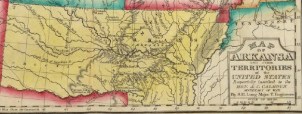
Arkansas TerritoryOn March 2, 1819, the Arkansas Territory was authorized by an act of Congress, to take effect  on July 4, 1819.

The Arkansas Territory was created from the portion of the Missouri Territory. It originally encompassed all of what is now Arkansas and much of what is now Oklahoma. The westernmost portion of the territory was removed on November 15, 1824, a second westernmost portion was removed on May 6, 1828, reducing the territory to the extent of the present state of Arkansas.

The Territorial capital was Arkansas Post from July 1819 until June 1821. At that point in time it was moved to Little Rock. In 1819, there was no permanent settlement in Little Rock. It would not be until early February 1820 that a permanent settlement would be established.  On 1818, the Quapaw Treaty had anticipated a future settlement in Little Rock.