Little Rock Look Back: SPRINGTIME FOR HENRY plays Robinson

On Monday, April 1, 1940, Edward Everett Horton came to Little Rock in the comedy SPRINGTIME FOR HENRY.  This was a play in which he had appeared regularly on tours and in summer stock. He would create productions of it in between film roles from the 1930s to the 1950s.

The play concerned a industrial heir whose dalliances put his family’s business in jeopardy.  It was a boulevard comedy (or a sex comedy—without the sex).  Originally performed on Broadway in 1931, it was written by Benn W. Levy.  He would later serve as a member of Parliament.

By the time Horton arrived in Little Rock, he was an accomplished stage and screen actor.  He was a staple of many Astaire-Rogers films.

The performance at Robinson did not go off without a hitch.  Because Spring had arrived in Little Rock, it was warmer outside.  This necessitated the air conditioner being turned on.   The fans rumbling through the vents made such a noise that it was difficult for the audience to hear the actors.  The air cooler was turned off for the remainder of the performance.  In the days after the performance, the Auditorium staff put buffering in the vents in the muffle the noise.

Little Rock Look Back: OKLAHOMA! first comes to LR

OkLRbill

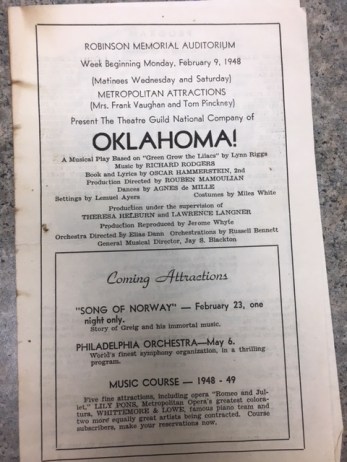
Program cover from OKLAHOMA!’s February 1948 visit to Little Rock. From the collection of Mary and Booker Worthen.

On March 31, 1943, Alfred Drake sauntered on the stage of Broadway’s St. James Theatre and sang “Oh, what a beautiful mornin'” to launch OKLAHOMA! into not only theatrical history but popular culture as well.

In February 1948, as the original Broadway run was about to mark five years on Broadway, the national tour of Oklahoma! made its way to Little Rock for eight performances. The week-long stay it had in Little Rock at Robinson Center was a record for that building that would last until Wicked came in 2010.  (Hello, Dolly! in 1966 and Beauty and the Beast in 2002 had both equalled the record.)

By the time Richard Rodgers and Oscar Hammerstein II’s first show made it to Little Rock, they were working on their fourth stage show, South Pacific, which had a leading character from Little Rock.

To get Robinson Auditorium ready for Oklahoma!, the Auditorium Commission had to spend $2,000 on upgrades.  That would be the equivalent of just under $21,000 today.

Oklahoma! opened at Robinson on Monday, February 9, 1948.  With eight performances, approximately 24,000 tickets were on sale during the run of the show.  There was a cast of 67 actors and 28 musicians.  The cast was led by Ridge Bond, Carolyn Adair, Alfred Cibelli Jr., Patricia Englund, and David Morris.  Mr. Bond had relatives who lived in Little Rock.  He was a native of Claremore, Oklahoma, which was the town in which the story took place.
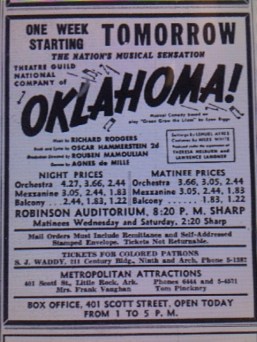
OkAdLR

Ad in ARKANSAS GAZETTE on February 8, 1948.

While they were in Little Rock, the stars of the show made an appearance at Reed Music on February 10.  The music store (located at 112 and 114 East 7th Street–across the street from the Donaghey Building) was promoting the sale of the Oklahoma! cast albums, sheet music, and recordings of songs from Oklahoma! by other singers.

Both the Arkansas Gazette and Arkansas Democrat carried reviews of the show.  Another item, which appeared in the paper that week was a syndicated column which noted that the film rights for the show had been sold. It was speculated that the star would be Bing Crosby.  It would actually be 1955 before the film was made, and Mr. Crosby had no connection to that movie.  By the time it was made, the stars were Gordon MacRae and Shirley Jones.  Mr. MacRae would appear in Little Rock for the 1963 opening of the Arkansas Arts Center.  Ms. Jones has made several concert appearances in Little Rock over the years.

Little Rock had seen its fair share of top Broadway shows on tour.  Prior to Robinson’s opening and since then, many well-known actors and popular shows had played Little Rock.  But just as it had been on Broadway, Oklahoma! in Little Rock was more than a show — it was an event!

Over the years, Oklahoma! has been performed by schools, churches, community theatres, dinner theatres, and colleges.  National tours have come through Arkansas again.  People have become jaded or dismissive of it, because they have seen it performed so often — and sometimes badly.  So it is hard to understand the excitement that was felt by Little Rock audiences in 1948 when they first saw it on the stage of Robinson Center.

But 75 years later (and 25 years after it was commemorated by the US Postal Service with its own stamp), Oklahoma! is still doing fine.  Countless new generations sing the songs and say the lines.

Two upcoming cultural events in Little Rock are a testament to the genius that helped create Oklahoma!  In May, Ballet Arkansas will present a dance piece which was the final dance created by Agnes de Mille.  Before choreographing Oklahoma!, Miss de Mille was already making her mark in the world of ballet.  She alternated between the two for decades.  At the 1993 Tony Awards, Miss de Mille accepted a special Tony upon the show’s 50th anniversary milestone.

The second connection to Oklahoma! will take place in February 2019.  The Arkansas Symphony Orchestra is bringing Oscar “Andy” Hammerstein III, grandson of the beloved librettist and lyricist Oscar Hammerstein II, to host a celebration of some of America’s most cherished music from the stage.

Little Rock Look Back: B-47 Explodes over Little Rock in 1960

An LRPD officer talks to bystanders next to a piece of debris

The peaceful morning of March 31, 1960, was interrupted by a horrendous noise over Hillcrest around 6:00am.  A six-engine B47 from the Little Rock Air Force Base exploded mid-air.

Flaming debris fell from Allsopp Park all the way to the State Capitol grounds and stretched from Cantrell to 12th Street.  Other debris was found as far away as the Country Club of Little Rock.  The next day the Arkansas Gazette ran a map which showed the extent of the damage.

Three airmen died in the explosion and two civilians were killed when debris fell on their homes.  The only survivor from the crew, 1st Lieutenant Thomas Smoak, was found dangling from a tree in his parachute at Kavanaugh and Martin.  He was treated by a nurse, Jimmye Lee Holeman, in whose yard he had landed.

Two civilians on the ground were killed by falling debris.  Many vehicles and homes were damaged, some were destroyed by debris.  The damage estimate was put around $4 million.

Police and fire crews were quickly on the scene to secure impacted areas, fight fires and rescue injured persons.

Those who perished were Captain Herbert Aldridge, Lieutenant Colonel Reynolds Watson, Staff-Sergeant Kenneth Brose, and civilians Alta Lois Clark and James Hollabaugh.

Today, part of the crash site is part of the Arkansas Children’s Hospital campus.  Other sites were removed by the I-630 construction.  Other houses were rebuilt or removed.  Fifty-eight years on, there are no visible scars to Little Rock’s landscape caused by the damage.

B47 Wreck Map

Arkansas Gazette map of debris and damage

Little Rock Look Back: Werner C. Knoop

To Little Rock citizens under a certain age, the name Knoop means Knoop Park — a picturesque park tucked away in a pocket of Hillcrest.  There are, however, still many who remember Werner C. Knoop as a business and political leader who helped shape Little Rock as a modern city.

Knoop was born on March 30, 1902.

In 1946, Knoop joined with Olen A. Cates and P. W. Baldwin to form Baldwin Construction Company in Little Rock.  Knoop had previously founded Capital Steel Company and established his business reputation there.  From 1945 through 1951, he served on the Little Rock School Board.

Following a series of political scandals, efforts were undertaken for Little Rock to shift from Mayor-Council to City Manager form of government.  Even before the desegregation of Little Rock Central put the city in the eyes of the world, an election for new leaders had been set for November 1957.  Knoop was on a “Good Government” slate and was one of the members elected.

At the first meeting of the new City Board, Werner C. Knoop was chosen by his fellow directors to serve as Little Rock Mayor.  Knoop served as Mayor until December 1962.  For the first several months in office, Little Rock had no City Manager so Knoop oversaw the transition of City staff as the forms of government changed.

Though City Hall generally stayed out of school district matters, that did not mean that the public viewed the two entities separately.  In September 1959, the Baldwin Construction offices were bombed as part of a series of terrorist activities protesting the desegregated reopening of all Little Rock high schools.

Downtown LR as viewed from Knoop Park

Downtown LR as viewed from Knoop Park

After two terms on the City Board, Knoop decided against seeking a third term.  He concluded his elected public service on December 31, 1962.  Following his time on the City Board, Knoop did not retire from Civic Affairs.  In 1970, he served as Chairman of the Little Rock Chamber of Commerce.   The previous year he served as President of the Arkansas Chapter of Associated General Contractors.

Mayor Knoop died in July 1983.  He is buried at Roselawn Memorial Park next to his wife Faith Yingling Knoop, a renowned author.

In the 1930s, Knoop moved into an Art Moderne house on Ozark Point in Hillcrest.  It was adjacent to Little Rock Waterworks property which was developed around the same time.  Eventually much of the land was deeded to the City for creation of a park.  In 1989, it was named in tribute to long-time neighbor Knoop in honor of his lifetime of service to Little Rock.

Little Rock Look Back: Final City Council meeting in 1868 City Hall

On March 30, 1908, the Little Rock City Hall held its final meeting in the 1868 City Hall.  The new city hall, located at Markham and Broadway streets, was nearing completion.  The meeting was presided over by Mayor W. E. Lenon.
The aldermen present were: John A. Adams, John Brod, A. B. Hightower, W. H. Jarrett, Christopher Ledwidge, Louie Miller, Jonathan S. Odom, R. C. Powers, A. L. Smith, George Stratman, Jonathan H. Tuohey, Louis Volmer, and L. N. Whitcomb.  Three aldermen missed the meeting: John Herndon Hollis, A. B. Poe and Benjamin S. Thalheimer.

The meeting was filled with typical requests for zoning and street improvements.  There was actually nothing out of the ordinary about the meeting.  If there was mention that it would be the final meeting, it did not make it into the minutes.

There was a request by the Arkansas Association of Pharmacists to have a meeting at the new building on May 12, 13 and 14.  It was referred to the City Hall Committee.  At prior meetings, there had also been requests by other groups to hold conferences at the new edifice.

At the conclusion of the meeting, it was noted that former City Clerk Clay Jones had died. A resolution memorializing him was proposed to be presented and adopted at the next meeting.

And with that, the meeting ended.  Forty years of City Council meetings at 120 to 122 West Markham came to a close.

MacArthur Returns to Little Rock

MacArthur and Mayor Remmel

General MacArthur and Mayor Remmel

On Sunday, March 23, 1952, General Douglas MacArthur made his only post-infancy visit to Little Rock. He had previously been scheduled to visit Mississippi, and Little Rock Mayor Pratt Remmel had persuaded him to add a visit to Little Rock to the agenda. The fact that Little Rock now had a Republican mayor had apparently piqued the General’s interest.

General MacArthur, accompanied by his wife and son as well as several journalists and members of his military retinue, arrived at Little Rock Airport at 10:40 am. He was met by a delegation of civic leaders including Mayor Remmel. Alderman James Griffey made welcoming remarks on behalf of the city. Then the General and Mayor boarded an open car and led a motorcade from the airport to downtown.

The motorcade’s destination was Christ Episcopal Church at Capitol and Scott streets. It was at this church that MacArthur had been baptized as an infant. The delegation was greeted by the Episcopal Bishop R. Bland Mitchell, Rector J. Hodge Alves, and Rector Emeritus W. P. Witsell. (While he had been Rector, Dr. Witsell had garnered national attention by issuing an Easter blessing to Gen. MacArthur as he had been evacuating the Philippines at the height of World War II.) In order to gain admittance to the church that morning, church members and guests had to have tickets.

Following the worship service, the General and his party went to three events in the park named in his honor. The first was a tour of the Museum of Natural History (now the Museum of Discovery and located in the River Market; the current tenant of the building is the MacArthur Museum of Arkansas Military History), which was located in the building in which the General had been born. After the tour, he spoke at a dedication of a small rose garden adjacent to the museum. It was sponsored by the Little Rock City Beautiful Commission and the Garden Clubs of Greater Little Rock.

Though every stop of the General’s visit had featured crowds, the largest was at the third location in MacArthur Park. A crowd of several thousand greeted the General as he spoke from the Foster Bandshell in the park’s southwest corner. Chamber of Commerce president Richard C. Butler (brother-in-law of Mayor Remmel) was the master of ceremonies. Following an invocation by Methodist Bishop Paul Martin, the only other speaker was the General. In his remarks he spoke of his Southern heritage and of his appreciation for the support of the citizens of Little Rock over the years.

Several gifts were bestowed upon the MacArthurs at the ceremony. The City of Little Rock presented Mrs. MacArthur with an engraved silver serving tray.

Following the events in MacArthur Park, the family retired for a brief respite to the Hotel Marion. They then attended a luncheon buffet in their honor at the home of Howard and Elsie Stebbins on Edgehill Road. The General and Mrs. MacArthur circulated through the house greeting guests and then eschewed a special table in favor of balancing their plates on their laps and sitting in wingback chairs. Meanwhile Arthur MacArthur stayed upstairs and discussed stamp collecting and other hobbies with the Stebbins’ two teenage sons.

Following the luncheon, the MacArthur party went back to the airport and by 4:00pm, the plane was in the air.

Though this visit was coming at the end of a whirlwind of activities, by all accounts, the General and Mrs. MacArthur were very gracious and accommodating. The General was being mentioned as a potential GOP candidate for President, but purposefully steered clear of any political comments in his remarks. He and Mrs. MacArthur dutifully posed for photos not only for the media but also for amateur photographers. At lunch, the General even asked a Gazette photographer to take a photo of him with his Little Rock Police motorcycle escorts so that they could have a souvenir of the visit.

Little Rock Look Back: War Memorial Stadium approved

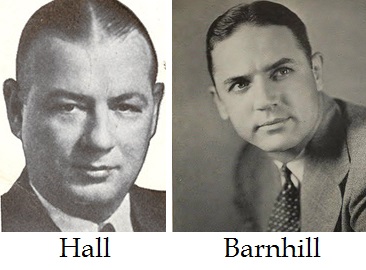
WMS Hall BarnhillOn March 18, 1947, Governor Ben T. Laney signed the bill into law which authorized the construction of War Memorial Stadium.

The plans for the stadium were the brainchild of Arkansas Secretary of State C.G. “Crip” Hall and University of Arkansas Athletic Director John Barnhill.

Apparently the Southwest Conference was threatening to kick Arkansas out because of an inadequate football facility. Since the University did not have the funds to build a new one on its campus, Barnhill and Hall decided that the state should build one. Many other states were building War Memorial facilities of a variety of natures. The duo decided that the new football facility could be a War Memorial Stadium to pay tribute to the men who died in the recently concluded World War II.  While the stadium was touted as being of use to all colleges in the state and a variety of other types of activities, it was very much designed to be a home for the Arkansas Razorbacks.

Getting the stadium through the Arkansas General Assembly was not easy.  The bill to create the stadium commission sailed through both houses. But even some who voted for it said they would oppose any funding bills.  When time came to vote for the funding, the bill fell far short of the three-quarters vote that was needed in the House for an appropriation bill.

WWII veterans were on both sides of the issue.  Some felt it was an appropriate way to honor those who died.  Others felt it was a gimmick to get the stadium approved.  Some of the opponents felt that a new state hospital for UAMS would be the more appropriate way to honor those who died during the war.  The debates were often heated and personal.

Overnight a new bill was created. It would pay for the stadium through the issuing of bonds. In addition to the state issuing bonds, any city which wished to bid for it would have to put up money for it as well as provide land.  This new bill would require only 51 votes to pass the House.  It was able to pass that threshold.  The Senate made a few amendments (mostly dealing with the composition of the stadium commission and the amount of dollars that the host city had to pledge).  Finally the House agreed to the Senate amendments and it went to Governor Laney.

The next hurdle for the stadium was choosing a location. That process would occupy stadium proponents throughout the spring and summer of 1947.