Wednesday evenings in May at South on Main feature music and visual art curated by M2 Gallery

Sessions presented by M2 Gallery featuring the work of Michael ShaefferM2 Gallery is curating May Sessions at South on Main by highlighting connections between music and visual art. For the first Wednesday in May, we invite you to experience the art of Michael Shaeffer as he spins records on stage with Control, a local vinyl business he owns with partner Wes Howerton.

This event is free and open to the public. Music begins at 8 pm. You may reserve a table for dinner by calling (501) 244-9660.

M2 Gallery is located in SOMA and offers a large selection of original artwork from both established and emerging artists. With a wide range of style and price, M2 Gallery is sure to fill your art needs. M2 also works with a large network of galleries throughout the country so that we can make sure to find exactly what our clients are looking for. Gallery director Mac Murphy has over 15 years experience, and has been the driving force behind M2 Gallery winning the Platinum Service Award for several years.

New exhibit: WASHED ASHORE opens at Clinton Center

Image result for clinton center washed ashore

The Clinton Presidential Center’s upcoming temporary exhibit, Washed Ashore: Art to Save the Sea, will debut on April 27, 2019. Washed Ashore is a family-friendly exhibit that will feature more than 20 giant sea life sculptures – made entirely of trash and debris collected from beaches. This exhibit poignantly illustrates the toll trash takes
on our oceans and waterways.

The incredible marine life sculptures will be accompanied by educational signage allowing visitors to learn about the fascinating species, environmental stewardship, responsible consumer habits, and how “every action counts” to help save our waterways.

Washed Ashore is a visual reminder of the disposable products that end up in our waters, and that each of us can take action to prevent further pollution. “Hope, creativity, [and] imagination will be required to meet the challenges that we face with our oceans,” said President Bill Clinton to the National Oceans Conference in June 1998. “But they are the traits that first enabled and inspired explorers to take to the sea. They are traits that allowed us to look at our inextricable ties to our environment and invent new ways to protect our natural wonders from harm in the last three decades. In the 21st century, these traits – hope, creativity, imagination – they must lead us to preserve our living oceans as a sacred legacy for all time to come.”

The Washed Ashore exhibit will be primarily displayed inside two of the Clinton Center’s
galleries. Visitors will see Eli the Eel, walk through the Reef at Risk, and be able to play the Styrofoam Drum Set. The exhibit will open to the public on April 27; a second phase featuring additional sculptures will open in June, when Priscilla the Parrot Fish, a 16-foot-long, 1,500-pound brightly-colored sculpture will greet visitors from the water fountains located outside the front doors.

“The sculptures are beautiful, truly works of art, but they are a poignant reminder that our oceans and waterways are precious resources that need our attention now more than ever,” said Stephanie S. Streett, executive director of the Clinton Foundation.

“From the student visitor to the grand parent, we hope that everyone who has the opportunity to enjoy Washed Ashore walks away with a renewed sense of awe and responsibility.”

Washed Ashore presents an opportunity to reflect on the Clinton administration’s efforts to safeguard essential bodies of water and promote environmental stewardship. “President Bill Clinton’s administration took strong action to protect our coasts and waterways,” said Terri Garner, director of the William J. Clinton Presidential Library. “He signed crucial legislation and issued key executive orders designed to improve water quality, protect wetlands and coasts, and reduce waste while increasing the use of recycled products.”

Little Rock Look Back: MOCKINGBIRD TREE sculpture installed on April 21, 2016

Photo by LRCVB

On April 21, 2016, Michael Warrick’s Mockingbird Tree sculpture was installed at the corner of Chenal Parkway and Chenal Valley Drive.

The piece was commissioned by Sculpture at the River Market after winning the 2015 Public Monument Sculpture competition.

The eighteen (18) foot tall sculpture is made out of stainless steel. It presents a fanciful version of a tree with cloud-like foliage.  Nestled in the tree are bronze mockingbirds (Arkansas’ state bird).

Warrick is a professor in the Department of Art at the University of Arkansas Little Rock and has been an artist and educator for 30 years. His work has resulted in more than 150 solo and group exhibitions and has been represented in 29 private collections and 34 public venues.

Easter Parade of Bunnies

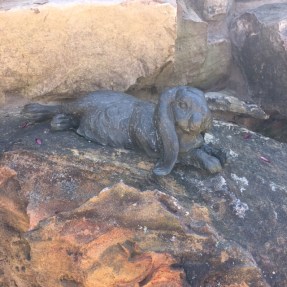
Little Rock has at least four different sculptures of rabbits.  Since today is Easter Sunday and the Easter Bunny is making his rounds, it seems a good day to highlight these sculptures.

RB MonThe newest sculpture is Dan Ostermiller’s R. B. Monument.  A gift to the citizens of Little Rock by the Little Rock Garden Club, it was dedicated in 2017.

Located at the southeast corner of Kavanaugh and Pierce, this rabbit has quickly become a landmark. It is a favorite for kids and adults as they walk or drive by.  The rabbit is situated so that people can easily pose for photos with it, without the photographer having to stand in the street.  At Christmas and Easter, the rabbit has been bedecked with an appropriate wreath to add to its festive nature.

Bun BumIn the Vogel Schwartz Sculpture Garden, Laurel Peterson Gregory’s Bunny Bump has been providing whimsy since 2010.

After she sculpts an animal in wax or oil-based clay, traditional lost-wax casting processes immortalize the design in bronze. One aspect of particular interest to me, and one for which I plan early in the sculpting phase, is the complex and rich patinas that constitute another hallmark of my limited-edition sculptures. Multiple layers of chemicals and oxides are applied to the heated bronze to achieve a range of unique effects, both translucent and opaque, that complement each design.

Two stylized rabbits make for an interesting piece of artwork when they are not only dancing, but also doing the butt bump while dancing. The smooth surface and color of the bronze add to the illusion. This small piece has been placed on a pedestal to elevate more to eye level.

LopsA few yards from the bumping bunnies, James Paulsen’s Lopsided presents a much more laconic rabbit.

Paulsen is a self-taught artist. Alternately studying the wilds of the northern forest, and the open beauty of the American Southwest, he concentrates his work on natural subjects he has grown up with, and is heavily influenced by his family’s artistic background, being raised by an artist-illustrator and an author. In his work, he explores merging the beauty he sees in the natural world with the expressiveness of clay and bronze.

While having most of his work in galleries or private collections across the country, he has recently completed two public commissions

And at the corner of President Clinton Avenue and Sherman Street, Tim Cherry’s Rabbit Reach welcomes visitors to the River Market.

The sculpture is located at the corner of Sherman Street and President Clinton Avenue across from the Museum of Discovery.

The sculpture is a gift from Whitlow Wyatt and the Carey Cox Wyatt Charitable Foundation. It was given in memory of George Wyatt and Frank Kumpuris.  Those two gentlemen were the fathers of Whitlow Wyatt and Dean & Drew Kumpuris.

Cherry’s sculpture was selected for this spot because of its proximity to children at the Museum and in the River Market district.  The design and size of the sculpture encourages children to climb on it and to play around the rabbit.  While some public art is situated so it cannot be touched, this one is situated to be touched as part of the appreciation experience.

Bid Adios to Frida today at the Arkansas Arts Center

Nickolas Muray, American (Szeged, Hungary, 1892 – 1965, New York, New York), Frida Kahlo on White Bench, New York (2nd Edition), 1939, color carbon print, 19 x 14 ½ inches. Courtesy of Throckmorton Fine Art, New York, New York.

Today (April 14) is the final day to visit the Arkansas Arts Center to have the rare opportunity to see one of Mexico’s greatest painters captured by some of the 20th century’s most important photographers.

Photographing Frida: Portraits of Frida Kahlo features 65 images of Kahlo as art and artist. The photographs document Kahlo’s life as seen by the greatest photographers of the time – Lola and Manuel Álvarez Bravo, Imogen Cunningham, Emmy Lou Packard, Graciela Iturbide, Nickolas Muray, and Edward Weston, among others. From casual snapshots to intimate family photographs to artfully posed studio portraits, viewers will see the full spectrum of Kahlo’s life, from self-assured adolescent, to influential artist, fashion icon and passionate lover, as she takes on a mythic presence in our collective imagination.

In the hands of photojournalists, friends and artists, the camera allowed Kahlo to explore her own image and identity, document her marriage to the great muralist Diego Rivera, express her strong political views, and artfully reveal her life-long struggle to overcome her physical challenges. In the process, she ultimately defined the principal subject of her own art – herself.

Photographing Frida is an opportunity to see Frida Kahlo as you’ve never seen her before,” Chief Curator Brian J. Lang said. “These images defined not only the way the world saw her – and continues to see her – but how she saw and depicted herself through her own work.”

Frida Kahlo was born in Coyoacán, Mexico City, Mexico in 1907. Her father, Guillermo Kahlo, was a photographer, and often photographed the young Frida. Through her father’s portraits, she became acquainted with the power of her own image.

In 1929, Kahlo married muralist Diego Rivera. Throughout their tumultuous marriage, the couple was often photographed together, both in Mexico and in the United States. Rivera was a major presence, both in Kahlo’s life and in the photographs that document their life. As they traveled through Mexico and the United States, “Frida and Diego” – as they were affectionately known – became a source of fascination and intrigue for the paparazzi: Kahlo, stunning in her Tehuana dresses, beribboned hair and beaded jewelry, accompanied her famous muralist husband. Photos of their second wedding (the couple divorced in 1939, only to remarry a year later) in California were captured by American press photographers.

The exhibition reveals Kahlo’s fascination with fashion – as self-expression, political expression, and a means for concealing her physical disabilities. She was often photographed wearing traditional Mexican clothing – Tehuana dresses, huipils and rebozos, and beaded jewelry. Under the voluminous skirts and flowing dresses, she was able to hide the injuries that had affected her since youth. The pre-Hispanic clothing she was so fond of allowed her to express her belief inmexicanidad – the nationalist movement that found its inspiration in pre-Columbian Mexico after the end of the Mexican Revolution.

Kahlo continued to be photographed until her death in 1954. To each photographer she encountered, she became something new – ever present and continually beguiling – but made different through their lens. In the process, she herself became a work of art.

Photographing Frida features images by Lola Álvarez Bravo, Manuel Álvarez Bravo, Florence Arquin, Lucienne Bloch, Imogen Cunningham, Gisèle Freund, Hector Garcia, Juan Guzman, Graciela Iturbide, Peter Juley, Guillermo Kahlo, Bernice Kolko, Leo Matiz, Nickolas Muray, Emmy Lou Packard, Victor Reyes, Bernard Silberstein, Edward Weston and Guillermo Zamora. A fully-illustrated catalogue, Mirror, Mirror: Portraits of Frida Kahlo, featuring an essay by Salomon Grimberg, a noted authority on Latin American art, accompanies the exhibition.

CALS Butler Center’s The Galleries at Library Square and AETN present “State of the Art” film premiere

Image may contain: text

Join CALS and AETN for the Arkansas premiere of a one-hour documentary by Brent and Craig Renaud that captures the personal stories of seven diverse artists who are redefining the American aesthetic.

The screening is tonight (April 13) at 8pm at the CALS Ron Robinson Theater.

These artists were a part of “State of the Art: Discovering American Art Now”, a groundbreaking exhibition at Crystal Bridges Museum of American Art in Bentonville. To create this exhibition, the curatorial team crisscrossed the nation to find extraordinary contemporary art happening in unexpected places. Be one of the first to experience this powerful story of artists working across our country, including here in Arkansas, prior to its debut on PBS nationally on April 26.

This event is FREE and open to the public. Doors open at 7:00pm with general admission seating on a first come, first served basis.

Presented by The Galleries at Library Square and AETN/PBS.