
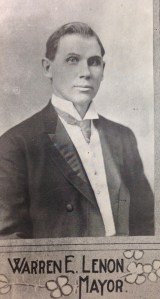
Little Rock Look Back: Mayoral Election of 1903

In April 1903, Warren E. Lenon took the oath of office and became Little Rock Mayor.  He had previously served a decade on the City Council.  A native of Iowa, Mr. Lenon was a banker and real estate developer.

At the time, winning the Democratic primary was tantamount to election. The Pulaski County Democratic Committee would set the primary date which would vary yearly anywhere from August to February prior to the April general election.  The primary for this race was set for January 28, 1903.

By July 1902, Alderman Lenon had expressed his desire to run for mayor. He would be challenging incumbent W. R. Duley who was planning on seeking another term. Over the summer, W. C. Faucette, a former alderman who lived north of the Arkansas River, and Col. S. M. Apperson announced their intentions to run for the office too.

In December 1902, Mayor Duley dropped out of the race citing business obligations.  Three days before Christmas, Mr. Faucette also dropped out and endorsed Col. Apperson.

In the primary, Lenon carried all eight of the City’s wards.  In Lenon’s home ward, he received 391 votes and Apperson only 21 votes.  The closest Apperson came was in Faucette’s ward, where Lenon received 159 and Apperson 123 votes.  The total results were 2009 and Apperson 716.

In the April 8, 1903, general election, Mr. Lenon was unopposed and received 662 votes.  This was down from the 1,911 which Mr. Duley had received in 1901 when he had an opponent.

Mayor Lenon took office in April 1903 and was re-elected in April 1905 and April 1907. He served until he resigned in April 1908 because of expanding responsibilities in the private sector.

31 Days of Arkansas Rep: GYPSY in 2003

In June 2003, the Arkansas Rep went back to the dying days of vaudeville when it presented Gypsy.  Written by Arthur Laurents, Jule Styne and Stephen Sondheim, this musical fable looks at the end of vaudeville and the rise of Gypsy Rose Lee.  It was directed by Rep founder Cliff Fannin Baker.

Baker said he had long wanted to do the show, but credited Bob Hupp (his successor as the Rep’s Producing Artistic Director) with figuring out a way to make it happen.

Mary Robin Roth took on the role of Mama Rose. She had previously played Miss Hannigan in Annie at the Rep.  Broadway vets Trista Moldovan and Joyce Chittick played Rose’s daughters Louise and June. In real life those grew up to be Gypsy Rose Lee and June Havoc.  Others in the cast of approximately 30 included John Kudan, Nicholas Dromard, and Steve Wilkerson.

The creative team included Mike Nichols (scenery), Margaret A. McKowen (costumes), David Neville (lighting) and M. Jason Pruzin (sound). Ron Hutchins choreographed, and Eric Alsford was the musical director.

Even before opening night, the production was extended a week and ended on July 6 instead of June 29.

31 Days of Arkansas Rep: ANYTHING GOES in 2001

The Arkansas Rep concluded its 25th season with the Cole Porter musical Anything Goes. Directed by Rep founder Cliff Fannin Baker, it featured an onstage orchestra led by then-Arkansas Symphony maestro David Itkin.  (Rep Producing Artistic Director Bob Hupp and Itkin had been trying for a while to find a project for collaboration.)

This shipboard romantic farce featured a book by Guy Bolton & P. G. Wodehouse which was revised before the 1934 opening by Howard Lindsay and Russel Crouse in their first collaboration. In 1987, Timothy Crouse (son of Russel) and John Weidman updated the script for a Lincoln Center Theatre production. It was that version which the Rep presented.

The cast was led by Rep newcomers Heather Ayers and Pat McRoberts. Kelly Vivian, Thomas-David McDonald, Rick Cox, Julie Conners, Marlene Toth and Steve Wilkerson also were featured.

Others in the cast included Bob Hulsey, Amy Curnow, Annie Mistak, Allison Stodola, Sarah Squire, Miranda Vannoy, Pamela Crane, Buddy Reeder, Case Dillard, Christopher Brown, Don Hill, Daryl Minefee, Matt Crowle, Christopher Crane, Scott Duquette and Joe Terry.

Ron Hutchens was the choreographer. Others on the creative team included Mike Nichols (set), Yslan Hicks (costumes), Japhy Weideman (sound), and Leland Jones (lighting).

The production proved so successful that even before its June 1, 2001, opening night, the run was extended a week. It closed on June 24, instead of the original June 17.

31 Days of Arkansas Rep: 1999’s AS BEES IN HONEY DROWN

A comedy about truth and trust, deception and decisions, Douglas Carter Beane’s As Bees in Honey Drown marked the first production of the 1999-2000 season for Arkansas Repertory Theatre.  It also signified the transition between Rep founder Cliff Fannin Baker and Bob Hupp as artistic director.
Baker directed this very dark comedy set in a sleek, modern late 1990s Manhattan. A fast-paced and almost cinematic feeling was abetted by Mike Nichols’ set design of rotating panels.

The cast was led by Jonna McElrath (who had appeared in Angels in America and other productions at the Rep) and John Houfe (Rep’s The Three Musketeers).  Mark Waterman, Angie Gilbert and Lakeetra Gilbert were also in the cast.

Baker would booked his post-Artistic Director career at the Rep with Douglas Carter Beane projects. While his first show post-retirement was As Bees in Honey Drown, his final was Sister Act which featured a revised libretto by Beane.

Little Rock Look Back: 190 Years of 1st Presbyterian Church

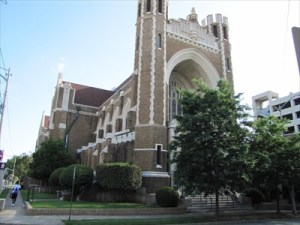
This weekend, Little Rock’s First Presbyterian Church will celebrate 190 years.

The Sunday service will feature a Scottish Bagpiper, special music, and historical readings to recognize the church’s history. The message will be delivered by Reverend Stewart Smith, General Presbyter of the Presbytery of Arkansas.

The church was organized in July 1828. It is the oldest continuously serving Presbyterian church west of the Mississippi River.  Not only that, it appears to be the oldest, continuously serving church of any denomination in Little Rock.  It predated the establishment of Catholic (1830), Methodist (1833) and Episcopal (1839) churches in the city.

Little Rock’s first Presbyterian congregation was organized in July 1828. Reverend James Wilson Moore had been commissioned by the Northumberland Presbytery of Pennsylvania as a Presbyterian Missionary to the Territory of Arkansas.

Prior to the formal establishment  of the church, Rev. Moore preached his first sermon in Little Rock on  January 28, 1828. It took place in Jesse Brown’s schoolhouse (Little Rock’s first school) which was at the foot of Rock Street.

When the church was established, it had seven members: two men and five women.  From 1828 until 1833, it met in a variety of temporary locations.

The congregation’s first permanent structure was at the southeast corner of Second and Main (where the Main Street Parking Deck is sited). In 1853, it moved to land on Markham between Cumberland and Rock.  Following an 1866 fire which destroyed the church and several other buildings, the church made plans to move.  In 1869, the congregation moved to three lots at the northwest corner of Capitol Avenue and Scott Streets. This brick sanctuary with a steeple was the first church built in Little Rock after the Civil War.

By 1909, the church was outgrowing the building. There was discussion as to whether the building should be expanded or a new building built elsewhere. Due to the increase in the property value in the existing site, the decision was made to move.  In 1913, property at the southwest corner of 8th and Scott Streets was purchased.  Construction began first on an education building (with a temporary auditorium). That building opened in 1914.

In May 1920, ground was broken for a new sanctuary building; the cornerstone was laid on November 7, 1920.  The first worship service in the sanctuary took place on October 2, 1921.

A disastrous four-alarm fire gutted the sanctuary in May 1958, causing thousands of dollars damage of the chancel and the organ. The sanctuary was restored for worship services within nine months.

A Sesquicentennial Anniversary celebration marking the 150 years of First Presbyterian Church history was held in the summer of 1978. Governor David Pryor (Governor of Arkansas and shortly U. S. Senator-elect) was principal speaker at worship services.

The building was listed on the National Register of Historic Places in 1986.

31 Days of Arkansas Rep: PETER PAN in 1994

Peter Pan flew into the window of the Darling’s nursery in December 1994 on the Arkansas Rep stage.  With a cast of thirty-six, Peter Pan was one of the Rep’s larger productions.
Directed by Brad Mooy, the production featured Steve Wilkerson in the title role. It gained some national press attention, because the role is usually played by women, so Wilkerson’s casting was a bit of a novelty.

Others in the cast were Ed Romanoff, Angie Ohren, Dustin Alford, Matthew Block, Peggy Billo, Tanya Duggar, Gary Taggart, Angie Foresman, and Linda Sue Sanders. The Lost Boys were played by Adam Napper, Bernie Baskin, James Knight, Brian Jones, Kale Ludwig, and Kyle Ludwig.

The pirates were played by Mark Hansen, Joel Gordon, Derek Reid, Shannon E. Farmer, Tony D. Owens Jr., DeJon Mayes, Kenneth Elins, Matt Patton, Eric Harrison and Tom Kagy. Taking on the roles of the indians were Suzan Hart, Rusty Miller, Mikel Brown, Ryan Martine, Patrick McNally, Christina Boatwright, Leslie Goodwin, Tori Petrus and Dennis Glasscock.

Glasscock was the production’s choreographer. Flying for Pan and others was created by Foy, the same firm which was responsible for Mary Martin’s flying in the role on Broadway in 1954. Hans Stiritz was the musical director, Mike Nichols was set designer, and Don Bolinger provided costume design.

The production was so successful, it was nearly sold out before it opened.  Two years later, the Rep reprised it.  There were some different design elements as well as a largely different cast. Wilkerson returned as did Ohren, Dugger, Gordon, Knight, Napper, Alford,  Petrus, and Kagy.

Little Rock Look Back: Installation of Chapel’s THE CENTER

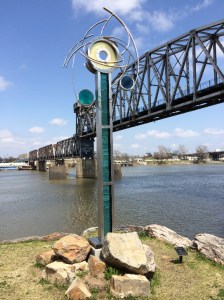
On October 19, 2012, the first winner of the Sculpture at the River Market public monument sculpture competition was dedicated.

Selected at the 2011 Sculpture at the River Market Show and Sale, Chapel’s THE CENTER is located to the west of the Junction Bridge in Riverfront Park.  It stands fifteen feet and is composed of glass, stainless steel and bronze.

According to Chapel:

The theme of The Center is a coalescence around a strong core.  Historically the Arkansas River was one of the mainstays of Little Rock’s economy.  Recently, the River has taken on a new life as a cultural and arts center through the various sculpture parks and amphitheater along its banks.


All of the disparate themes of life here are represented by the complex structure of gathering arcs.  These highly finished arcs reflect all the colors of the surrounding environment while the transparent central glass column refracts the changing light.  The shape itself will cast a fascinating shadow providing a constantly changing and adapting sculpture.